
Stress and cortisol in men is a subject the fitness industry consistently gets wrong. The typical message is either that stress is a mindset problem requiring more discipline, or that training harder will fix it. Neither is true. Chronic stress is a physiological state with measurable hormonal consequences, and those consequences directly undermine fat loss, muscle building, sleep quality, libido, testosterone production, and long-term health. You cannot out-train a stressful life. But you can understand what stress is doing to your body and take deliberate, evidence-based steps to manage it.
I have worked with hundreds of men who were doing everything ostensibly right, training consistently, eating reasonably well, and getting reasonable amounts of sleep, yet making little or no progress with their body composition. When I dig into their lifestyle, the pattern I find repeatedly is chronic, unmanaged stress. Work pressure. Financial strain. Relationship tension. The relentless low-grade activation of the stress response that modern professional life produces. These men are not undisciplined. They are physiologically compromised, and until the cortisol load is addressed, the results they are pursuing will remain out of reach.
This article is going to explain the physiology of stress and cortisol in plain language, show you exactly what chronic stress does to your body composition, and give you a practical, evidence-based framework for managing it. This is not about meditation retreats or bubble baths. This is about understanding a hormonal system and using that understanding to make targeted interventions that work.
The Stress Problem That Training Cannot Fix
There is a particular type of client I encounter with regularity. He is in his 40s, typically working in a demanding profession, carrying 10 to 20 kilograms of excess body fat concentrated primarily around his midsection, training three to four times per week, eating what he considers a reasonable diet, and sleeping between five and six hours most nights because work demands it. He is tired much of the time. His recovery between training sessions is poor. He has been carrying roughly the same amount of visceral fat for two to three years despite periods of diligent effort.
The missing piece is almost invariably cortisol. Not because this man is weak or lacking commitment, but because the physiological environment created by chronic stress is directly opposed to the changes he is trying to make. Elevated cortisol promotes visceral fat storage. It breaks down muscle tissue for glucose. It suppresses testosterone. It disrupts sleep in ways that further elevate cortisol the following day, creating a self-reinforcing cycle. And it makes the body significantly more resistant to fat loss, regardless of how well-designed the training programme is.
The solution is not to train harder. Adding more training volume to an already cortisol-elevated system frequently makes things worse, not better, by adding training-induced cortisol on top of an already burdened system. The solution is to understand the physiological mechanism and address it directly.

What Cortisol Actually Is and What It Does
Cortisol is a glucocorticoid hormone produced by the adrenal glands in response to stimulation from the hypothalamic-pituitary-adrenal (HPA) axis. It is not a toxin. It is not a villain. In its acute, short-term form, cortisol is a profoundly important and adaptive hormone. It mobilises energy by raising blood glucose, sharpens focus and alertness, modulates immune function, and prepares the body to meet physical demands. Without cortisol, you could not get out of bed in the morning. The morning cortisol peak that occurs naturally upon waking is a healthy and essential part of normal physiology.
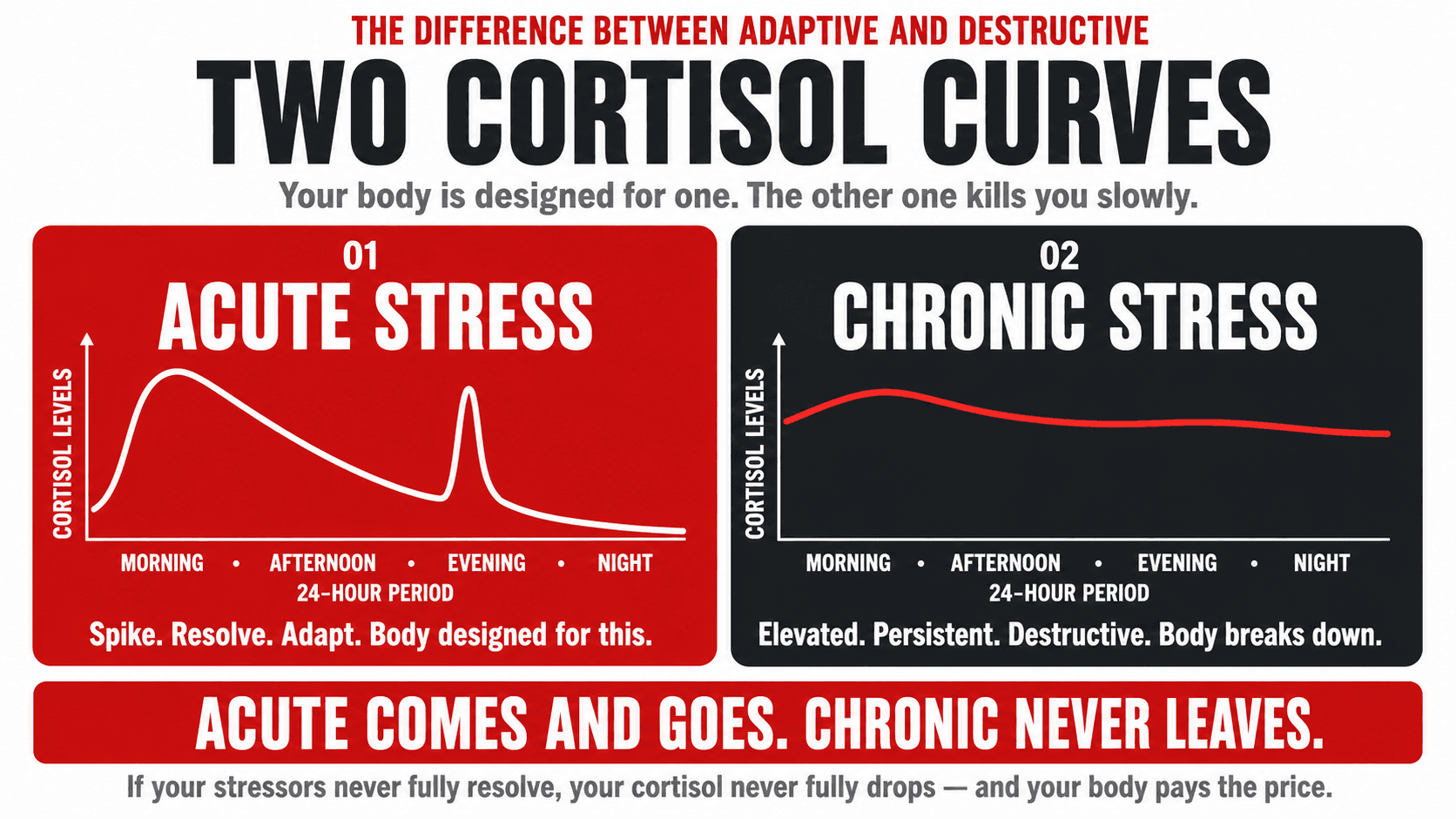
The problem, and it is an increasingly common one in modern life, is when cortisol shifts from being an acute, responsive hormone to a chronically elevated one. When the stressors are not a single physical threat but an unrelenting stream of psychological, occupational, and social demands, the HPA axis remains in a state of persistent activation. Cortisol levels do not spike and resolve. They remain persistently elevated above baseline, and the consequences of this are qualitatively different from anything the acute stress response produces.
Top Tip
The distinction between acute stress and chronic stress is everything. Your body is extraordinarily well designed to handle a difficult meeting, a hard training session, or a challenging conversation. What it is not designed to handle is the unrelenting, never-fully-resolved activation that comes from perpetual work pressure, financial anxiety, relationship strain, and sleep deprivation stacked simultaneously over months and years. If your stressors never fully resolve, your cortisol never fully drops, and your body pays the price.
Acute vs Chronic Stress: The Critical Distinction
| ACUTE STRESS (Short-term, Adaptive) | CHRONIC STRESS (Long-term, Destructive) |
|---|---|
| Trigger: a single event | Trigger: sustained pressure with no recovery period |
| Cortisol spikes rapidly | Cortisol remains persistently elevated |
| Body mobilises energy | Body stores fat around the organs |
| Cortisol falls once resolved | Cortisol does not fall |
| Immune function briefly suppressed, then restored | Immune function chronically suppressed |
| Testosterone unaffected or transiently elevated | Testosterone suppressed |
| Muscle tissue is preserved | Muscle tissue is broken down for glucose |
| Sleep architecture is maintained | Sleep is disrupted |
| Outcome: the body adapts and grows stronger | Outcome: the body accumulates fat, loses muscle, and deteriorates |
Why Training Harder Is Not the Answer
Exercise is itself a cortisol-producing stressor. When you train, your body mounts a controlled stress response. Cortisol rises during the session to mobilise energy, support performance, and initiate the breakdown of tissue that will subsequently be rebuilt stronger. This is not a problem. It is the mechanism of adaptation. The cortisol spike from training is acute, purposeful, and resolved within a few hours in a well-rested, adequately nourished individual.
The problem arises when training cortisol is added on top of an HPA axis that is already chronically activated by lifestyle stress. In this state, the system cannot fully resolve the training-induced cortisol load before the next session. Recovery is incomplete. The anabolic window that follows a training session, during which testosterone and growth hormone promote repair and muscle building, is compressed or suppressed by the persistently elevated cortisol environment. The net effect is that the training stimulus produces less adaptation than it should, and in some cases accelerates the catabolic processes the individual is trying to reverse.
This is why I sometimes prescribe less training, not more, for clients who present with high stress loads and poor recovery markers. Reducing training volume by 30 to 40 percent while simultaneously addressing the lifestyle contributors to cortisol elevation often produces better results than maintaining or increasing training volume. This runs counter to the prevailing fitness culture narrative of more being better, but it is the physiologically correct response to an overloaded stress system.
Top Tip
You can have the best training programme and the most precise nutrition plan in the world, but if you are sleeping five hours a night, working 60-hour weeks, and never fully disengaging from your phone and email, you are fighting your own physiology. The most productive thing you can do for your body composition is not always adding another training session. Sometimes it is removing one and investing that hour in sleep, recovery, or active stress reduction.

What Chronic Stress Does to Body Composition
The body composition effects of chronic cortisol elevation are well documented and mechanistically understood. They operate through several distinct pathways that work in concert to make fat loss harder and muscle preservation more difficult.
Cortisol directly stimulates the accumulation of visceral fat, the metabolically active fat stored around the internal organs, by activating glucocorticoid receptors in visceral adipose tissue. These receptors are more densely expressed in visceral fat than in subcutaneous fat, which is why chronic stress tends to produce the characteristic pattern of central fat accumulation even in men who are not overweight in any other respect. This visceral fat is not merely a cosmetic concern. It is metabolically active, producing inflammatory cytokines and disrupting insulin signalling in ways that further elevate cortisol and reinforce the cycle.
Cortisol is also catabolic to muscle tissue. In a state of chronic elevation, it promotes the breakdown of skeletal muscle protein into amino acids, which are converted to glucose by the liver through gluconeogenesis. This is a survival mechanism: the body interprets persistent stress as a threat requiring sustained energy availability and mobilises its protein stores accordingly. The result is an accelerated loss of the lean muscle mass that underpins metabolic rate, insulin sensitivity, and physical capability.
Testosterone and cortisol operate in a hormonal see-saw relationship. When cortisol is chronically elevated, testosterone is suppressed. This is not incidental: cortisol and testosterone are both derived from pregnenolone, and under chronic stress conditions, the metabolic pathway preferentially produces cortisol at the expense of testosterone. Reduced testosterone in men over 40 compounds the muscle loss and fat gain effects already produced by elevated cortisol, and also directly reduces motivation, libido, and the drive to train consistently.
Finally, cortisol disrupts sleep. It suppresses melatonin production, elevates alertness at inappropriate times, and disrupts the deep sleep stages during which growth hormone release is most pronounced. Poor sleep further elevates cortisol the following day, and the cycle repeats. Sleep deprivation is itself independently associated with increased visceral fat accumulation, elevated blood glucose, reduced insulin sensitivity, and suppressed testosterone.
Top Tip
If your recovery between sessions feels poor, your performance has been declining for several weeks, you are sleeping but not feeling rested, and your midsection fat is not responding to what should be an effective training and nutrition approach, chronic cortisol elevation should be your primary working hypothesis. The solution is not a new training programme. It is a systematic reduction in the total stress load your body is carrying.

What Actually Works: Evidence-Based Stress Management for Men
The strategies that reliably reduce cortisol and its physiological consequences are not exotic, expensive, or time-consuming. They are grounded in basic physiology and supported by robust evidence. What they require is consistent application over weeks and months, not occasional heroic efforts.
I am going to present these strategies as a practical reference rather than a theoretical framework. Each one is supported by clinical research. Each one is applicable to a man living a normal professional and family life. And each one produces measurable results when applied consistently.
Practical Stress Reducers: Evidence-Based Strategies
| Strategy | Time Required | Evidence Strength | How It Works | How to Start |
|---|---|---|---|---|
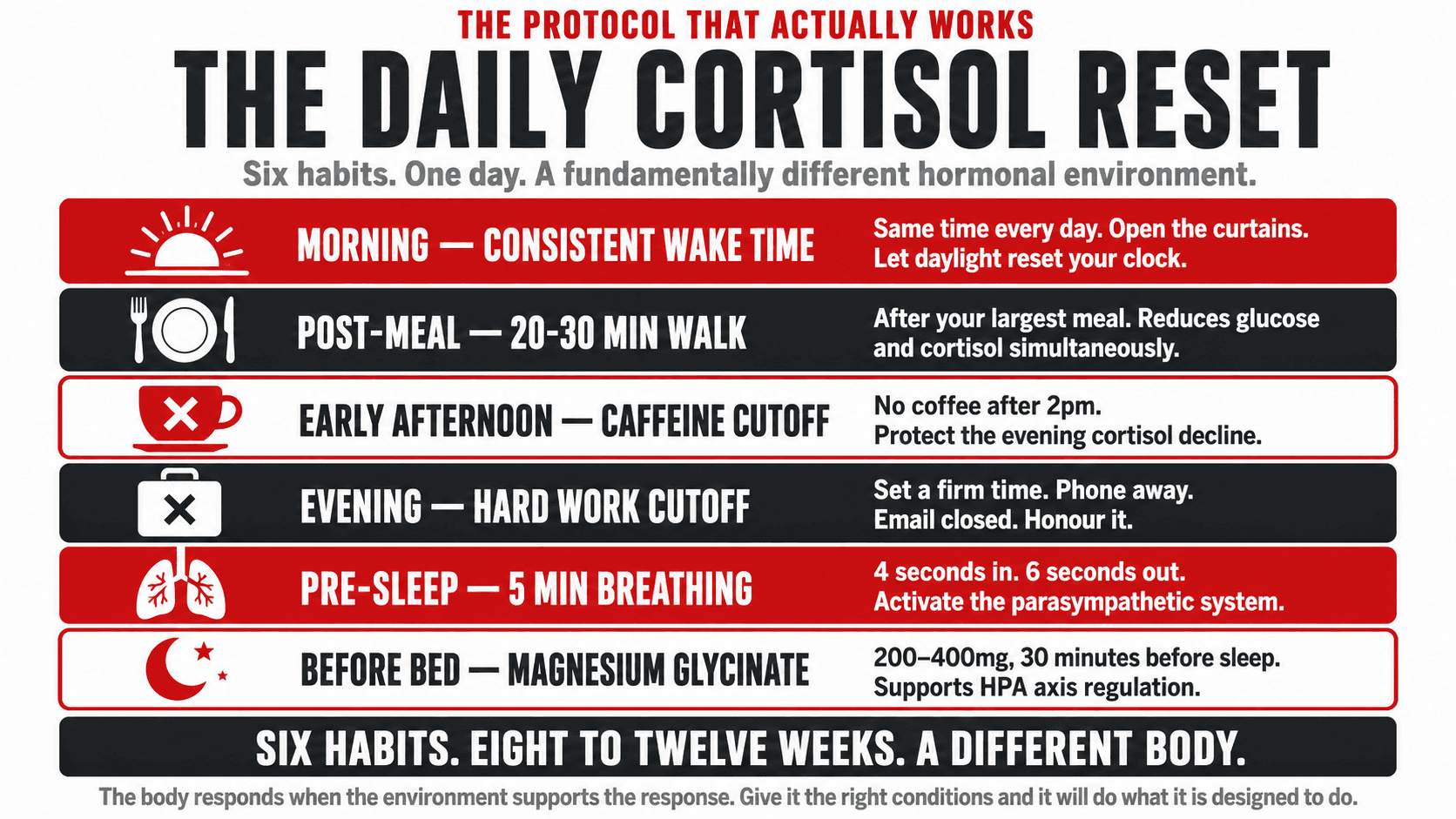
| Post-meal walking | 20 to 30 minutes | Strong | Reduces post-meal blood glucose and cortisol | Walk after your largest meal of the day |
| Diaphragmatic breathing | 5 minutes | Moderate to strong | Activates vagus nerve, shifting nervous system toward parasympathetic state | 4 seconds in, 6 seconds out. Repeat for 5 minutes before sleep or after a stressful period |
| Training deload weeks | 1 week per 4 to 6 | Strong | Reduces training-induced cortisol load and allows HPA axis partial recovery | Every 4 to 6 weeks, reduce training volume by 40 to 50% for one week |
| Consistent sleep schedule | Habitual change | Strong | Re-establishes healthy diurnal cortisol rhythm, reducing dysregulation | Set a fixed wake time seven days a week and work backwards to determine bedtime |
| Green space walking | 20 to 60 minutes | Moderate | Nature exposure reduces cortisol beyond the effect of walking in urban environments | Swap one urban walking route per week for time in a park or green space |
| Work-life boundary setting | Habitual change | Moderate | Removes constant low-grade cortisol activation from always-on work culture | Set a firm email and notification cutoff time each evening and honour it |
| Magnesium glycinate supplementation | Daily, 2 minutes | Moderate | Supports HPA axis regulation and GABA receptor activity, reducing cortisol reactivity | 200 to 400mg magnesium glycinate 30 to 60 minutes before bed |
Top Tip
Schedule disengagement the same way you schedule meetings. Put a hard stop on work emails at a consistent time each evening and do not negotiate with yourself about exceptions. The research on recovery from work-related stress is clear: psychological detachment from work during non-work hours is one of the most robust predictors of reduced cortisol, better sleep quality, and better next-day cognitive and physical performance. The boundary has to be real and consistent to be effective.
How Nutrition Supports Cortisol Regulation
Nutrition does not cure chronic stress. But it creates a physiological environment that either buffers or amplifies the cortisol response. Several nutritional factors are directly relevant to HPA axis function and cortisol regulation.
Blood glucose stability is one of the most important. Significant blood glucose fluctuations, particularly the rapid drops that follow high-glycaemic meals or prolonged fasting, trigger cortisol release as the body attempts to mobilise stored glucose. Men who eat irregularly, skip meals under work pressure, or rely heavily on refined carbohydrates and caffeine for energy tend to have more dysregulated cortisol patterns as a consequence. Structuring meals around protein, fibre-rich carbohydrates, and healthy fats produces a more stable glucose curve and reduces the glucose-driven cortisol spikes that compound the stress-driven ones.
Magnesium is the micronutrient most directly associated with HPA axis regulation. It modulates NMDA receptor activity, supports GABA signalling, and reduces the reactivity of the stress response. The majority of men eating a typical Western diet are at least sub-optimally supplied with magnesium, and deficiency is associated with heightened cortisol reactivity. Dark leafy greens, nuts and seeds, and legumes are the richest dietary sources. A magnesium glycinate supplement of 200 to 400 milligrams before bed is a practical and well-evidenced intervention for men whose dietary intake is inadequate.
Caffeine, consumed in excess or at inappropriate times, directly elevates cortisol. A cup of coffee in the morning, after the natural morning cortisol peak has begun to decline, is physiologically reasonable for most men. Multiple cups consumed throughout the afternoon and evening prolong cortisol elevation, disrupt the natural diurnal rhythm, and compromise sleep quality in ways that further dysregulate the HPA axis the following day. Cutting off caffeine intake by early afternoon is one of the most straightforward and effective adjustments a chronically stressed man can make.
Omega-3 fatty acids, particularly EPA and DHA from oily fish or algae oil supplementation, have demonstrated modest but consistent effects on cortisol reactivity in randomised controlled trials. They exert anti-inflammatory effects that reduce the inflammatory signalling that drives HPA axis activation, and they support the structural integrity of neuronal membranes involved in stress signal processing.
Top Tip
Build every meal around a protein source and a fibre source first. Protein promotes satiety and provides the amino acids required for neurotransmitter synthesis, including serotonin and GABA, which are directly involved in the stress response. Fibre slows glucose absorption and supports the gut microbiome, which has bidirectional communication with the HPA axis through the gut-brain axis. These two priorities, protein and fibre at every meal, do more to stabilise the physiological environment for cortisol regulation than any supplement stack.
When Stress Requires Professional Support
Lifestyle management strategies are effective for the chronic low-to-moderate stress load that most men experience. But there are situations where the stress burden is severe enough, or the HPA axis dysregulation is advanced enough, that professional support is warranted and important.
If you are experiencing symptoms that significantly interfere with your daily functioning, including persistent inability to sleep despite good sleep hygiene, pervasive anxiety that does not respond to the strategies in this article, complete loss of motivation or interest in activities that previously engaged you, persistent low mood lasting more than two weeks, or physical symptoms including chest tightness, chronic headaches, or gut disturbances that have no identified cause, these warrant a conversation with your GP.
Cognitive behavioural therapy, particularly CBT-based approaches adapted for stress and anxiety management, has a strong evidence base for reducing both perceived stress and measurable cortisol levels. It addresses the cognitive appraisal patterns, specifically the way in which events are interpreted as threatening or unmanageable, that drive the HPA axis response in the first place. For men whose stress is substantially driven by psychological patterns around performance, control, or catastrophising, CBT can produce durable changes that lifestyle interventions alone cannot achieve.
There is also a small but growing evidence base for adaptogens, including ashwagandha, which has demonstrated cortisol-lowering effects in several randomised controlled trials in individuals with diagnosed stress and anxiety. These are adjuncts to, not substitutes for, the fundamental lifestyle changes described in this article. If you are interested in this area, discuss it with your GP or a registered nutritionist rather than self-prescribing based on marketing material.
How I Address Stress With Every Client I Coach
When I begin working with a new male client, stress and recovery capacity are assessed as fundamental variables before I design any training programme or nutrition plan. I ask about sleep duration and quality. I ask about work hours and psychological disengagement from work. I ask about alcohol use, which is frequently a self-medication strategy for stress and one that compounds the cortisol problem significantly. I ask about perceived life stress, relationship quality, and financial pressures.
This is not therapy. I am not a therapist and I do not position myself as one. But I need to know the hormonal environment I am designing a programme for. A client sleeping five hours a night under sustained work pressure requires a fundamentally different approach to training volume, intensity, and recovery scheduling than a client who is sleeping seven to eight hours, working reasonable hours, and managing their stress effectively. Applying the same programme to both is not evidence-based coaching. It is template coaching, and it will not produce the results the stressed client needs.
The practical steps I take with high-stress clients consistently include three priorities. First, protecting sleep above all other variables: this means reducing training volume if necessary to ensure adequate recovery, and helping the client understand why this is not a step backwards but a physiological necessity. Second, implementing the concrete boundary and recovery strategies described in this article, specifically the work cutoff time, the post-meal walk, and where appropriate, the magnesium glycinate supplementation. Third, structuring nutrition to support blood glucose stability throughout the day, which reduces the glucose-driven cortisol spikes that compound the stress-driven ones.
These changes, applied consistently over eight to twelve weeks, reliably shift the physiological environment in a direction that allows the training and nutrition plan to produce the results the client came for. The body responds when the environment supports the response. Give it the right conditions and it will do what it is designed to do.
If you are training consistently, eating reasonably well, and not seeing the results you should be seeing, do not add more training. Ask yourself honestly about your sleep, your stress load, and your recovery. The answer is almost certainly there, and the solution is available to you. It just requires a different kind of effort than adding another session to your week.
Work with Me
Get a personalised coaching plan built around your goals, your schedule, and your life.
Enquire NowReferences
- Epel, E. S., et al. (2000). Stress and body shape: stress-induced cortisol secretion is consistently greater among women with central fat. Psychosomatic Medicine, 62(5), 623–632.
- Tsigos, C., & Chrousos, G. P. (2002). Hypothalamic-pituitary-adrenal axis, neuroendocrine factors and stress. Journal of Psychosomatic Research, 53(4), 865–871.
- Hackney, A. C. (2006). Stress and the neuroendocrine system: the role of exercise as a stressor and modifier of stress. Expert Review of Endocrinology and Metabolism, 1(6), 783–792.
- Puterman, E., et al. (2010). The power of exercise: buffering the effect of chronic stress on telomere length. PLoS ONE, 5(5), e10837.
- Leproult, R., & Van Cauter, E. (2011). Effect of 1 week of sleep restriction on testosterone levels in young healthy men. JAMA, 305(21), 2173–2174.
- Isbell, L. A., et al. (2018). Cortisol reactivity and nature: walking in a natural environment reduces cortisol levels compared to an urban environment. Frontiers in Psychology, 9, 722.
- Aschbacher, K., et al. (2013). Good stress, bad stress and oxidative stress: insights from anticipatory cortisol reactivity. Psychoneuroendocrinology, 38(9), 1698–1708.
- Chandrasekhar, K., et al. (2012). A prospective, randomized double-blind study of the effects of ashwagandha root extract on cortisol levels. Indian Journal of Psychological Medicine, 34(3), 255–262.
- Somer, E. (2009). Nutrition and cortisol: the impact of diet on the stress response. Journal of Nutritional and Environmental Medicine, 17(3), 132–145.