Sleep and men's health have a complicated relationship, and that relationship is built almost entirely on denial. Most men will openly discuss their training, their nutrition, even their stress levels, but very few will acknowledge that they are chronically under-slept and that it is costing them significant progress in almost every area of their health and physique.
Sleep is not passive recovery. It is the most anabolically active period of the entire day. It is when testosterone and growth hormone are secreted in their greatest quantities. It is when muscle protein synthesis consolidates the training stimulus you worked hard to create. It is when cortisol is cleared, inflammation is resolved, and the brain undergoes the neurological maintenance that keeps cognition, mood, and motivation intact.
When you sacrifice sleep, you are not just feeling tired the next day. You are systematically dismantling the hormonal and physiological foundation that your results are built on. This article will explain exactly how, and what you can do about it.
Understanding Sleep Architecture: What Actually Happens When You Sleep
Sleep is not a uniform state of unconsciousness. It is a highly organised sequence of stages that cycle throughout the night, each serving distinct physiological functions.
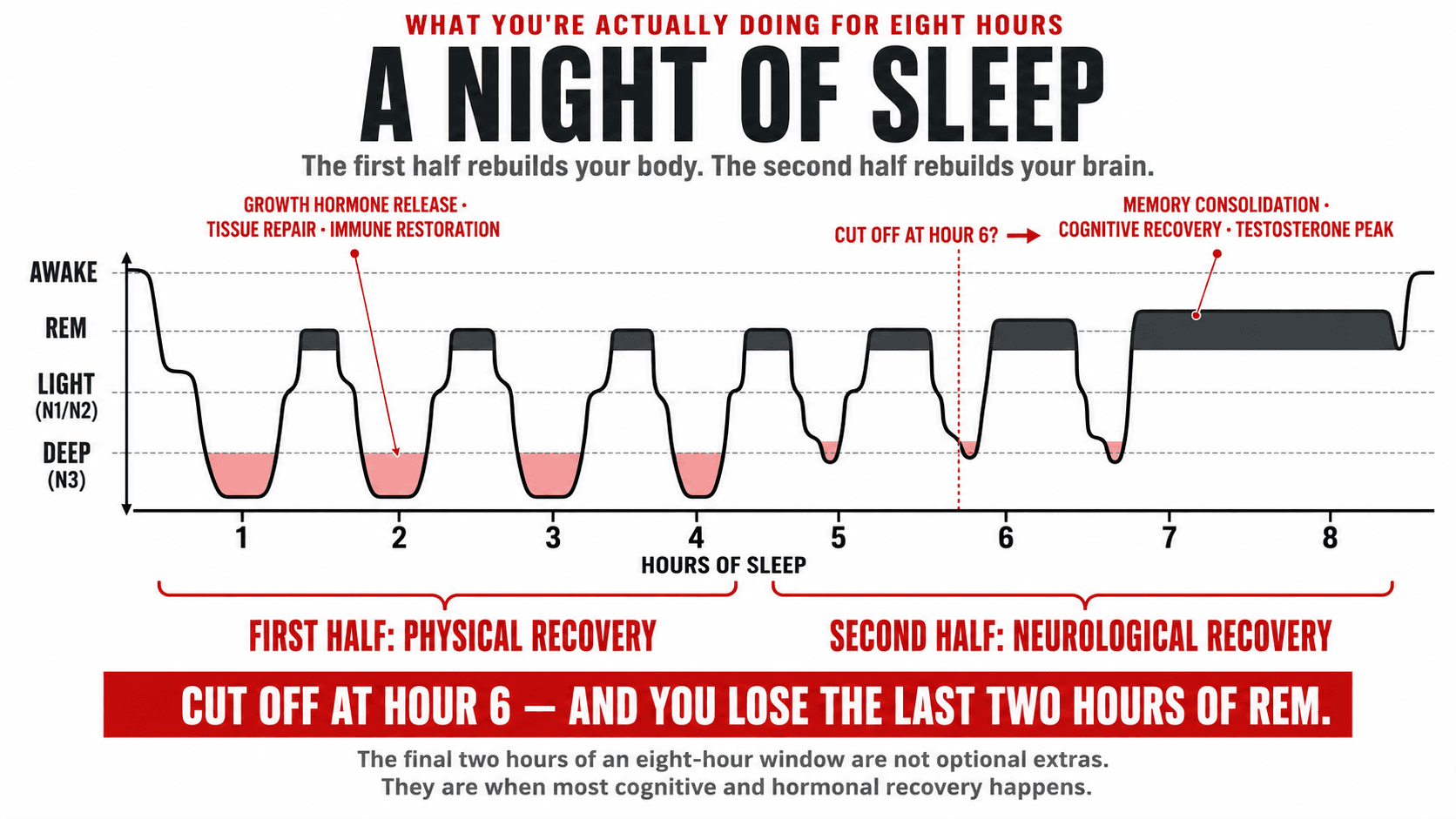
Light sleep (N1 and N2) represents the transitional and early sleep stages. Body temperature begins to drop, heart rate slows, and the brain starts producing sleep spindles, which are bursts of neural activity that play a role in memory consolidation and sensory processing.
Deep slow-wave sleep (N3) is the most physically restorative stage. This is where the majority of growth hormone is released, where tissue repair occurs, where the immune system is most active, and where the body performs the bulk of its physical recovery work. N3 sleep is most abundant in the first half of the night.
REM sleep (Rapid Eye Movement) is when the majority of dreaming occurs. It is the neurologically restorative stage. Emotional regulation, memory consolidation, creativity, cognitive flexibility, and hormonal recalibration all depend on adequate REM. REM cycles become progressively longer across the night, with the majority occurring in the final two hours of an eight-hour sleep window.
Top Tip
If you sleep from midnight to six in the morning, you are getting six hours of sleep but you are losing the majority of your REM cycles. The final two hours of an eight-hour window are not optional extras. They are where much of your hormonal and cognitive recovery takes place. Cutting them off early is not the same as sleeping less — it is specifically cutting your most restorative sleep.
What Chronic Poor Sleep Does to the Male Body
The consequences of chronic sleep restriction are not subtle and they are not limited to feeling tired. They are measurable, systemic, and accumulate over time. The table below outlines the evidence-based effects across every major physiological system.
| Body System | What Chronic Poor Sleep Does |
|---|---|
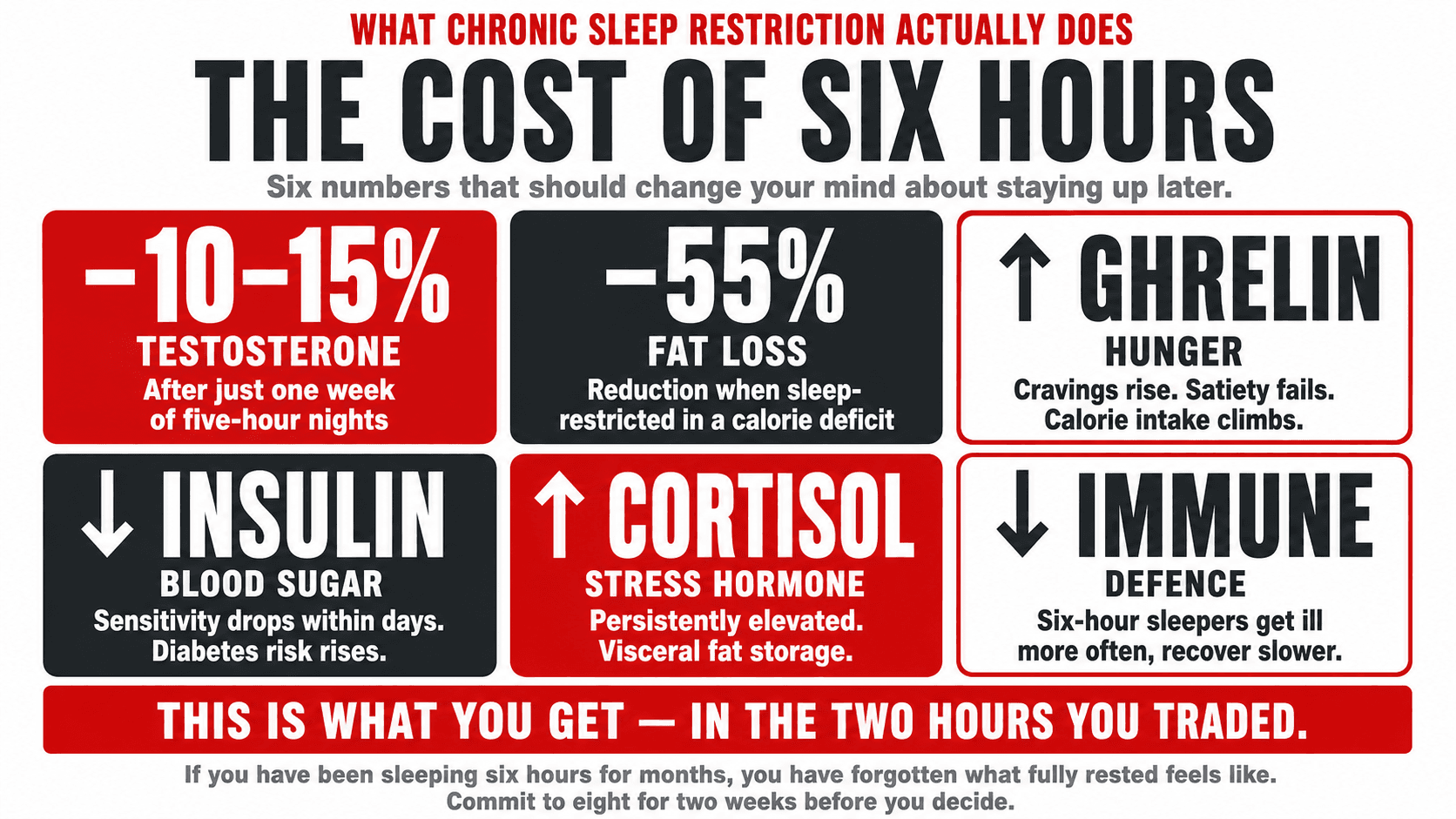
| Hormones | Testosterone falls. Research published in JAMA found that one week of sleep restricted to five hours per night reduced testosterone levels in young healthy men by 10 to 15% (1). Cortisol rises. Growth hormone pulse amplitude is reduced. Prolactin dysregulation can occur with extended restriction. The hormonal environment shifts from anabolic to catabolic. |
| Muscles | Muscle protein synthesis is impaired. Recovery from training is delayed. Without adequate deep sleep and growth hormone release, the muscle-building stimulus from your sessions is only partially converted into actual muscle tissue. Chronic restriction accelerates age-related muscle loss. |
| Body Fat | Fat loss is impaired. A study in the Annals of Internal Medicine demonstrated that sleep restriction in people in a calorie deficit resulted in a 55% reduction in fat loss and a significant increase in lean mass loss (2). You lose less fat and more muscle when under-slept, even in a deficit. |
| Hunger | Ghrelin, the hunger-stimulating hormone, rises significantly with sleep restriction. Leptin, the satiety hormone, falls. The result is greater appetite, stronger cravings for calorie-dense food, and reduced ability to use satiety signals as a guide for food intake. |
| Blood Sugar | Insulin sensitivity is reduced by sleep deprivation within days. Glucose tolerance deteriorates. Chronically poor sleep is an independent risk factor for Type 2 diabetes and metabolic syndrome, even when controlling for diet and exercise. |
| Heart | Blood pressure rises. Resting heart rate is elevated. Inflammatory markers including C-reactive protein increase. Chronic sleep restriction is associated with increased risk of cardiovascular events, independent of other lifestyle variables. |
| Brain and Mood | Cognitive function declines. Reaction time, working memory, emotional regulation, and decision-making are all impaired with chronic sleep restriction. Anxiety and depressive symptoms increase. Risk tolerance and impulse control are reduced. |
| Immune System | Immune response is suppressed. Men sleeping six hours or fewer per night are more susceptible to infectious illness, take longer to recover, and show impaired vaccine response. Chronic inflammation is elevated. |
Why Men Underestimate the Damage
One of the most well-documented findings in sleep research is that chronic sleep restriction impairs your ability to accurately assess how impaired you are. After several days of restricted sleep, subjects report feeling fine. Their subjective sense of sleepiness stabilises. But objective measures of cognitive performance, reaction time, and physiological function continue to deteriorate (4).
This is the trap. Men who have been sleeping six hours for years have no baseline to compare against. They have forgotten what a fully rested state feels like. They attribute their low energy, blunted motivation, poor training recovery, and body composition stagnation to anything except the most obvious cause: they are chronically under-slept.
There is also a cultural dimension. Sleep deprivation has been normalised and, in some circles, celebrated as a badge of productivity. The man who sleeps five hours is working harder, supposedly. The man who sleeps eight is soft. This is one of the most counterproductive belief systems in modern male culture, and it has a measurable physiological cost.
Top Tip
If you have been sleeping six hours or fewer for months or years, you may have forgotten what feeling fully rested actually feels like. Commit to eight hours per night for two weeks, using the protocol below, before you make any judgement about how much sleep you need. Your training performance, mood, libido, and cognitive function will likely shift noticeably within the first week.
The Sleep Optimisation Protocol for Men
Improving sleep is not complicated. It requires consistency and a willingness to treat sleep with the same seriousness you would treat training or nutrition. The following habits are evidence-based and represent the highest-return interventions available.
| Habit | Why It Matters | How to Implement | Difficulty |
|---|---|---|---|
| Consistent wake time daily | Anchors circadian rhythm. Most powerful single lever. | Set one wake time. Keep it seven days a week. | Low to moderate |
| Cool bedroom (16 to 19 degrees) | Enables core temperature drop required to initiate sleep. | Fan, lighter bedding, or open window. | Low |
| Morning natural light within 30 minutes | Sets circadian timing. Determines when melatonin rises. | Step outside, open blinds, or use a daylight lamp. | Low |
| No screens 90 minutes before bed | Blue light suppresses melatonin. | Replace with reading or low-stimulation activity. | Moderate |
| Caffeine cutoff at 2pm | Eliminates caffeine's disruption of sleep onset. | Switch to decaf or herbal tea after 2pm. | Moderate |
| No alcohol within three hours of bed | Prevents REM fragmentation in second half of night. | Shift drinking earlier or choose non-alcoholic alternatives. | Moderate to hard |
| Magnesium glycinate before bed | Supports GABA receptor activity. | 200 to 400mg, 30 to 60 minutes before sleep. | Low |
| Tryptophan-rich evening snack | Provides precursor for serotonin and melatonin. | Pumpkin seeds, oats, soy products, tart cherry juice. | Low |
Top Tip
Address these six variables as a protocol, not as individual choices. Each habit compounds the others. A consistent wake time combined with morning light exposure and an evening wind-down routine is significantly more effective than any single habit implemented in isolation.

A Note on Sleep Apnoea: When to See Your GP
Obstructive sleep apnoea (OSA) is a condition in which the upper airway repeatedly collapses during sleep, causing brief cessations in breathing, micro-arousals, and severe disruption to sleep architecture. It is significantly more common in men than women, and it is dramatically under-diagnosed.
OSA causes fragmentation of both deep sleep and REM sleep, dramatically suppresses testosterone and growth hormone secretion, elevates cortisol, increases cardiovascular risk, and produces chronic fatigue that no amount of lifestyle optimisation will overcome — because the underlying sleep architecture is being destroyed.
Common indicators include loud snoring, witnessed apnoeas during sleep, waking unrefreshed regardless of hours slept, excessive daytime sleepiness, morning headaches, and frequent nocturnal urination. If you have three or more of these, speak to your GP and request a sleep study. CPAP therapy for confirmed OSA can produce rapid and dramatic improvements in testosterone, energy, body composition, cognitive function, and cardiovascular health.
Top Tip
If you snore loudly, have been told you stop breathing in your sleep, or wake every morning feeling unrested despite adequate hours, do not spend money on supplements or sleep gadgets. Speak to your GP first. Undiagnosed sleep apnoea is one of the most common and most impactful reversible causes of low testosterone, fatigue, and poor body composition in men over thirty-five.

Why Sleep Is the First Thing I Address With Every New Client
When I begin working with a new client, sleep is always assessed before training programming, before macros, before supplementation. The reason is straightforward. A client who is sleeping five hours per night and training four times per week is undermining almost all of the physiological adaptations we are trying to create.
The training stimulus is delivered in the gym. The adaptation occurs during sleep. Without adequate sleep, the anabolic signal is partially wasted. Testosterone and growth hormone are insufficient for optimal tissue remodelling. Muscle protein synthesis is impaired. The cortisol-to-testosterone ratio is unfavourable. Recovery between sessions is incomplete, which increases injury risk, reduces training quality, and stalls progress in ways that look like programming problems but are actually recovery problems.
I have had clients add significant lean mass and drop meaningful body fat without any major changes to training or nutrition, simply by prioritising consistent, high-quality sleep. It is not a dramatic story. It is not a complicated protocol. But it is repeatable, and it demonstrates clearly that for a large proportion of men, sleep is the limiting factor in their results.
If your training is consistent, your nutrition is dialled in, and your progress has stalled, the question I would ask you is simple. How much are you sleeping? The answer is often where the problem lies.
Work with Me
Get a personalised coaching plan built around your goals, your schedule, and your life.
Enquire NowReferences
- (1) Leproult R, Van Cauter E. Effect of 1 week of sleep restriction on testosterone levels in young healthy men. JAMA. 2011;305(21):2173-2174.
- (2) Nedeltcheva AV, Kilkus JM, Imperial J, et al. Insufficient sleep undermines dietary efforts to reduce adiposity. Ann Intern Med. 2010;153(7):435-441.
- (3) Van Cauter E, Latta F, Nedeltcheva A, et al. Reciprocal interactions between the GH axis and sleep. Growth Horm IGF Res. 2004;14(Suppl A):S10-S17.
- (4) Van Dongen HP, Maislin G, Mullington JM, Dinges DF. The cumulative cost of additional wakefulness: dose-response effects on neurobehavioral functions and sleep physiology from chronic sleep restriction and total sleep deprivation. Sleep. 2003;26(2):117-126.
- (5) Spiegel K, Tasali E, Penev P, Van Cauter E. Sleep curtailment in healthy young men is associated with decreased leptin levels, elevated ghrelin levels, and increased hunger and appetite. Ann Intern Med. 2004;141(11):846-850.
- (6) Tasali E, Leproult R, Ehrmann DA, Van Cauter E. Slow-wave sleep and the risk of type 2 diabetes in humans. Proc Natl Acad Sci USA. 2008;105(3):1044-1049.
- (7) Meier-Ewert HK, Ridker PM, Rifai N, et al. Effect of sleep loss on C-reactive protein, an inflammatory marker of cardiovascular risk. J Am Coll Cardiol. 2004;43(4):678-683.
- (8) Xie L, Kang H, Xu Q, et al. Sleep drives metabolite clearance from the adult brain. Science. 2013;342(6156):373-377.
- (9) Dattilo M, Antunes HK, Medeiros A, et al. Sleep and muscle recovery: endocrinological and molecular basis for a new and promising hypothesis. Med Hypotheses. 2011;77(2):220-222.
- (10) Walker MP. Why We Sleep: Unlocking the Power of Sleep and Dreams. Scribner; 2017.
- (11) Punjabi NM. The epidemiology of adult obstructive sleep apnea. Proc Am Thorac Soc. 2008;5(2):136-143.
- (12) Andersen ML, Alvarenga TF, Mazaro-Costa R, Hachul HC, Tufik S. The association of testosterone, sleep, and sexual function in men and women. Brain Res. 2011;1416:80-104.