The stationary bike is one of the most popular pieces of equipment in every gym on the planet. It is also one of the most misused. Walk into any commercial gym and you will see the same picture: people sitting on exercise bikes, pedalling at a gentle pace, watching their phones, barely breaking a sweat, and doing this for 30, 40, sometimes 60 minutes at a time. Then they step off, check the calorie counter, feel satisfied, and go home believing they have done a productive workout.
I am not here to tell you that the stationary bike is useless. That would be dishonest. But I am here to tell you that the way most people use it is almost certainly a waste of their time. I can count on one hand the number of times I have put someone on a stationary bike and told them to pedal at a steady pace for 45 minutes. It is not that the bike itself is the problem. It is how people use it.
The Problem: How Most People Use the Stationary Bike
Let me describe the typical stationary bike session I see in commercial gyms. A person sits down, adjusts the seat (if they bother), sets the resistance to a comfortable level, and begins pedalling. The pace is moderate. They can easily hold a conversation, check social media, or watch a television screen. Their heart rate is mildly elevated but nowhere near challenging. After 30 to 45 minutes, they stop, look at the display that says something like 250 to 350 calories burned, and feel like they have accomplished something meaningful.
Here is the problem. That session likely burned far fewer actual calories than displayed. As I covered in a previous article, exercise machines routinely overestimate calorie expenditure, with some studies showing errors of 7 to 42 percent (1). But more importantly, the session provided almost no stimulus for the adaptations that actually matter for body composition, health, and longevity: it did not build muscle, it did not meaningfully challenge the cardiovascular system, it did not elevate metabolism after the session, and the effort level was so low that the body barely needed to adapt at all.
| HOW MOST PEOPLE USE THE BIKE (WRONG) | HOW THE BIKE SHOULD BE USED (RIGHT) |
|---|---|
| Low resistance, comfortable pace for 30 to 60 minutes | Structured intervals with challenging resistance |
| Scrolling phone or watching TV throughout | Focused effort during work periods, genuine recovery during rest |
| Heart rate barely elevated above resting | Heart rate reaches 80 to 95% of max during hard intervals |
| No structured intervals or progression plan | Progressive overload: increasing resistance or duration over time |
| Same session every time, week after week | Varied protocols to prevent adaptation |
| Relying on the calorie counter for motivation | Using it as a strategic tool alongside resistance training |
| Using it as their only form of exercise | Using it as one component of a broader training programme |
A study published in the European Journal of Applied Physiology found that training at intensities below 60 percent of maximum heart rate produced minimal improvements in cardiovascular fitness or body composition in untrained adults (2). Most people on a stationary bike in a commercial gym are working well below this threshold. They are moving, which is better than sitting on the sofa, but they are not exercising with enough purpose to drive real change.
Top Tip
If you can comfortably scroll through social media while on the stationary bike, you are not working hard enough for it to count as a meaningful training session. That does not mean you need to suffer for an hour. It means you need to increase the intensity, reduce the time, and focus on what you are doing.
Why the “Sit and Pedal” Approach Fails You
Let me explain specifically why the typical gentle stationary bike session falls short, because understanding this will help you make better decisions about your training.
1. It Does Not Build or Preserve Muscle
Low intensity cycling does not provide any meaningful stimulus for muscle growth or retention. Unlike resistance training, which loads your muscles against progressively heavier weights and triggers hypertrophy, gentle cycling provides a repetitive, low load movement that your body adapts to very quickly. A meta analysis published in the Journal of Strength and Conditioning Research found that concurrent endurance and resistance training reduced muscle and strength gains compared to resistance training alone, and this effect was most pronounced with cycling based endurance training (3). In plain terms, excessive time on the bike can actually work against your muscle building goals.
2. Your Body Adapts Rapidly, Making It Less Effective Over Time
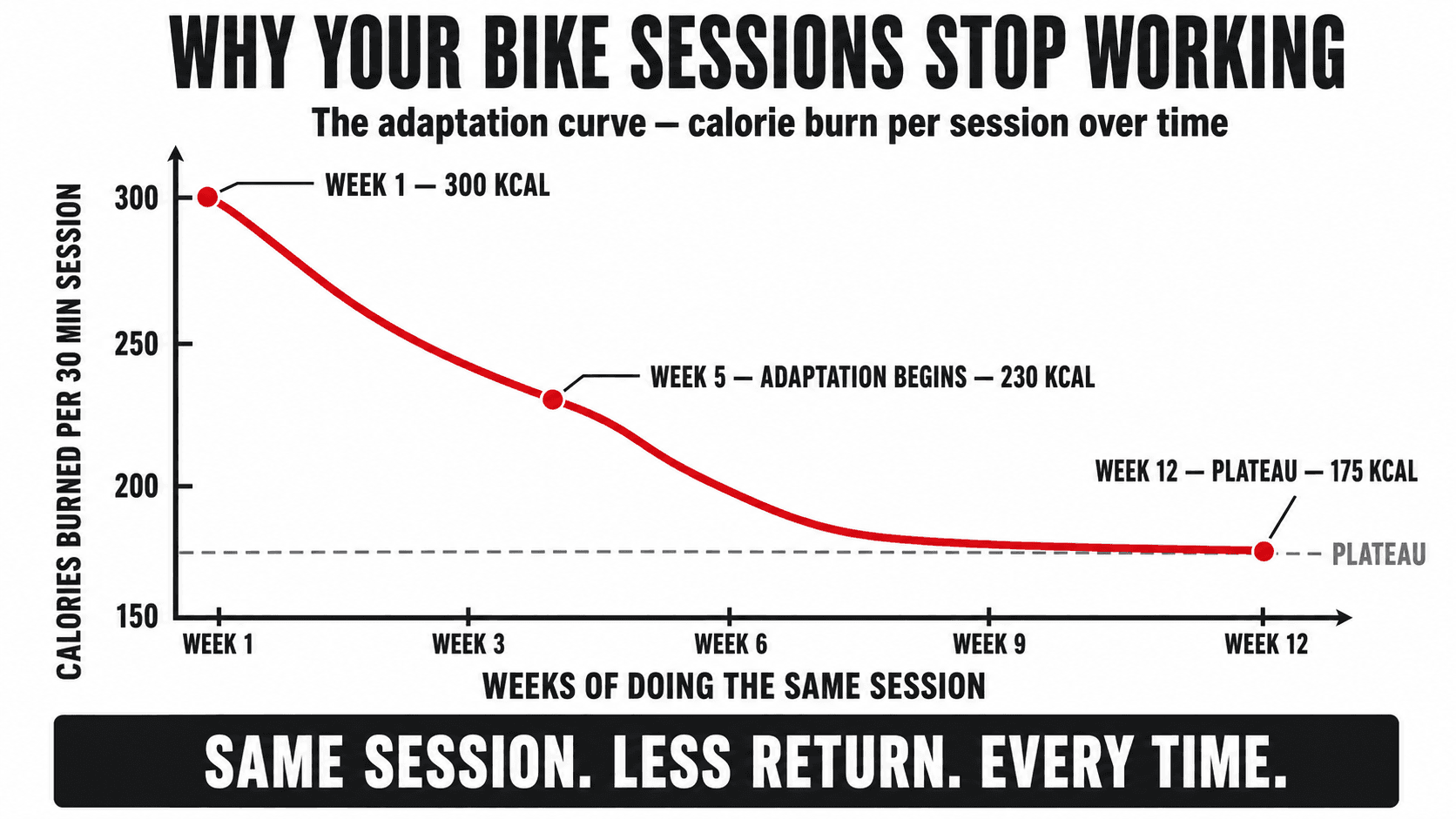
One of the most important concepts in exercise science is the principle of adaptation. Your body is designed to become efficient at whatever you repeatedly ask it to do. When you first start cycling, a 30 minute session at moderate intensity is a novel stimulus and your body responds with improvements. But within four to eight weeks of doing the same thing, your body has adapted. You burn fewer calories doing the same work. Your cardiovascular system is no longer being challenged. And without changing the stimulus, you will plateau completely (4).
This is exactly why so many people who cycle for months on end see results in the first few weeks and then nothing thereafter. They are doing the same session, at the same intensity, for the same duration, and their body has no reason to change further.
WHY THE SAME BIKE SESSION STOPS WORKING (THE ADAPTATION TIMELINE)
Weeks 1 to 3: Novel Stimulus
Your body is not used to cycling. Heart rate is elevated. You feel challenged. You may see some initial changes in weight and fitness.
Weeks 4 to 6: Efficiency Improves
Your body becomes better at cycling. The same session burns fewer calories. You need to increase intensity or duration to get the same effect (4).
Weeks 7 to 12: Full Adaptation
The session feels easy. Calorie burn has decreased significantly. Your body has fully adapted and no longer needs to change. Results plateau.
Months 3+: Spinning Your Wheels (Literally)
Without progressive overload, the session becomes maintenance at best. For many people, it provides little more than light movement.
Top Tip
If you have been doing the same bike session for more than six weeks and your results have stalled, you have two options: dramatically change how you use the bike (increase intensity, add intervals, increase resistance), or switch to a more effective form of exercise entirely. Doing the same thing and expecting different results is the definition of wasted effort.
3. It Burns Fewer Calories Than You Think
I have already addressed the calorie counter issue in detail in a previous article, but it bears repeating in this context. Research shows that stationary bikes overestimate calorie expenditure by approximately 7 percent on average (1), and that figure gets significantly worse when people hold the handlebars loosely, sit with poor posture, or set the resistance too low. The real calorie burn from a gentle 30 minute bike session for most people is likely in the range of 150 to 250 calories. That is the caloric equivalent of a medium banana and a tablespoon of peanut butter. It is not nothing, but it is far less than most people believe, and it is certainly not enough to compensate for poor nutritional choices.
4. It Does Not Improve Functional Strength or Movement Quality
The stationary bike locks you into a fixed, repetitive movement pattern. There is no balance component, no core engagement (if you are leaning on the handlebars), no requirement for coordination, and no load bearing through your bones. For a population that increasingly suffers from poor posture, weak core muscles, reduced bone density, and declining functional strength as they age, the stationary bike addresses none of these issues. Compare this to a resistance training programme that includes squats, deadlifts, lunges, presses, and rows, all of which challenge your balance, strengthen your core, load your bones, and improve your ability to move well in daily life.
The Solution: When and How the Stationary Bike Actually Works
Now, here is where I balance the argument. I said at the outset that the bike is not useless and I meant it. There are specific situations where the stationary bike is a genuinely useful tool, and specific ways to use it that deliver real results. Let me walk you through both.
Situation 1: HIIT on the Bike
The stationary bike is actually one of the best pieces of equipment for performing genuine high intensity interval training. Unlike a treadmill, where you have to constantly adjust speed settings and risk tripping, the bike allows instant transitions between maximum effort sprints and complete rest. You simply pedal harder and increase the resistance for the work interval, then ease off for recovery. It is simple, effective, and safe.
Research by Tabata and colleagues, published in Medicine and Science in Sports and Exercise, used a stationary bike for one of the most famous interval protocols in exercise science. Participants performed 20 seconds of all out effort followed by 10 seconds of rest, repeated for just four minutes. Despite the extremely short session duration, the results showed significant improvements in both aerobic and anaerobic capacity (5). More recent research in the British Journal of Sports Medicine found that HIIT was associated with 28.5 percent greater reductions in total body fat compared to moderate intensity continuous training (6).
| Protocol | Work Interval | Rest Interval | Total Rounds | Total Session Time | Who Is It For? |
|---|---|---|---|---|---|
| Beginner HIIT | 15 seconds hard | 45 seconds easy | 8 rounds | 8 minutes + warm up / cool down | New to HIIT. Building fitness base. |
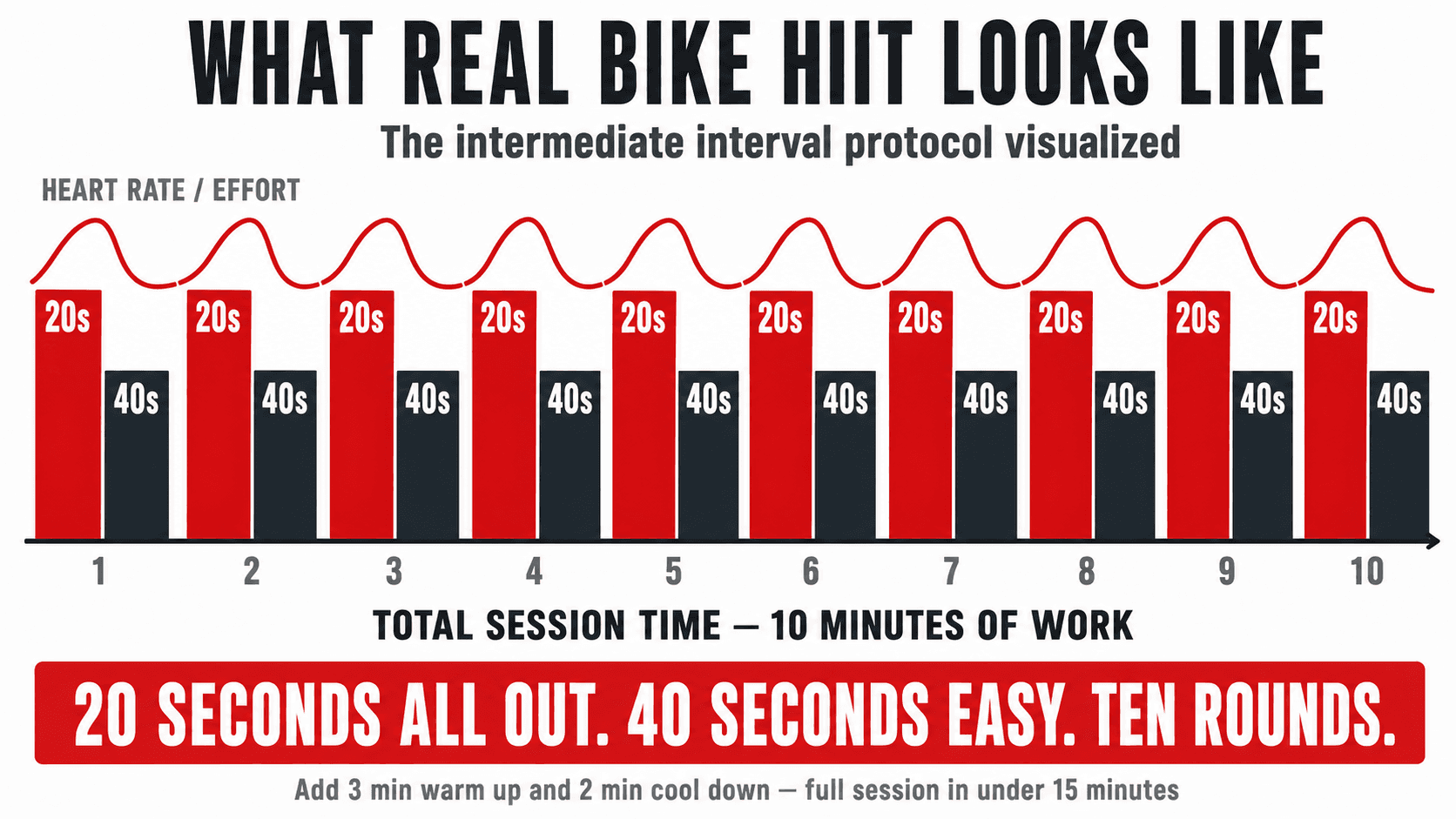
| Intermediate HIIT | 20 seconds max effort | 40 seconds easy | 10 rounds | 10 minutes + warm up / cool down | Some training experience. Good baseline fitness. |
| Tabata Protocol | 20 seconds all out | 10 seconds complete rest | 8 rounds | 4 minutes + warm up / cool down | Experienced. Very high intensity. Not for beginners. |
| Longer Intervals | 30 seconds hard | 60 seconds easy | 8 to 12 rounds | 12 to 18 minutes + warm up / cool down | Good all round fat loss protocol. Challenging but sustainable. |
Top Tip
If you want to use the bike effectively for fat loss, switch from steady state pedalling to interval training. Start with the beginner protocol: 15 seconds hard, 45 seconds easy, 8 rounds. That is just 8 minutes of work. If it feels manageable, increase the resistance on the hard intervals next session. Progress the work to rest ratio over time.
Situation 2: Active Recovery Between Resistance Training Sessions
This is one of the most underappreciated uses of the stationary bike. On days between heavy resistance training sessions, 10 to 15 minutes of very gentle cycling can promote blood flow to your muscles, aid recovery, and reduce delayed onset muscle soreness (DOMS). A study in Journal of Strength and Conditioning Research found that low intensity active recovery, including cycling, reduced perceptions of muscle soreness and improved subsequent exercise performance compared to passive rest (7).
The key here is that the intensity must be genuinely low. This is not a training session. This is recovery work. Heart rate should stay below 60 percent of your maximum. You should be able to hold a full conversation without any breathlessness. Five to fifteen minutes is enough. This is the one context where gentle, easy pedalling is appropriate and beneficial.
Top Tip
If you have sore legs from a squat or deadlift session, 10 minutes of gentle cycling the following day can help you recover faster than complete rest. Keep the resistance low, the pace easy, and think of it as moving blood through your muscles rather than exercising them.
Situation 3: Low Impact Cardio for People With Joint Issues
If you have knee, hip, or ankle problems that make walking painful or running impossible, the stationary bike can be a genuinely useful alternative for maintaining cardiovascular fitness and daily energy expenditure. Because cycling is non weight bearing, it places significantly less stress on your joints compared to walking or running (8). For clients recovering from lower limb injuries, or for older adults with osteoarthritis, the bike can serve as a bridge that keeps them active while they rehabilitate.
I have worked with clients who could not walk for extended periods due to knee issues, and the bike allowed them to maintain their cardiovascular health and daily calorie expenditure while we addressed the underlying problem through targeted resistance training and mobility work. In that context, the bike was not a waste of time at all. It was an essential part of their programme.
Situation 4: A HIIT Tool That Protects Muscle Better Than Running
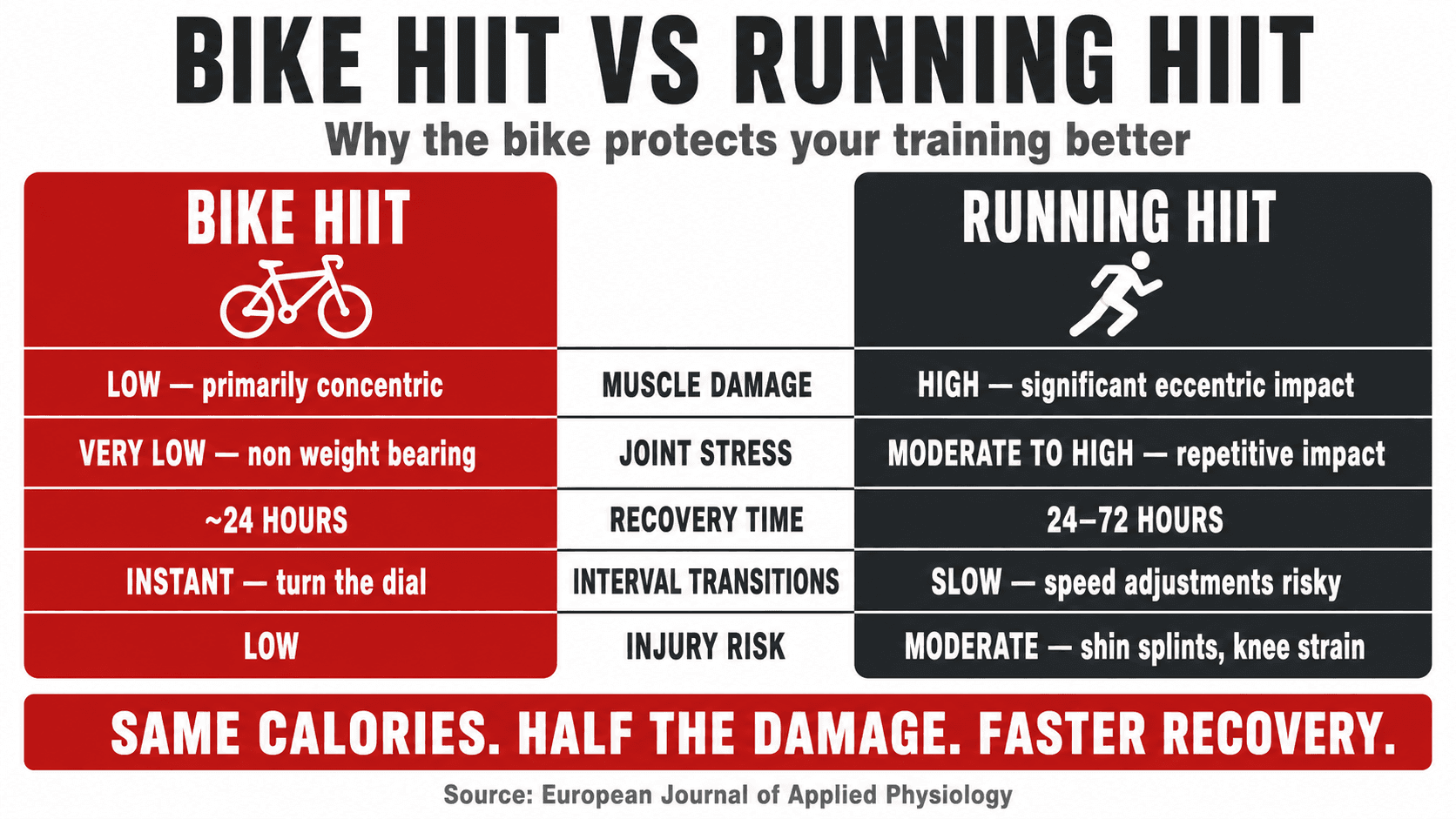
This is a nuance that matters for anyone focused on body composition. Running involves significant eccentric muscle contractions (where your muscles lengthen under load, particularly when your foot strikes the ground). These eccentric contractions create muscle damage that requires recovery time. When you are also doing resistance training for your legs, adding running HIIT on top can create excessive muscle damage that impairs your recovery and your performance in the weight room.
Cycling, by contrast, is primarily concentric (muscles shorten under load while pedalling). This creates far less muscle damage per session. Research published in the European Journal of Applied Physiology confirmed that cycling produced less exercise induced muscle damage than running when both were performed at comparable intensities (9). This is why, when I prescribe HIIT for clients who are also doing heavy leg training, I almost always choose the bike over the treadmill.
| Factor | Bike HIIT | Running HIIT |
|---|---|---|
| Muscle damage | Low (primarily concentric movement) | High (significant eccentric impact with each stride) |
| Impact on subsequent leg training | Minimal if limited to 1 to 2 sessions per week | Can impair squat and deadlift performance for 24 to 72 hours |
| Joint stress | Very low (non weight bearing) | Moderate to high (repetitive impact) |
| Injury risk | Low | Moderate (shin splints, ankle sprains, knee strain) |
| Ease of interval transitions | Excellent (instant resistance changes) | Poor (treadmill speed adjustments are slow and risky) |
| Calorie burn | Comparable when performed at equal intensity | Comparable when performed at equal intensity |
| Best for | Preserving muscle, joint friendly HIIT, body composition focus | Runners, sport specific fitness, outdoor training lovers |
Top Tip
If your primary goal is fat loss and you are doing resistance training three to four times per week, choose the bike over the treadmill for your HIIT sessions. The lower muscle damage means faster recovery, which means you can train with weights at full intensity without your HIIT sessions holding you back.
The Verdict: Is the Stationary Bike a Waste of Time?
The honest answer is: it depends entirely on how you use it.
| THE STATIONARY BIKE VERDICT: WASTE OF TIME OR USEFUL TOOL? | |
|---|---|
| A Waste of Time When... | Used at low intensity for 30 to 60 minutes as your primary or only form of exercise. Used without structure, progression, or purpose. Used as a substitute for resistance training. |
| A Useful Tool When... | Used for structured HIIT intervals with genuine high intensity effort. Used as active recovery between resistance training sessions. Used as low impact cardio for people with joint issues. |
| An Excellent Tool When... | Used specifically for HIIT because it allows instant transitions and produces less muscle damage than running. Used as part of a broader programme that includes resistance training, walking, and good nutrition. |
| Never a Replacement For... | Resistance training. Walking. A well structured nutrition plan. These are the foundations. The bike is a supplementary tool at best. |
A Quick Note on Fuelling Your Bike Sessions
If you are using the bike for HIIT, which is the primary way I recommend it, you want to ensure you have adequate fuel. HIIT is glycolytic, meaning it runs predominantly on carbohydrates. Performing intense intervals on a completely empty stomach or on a very low carbohydrate diet will likely result in poor performance, early fatigue, and a suboptimal training stimulus.
I recommend eating a small meal containing protein and carbohydrates 60 to 90 minutes before a HIIT bike session. This applies regardless of dietary background. Good options include eggs on toast, porridge with protein powder, a chicken wrap, a tofu and rice bowl, or a banana with a scoop of pea or whey protein blended into a shake. The goal is fuel, not a feast.
YOUR STATIONARY BIKE DECISION GUIDE
If you currently sit on the bike for 30 to 60 minutes at low intensity, your time would be better spent doing resistance training or brisk walking.
If you want to use the bike effectively, switch to HIIT intervals: short, intense efforts followed by rest periods. 10 to 20 minutes is plenty.
The bike is one of the best tools for HIIT because it allows instant transitions and causes less muscle damage than running.
Use the bike for active recovery on rest days: 10 to 15 minutes at very low intensity to promote blood flow and reduce soreness.
If you have joint issues that make walking or running painful, the bike is a valuable low impact option for maintaining cardiovascular fitness.
Never rely on the calorie counter. It overestimates. Plan your nutrition independently based on your total daily needs.
The bike is a tool, not a programme. It should complement resistance training and walking, never replace them.
If you enjoy cycling and it keeps you active, that has value. But understand its limitations and supplement with resistance training for a complete programme.
Where to Start
If you have been spending 30 to 60 minutes on the stationary bike several times a week without seeing results, I hope this article has given you clarity on why. The solution is not to abandon the bike entirely. It is to use it with purpose, at the right intensity, in the right context, and as part of a programme that prioritises the things that actually drive body composition change: resistance training, daily walking, and well structured nutrition.
From cardio machine regulars to people who had never touched a dumbbell. From clients in their 20s to clients in their 60s. From meat eaters to lifelong vegetarians and vegans. The principles are the same and the results speak for themselves.
If you want a programme that is built specifically for your goals, your body, your health history, and your dietary preferences, get in touch through trperformancecoaching.com. I coach one-to-one online globally, and I would welcome the opportunity to help you train smarter.
Work with Me
Get a personalised coaching plan built around your goals, your schedule, and your life.
Enquire NowReferences
- Ozemek C, Kirschner MM, Galanis CR, et al. Validity of commonly used cardio equipment calorie expenditure estimates during graded exercise testing. Journal of Sports Sciences. 2014; 32(11): 1070-1077.
- Garber CE, Blissmer B, Deschenes MR, et al. American College of Sports Medicine position stand: quantity and quality of exercise for developing and maintaining cardiorespiratory, musculoskeletal, and neuromotor fitness in apparently healthy adults. Medicine and Science in Sports and Exercise. 2011; 43(7): 1334-1359.
- Wilson JM, Marin PJ, Rhea MR, Wilson SMC, Loenneke JP, Anderson JC. Concurrent training: a meta-analysis examining interference of aerobic and resistance exercises. Journal of Strength and Conditioning Research. 2012; 26(8): 2293-2307.
- Poliquin C. The Poliquin Principles: Successful Methods for Strength and Mass Development. Dayton Writers Group. 1997.
- Tabata I, Nishimura K, Kouzaki M, et al. Effects of moderate-intensity endurance and high-intensity intermittent training on anaerobic capacity and VO2max. Medicine and Science in Sports and Exercise. 1996; 28(10): 1327-1330.
- Viana RB, Naves JPA, Coswig VS, et al. Is interval training the magic bullet for fat loss? A systematic review and meta-analysis comparing moderate-intensity continuous training with high-intensity interval training (HIIT). British Journal of Sports Medicine. 2019; 53(10): 655-664.
- Mika A, Oleksy L, Kielnar R, et al. Comparison of two different modes of active recovery on muscles performance after fatiguing exercise in mountain canoeist and football players. PLoS One. 2016; 11(10): e0164216.
- Kutzner I, Heinlein B, Graichen F, et al. Loading of the knee joint during activities of daily living measured in vivo in five subjects. Journal of Biomechanics. 2010; 43(11): 2164-2173.
- Peake JM, Neubauer O, Della Gatta PA, Nosaka K. Muscle damage and inflammation during recovery from exercise. Journal of Applied Physiology. 2017; 122(3): 559-570.