If you are a woman who spends most of your gym time on the treadmill, the cross trainer, or in a spin class, I need you to hear this. Cardio alone will not give you the body or the health you are looking for. I have coached women from complete beginners to experienced athletes, and across every single dietary background from meat eaters to vegans. The pattern I see repeated again and again is the same: women who rely exclusively on women and weights avoidance, sticking to cardio only, end up frustrated with their results, tired all the time, and often in worse metabolic health than when they started.
This is not about shaming anyone for enjoying cardio. If you love running or cycling, that is wonderful and I will never tell you to stop. But if your goal is fat loss, a stronger body, better hormonal health, or protection against the diseases that affect women disproportionately as they age, then resistance training needs to be part of your programme. Not optional. Essential.
The Problem: The Cardio Trap That Millions of Women Fall Into
Walk into almost any commercial gym in London or anywhere in the world and you will see the same thing. The cardio section is dominated by women. The free weights area is dominated by men. This is not an accident. It is the result of decades of misleading fitness marketing that told women they should “tone” and “burn calories” on machines, while men should build muscle with weights.
The fitness industry sold women the idea that lifting weights would make them “bulky.” That word has done more damage to women's health than almost any other myth in the industry. Let me be absolutely clear: resistance training will not make women bulky. It is physiologically extremely difficult for women to gain large amounts of muscle mass. Women produce roughly 15 to 20 times less testosterone than men (1). Testosterone is the primary anabolic hormone responsible for significant muscle hypertrophy. Without it in large quantities, the kind of extreme muscle growth women fear simply does not happen naturally.
A landmark study published in the Journal of Strength and Conditioning Research found that women who performed resistance training two to three times per week for 12 weeks gained lean muscle and lost body fat, but did not experience the kind of dramatic size increases that the “bulky” myth suggests (2). What they did experience was a firmer, more defined physique, improved strength, and better body composition. That is the opposite of bulky.
| WHY WOMEN WILL NOT GET “BULKY” FROM LIFTING WEIGHTS | |
|---|---|
| Testosterone | Women produce 15 to 20 times less testosterone than men, making extreme muscle growth physiologically unlikely (1) |
| Muscle Fibre Type | Women tend to have a higher proportion of Type I (endurance) fibres, which grow less in size than Type II fibres (3) |
| Training Response | Women gain strength significantly but add muscle size at a much slower rate than men (2) |
| What Actually Happens | Body fat decreases, muscle becomes firmer and more defined, clothes fit better, metabolism increases |
| What Does NOT Happen | Arms do not suddenly double in size. Thighs do not become enormous. You do not wake up looking like a bodybuilder. |
Top Tip
If someone tells you that lifting weights will make you bulky, they do not understand the science. Women who lift weights build lean, strong, defined physiques. The women who look “bulky” in bodybuilding competitions have typically trained for years with extreme protocols and often with pharmaceutical assistance. Normal resistance training will not do this.
What Happens When You Only Do Cardio
Here is the uncomfortable truth about a cardio only approach. When you do excessive amounts of steady state cardio, particularly moderate intensity work like jogging for 45 to 60 minutes several times a week, your body adapts in ways that actively work against your goals.
First, your body becomes more efficient at the exercise, which sounds positive but actually means you burn fewer calories over time doing the same workout (4). You end up having to run further or faster just to get the same energy expenditure you were getting when you started. This is why so many women hit a plateau after the first few weeks of a new running programme.
Second, excessive cardio without resistance training can actually lead to muscle loss. A study in the Journal of the American Geriatrics Society found that weight loss achieved through calorie restriction combined with aerobic exercise alone resulted in significant loss of lean muscle mass, whereas groups that included resistance training preserved or increased their muscle (5). When you lose muscle, your resting metabolic rate drops, meaning you burn fewer calories at rest. This sets you up for a cycle of needing to eat less and less, or do more and more cardio, just to maintain your weight. It is an unsustainable and deeply frustrating path.
THE CARDIO ONLY TRAP (A DOWNWARD CYCLE)
Stage 1: You Start Running or Doing Cardio
You feel great. You lose a few pounds in the first 2 to 3 weeks. Motivation is high.
Stage 2: Your Body Adapts
After 4 to 6 weeks, the same session burns fewer calories. Your body has become efficient at this activity (4).
Stage 3: The Plateau Hits
Weight loss stalls. You increase the duration or frequency to compensate. Fatigue builds.
Stage 4: Muscle Loss Begins
Without resistance training, you lose lean tissue alongside fat. Your metabolism slows further (5).
Stage 5: The Frustration Loop
You are doing more cardio than ever, eating less than ever, and your body looks and feels the same or worse.
Third, and this is particularly relevant for women, chronically elevated cortisol from excessive cardiovascular exercise can interfere with hormonal balance. Research published in the European Journal of Applied Physiology found that prolonged endurance exercise increased cortisol production, which over time can disrupt menstrual cycles, impair thyroid function, and promote fat storage around the midsection (6). For women dealing with PCOS, this is especially problematic because cortisol and insulin interact in ways that can worsen the underlying hormonal imbalance.
Top Tip
If you have been doing cardio consistently for more than six weeks and your results have stalled, that is not a signal to do more cardio. It is a signal to change your approach. Adding resistance training two to three times per week will restart your progress more effectively than another hour on the treadmill.

The Solution: Why Resistance Training Changes Everything for Women
When I start working with a female client who has only ever done cardio, the transformation that happens once we introduce resistance training is remarkable. Not just physically, but in how they feel, how they move, and how they relate to their own body. Let me walk you through exactly why lifting weights is so effective for women.
1. Fat Loss That Actually Lasts
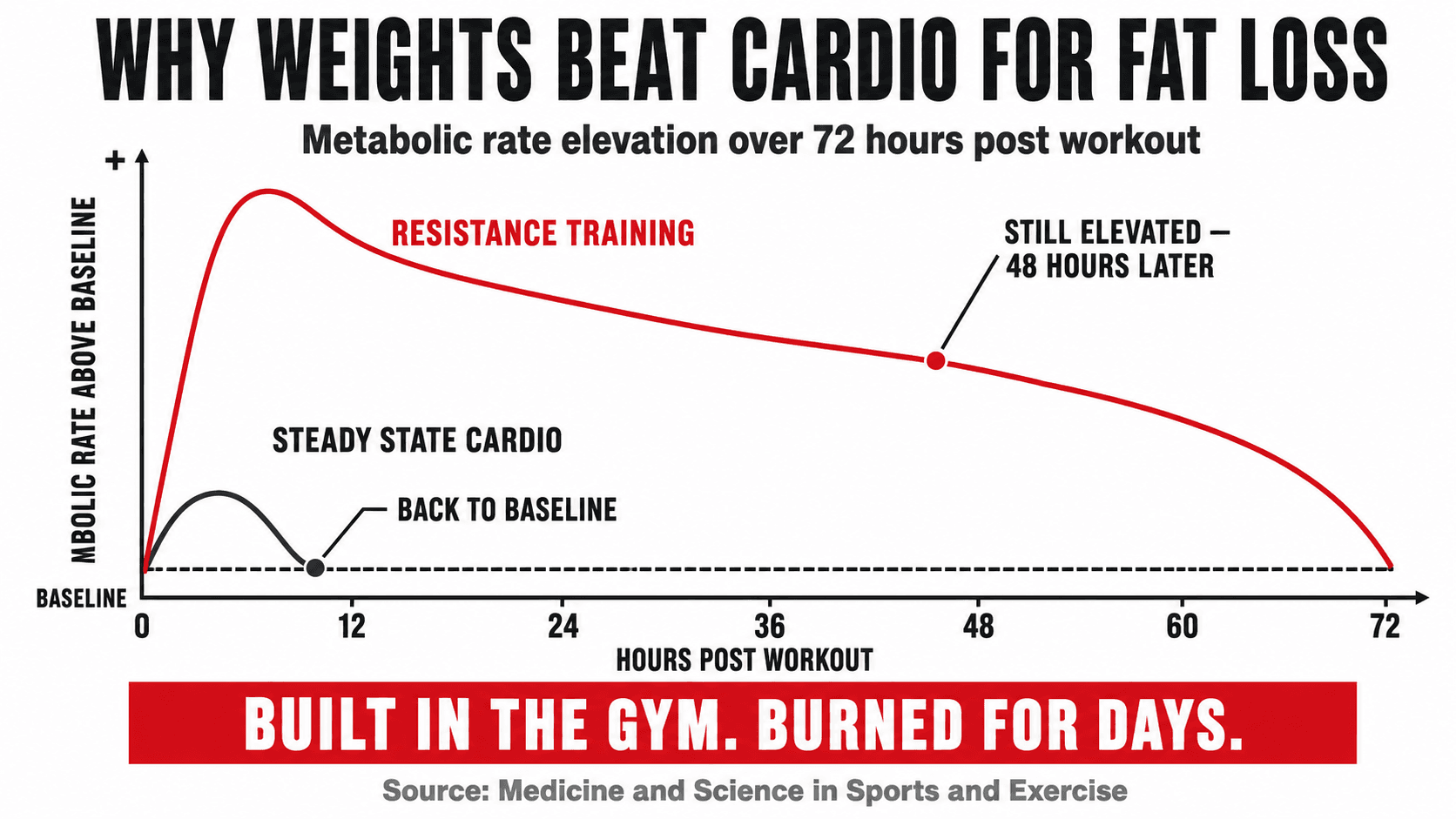
Resistance training builds and preserves lean muscle tissue. Muscle is metabolically active, meaning it burns calories even when you are sitting at your desk or sleeping. A study in Medicine and Science in Sports and Exercise found that resistance training elevated resting metabolic rate for up to 72 hours after a session, a far greater metabolic boost than what steady state cardio provides (7). In practical terms, this means your body is burning more calories around the clock, not just during your workout.
This is why I always tell my clients that fat loss is built in the gym with weights and managed in the kitchen with nutrition. Cardio is a tool, not the foundation.
| Factor | Cardio Only | Resistance Training + Cardio |
|---|---|---|
| Calories burned during session | Moderate to high depending on intensity | Moderate, but continues burning post session for up to 72 hours (7) |
| Effect on muscle mass | Can cause muscle loss if excessive (5) | Builds and preserves lean muscle |
| Resting metabolic rate | Decreases over time as body adapts | Increases as lean tissue is added (7) |
| Long term sustainability | Requires constant escalation of duration or intensity | Progressive overload provides structured, measurable progress |
| Body composition change | Scale weight may drop but body fat percentage often stays similar | Body fat decreases, muscle definition increases, clothes fit differently |
| Hormonal impact on women | Excessive cardio can raise cortisol and disrupt hormones (6) | Supports healthy testosterone, growth hormone, and insulin sensitivity (8) |
2. Stronger Bones and Protection Against Osteoporosis
This is something every woman needs to understand. After menopause, women lose bone density at an accelerated rate due to declining oestrogen levels. Osteoporosis affects roughly one in three women over the age of 50 worldwide (9). It is not a distant, abstract risk. It is a genuine and serious threat to your independence, your mobility, and your quality of life.
Resistance training is one of the most effective ways to maintain and even increase bone mineral density. A meta analysis published in Osteoporosis International found that progressive resistance training significantly improved bone density at the lumbar spine and femoral neck, two of the most common fracture sites in post menopausal women (10). No amount of running or cycling will provide this specific benefit. Your bones respond to the mechanical loading that comes from lifting weights, and nothing else replicates that stimulus as effectively.
Top Tip
If you are a woman over 40, bone health should be near the top of your priority list. Resistance training two to three times per week with compound movements like squats, deadlifts, and overhead presses provides the mechanical loading your bones need to stay strong. Start now, not after a diagnosis.
3. Hormonal Health, PCOS, and Menopause
I work with a significant number of female clients dealing with hormonal challenges, from PCOS in younger women to perimenopause and post menopause in older women. In both cases, resistance training plays a central role in my approach.
For women with PCOS, resistance training has been shown to improve insulin sensitivity, reduce circulating androgen levels, and support fat loss, all of which directly address the metabolic dysfunction at the heart of the condition (11). A study in the Journal of Clinical Endocrinology and Metabolism found that just 16 weeks of resistance training improved insulin resistance and reduced waist circumference in women with PCOS, independent of dietary changes (12).
For women going through menopause, the benefits are equally significant. Declining oestrogen affects everything from body composition to mood to cardiovascular risk. Resistance training helps offset many of these changes by preserving muscle mass, supporting metabolic rate, improving sleep quality, and reducing symptoms of anxiety and depression (13). I have worked with women in their 50s and 60s who have told me that lifting weights made them feel more like themselves than they had in years.
| HOW RESISTANCE TRAINING SUPPORTS WOMEN'S HORMONAL HEALTH | |
|---|---|
| PCOS | Improves insulin sensitivity, lowers androgens, supports fat loss around the midsection (11, 12) |
| Perimenopause | Helps manage weight fluctuations, supports mood, maintains muscle as oestrogen begins to decline |
| Post Menopause | Protects bone density, preserves metabolic rate, reduces cardiovascular risk, improves sleep (13) |
| Thyroid Health | Supports metabolic function and can help counteract the sluggishness associated with hypothyroidism |
| Mental Health | Reduces symptoms of anxiety and depression by up to 40% in some studies (14) |
4. What About NEAT? The Power of Daily Movement
Before I even talk about formal cardio with my clients, I always address something called NEAT. NEAT stands for Non Exercise Activity Thermogenesis, and in plain language it means all the calories you burn through daily movement that is not structured exercise. Walking to the shops, taking the stairs, playing with your children, cooking, cleaning, fidgeting. All of it counts.
NEAT can account for anywhere between 200 and 800 calories per day depending on your activity level (15). That is a massive variable. Before adding three spin classes a week, I always ask my clients: how many steps are you doing? If the answer is under 7,000, we have low hanging fruit to pick before we even think about formal cardio.
WHERE YOUR DAILY CALORIES ACTUALLY GO (ENERGY EXPENDITURE BREAKDOWN)
Basal Metabolic Rate (BMR): 60 to 70%
The calories your body burns just to stay alive. Breathing, brain function, organ function. You cannot change this much, but building muscle increases it slightly.
NEAT: 15 to 30%
All your non exercise movement. Walking, standing, fidgeting, daily tasks. This is the BIGGEST variable you can control and has more impact than formal exercise for most people (15).
Thermic Effect of Food (TEF): 8 to 12%
The energy cost of digesting food. Protein has the highest thermic effect, which is another reason to prioritise protein intake.
Exercise Activity (EAT): 5 to 10%
Your gym sessions, runs, classes. This is the SMALLEST contributor to total daily energy expenditure. Most people overestimate how much this matters.
Top Tip
Aim for a weekly average of at least 8,000 to 10,000 steps per day before adding any formal cardio to your routine. For many of my clients, especially those with desk jobs, simply increasing daily steps has a bigger impact on fat loss than adding extra gym sessions.

5. If You Are Going to Do Cardio, Do It Smart
I am not anti cardio. I use it strategically with my clients when the time is right. But the type and timing matter enormously. Here is how I think about it.
Low intensity steady state cardio, which basically means brisk walking, is excellent. It is easy to recover from, it does not interfere with your resistance training, and it supports overall health and mental wellbeing. I recommend it to almost every client I work with.
High intensity interval training, or HIIT, can also be effective for fat loss because it creates a significant metabolic demand in a short period of time. Research in the British Journal of Sports Medicine found that HIIT was more effective than moderate intensity continuous training for reducing total body fat in overweight adults (16). However, HIIT is genuinely taxing on the body. I cap it at one to two sessions per week for most clients, and never on the same day as a heavy resistance training session.
Moderate intensity steady state cardio, the kind where you jog at a consistent pace for 30 to 60 minutes, is the type I use least. It creates competing adaptations with resistance training, a phenomenon researchers call the interference effect (17). Your body cannot optimally adapt to both long duration endurance work and strength training simultaneously. If your goal is a lean, strong, healthy body, prioritise resistance training and use walking and occasional HIIT as your cardiovascular tools.
| Type of Cardio | What It Is | Best For | How Much Per Week |
|---|---|---|---|
| LISS (Low Intensity Steady State) | Brisk walking, light cycling, easy swimming | Recovery, daily energy expenditure, mental health, beginners | As much as you enjoy. 3 to 7 days per week is fine. |
| HIIT (High Intensity Interval Training) | Short bursts of maximum effort followed by rest periods | Time efficient fat loss, cardiovascular fitness | Maximum 1 to 2 sessions per week. Not on heavy training days. |
| MISS (Moderate Intensity Steady State) | Jogging, moderate cycling, sustained effort for 30 to 60 minutes | Endurance goals, running events | Use sparingly if body composition is the goal. Can interfere with muscle building (17). |
Top Tip
If you only have three days per week to exercise, spend all three on resistance training and get your cardio through daily walking. That combination will produce better body composition results than five days of cardio and no weights.
6. Nutrition for Women Who Train: Fuel the Work
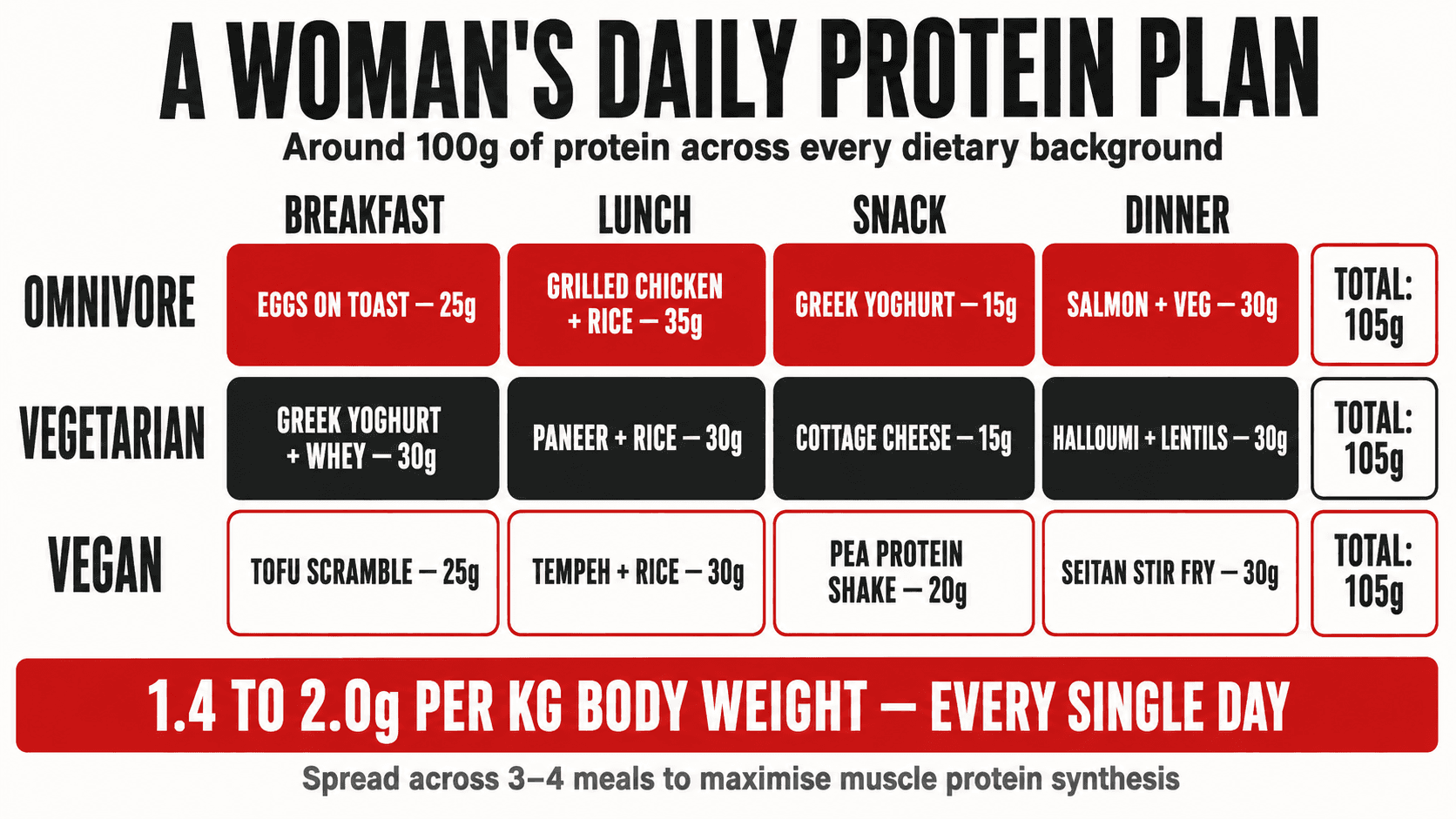
Training is only half the equation. What you eat determines whether that training produces results or not. As a lifelong vegetarian myself, I coach clients across every dietary background, from omnivores to vegetarians to fully plant based, and I can tell you with absolute certainty that you can build an excellent physique on any of these approaches. The key is getting enough protein.
Women who resistance train need more protein than the general population. Research published in the Journal of the International Society of Sports Nutrition recommends between 1.4 and 2.0 grams of protein per kilogram of body weight per day for active individuals looking to build or maintain muscle (18). For a 65kg woman, that is roughly 91 to 130 grams of protein per day.
| Dietary Background | High Protein Sources | Approx. Protein Per Serving |
|---|---|---|
| Omnivore | Chicken breast, salmon, turkey mince, eggs, Greek yoghurt | 25 to 35g per serving |
| Vegetarian | Eggs, paneer, cottage cheese, Greek yoghurt, whey protein, halloumi | 15 to 30g per serving |
| Vegan / Plant Based | Tofu, tempeh, seitan, soy protein isolate, pea protein, lentils, edamame, mock meats | 15 to 30g per serving |
Top Tip
Spread your protein intake across three to four meals per day, aiming for 25 to 40 grams per meal. This approach maximises muscle protein synthesis throughout the day rather than loading all your protein into one sitting (19).
Where to Start
If you have spent years avoiding the weights section, I understand. The fitness industry has let women down for decades with bad advice, misleading marketing, and a fundamental misunderstanding of female physiology. But the science is clear, and the results I have seen are undeniable.
Resistance training will not make you bulky. It will make you leaner, stronger, more confident, and significantly healthier. Combined with smart nutrition and appropriate daily movement, it is the single most effective approach for women who want lasting results.
I coach women one-to-one online globally, across every dietary background and health condition including PCOS, diabetes, hypertension, and menopause. Every programme I write is built from the ground up for the individual. If you are ready to change your approach and finally get the results you deserve, get in touch through trperformancecoaching.com and let us start that conversation.
Work with Me
Get a personalised coaching plan built around your goals, your schedule, and your life.
Enquire NowReferences
- Vingren JL, Kraemer WJ, Ratamess NA, et al. Testosterone physiology in resistance exercise and training: the up-stream regulatory elements. Sports Medicine. 2010; 40(12): 1037-1053.
- Staron RS, Karapondo DL, Kraemer WJ, et al. Skeletal muscle adaptations during early phase of heavy-resistance training in men and women. Journal of Applied Physiology. 1994; 76(3): 1247-1255.
- Staron RS, Hagerman FC, Hikida RS, et al. Fiber type composition of the vastus lateralis muscle of young men and women. Journal of Histochemistry and Cytochemistry. 2000; 48(5): 623-629.
- Melanson EL, Keadle SK, Donnelly JE, Braun B, King NA. Resistance to exercise-induced weight loss: compensatory behavioral adaptations. Medicine and Science in Sports and Exercise. 2013; 45(8): 1600-1609.
- Villareal DT, Chode S, Parimi N, et al. Weight loss, exercise, or both and physical function in obese older adults. New England Journal of Medicine. 2011; 364(13): 1218-1229.
- Hackney AC. Stress and the neuroendocrine system: the role of exercise as a stressor and modifier of stress. Expert Review of Endocrinology and Metabolism. 2006; 1(6): 783-792.
- Greer BK, Sirithienthad P, Moffatt RJ, Marcello RT, Panton LB. EPOC comparison between isocaloric bouts of steady-state aerobic, intermittent aerobic, and resistance training. Research Quarterly for Exercise and Sport. 2015; 86(2): 190-195.
- Kraemer WJ, Ratamess NA. Hormonal responses and adaptations to resistance exercise and training. Sports Medicine. 2005; 35(4): 339-361.
- Kanis JA, McCloskey EV, Johansson H, et al. European guidance for the diagnosis and management of osteoporosis in postmenopausal women. Osteoporosis International. 2013; 24(1): 23-57.
- Zhao R, Zhao M, Xu Z. The effects of differing resistance training modes on the preservation of bone mineral density in postmenopausal women: a meta-analysis. Osteoporosis International. 2015; 26(5): 1605-1618.
- Kogure GS, Miranda-Furtado CL, Silva RC, et al. Resistance exercise impacts lean muscle mass in women with polycystic ovary syndrome. Medicine and Science in Sports and Exercise. 2016; 48(4): 589-598.
- Cheema BS, Vince RV, Brodie D, et al. Exercise training in women with polycystic ovary syndrome: a systematic review and meta-analysis. Journal of Clinical Endocrinology and Metabolism. 2014; 99(7): 2569-2578.
- Berin E, Hammar M, Lindblom H, Lindh-Astrand L, Spetz Holm AC. Resistance training for hot flushes in postmenopausal women: a randomised controlled trial. Maturitas. 2019; 126: 55-60.
- Gordon BR, McDowell CP, Hallgren M, Meyer JD, Lyons M, Herring MP. Association of efficacy of resistance exercise training with depressive symptoms: meta-analysis and meta-regression analysis of randomized clinical trials. JAMA Psychiatry. 2018; 75(6): 566-576.
- Levine JA. Non-exercise activity thermogenesis (NEAT). Best Practice and Research Clinical Endocrinology and Metabolism. 2002; 16(4): 679-702.
- Viana RB, Naves JPA, Coswig VS, et al. Is interval training the magic bullet for fat loss? A systematic review and meta-analysis comparing moderate-intensity continuous training with high-intensity interval training (HIIT). British Journal of Sports Medicine. 2019; 53(10): 655-664.
- Wilson JM, Marin PJ, Rhea MR, Wilson SMC, Loenneke JP, Anderson JC. Concurrent training: a meta-analysis examining interference of aerobic and resistance exercises. Journal of Strength and Conditioning Research. 2012; 26(8): 2293-2307.
- Jager R, Kerksick CM, Campbell BI, et al. International Society of Sports Nutrition position stand: protein and exercise. Journal of the International Society of Sports Nutrition. 2017; 14: 20.
- Areta JL, Burke LM, Ross ML, et al. Timing and distribution of protein ingestion during prolonged recovery from resistance exercise alters myofibrillar protein synthesis. Journal of Physiology. 2013; 591(9): 2319-2331.