
If you have been dieting consistently for several weeks and your fat loss has stalled, your energy is flagging, your training performance has dropped, and you feel like you could eat the contents of your entire fridge, you might not need to push harder. You might need to eat more. Strategically. This is where refeed days fat loss strategies come in, and when they are used correctly, they can be one of the most powerful tools in your fat loss arsenal.
I use refeeds with the majority of my coaching clients, whether they are meat eaters, vegetarians, or vegans. But there is an enormous amount of confusion around what a refeed actually is, how it differs from a cheat day, when to use one, how to structure it, and whether the science actually supports the practice. This article will cut through that confusion and give you a clear, evidence based understanding of how to use refeeds to support your fat loss rather than sabotage it.
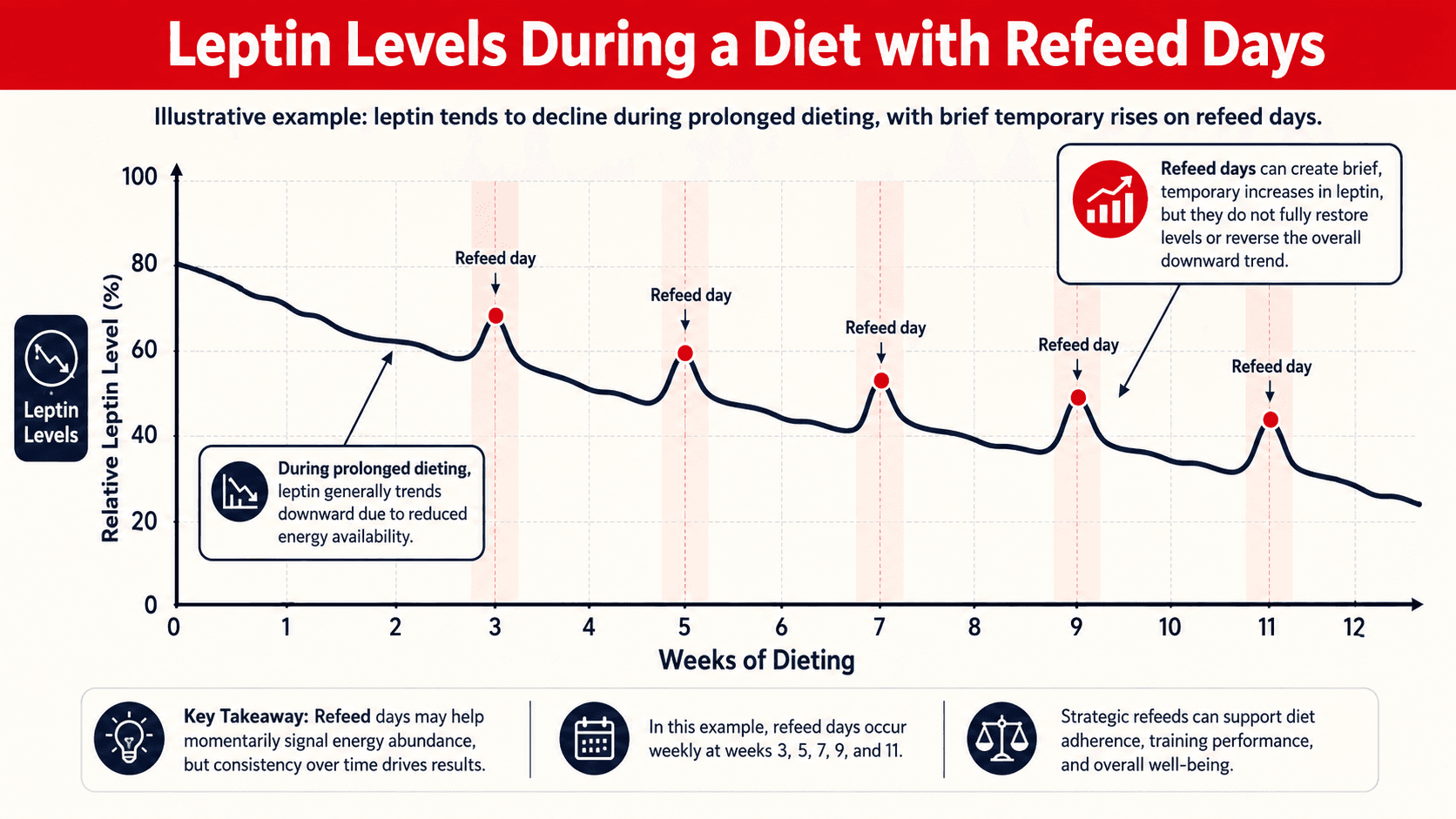
The problem with extended dieting is not just psychological. When you maintain a calorie deficit for weeks or months, your body mounts a coordinated physiological resistance. Leptin, the hormone that communicates your energy status to your brain and plays a central role in regulating appetite and metabolic rate, declines significantly during energy restriction (1). Thyroid hormones decrease, reducing your basal metabolic rate. Cortisol rises, promoting water retention and muscle catabolism. Ghrelin increases, amplifying hunger. Testosterone drops in men. And your non-exercise activity thermogenesis quietly declines as your body subconsciously conserves energy (2). Left unaddressed, these adaptations eventually stall your fat loss entirely, no matter how disciplined you are.
The refeed is designed to interrupt this cascade. But to use it properly, you first need to understand what it is and what it is not.
What Is a Refeed Day
A refeed day is a planned, controlled increase in calorie intake, predominantly from carbohydrates, typically raising your intake to maintenance level or slightly above for one to three days during a fat loss phase. The purpose is to temporarily elevate leptin levels, replenish depleted muscle glycogen stores, support training performance, and provide a psychological break from the monotony and restriction of dieting (3).
The emphasis on carbohydrates is deliberate and important. Research demonstrates that carbohydrates have a significantly greater effect on leptin levels than either fat or protein (4). A three day carbohydrate refeed has been shown to increase plasma leptin concentrations by approximately 28 percent and energy expenditure by approximately 7 percent (4). Increasing dietary fat on a refeed day does not produce the same hormonal effect and may actually blunt the leptin response (4). This is why a refeed is not simply a day of eating more of everything. It is a targeted carbohydrate intervention.

Refeed Day vs Cheat Day vs Diet Break: Know the Difference
One of the biggest mistakes I see is people treating these three strategies as interchangeable. They are not. Each serves a different purpose, operates at a different timescale, and produces very different outcomes. This comparison table breaks down the key differences.
| Feature | Refeed Day | Cheat Day | Diet Break |
|---|---|---|---|
| Duration | 1 to 3 days | Usually 1 day (unplanned) | 7 to 14 days |
| Calorie level | Maintenance calories, structured | Uncontrolled, often 3,000 to 6,000+ calories | Maintenance calories, structured |
| Macro focus | High carbohydrate, moderate protein, low fat | No structure, typically high fat and high carb junk food | Balanced macros at maintenance level |
| Purpose | Boost leptin, replenish glycogen, support training, psychological break | Psychological relief (short term), often leads to guilt and overconsumption | Reverse metabolic adaptation, hormonal recovery, long term sustainability |
| Effect on weekly deficit | Minimal impact if planned correctly within the weekly calorie budget | Can erase an entire week's deficit or more in a single day | Pauses the deficit entirely for 1 to 2 weeks |
| Evidence base | Moderate support, particularly for lean individuals and athletes (3, 5, 6) | No supporting evidence. Frequently counterproductive | Strong support from the MATADOR study and related research (7) |
| My recommendation | Use weekly or fortnightly during active fat loss phases | Avoid entirely. Replace with structured refeeds | Use every 8 to 16 weeks during extended fat loss phases |
A refeed is not a cheat day. Understand this distinction and you will save yourself weeks of wasted progress. A cheat day is unplanned, uncontrolled, and frequently results in calorie intakes so extreme that they erase the entire week's deficit. I have seen clients consume upwards of 5,000 to 6,000 calories on a so called cheat day, primarily from ultra processed, high fat, high sugar foods that do nothing to support the hormonal goals of a refeed. A refeed is planned, measured, predominantly carbohydrate based, and fits within the broader structure of your weekly nutrition plan.
What Does the Science Actually Say
The evidence base for refeeds is growing but still developing, and I think it is important to be honest about where the science is strong and where it is still emerging. The theoretical rationale is well established: carbohydrate intake acutely elevates leptin and thyroid hormone levels, both of which decline during sustained energy restriction (1, 4). However, the practical question of whether short term leptin elevations from a single refeed day translate into meaningful metabolic benefits is more nuanced.
Research suggests that leptin responds quickly to acute changes in energy intake, with levels rising within hours of increased carbohydrate consumption. However, leptin also falls rapidly once energy restriction is resumed, potentially within 12 to 24 hours (1). This means a single refeed day is unlikely to sustainably reverse the leptin decline associated with weeks of dieting. The benefit may be more cumulative and more related to glycogen replenishment, training performance, and psychological adherence than to a single day's hormonal shift.
Where the evidence is strongest is in the slightly longer format of intermittent energy restriction. The landmark MATADOR study compared 16 weeks of continuous dieting against an intermittent approach that alternated two weeks of energy restriction with two weeks at maintenance calories. The intermittent group lost significantly more fat, 12.3 kg versus 8.0 kg, experienced less metabolic adaptation, and retained more of their weight loss at six month follow up (7). While this was a diet break protocol rather than single day refeeds, it provides the strongest evidence that strategic interruptions to energy restriction improve fat loss outcomes.
A 2020 study by Campbell and colleagues examined resistance trained men and women on a seven week energy restriction protocol with five days of deficit followed by two days of carbohydrate refeeding at maintenance. The refeeding group preserved more dry fat free mass than the continuous dieting group, supporting the use of periodic refeeds for muscle preservation during a cut (5). Total fat loss was similar between groups, which is an important point: refeeds do not necessarily accelerate fat loss directly, but they help preserve muscle mass and metabolic rate, which supports better long term outcomes.
How a Refeed Day Affects Your Hormones
This table summarises the key hormonal changes that occur during sustained dieting and how a carbohydrate refeed temporarily counteracts them.
| Hormone | Role in Fat Loss | What Dieting Does | Effect of Carb Refeed |
|---|---|---|---|
| Leptin | Signals satiety to the brain and supports metabolic rate | Declines significantly, increasing hunger and reducing metabolic output | Temporarily elevated by carbohydrate intake within hours (4) |
| Thyroid (T3/T4) | Regulates basal metabolic rate and energy expenditure | Decreases, contributing to reduced calorie burn at rest | Carbohydrate intake helps support thyroid hormone production (2) |
| Cortisol | Stress hormone that promotes water retention and muscle breakdown | Rises during prolonged restriction and calorie deficit stress | May decrease temporarily as energy availability improves |
| Ghrelin | Stimulates appetite and hunger signals | Increases during energy restriction, driving appetite | May be temporarily suppressed by increased food intake and satiety |
| Insulin | Regulates blood sugar and has anti-catabolic effects on muscle | Decreases due to lower carbohydrate and calorie intake | Rises with carbohydrate intake, supporting glycogen storage and reducing muscle breakdown (8) |
| Testosterone | Supports muscle mass, strength, and metabolic health (predominantly in men) | Declines during prolonged energy restriction | May be partially supported by improved energy availability and insulin levels |
How I Structure Refeed Days for My Clients
The way I programme refeeds depends on the individual, their body composition, how long they have been dieting, their training schedule, and their dietary preferences. But there are principles that apply across the board.
The primary adjustment on a refeed day is to increase carbohydrate intake significantly while keeping protein stable and reducing fat intake to accommodate the extra carbohydrate calories. The total calorie intake on a refeed day should sit at approximately your estimated maintenance level, or at most 10 to 15 percent above maintenance. Going significantly higher than this transforms a refeed into a surplus day that can meaningfully impair your weekly deficit.
Protein stays at the same level as your deficit days, typically 1.6 to 2.2 grams per kilogram of bodyweight. For omnivores this means continuing with your usual protein sources. For vegetarians and vegans, this means maintaining your intake from tofu, tempeh, seitan, lentils, soy protein, pea protein, and other plant based proteins. The refeed is about carbohydrates, not about abandoning your protein targets.
Dietary fat should be reduced on refeed days, ideally to around 0.3 to 0.5 grams per kilogram of bodyweight. This is not because fat is bad but because it does not stimulate leptin the way carbohydrates do, and keeping fat low allows you to maximise carbohydrate intake without overshooting your calorie target (4).
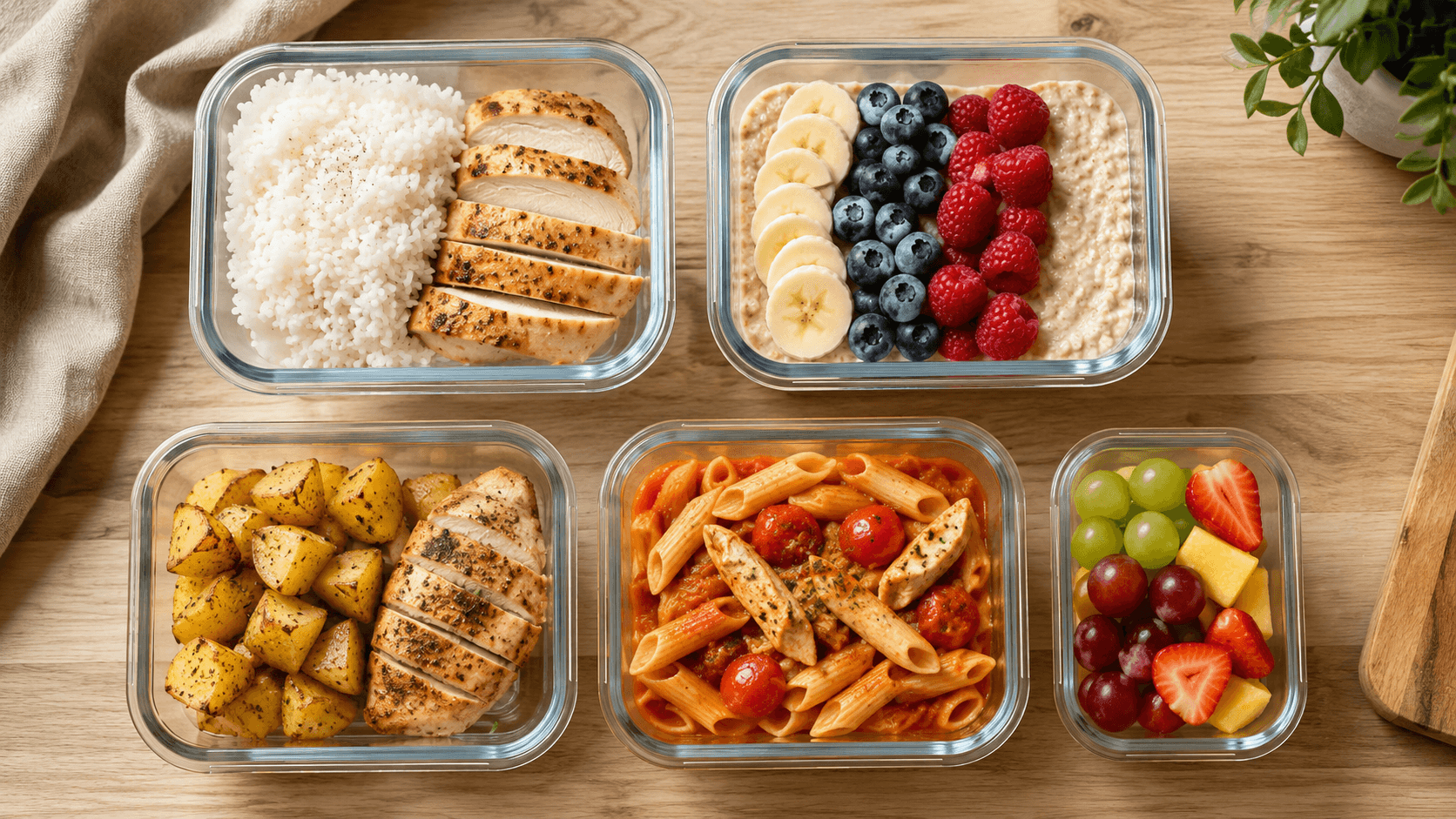
Carbohydrate sources on a refeed day should be predominantly complex, nutrient dense options: rice, oats, potatoes, sweet potatoes, pasta, bread, fruits, beans, lentils, and quinoa. However, there is room for some higher glycemic or more enjoyable options if they help with adherence and psychological relief. The important thing is that the total calorie and macro targets are hit, not that every single gram comes from perfectly clean sources.
Refeed Day in Practice: A Sample Setup
This table shows a practical example of how refeed day macros might differ from a standard deficit day for an 80kg individual. The exact numbers will vary based on your bodyweight, activity level, and deficit size, but the principle remains the same.
| Deficit Day | Refeed Day | Key Difference | |
|---|---|---|---|
| Total Calories | 1,900 kcal | 2,500 kcal | Increased to approximately maintenance |
| Protein | 160g (640 kcal) | 160g (640 kcal) | Stays the same. Non-negotiable |
| Fat | 65g (585 kcal) | 35g (315 kcal) | Reduced to make room for carbs |
| Carbohydrates | 170g (680 kcal) | 385g (1,540 kcal) | More than doubled. This is the primary driver of the refeed |
The numbers above are illustrative. Your exact setup will depend on your specific deficit, maintenance calories, bodyweight, and training demands. But the pattern is always the same: protein holds steady, fat comes down, and carbohydrates go up significantly.
When and How Often to Use Refeed Days
The frequency of refeeds should increase as your diet progresses and as you get leaner. In the early weeks of a fat loss phase, when body fat is higher and metabolic adaptation is minimal, you may not need refeeds at all. As the diet extends beyond four to six weeks and the adaptive responses become more pronounced, introducing refeeds becomes increasingly valuable.
As a general framework, I tend to programme refeeds as follows. In the first four weeks of a fat loss phase, I typically do not include scheduled refeeds unless the client is already quite lean or coming off a previous diet phase. From weeks five to eight, I introduce one refeed day per week, usually placed on the day before or the day of the most demanding training session to maximise glycogen availability and performance. From weeks nine to twelve and beyond, I may increase to two refeed days per week for leaner clients or those showing signs of significant metabolic fatigue, or transition to a full one to two week diet break if the adaptive responses are pronounced enough to warrant it.
Time your refeed day on the day before or the day of your hardest training session. The replenished glycogen stores will directly benefit your training volume and intensity, which in turn supports muscle preservation and metabolic rate. For most people this means placing the refeed before a heavy lower body or full body session.
Refeed Frequency Guide by Diet Phase and Body Fat Level
| Diet Phase | Body Fat Level | Refeed Frequency | Notes |
|---|---|---|---|
| Early (weeks 1 to 4) | Men: above 20%. Women: above 30% | None or 1 every 2 weeks | Adaptation is minimal. Focus on establishing the deficit |
| Mid (weeks 5 to 8) | Men: 15 to 20%. Women: 25 to 30% | 1 per week | Leptin and thyroid start to decline. Weekly refeeds support adherence and performance |
| Late (weeks 9 to 12) | Men: 12 to 15%. Women: 20 to 25% | 1 to 2 per week | Adaptive responses more pronounced. More frequent refeeds maintain metabolic output |
| Extended (12+ weeks) | Men: below 12%. Women: below 20% | 2 per week or full diet break | Consider a 1 to 2 week maintenance phase rather than continued restriction |
The Most Common Refeed Mistakes I See
Treating the refeed as a cheat day is by far the most common error. I cannot emphasise this enough. The moment you lose control and eat ad libitum on a refeed day, you are no longer refeeding. You are bingeing. I have seen clients consume 4,000 to 5,000 calories on what was supposed to be a 2,500 calorie refeed, wiping out three to four days of deficit in a single sitting. The refeed must be tracked and controlled with the same precision as your deficit days.
Increasing fat instead of carbohydrates defeats the purpose. Pizza, burgers, ice cream, and fried food are high in fat, not high in carbohydrate relative to their calorie content. If your refeed day is dominated by these foods, you will overshoot your calorie target while underdelivering on the carbohydrate intake that drives the hormonal benefits. Choose carbohydrate dense, relatively low fat foods: rice, pasta, potatoes, oats, fruit, bread, bagels, rice cakes, cereal, and similar options.

Skipping protein on refeed days is a mistake I see frequently. Some people become so focused on increasing carbohydrates that they neglect their protein targets. Protein should not change on a refeed day. It remains at 1.6 to 2.2 grams per kilogram of bodyweight from whatever sources suit your dietary preference, whether that is chicken, fish, eggs, Greek yoghurt, tofu, tempeh, seitan, lentils, or protein shakes made with whey, soy, or pea protein.
Using refeeds too early in a diet when they are not yet needed wastes a valuable tool. If you are in week two of a fat loss phase and already introducing weekly refeeds, you are reducing your weekly calorie deficit by roughly 15 percent with no physiological justification. Refeeds become more valuable as metabolic adaptation increases. Save them for when you need them.
Top Tips: Making Refeed Days Work for You
Plan your refeed day in advance, including the exact calorie and macro targets. Write out your meals for the day the night before. Know what you are going to eat, when you are going to eat it, and how it fits within your targets. Spontaneous refeeds almost always become cheat days.
Keep fat intake low on refeed days, ideally 0.3 to 0.5g per kilogram of bodyweight. This is not about demonising fat. It is about maximising the carbohydrate intake that drives the hormonal and glycogen benefits of the refeed within a defined calorie ceiling.
Place your refeed on or before your most demanding training day. The glycogen replenishment from the refeed will fuel better training, which supports muscle preservation and long term metabolic health.
Do not weigh yourself the morning after a refeed. Increased carbohydrate intake causes temporary water retention. Each gram of stored glycogen binds approximately 3 grams of water. You will be heavier the day after a refeed and this is expected and temporary. Resume weighing two days later or simply continue with your weekly average.

If you are vegetarian or vegan, refeeds can actually be easier to structure. Many plant based staples are naturally high in carbohydrates and relatively low in fat: rice, oats, potatoes, pasta, bread, beans, lentils, fruit, and quinoa. Pair these with your usual plant protein sources and you have a refeed that hits all the right macros without any complicated food swaps.
Track your refeed day with the same precision as your deficit days. Use a food scale. Log every meal. The refeed is a strategic tool, not a holiday from discipline. Controlled intake is what separates a productive refeed from a counterproductive binge.
Expect to feel slightly bloated and fuller the day after a refeed. This is normal and temporary. The glycogen and water stored in your muscles will actually make you look and feel fuller in a positive way during your training sessions over the following day or two.
Increase refeed frequency as your diet progresses and you get leaner. The leaner you are and the longer you have been dieting, the more aggressive the adaptive hormonal responses become and the more benefit you will derive from strategic refeeds. Adjust frequency every four to six weeks based on your progress, energy levels, and training performance.
The Bottom Line
Refeed days are not an excuse to overeat. They are a structured, evidence informed strategy for managing the hormonal and metabolic consequences of sustained calorie restriction. When used correctly, with the right macronutrient composition, at the right frequency, and with the same tracking discipline you apply to your deficit days, refeeds can help preserve muscle mass, support training performance, improve dietary adherence, and potentially attenuate the metabolic adaptation that stalls fat loss over time.
The MATADOR study and related research have shown that strategic interruptions to energy restriction can produce superior fat loss outcomes compared to continuous dieting. Whether you use single day refeeds, two day carbohydrate reloads, or periodic one to two week diet breaks depends on your individual circumstances, your body composition, your training demands, and how far into your fat loss phase you are. The key is that these tools exist and they work, but only if you use them with the same discipline and precision that you bring to your deficit days.
If you want help building a fat loss plan that includes intelligently structured refeeds and diet breaks tailored to your body, your training, and your dietary preferences, get in touch through trperformancecoaching.com. I work one-to-one with clients online globally. Whether you are an omnivore, vegetarian, vegan, or somewhere in between, I will build a nutrition and training programme that gets you results without destroying your metabolism, your muscle mass, or your sanity in the process.
Work with Me
Get a personalised coaching plan built around your goals, your schedule, and your life.
Enquire NowReferences
- Klok MD, Jakobsdottir S, Drent ML. The role of leptin and ghrelin in the regulation of food intake and body weight in humans: a review. Obesity Reviews. 2007; 8(1): 21-34.
- Trexler ET, Smith-Ryan AE, Norton LE. Metabolic adaptation to weight loss: implications for the athlete. Journal of the International Society of Sports Nutrition. 2014; 11(1): 7.
- Peos JJ, Norton LE, Helms ER, Galpin AJ, Fournier P. Intermittent dieting: theoretical considerations for the athlete. Sports Medicine. 2019; 49(5): 691-703.
- Dirlewanger M, di Vetta V, Guenat E, et al. Effects of short-term carbohydrate or fat overfeeding on energy expenditure and plasma leptin concentrations in healthy female subjects. International Journal of Obesity. 2000; 24(11): 1413-1418.
- Campbell BI, Aguilar D, Colenso-Semple LM, et al. Intermittent energy restriction attenuates the loss of fat free mass in resistance trained individuals. A randomized controlled trial. Journal of Functional Morphology and Kinesiology. 2020; 5(1): 19.
- Moura RF, De Moraes WMAM, De Castro BM, et al. Carbohydrate refeed does not modify GVT-performance following energy restriction in bodybuilders. Clinical Nutrition ESPEN. 2021; 43: 308-316.
- Byrne NM, Sainsbury A, King NA, Hills AP, Wood RE. Intermittent energy restriction improves weight loss efficiency in obese men: the MATADOR study. International Journal of Obesity. 2018; 42(2): 129-138.
- Jager R, Kerksick CM, Campbell BI, et al. International Society of Sports Nutrition position stand: protein and exercise. Journal of the International Society of Sports Nutrition. 2017; 14: 20.
- Sumithran P, Prendergast LA, Delbridge E, et al. Long-term persistence of hormonal adaptations to weight loss. New England Journal of Medicine. 2011; 365(17): 1597-1604.
- Rosenbaum M, Leibel RL. Adaptive thermogenesis in humans. International Journal of Obesity. 2010; 34(Suppl 1): S47-S55.