
Most people’s first meal of the day is almost entirely devoid of protein. Toast with jam. A bowl of cereal with milk. A croissant grabbed on the way to work. A banana and a coffee. Maybe a granola bar from the desk drawer at 10am. These are the breakfasts I see on food diaries week after week when new clients come to me. They are not terrible foods. But they share a common problem. They are overwhelmingly carbohydrate and fat based with almost no meaningful protein content. And that one habit, repeated every single morning, is quietly undermining their fat loss, their muscle building, their energy levels, and their ability to control their appetite for the rest of the day.
Protein at breakfast is one of the simplest and most impactful changes I make to a client’s nutrition. It does not require fancy recipes or expensive ingredients. It does not require waking up an hour earlier. But the difference it makes to how you feel, how you perform, and how your body composition responds over weeks and months is genuinely significant. The science backs this up convincingly.

What a Low Protein Breakfast Actually Does to Your Body
When your first meal of the day is predominantly carbohydrate based and low in protein, you trigger a cascade of physiological events that work against your goals for the entire morning and often well into the afternoon.
The first issue is blood sugar instability. A breakfast high in refined carbohydrates and low in protein causes a rapid spike in blood glucose followed by a sharp crash. That crash, which typically hits between 90 minutes and two hours after eating, brings with it hunger, irritability, brain fog, and cravings for more sugar or starchy food. Research published in the American Journal of Clinical Nutrition demonstrated that high glycaemic meals triggered significantly greater activity in brain regions associated with craving and reward compared to low glycaemic alternatives (1). Your 10am biscuit habit is not a lack of discipline. It is a predictable physiological response to a poorly constructed breakfast.
The second issue is appetite dysregulation across the day. When you start the day with insufficient protein, you spend the rest of the day chasing satiety. You are hungrier at mid morning. You are more likely to overeat at lunch. You snack more in the afternoon. And by evening, you have consumed significantly more total calories than you would have if breakfast had set you up properly. A landmark study published in the journal Obesity found that a high protein breakfast, containing approximately 35 grams of protein, significantly reduced evening snacking on high fat and high sugar foods compared to a low protein breakfast or no breakfast at all (2). The first meal of the day sets the hormonal and appetite trajectory for the next 12 to 16 hours. Getting it wrong creates a domino effect that is very difficult to correct later.
The third issue is the missed opportunity for muscle protein synthesis. After an overnight fast of eight or more hours, your body is in a catabolic state. Muscle protein breakdown has been occurring while you slept and the amino acid pool in your blood is depleted. Consuming protein at breakfast provides the amino acids needed to switch your body back into an anabolic state and stimulate muscle protein synthesis. Research published in the Journal of Nutrition found that distributing protein intake evenly across meals, including a substantial portion at breakfast, resulted in 25 percent greater muscle protein synthesis over 24 hours compared to a pattern where the same total protein was skewed heavily toward the evening meal (3). Every morning you eat a low protein breakfast, you are missing one of the most effective windows for muscle building and repair.

How to Build a Breakfast That Actually Supports Your Goals
The fix is not complicated. You need to include a meaningful source of protein in your first meal of the day. I am not asking you to cook a three course meal at 6am. I am asking you to make one deliberate change to what is already a daily habit. The target I set for most clients is a minimum of 25 to 40 grams of protein at breakfast. This is the threshold that the research consistently identifies as sufficient to maximise the muscle protein synthesis response and meaningfully improve satiety across the morning (4).
What 30 Grams of Protein at Breakfast Actually Looks Like
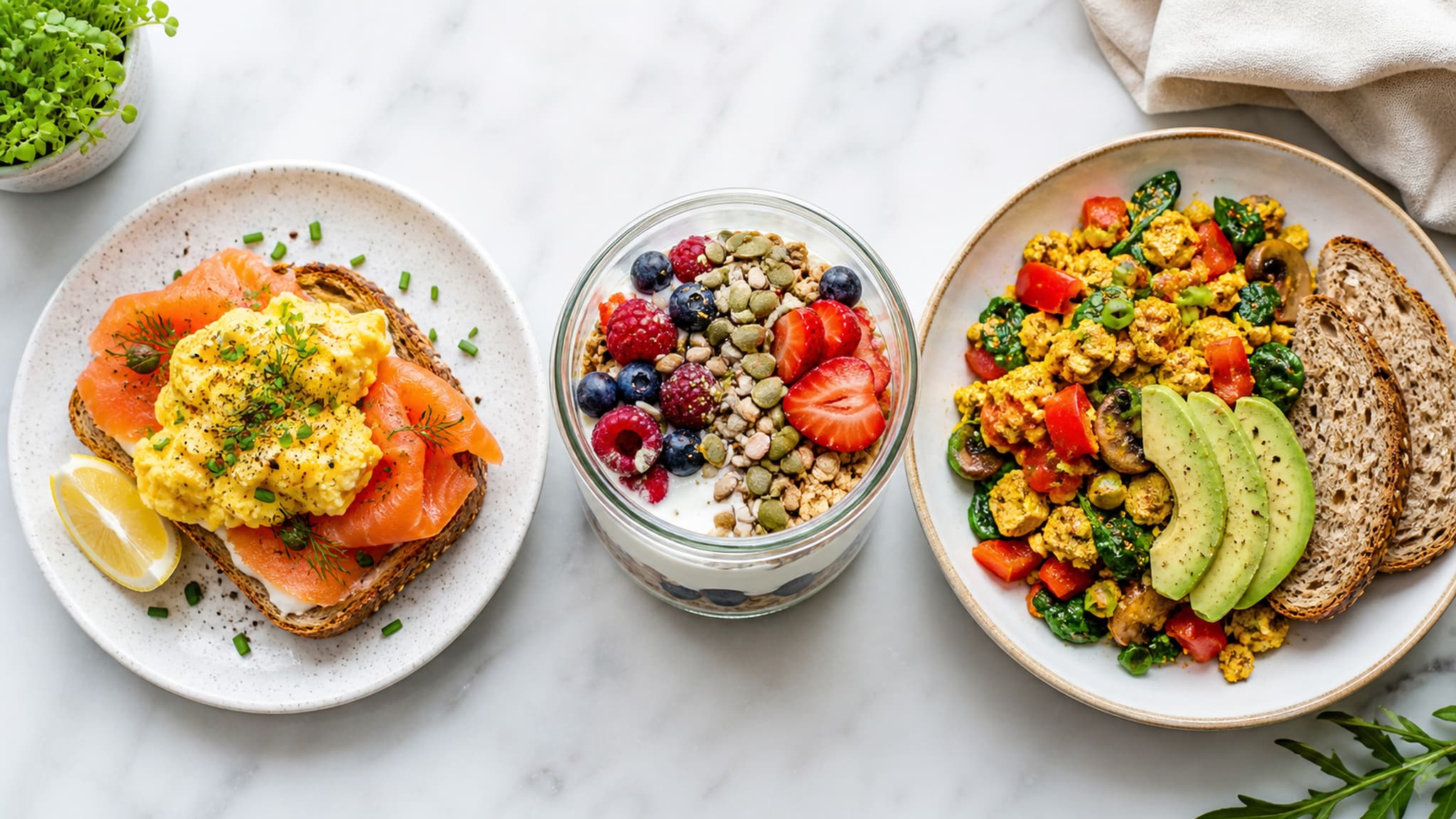
For omnivore clients, 30 grams of protein at breakfast is surprisingly easy to achieve. Three eggs scrambled or poached on a slice of toast provides roughly 21 grams from the eggs alone. Add a side of smoked salmon and you are comfortably over 30. Two eggs with a couple of turkey rashers and a slice of wholemeal toast hits the mark. A bowl of Greek yoghurt with fruit and a scoop of whey protein takes you past 35 grams in under two minutes of preparation.
For vegetarian clients, eggs remain the simplest and most versatile option. A three egg omelette with spinach and feta. Scrambled eggs on toast with a side of cottage cheese. Greek yoghurt with nuts, seeds, and a drizzle of honey. Overnight oats made with milk, protein powder, chia seeds, and berries, prepared the night before and ready to grab from the fridge. Paneer scramble with peppers and onions, spiced with turmeric and cumin, is another excellent option that my vegetarian clients love.
For vegan clients, hitting 30 grams at breakfast requires slightly more planning but is entirely achievable. A tofu scramble with vegetables and nutritional yeast is one of the best options, providing around 20 to 25 grams of protein from a block of firm tofu. Pair it with a slice of seeded bread or a handful of edamame and you are there. A smoothie made with soy milk, a scoop of pea protein, a banana, and a tablespoon of peanut butter delivers over 30 grams and takes three minutes to prepare. Overnight oats made with soy milk, soy yoghurt, chia seeds, and protein powder work brilliantly as a grab and go option. Chia pudding made with soy milk and topped with nuts and berries is another strong choice.
The Overnight Prep Strategy
The most common objection I hear is time. People feel they do not have enough of it in the morning to prepare a proper breakfast. I understand that. But many high protein breakfasts require zero morning preparation if you do the work the night before. Overnight oats take five minutes to assemble in the evening and are ready to eat straight from the fridge. Hard boiled eggs can be batch cooked in advance and kept in the fridge for three to four days. A smoothie can be assembled from pre-portioned freezer bags of fruit, protein powder, and seeds that just need liquid and a blender. Greek yoghurt with toppings takes less than a minute to put together. Even a tofu scramble can be prepped in bulk and reheated in the microwave in two minutes.
The time barrier is almost always a perception issue rather than a genuine logistical problem. Once clients build the habit and see how different their morning energy and appetite feel, the objection disappears completely. A study published in the Journal of the American Dietetic Association found that individuals who regularly consumed breakfast had significantly better overall diet quality and were more likely to meet recommended intakes of key nutrients compared to breakfast skippers (5). The habit itself has compounding benefits beyond just the protein content.

What About People Who Are Not Hungry in the Morning
This comes up frequently and it is a valid concern. Many people genuinely do not feel hungry when they wake up. There are a few reasons for this. If you eat a large meal late at night, your appetite will naturally be suppressed the next morning. If you have been skipping breakfast for years, your body has adapted to that pattern and the hunger signals have dimmed. If you drink a large coffee first thing, the caffeine temporarily suppresses appetite.
My advice to clients who are not hungry in the morning is to start small and build gradually. You do not need to eat a full meal at 6am. A protein shake or a small pot of yoghurt within the first hour or two of waking is enough to begin reintroducing the habit. Over the course of two to three weeks, your body adapts and morning appetite returns. Research on meal frequency and appetite regulation has shown that the body adjusts hunger signalling to match habitual meal patterns within a relatively short adaptation period (6). If you have spent years without breakfast, your body is not broken. It has simply adapted to the pattern you have given it. Change the pattern and the appetite will follow.
Protein at Breakfast During a Fat Loss Phase
If you are currently in a calorie deficit trying to lose body fat, protein at breakfast becomes even more critical. During a deficit, the risk of muscle loss increases, appetite is heightened, and the temptation to overeat later in the day is amplified. A high protein breakfast addresses all three of these issues simultaneously. It stimulates muscle protein synthesis to protect lean mass. It blunts hunger hormones and keeps you satisfied through the morning. And it reduces the likelihood of impulsive food choices later in the day.
A controlled trial published in the American Journal of Clinical Nutrition found that participants who consumed a higher protein breakfast during a calorie restricted period experienced significantly greater reductions in body fat and better preservation of lean body mass compared to those who consumed an isocaloric breakfast with lower protein content (7). The calories were the same. The results were meaningfully different. That is the power of protein placement in a fat loss context.
Your Morning Sets the Tone for Everything That Follows
I have coached hundreds of clients through body transformations and if I had to pick one nutritional habit that produces the most immediate and noticeable improvement in how someone feels and performs, it would be adding protein to breakfast. The change in energy is obvious within the first week. The reduction in mid morning cravings is dramatic. The downstream effect on total daily calorie intake and food choices is consistent and measurable. It is one of the lowest effort, highest impact changes you can make.
You do not need to overhaul your entire morning routine. You do not need expensive ingredients or complicated recipes. You need eggs, Greek yoghurt, tofu, protein powder, or any of the other options I have outlined in this article. You need five minutes of preparation, or zero if you prep the night before. And you need to commit to making it a non-negotiable part of your day for at least three weeks until it becomes automatic.
If you want a complete nutrition plan with your breakfast, lunch, dinner, and snacks structured around your protein targets, your calorie goals, your training schedule, and the foods you actually enjoy eating, that is exactly what I build for every client I work with. I coach one-to-one online globally. Whether you eat meat, are vegetarian, vegan, or somewhere in between, I will create a plan that starts your day right and carries that momentum through to the evening. Get in touch and let me show you what a properly fuelled morning looks like.
Work with Me
Get a personalised coaching plan built around your goals, your schedule, and your life.
Enquire NowReferences
- Lennerz BS, Alsop DC, Holsen LM, Stern E, Rojas R, Ebbeling CB, Goldstein JM, Ludwig DS. Effects of dietary glycemic index on brain regions related to reward and craving in men. American Journal of Clinical Nutrition. 2013; 98(3): 641-647.
- Leidy HJ, Ortinau LC, Douglas SM, Hoertel HA. Beneficial effects of a higher-protein breakfast on the appetitive, hormonal, and neural signals controlling energy intake regulation in overweight/obese, breakfast-skipping, late-adolescent girls. American Journal of Clinical Nutrition. 2013; 97(4): 677-688.
- Mamerow MM, Mettler JA, English KL, Casperson SL, Arentson-Lantz E, Sheffield-Moore M, Layman DK, Paddon-Jones D. Dietary protein distribution positively influences 24-h muscle protein synthesis in healthy adults. Journal of Nutrition. 2014; 144(6): 876-880.
- Schoenfeld BJ, Aragon AA. How much protein can the body use in a single meal for muscle-building? Implications for daily protein distribution. Journal of the International Society of Sports Nutrition. 2018; 15(1): 10.
- Deshmukh-Taskar PR, Nicklas TA, O’Neil CE, Keast DR, Radcliffe JD, Cho S. The relationship of breakfast skipping and type of breakfast consumption with nutrient intake and weight status in children and adolescents: the National Health and Nutrition Examination Survey 1999-2006. Journal of the American Dietetic Association. 2010; 110(6): 869-878.
- Leidy HJ, Armstrong CL, Tang M, Mattes RD, Campbell WW. The influence of higher protein intake and greater eating frequency on appetite control in overweight and obese men. Obesity. 2010; 18(9): 1725-1732.
- Layman DK, Evans EM, Erickson D, Seyler J, Weber J, Bagshaw D, Griel A, Psota T, Kris-Etherton P. A moderate-protein diet produces sustained weight loss and long-term changes in body composition and blood lipids in obese adults. Journal of Nutrition. 2009; 139(3): 514-521.