
What You See in Your Mind Shapes What Your Body Does Next
Visualisation as a performance tool is one of the most consistently underused and consistently misunderstood practices available to anyone pursuing a meaningful physical or personal transformation. The misunderstanding runs in two opposite directions at once. On one side are the people who dismiss it entirely as wishful thinking, the kind of thing motivational speakers talk about that bears no relationship to the hard physiological work of actual change. On the other side are the people who have encountered it in a purely law-of-attraction context and believe that picturing a result with sufficient clarity and emotion will somehow produce it without the commensurate effort and programme. Both groups are wrong, for different reasons, and both are missing something that the science, the elite sport research, and the evidence from the highest performers across multiple domains support with unusual consistency.
The accurate understanding of visualisation sits between these two positions. It is not magic, and it does not replace training. What it does is measurably enhance the effectiveness of training, compress the timeline of skill and performance acquisition, build and reinforce the psychological identity of the person doing the work, and maintain the motivational architecture of a long programme through the inevitable periods when external feedback is scarce. These are not small claims. They are documented, replicated, and grounded in a neuroscience that is considerably more rigorous than either the sceptics or the mystifiers of the practice tend to acknowledge.
“The mind is the athlete. The body is simply the means it uses to run faster, jump higher, hit further.”
— Bryce Courtenay
What the Brain Cannot Tell the Difference Between
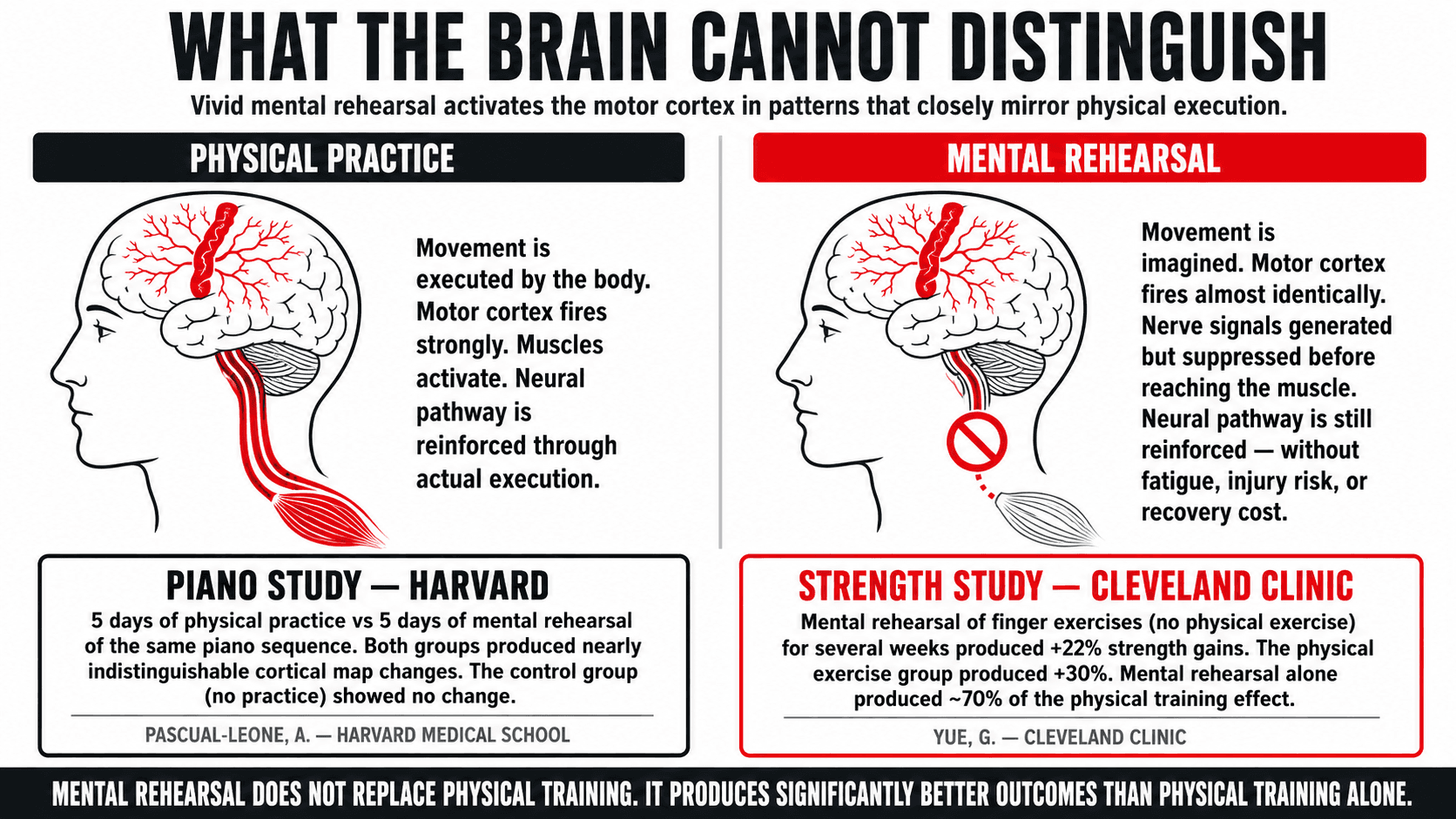
The neurological foundation of visualisation rests on a finding that is counterintuitive enough that it is worth stating twice: when a person vividly imagines performing a physical action, the motor cortex activates in patterns that closely mirror those produced by the actual physical performance of that action. The brain, under conditions of vivid, focused mental rehearsal, does not distinguish cleanly between imagined and actual movement at the level of motor programming. The neural pathway that organises and coordinates the movement is engaged by both, and the engagement by mental rehearsal, while less intense than physical practice, is sufficient to produce measurable neurological change.
Alvaro Pascual-Leone's piano study at Harvard Medical School is among the most cited demonstrations of this principle in the neuroscience literature. In a controlled experiment, Pascual-Leone divided participants into three groups: one group physically practised a simple piano sequence daily for five days, a second group mentally rehearsed the same sequence without touching the piano for the same period, and a third group received no practice of any kind. Brain scanning before and after the five days showed that the mental rehearsal group produced cortical map changes that were almost indistinguishable from those produced by the physical practice group. Both groups had expanded the neural territory allocated to the finger movements involved. The group that had not practised showed no change. Mental rehearsal, done with sufficient vividness and attention, produces genuine neuroplastic change (1).
Guang Yue's research at the Cleveland Clinic extended this finding into the domain of physical strength with results that were striking enough to attract considerable attention beyond academic neuroscience. Yue's study showed that participants who mentally rehearsed finger strength exercises for a period of weeks, without performing any physical exercise at all, produced strength gains of approximately twenty-two percent compared to a control group that produced none. A second group performing the physical exercises produced gains of thirty percent. The mental rehearsal group produced roughly seventy percent of the physical training effect without moving a muscle (2).
The mechanism is now reasonably well understood. Vivid mental rehearsal activates the same neuromuscular pathways that physical practice uses. The nerve signals to the muscle are generated but suppressed before they reach the level of producing overt movement. The myelination process discussed in the neuroplasticity article in this series begins in response to this activation. The pathway is being strengthened, the movement pattern is being refined, and the motor programme is being rehearsed and consolidated, all without the fatigue, the injury risk, and the recovery cost of physical practice. This does not mean that mental rehearsal replaces physical training. It means that mental rehearsal, combined with physical training, produces significantly better outcomes than physical training alone.
Key Insight: Every elite performer you have ever admired who seems to execute under pressure with a composure that appears almost unnatural has, with near-universal consistency, a visualisation practice behind it. The composure under pressure is not temperamental. It is trained. They have been to the moment thousands of times in their minds before they arrive at it in the arena. By the time the event arrives, it is not new. It is a repetition.
The Gold Environment: How the World Around You Can Hold Your Vision When Your Mind Is Elsewhere
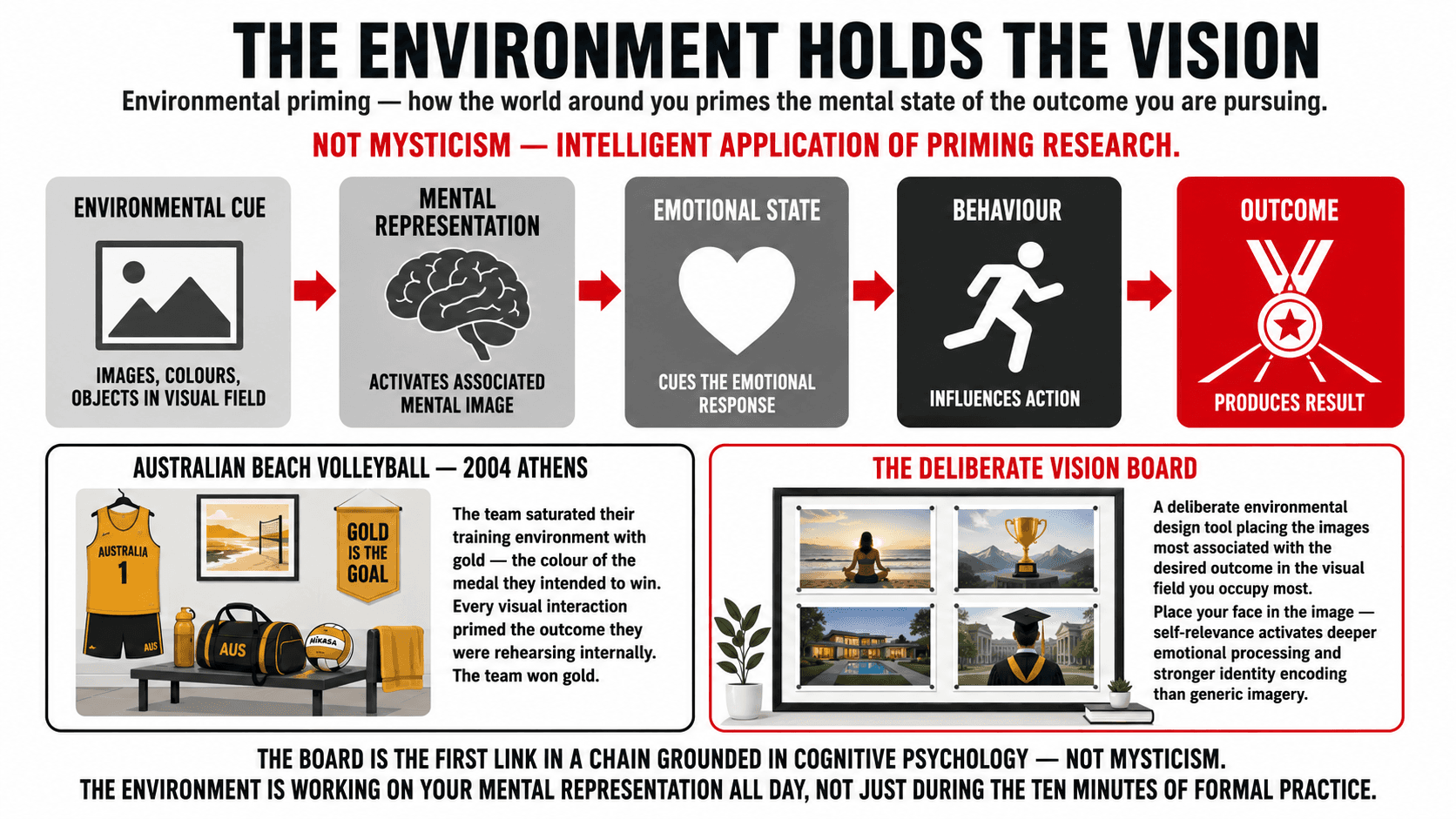
One of the most compelling examples of environmental visualisation in elite sport comes from the approach that Rhonda Byrne documented in The Secret, describing how the Australian women's beach volleyball team prepared for the 2004 Athens Olympics. The athletes, coached in the application of deliberate visualisation practices, saturated their environment with gold. Their training spaces, their personal environments, their equipment bags, the objects around them in daily life were deliberately chosen or decorated in gold, the colour of the medal they intended to win. Every time they looked up from a meal, reached for their kit, or moved through their environment, they received a visual stimulus that was a direct sensory cue for the outcome they were rehearsing internally. The team won gold (3).
This is not a mystical practice. It is an intelligent application of the priming research that has been accumulating in social and cognitive psychology for decades. Environmental cues reliably activate associated mental states, emotional responses, and behavioural tendencies without conscious awareness or effort. The person who fills their physical environment with cues for the outcome they are pursuing is not engaging in wishful thinking. They are engineering their own priming environment, ensuring that the stimuli they encounter most frequently are the ones most likely to activate the mental and emotional states associated with the performance they are building toward.
The vision board, which has accumulated a somewhat dismissive cultural reputation, is the most accessible version of this same principle. The dismissal is based on a misunderstanding of how it is meant to work. A vision board is not a wish list posted to the universe. It is a deliberate environmental design tool that places the images most associated with the desired outcome in the visual field that the person occupies most frequently. The images activate the associated mental representations. The mental representations cue the emotional states. The emotional states influence the behaviour. The behaviour produces the outcome. The board is the first link in a chain that is thoroughly grounded in cognitive psychology, not in mysticism.
The specific practice of placing the face on a desired outcome image, a competition podium, a healthy physique photograph, a professional achievement, is a version of the same principle taken one step further. The image now contains the self in the desired state rather than simply representing the state in the abstract. The brain processes this self-in-the-desired-state image differently from a generic image of the same outcome. The self-relevance activates deeper emotional processing, stronger identity encoding, and more durable motivational response. It makes the outcome personal in a way that generic imagery cannot fully replicate.
Visualisation Across Domains: The Same Principle Applied to Sport, Health, and Life
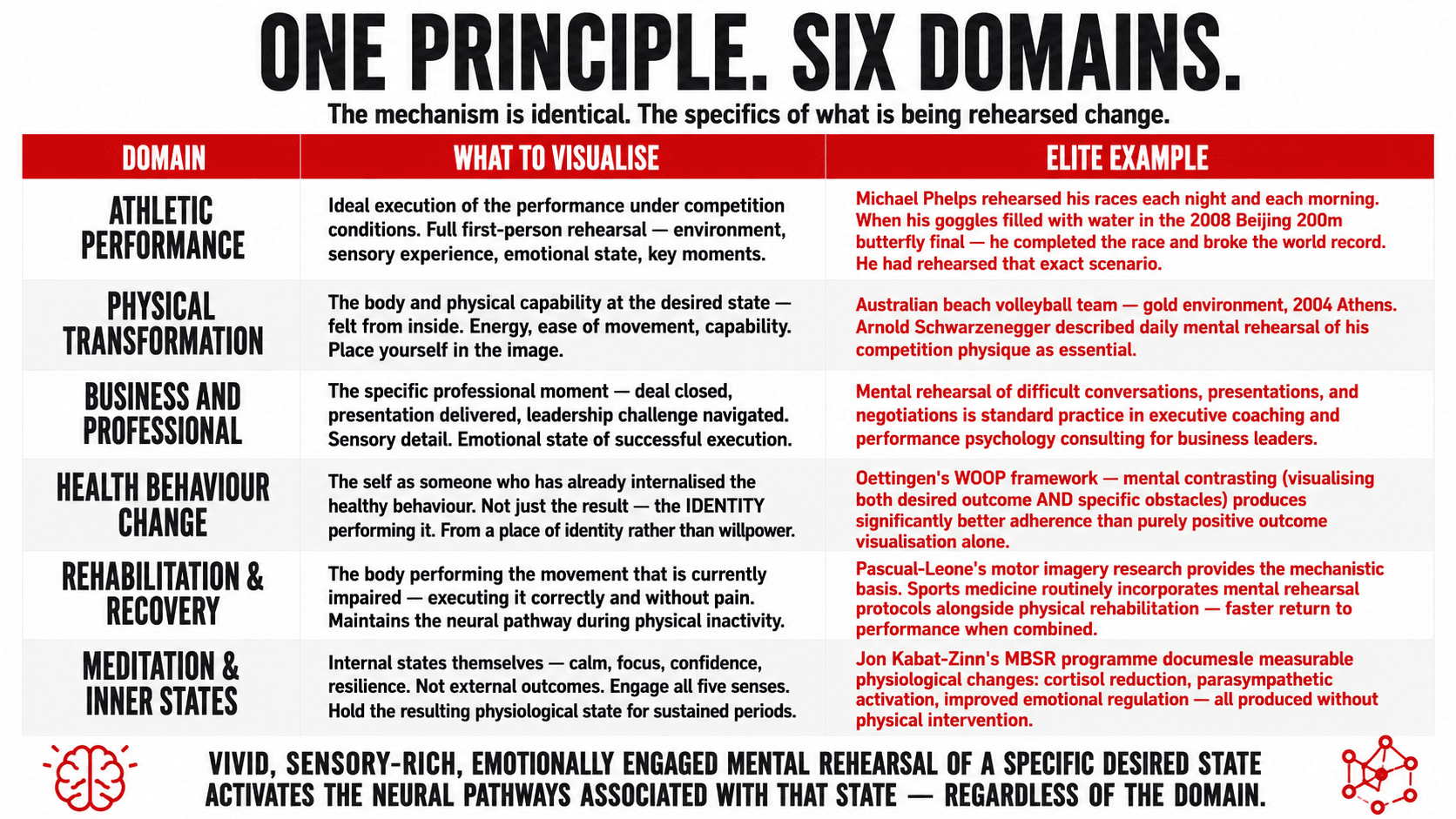
The principles that produce measurable performance enhancement in elite sport operate through the same neurological mechanisms in every other domain where a person is trying to close the gap between their current state and a desired outcome. The visualisation practice of the Olympic athlete and the visualisation practice of the person trying to transform their body, build a business, or change a deep-seated behaviour pattern are not different in kind. They are different in the specifics of what is being rehearsed. The table below maps the principle across six domains.
TABLE: Visualisation Applied Across Six Domains — Focus, Practice, and Elite Examples
| Domain | What to Visualise | Specific Practice | Known Examples and Evidence |
|---|---|---|---|
| Athletic Performance | The ideal execution of the performance under competition conditions | Mentally rehearse the full performance from first-person perspective, including the environment, the sensory experience, the emotional state, and the specific physical execution of the key moments. Rehearse under adversity as well as ideal conditions. | Michael Phelps rehearsed his races in such detail each night before sleep, and each morning on waking, that his coach Bob Bowman described his mental rehearsal as the actual training and the pool sessions as the confirmation. When Phelps' goggles filled with water during the 2008 Beijing 200m butterfly final, he completed the race and broke the world record. He had rehearsed that exact scenario. |
| Physical Transformation | The body and physical capability at the desired state, experienced from the inside rather than observed from outside | Visualise the feeling of moving in the transformed body: the energy, the ease of movement, the physical capability. Add images to the environment that represent the desired physical state. Place yourself, literally your face on the image, in the desired outcome. Review this daily during the programme. | The Australian beach volleyball team's gold environment practice is the most documented example. Elite bodybuilders have described environmental visualisation as a standard preparation tool for competition for decades. Arnold Schwarzenegger described his daily mental rehearsal of his competition physique as essential to his training. |
| Business and Professional Goals | The specific professional outcome being pursued: the deal closed, the presentation delivered, the leadership challenge navigated | Visualise the successful execution of the key professional moment in precise sensory detail. What does the room look like? Who is present? What does the conversation sound like? Rehearse the emotional state of the successful execution, not just the visual outcome. Place representations of the professional goal in the daily environment. | The practice of mentally rehearsing difficult conversations, presentations, and negotiations before high-stakes professional events is documented across executive coaching literature and is standard practice in performance psychology consulting for business leaders. |
| Health Behaviour Change | The self as someone who has already internalised the healthy behaviour: the identity, not just the outcome | Visualise not just the result of the healthy behaviour but the identity of the person performing it. See yourself training as someone who simply does this, not as someone forcing themselves through it. Visualise the nutritional choice being made easily and naturally from a place of health identity rather than willpower. | Research on mental contrasting, Oettingen's WOOP framework, shows that visualising both the desired health outcome and the specific obstacles between the current state and that outcome produces significantly better adherence than purely positive outcome visualisation alone. |
| Rehabilitation and Recovery | The body performing the movement that is currently impaired, executing it correctly and without pain | During periods of injury or enforced rest, mentally rehearse the physical movements that cannot currently be performed. This maintains the neural pathways for the movement pattern during the period of physical inactivity. Visualise full recovery and the return to full training with specific sensory detail. | Pascual-Leone's motor imagery research provides the mechanistic basis. Sports medicine and physiotherapy now routinely incorporate mental rehearsal protocols alongside physical rehabilitation, with research showing faster return to performance when combined with physical therapy. |
| Meditation and Inner States | The emotional and physiological state of calm, focus, confidence, or resilience rather than an external outcome | Use visualisation as a meditation practice, not to rehearse external outcomes but to deliberately generate internal states. Picture a place, person, or experience that reliably produces calm or confidence, engage all five senses in the visualisation, and hold the resulting physiological state for a sustained period. This builds the neural pathway for eliciting that state on demand. | Jon Kabat-Zinn's MBSR programme, and the extensive mindfulness research built on it, documents the measurable physiological changes produced by sustained mental imagery practice: cortisol reduction, parasympathetic activation, and improved emotional regulation, all produced without physical intervention of any kind. |
| The domain changes. The mechanism is the same. Vivid, sensory-rich, emotionally engaged mental rehearsal of a specific desired state activates the neural pathways associated with that state, strengthens them through repetition, and builds the neurological and psychological architecture that makes the real-world execution of the desired state more available. | |||
The Quality of the Image: Why Vague Visualisation Produces Vague Results
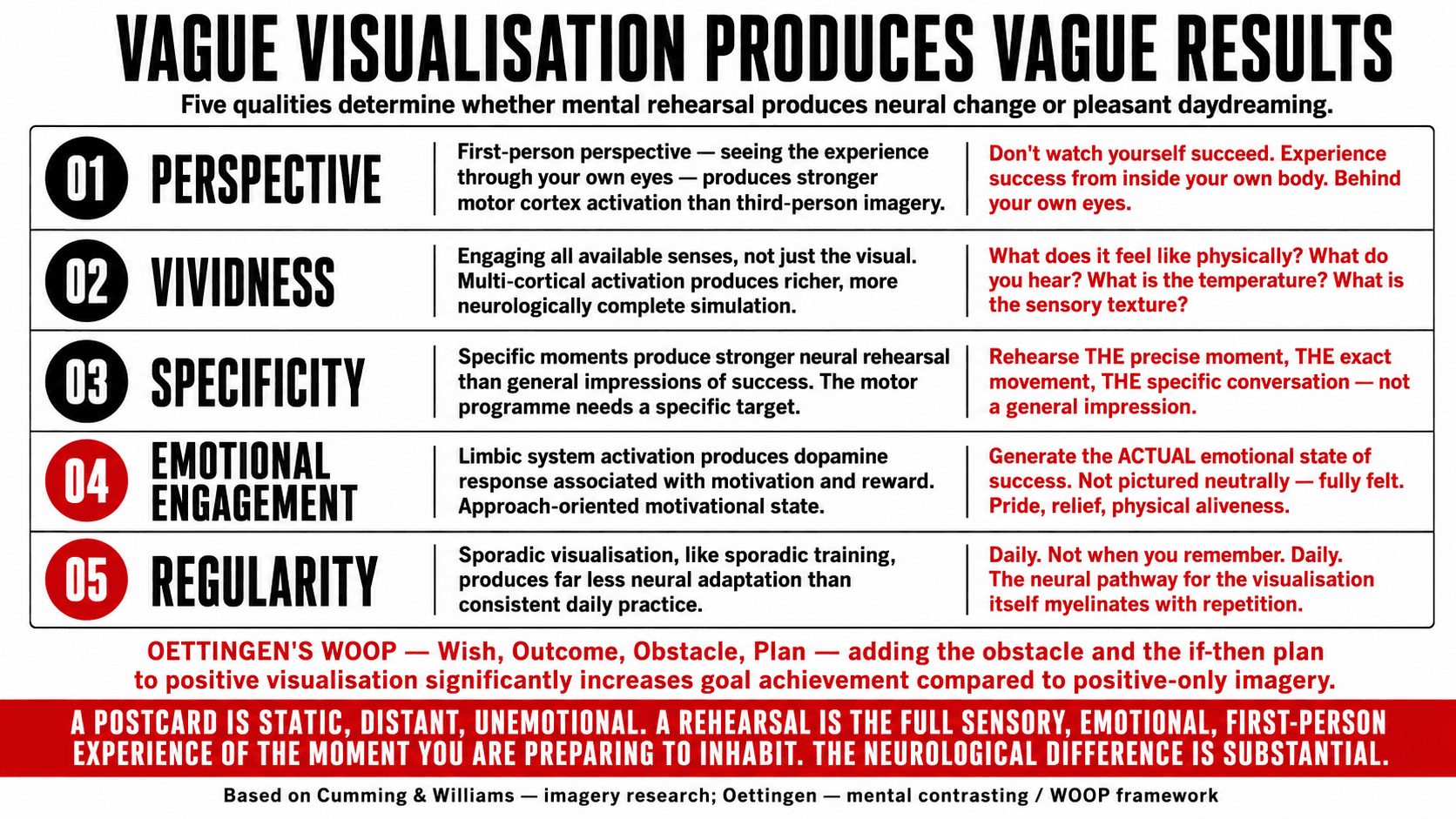
Not all visualisation is equally effective, and this is the most important practical point in the entire subject. The research on mental rehearsal consistently shows that the quality of the neurological response is directly proportional to the vividness, specificity, and multisensory richness of the visualisation. A vague, brief, unemotional mental image of a desired outcome produces a vague, brief, unemotional neurological response. A vivid, detailed, emotionally engaged, first-person, multi-sensory rehearsal of the specific desired state produces the kind of sustained neural activation that actually changes the pathway.
The five qualities that determine the effectiveness of a visualisation practice are: perspective, vividness, specificity, emotional engagement, and regularity. First-person perspective, seeing the experience through your own eyes rather than watching yourself from outside, produces stronger motor cortex activation than third-person imagery. Vividness means engaging all available senses, not just the visual: what does it feel like physically, what do you hear, what is the temperature, what is the sensory texture of the experience? Specificity means rehearsing the precise moment, the exact movement, the specific conversation, rather than a general impression of success. Emotional engagement means generating the actual emotional state of the success rather than merely picturing it neutrally. And regularity means that sporadic visualisation, like sporadic training, produces far less adaptation than consistent daily practice (4).
Gabriele Oettingen's research on mental contrasting, which produced the WOOP framework, adds an important nuance to the purely positive visualisation practice. Her studies showed that visualising only the desired positive outcome, without also mentally rehearsing the specific obstacles between the current state and that outcome and the specific responses to those obstacles, produces significantly lower rates of goal achievement than the combined practice. The WOOP protocol: Wish, Outcome, Obstacle, Plan involves first visualising the desired outcome vividly, then identifying the most significant internal obstacle to achieving it, then visualising a specific if-then plan for responding to that obstacle when it arises. The contrast between the desired state and the obstacle activates the motivational energisation that purely positive visualisation tends to bypass (5).
Key Insight: The most common reason visualisation does not work for people who try it is that they are producing a mental postcard rather than a mental rehearsal. A postcard is a static, distant, unemotional image of a place you have not been. A rehearsal is the full sensory, emotional, first-person experience of the specific moment you are preparing to inhabit. The difference in neurological effect between these two practices is substantial. If your visualisation feels like pleasant daydreaming, it is probably not producing the kind of neural activation that changes anything.
The Daily Visualisation Protocol: A Practical Five-Step Practice
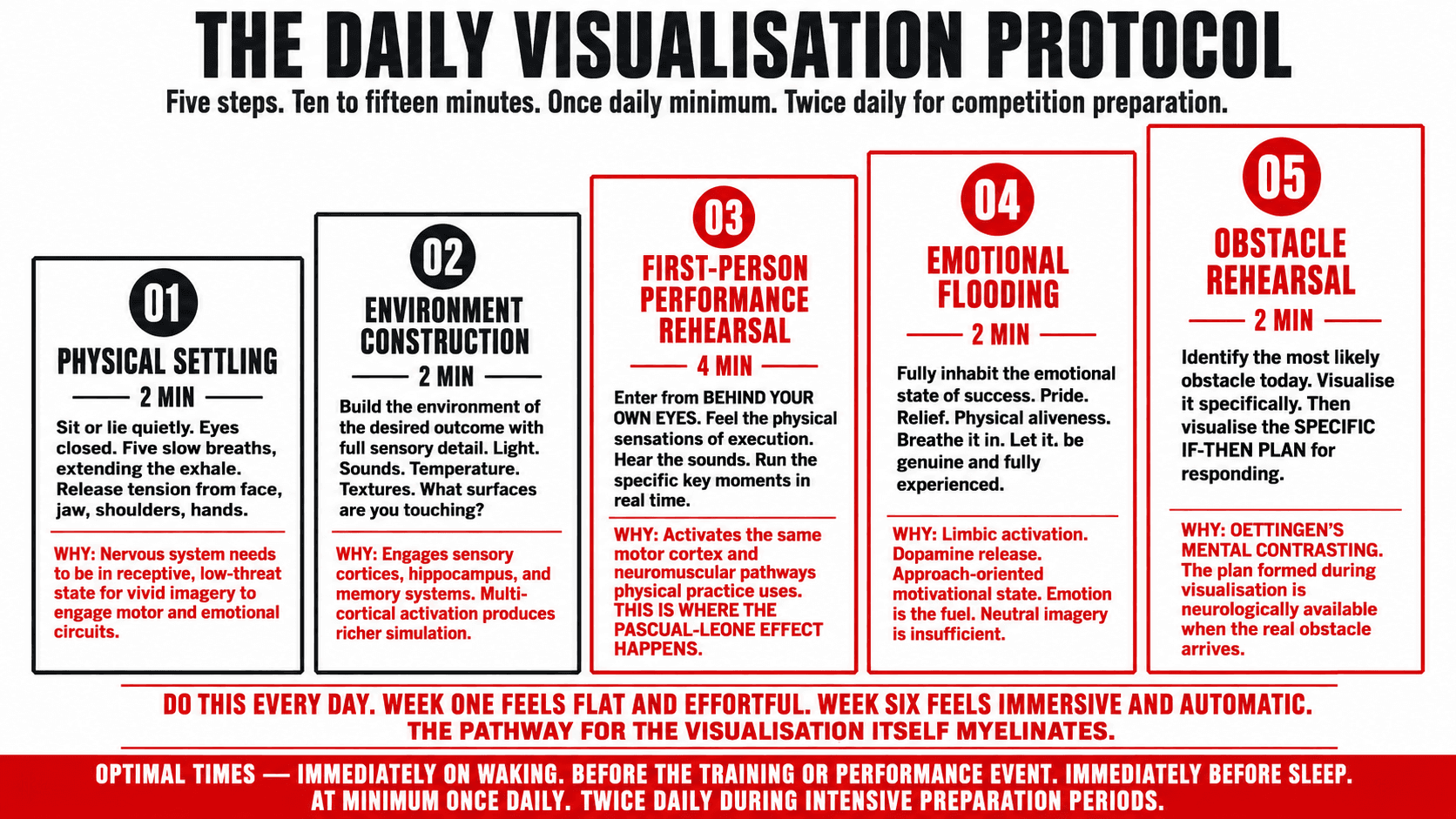
The protocol below is a structured daily visualisation practice that integrates the research on first-person perspective, multisensory vividness, emotional engagement, and mental contrasting. It takes between ten and fifteen minutes when first established and reduces to five to ten minutes once the practice is familiar. The optimal times are immediately on waking, before the critical training or performance event, and immediately before sleep. At minimum, once daily. The research on Phelps and other elite athletes who use visualisation most effectively suggests twice daily during intensive training and competition preparation periods.
TABLE: The Daily Visualisation Protocol — Five Steps with Instructions and Neurological Rationale
| Step | Stage | Time | What to Do | Why This Step Matters |
|---|---|---|---|---|
| 1 | Physical Settling | 2 min | Sit or lie in a quiet position. Close your eyes. Take five slow, deliberate breaths, extending the exhale. With each exhale, consciously release physical tension from the face, jaw, shoulders, and hands. The body needs to be in a state of calm parasympathetic activation for the visualisation to produce its full neurological effect. | The nervous system needs to be in a receptive, low-threat state for vivid mental imagery to engage the motor and emotional circuits most effectively. Visualisation performed under physical tension or cognitive agitation produces weaker neural activation and weaker emotional engagement. The settling step is not optional preparation. It is the physiological condition the practice requires. |
| 2 | Environment Construction | 2 min | Build the environment of the desired outcome with as much sensory detail as you can access. What does the space look like? What is the light quality? What sounds are present? What is the temperature? What surfaces are you touching? Take your time. The more fully realised the sensory environment, the more completely the brain is recruited into the simulation. | The environment construction engages the sensory cortices, the hippocampus, and the memory systems that hold prior experience of the relevant context. This multi-cortical activation produces a richer, more neurologically complete simulation. The brain is being asked to reconstruct a plausible reality, and the more detail it is given, the more convincingly it does so. |
| 3 | First-Person Performance Rehearsal | 4 min | Enter the rehearsal from behind your own eyes. You are not watching yourself succeed. You are experiencing success from inside your own body. Feel the physical sensations of the execution: the movement, the breath, the physical confidence. Hear the sounds. Run the specific key moments of the desired performance in real time. If it is a training session, feel each movement correctly executed. If it is a professional moment, hear your own voice clear and composed. If it is your transformed body, feel the ease of movement and physical capability. | First-person imagery activates the motor cortex and the associated neuromuscular pathways more strongly than third-person imagery. The brain is not watching a film. It is running a motor programme. This is the stage that produces the Pascual-Leone effect: the neural pathway for the desired performance is being activated, refined, and myelinated by the mental rehearsal in the same way it would be by the physical execution. |
| 4 | Emotional Flooding | 2 min | Before you leave the rehearsed moment, allow yourself to fully inhabit the emotional state of the success. Not a mild satisfaction. The actual feeling: the pride, the relief, the physical aliveness of the accomplished outcome. Breathe it in. Let the emotional state be genuine and fully experienced. This is not performance. It is deliberate emotional generation, and the quality of this step determines a significant portion of the practice's effectiveness. | Emotional engagement activates the limbic system and produces neurochemical responses that are closely associated with motivation and reward. Dopamine released in response to the emotionally engaged visualisation of a desired outcome produces an approach-oriented motivational state that makes the subsequent real-world behaviour more likely. The emotion is the fuel. Neutral imagery is insufficient. |
| 5 | Obstacle Rehearsal | 2 min | Before ending, identify the most likely obstacle between you and the desired outcome today. Visualise it specifically: the difficult training session you would rather skip, the nutritional decision that will be hardest today, the moment of doubt that is most likely to arise. Then visualise your specific response to it: the action you will take, the words you will say to yourself, the behaviour you will execute. The if-then plan, formed vividly in the mind, is neurologically available when the real obstacle arrives. | Oettingen's mental contrasting research consistently shows that adding the obstacle and the plan to the positive outcome visualisation significantly increases goal achievement compared to positive-only visualisation. The plan formed during the visualisation is neurologically encoded as an available response. When the real obstacle arrives, the brain retrieves the plan rather than constructing a new response under pressure. |
| Do this every day. The visualisation that feels slightly flat and effortful in week one feels immersive and automatic by week six. The neural pathway for the visualisation practice itself myelinates with repetition, the same as any other skill. Give it the repetitions it needs before assessing whether it is working. | ||||
Top Tips for Making Your Visualisation Practice Work
The first tip is to anchor the practice to an existing habit. The most common reason people do not build a consistent visualisation practice is that it never finds a fixed place in the day. Attach it to something that already happens without deliberation: immediately on waking before the phone is checked, the ten minutes before sleep, the warm-up before training. The habit stacking principle applies here as precisely as it does to any other behaviour. The new practice follows the established one and inherits its automaticity over time.
The second tip is to build your physical environment to support the mental one. The gold environment practice of the Australian volleyball athletes is available to you in whatever form is relevant to your goal. This does not require decorating your house in a single colour. It requires placing in your most frequently occupied visual field the objects, images, and cues that prime the mental and emotional state most associated with your desired outcome. A photograph in a frame. An image on a phone lock screen. A physical object on your desk that carries specific meaning related to the goal. These environmental anchors are working on your mental representation of the outcome all day, not just during the ten minutes of formal practice.
The third tip is to cut the image and place yourself in it. Find the image that most closely represents the specific desired outcome you are pursuing. If it is a physical transformation, find an image of the physique that represents the direction of travel and, literally, place your face on it. The self-relevance of the image changes its neurological effect completely. A generic image of success activates the desired mental representation with moderate force. An image that contains your specific self in the desired state activates it with a specificity and personal relevance that generic imagery cannot match. It may feel slightly awkward the first time you do it. Do it anyway.
The fourth tip is to write the visualisation before you see it. Before beginning your formal visualisation practice on any given day, spend two minutes writing, in present tense, a description of the desired state. Not “I will be”, but “I am”. The writing in present tense activates the language systems and the associated mental representations in a way that primes the subsequent imagery to be richer and more specific. “I am moving through my training session with energy and focus. My body is responding. I am exactly where I am supposed to be.” Then close the notebook and visualise what you just wrote.
The fifth tip is to use it specifically before the moment of maximum difficulty. The most powerful single use of the visualisation practice is in the two to three minutes immediately before the moment that is most likely to be difficult: the start of a training session you do not want to begin, the nutritional decision that will be hardest to make well, the professional moment that requires your best performance under pressure. A brief, focused, first-person visualisation of executing that specific moment well, immediately before it arrives, provides a neurological head start that motivation and willpower alone cannot replicate. The moment has already been rehearsed. When it arrives, it is not new.
Key Insight: Start with one week of daily practice before judging the results. The first few sessions will feel underpowered. You will find your mind wandering. The images will be less vivid than you want. This is normal, and it is the same experience as the first training sessions of any new programme. The practice improves with repetition because the neural pathway for the practice itself is being built. By session fourteen you will notice that the images arrive more readily, hold more completely, and produce a more distinct emotional and motivational response. That is the myelination. Give it the repetitions.
The Mind Is the First Arena
The athletes who perform with composure in the moments that matter most have not simply arrived at composure through experience. They have built it, deliberately, through the accumulated repetition of mental rehearsals that made the pressure moment familiar before it was real. The business leader who walks into the high-stakes negotiation with a clarity and confidence that others in the room find difficult to understand has rehearsed the room, the conversation, and their own best performance of it more times than anyone watching them would guess. The person who transforms their physical condition and maintains that transformation across years has, almost always, built and held a vivid internal image of the person they were becoming throughout the period when external evidence of that person was incomplete.
The mind is the first arena. What is built there, consistently and vividly, with the full engagement of emotion and sensory detail that the neuroscience requires, shapes what becomes available in every other arena that follows. This is not mysticism. It is the most direct application of what the neuroscience of mental rehearsal has established. The image you hold most consistently and most vividly is the one your brain is building the neural architecture for. Hold the right image. Hold it every day. Give the practice the repetitions it deserves.
I work one-to-one with clients online globally. If you would like to explore how the full toolkit of performance mindset, including visualisation, identity work, and habit architecture, can be applied to your specific health and performance goals, the conversation is the beginning.
Work with Me
Get a personalised coaching plan built around your goals, your schedule, and your life.
Enquire NowReferences
- Pascual-Leone A, Nguyet D, Cohen LG, et al. Modulation of muscle responses evoked by transcranial magnetic stimulation during the acquisition of new fine motor skills. Journal of Neurophysiology. 1995; 74(3): 1037-1045.
- Yue G, Cole KJ. Strength increases from the motor program: comparison of training with maximal voluntary and imagined muscle contractions. Journal of Neurophysiology. 1992; 67(5): 1114-1123.
- Byrne R. The Secret. New York: Atria Books; 2006.
- Cumming J, Williams SE. The role of imagery in performance. In: Murphy S, ed. The Oxford Handbook of Sport and Performance Psychology. Oxford: Oxford University Press; 2012: 213-232.
- Oettingen G. Rethinking Positive Thinking: Inside the New Science of Motivation. New York: Current; 2014.
- Driskell JE, Copper C, Moran A. Does mental practice enhance performance? Journal of Applied Psychology. 1994; 79(4): 481-492.
- Ranganathan VK, Siemionow V, Liu JZ, et al. From mental power to muscle power: gaining strength by using the mind. Neuropsychologia. 2004; 42(7): 944-956.
- Oettingen G, Pak HJ, Schnetter K. Self-regulation of goal setting: turning free fantasies about the future into binding goals. Journal of Personality and Social Psychology. 2001; 80(5): 736-753.