
The Conversation That Is Already Happening
Transformational vocabulary is a concept I return to consistently in coaching because the gap between what people know they should do and what they actually do is often not a knowledge gap or a strategy gap. It is a language gap. The words people habitually use to describe their experience, their capability, their body, and their progress are not neutral reports on a pre-existing reality. They are the active construction of that reality, in real time, in a neurological process that has measurable consequences for how the body responds, how the brain organises its resources, and whether the next healthy behaviour happens or does not.
Most people, if you ask them about their self-talk, will tell you they do not really have a strong inner critic, that they do not speak to themselves harshly, that they are reasonably positive in their general outlook. Then you spend an hour with them and you hear the actual language. I am terrible at consistency. I have no willpower. My body just holds weight. I always do this. I am not the kind of person who can sustain this. The words are delivered in a completely casual, almost offhand manner, as if they are simply describing an observed fact rather than constructing one. That is precisely the problem. The casualness is the mechanism. The words that do the most damage are not the ones delivered in moments of high emotional intensity. They are the ones delivered habitually, thoughtlessly, as unremarkable statements of fact, across every day of the year.
Tony Robbins, whose work on transformational vocabulary in Awaken the Giant Within remains one of the most practically useful frameworks I have encountered on this subject, makes a point that sounds deceptively simple but has substantial implications. The words we habitually use to describe our emotional experiences do not merely label those experiences after the fact. They shape the intensity, the quality, and the physiological signature of the experience itself. The word you choose to describe what is happening to you is not a passive report. It is an active instruction to the nervous system about how intensely and in what direction to respond (1).
“The words you attach to your experience become your experience.”
— Tony Robbins
What Happens When the Language Runs Unchallenged
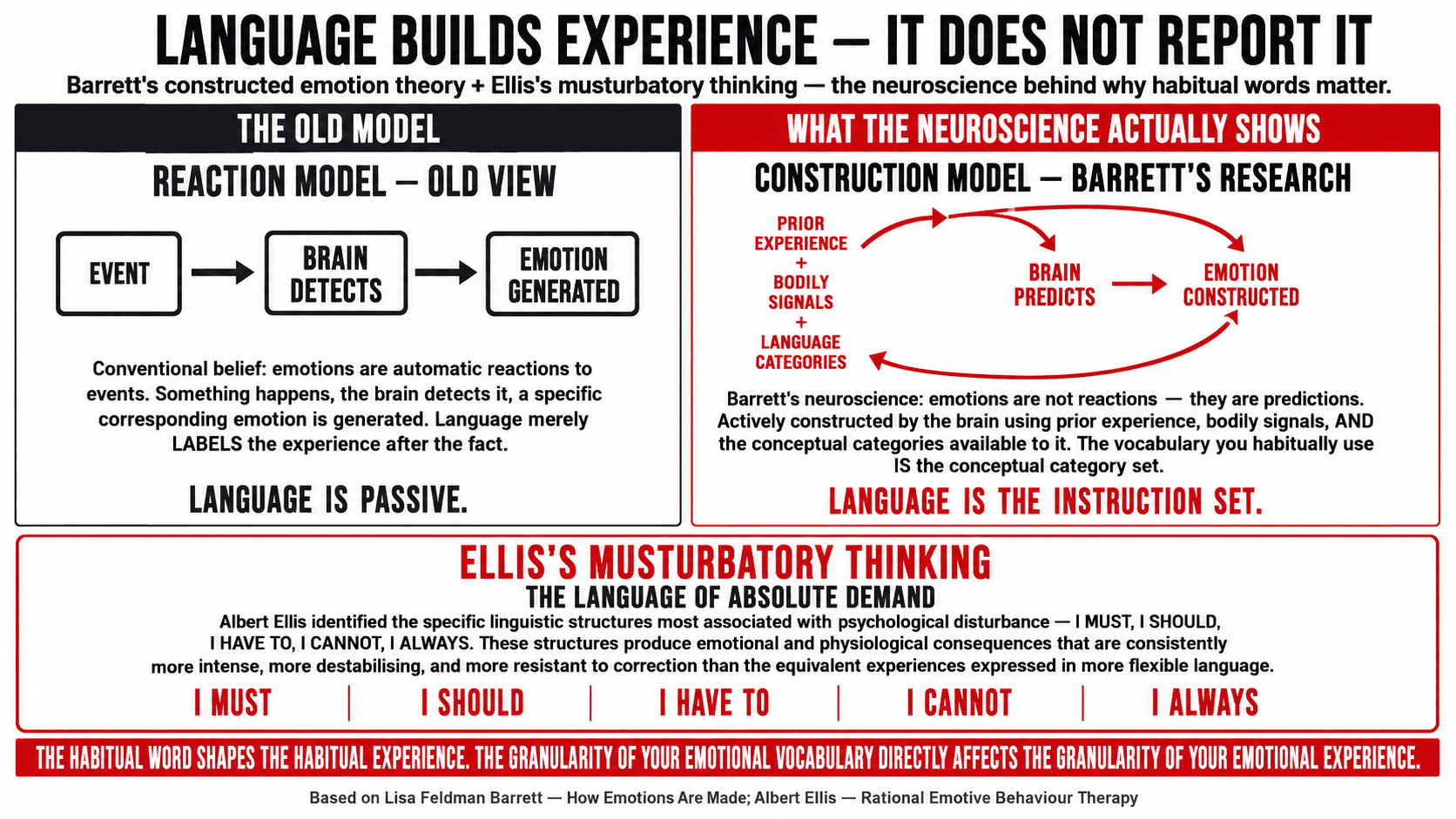
The neuroscience behind this is more rigorous than most people expect. Lisa Feldman Barrett's theory of constructed emotion, developed from decades of neuroscience research and most accessibly presented in How Emotions Are Made, fundamentally revises the conventional model of how human emotional experience is produced. The traditional view, which most people implicitly hold, is that emotions are automatic reactions to events: something happens, the brain detects it, and a specific corresponding emotion is generated in response. Barrett's research challenges this model at a foundational level. Her evidence suggests that emotions are not reactions. They are predictions, actively constructed by the brain using prior experience, bodily signals, and crucially the conceptual categories available to it (2).
The conceptual categories available to the brain are largely provided by language. Barrett's research shows that the granularity of a person's emotional vocabulary, the number of distinct emotional concepts they have available to describe what they are experiencing, directly affects the granularity of their emotional experience. A person with a rich emotional vocabulary does not just have more words for their feelings. They actually experience their feelings with greater precision and greater differentiation. And critically, the words that are most frequently used to describe emotional states are the ones most readily available to the brain when it is constructing the next experience of a similar kind. The habitual word shapes the habitual experience.
Albert Ellis, whose rational emotive behaviour therapy preceded and substantially influenced cognitive behavioural therapy, identified the specific linguistic structures most associated with psychological disturbance and poor adaptive functioning. His ABC model, in which an activating event produces a belief that produces a consequence, located the critical intervention point not in the event itself but in the language of the belief. Ellis was particularly focused on what he called musturbatory thinking: the language of absolute demand expressed through words like I must, I should, I have to, I cannot, and I always. These linguistic structures, which are extraordinarily common in health behaviour self-talk, produce emotional and physiological consequences that are consistently more intense, more destabilising, and more resistant to correction than the equivalent experiences expressed in more flexible language (3).
The daily accumulation of this kind of language, unremarked and unchallenged, is not a soft problem. I watch it dismantle programmes that are technically excellent. The training plan is good. The nutritional approach is sound. The physiological conditions for change are in place. And the person is quietly narrating their way out of it, one casual self-description at a time, constructing a story about themselves that makes the programme progressively harder to sustain rather than easier.
Key Insight: Pay attention for one full day to the specific words you use to describe yourself, your body, your progress, and your capability in the domain of health. Write them down exactly as spoken. Not the sentiment behind them but the specific words. I am exhausted. I have no energy today. I am terrible at this. I always struggle with this. That list is the current instruction set your nervous system is receiving about who you are and what is possible. It is not a neutral inventory. It is an active programme.
Robbins' Transformational Vocabulary: The Mechanism of Language-Driven State Change
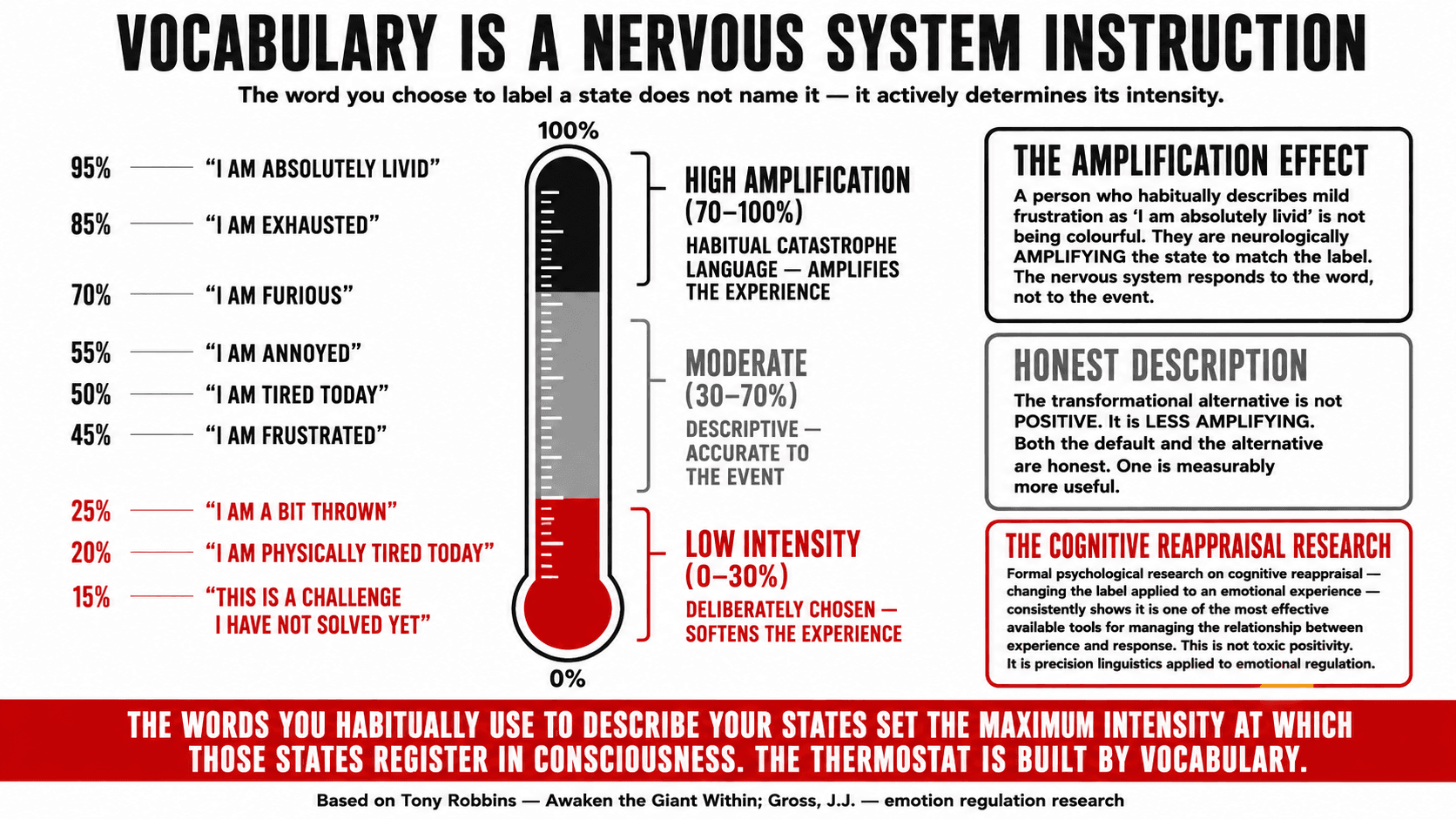
The core principle of Robbins' transformational vocabulary framework is that the specific word you choose to label an emotional state does not merely name something that already exists with a fixed intensity. It actively determines the intensity. Robbins identified what he called the emotional thermostat function of habitual vocabulary: the words you habitually use to describe your negative states set the maximum intensity at which those states register in consciousness, and the words you habitually use to describe your positive states determine the maximum height at which those states are experienced. A person who habitually describes mild frustration as I am absolutely livid is not simply being colourful. They are neurologically amplifying the state to match the label (1).
The reverse is equally true. A person who responds to what would ordinarily register as a significant disappointment with the deliberate and practised use of a softer label, I am a bit thrown, or I am temporarily frustrated, or this is just a challenge I have not solved yet, is not pretending that the event did not happen. They are deliberately reducing the emotional amplification by selecting a word that instructs the nervous system to respond at a lower intensity. This is not toxic positivity. It is precision linguistics applied to emotional regulation, and the research on cognitive reappraisal, the formal psychological term for changing the label applied to an emotional experience, consistently shows that it is one of the most effective available tools for managing the relationship between experience and response (4).
Robbins proposed a specific vocabulary replacement practice that I have found genuinely useful as a coaching tool. It involves identifying the habitual negative words most frequently used in a particular domain, in our case health behaviour, and replacing them with words of lower emotional intensity that are still honest descriptions of the experience. The replacement word does not need to be positive. It needs to be less amplifying. Changing I am exhausted to I am physically tired today changes nothing about the physical state but changes the neurological instruction significantly. Exhausted carries connotations of depletion, crisis, and unsustainability. Physically tired today carries connotations of a normal human experience that will resolve with sleep. Both are honest. One is measurably more useful.
The Vocabulary Swap: Common Health Behaviour Language and Its Transformational Alternative
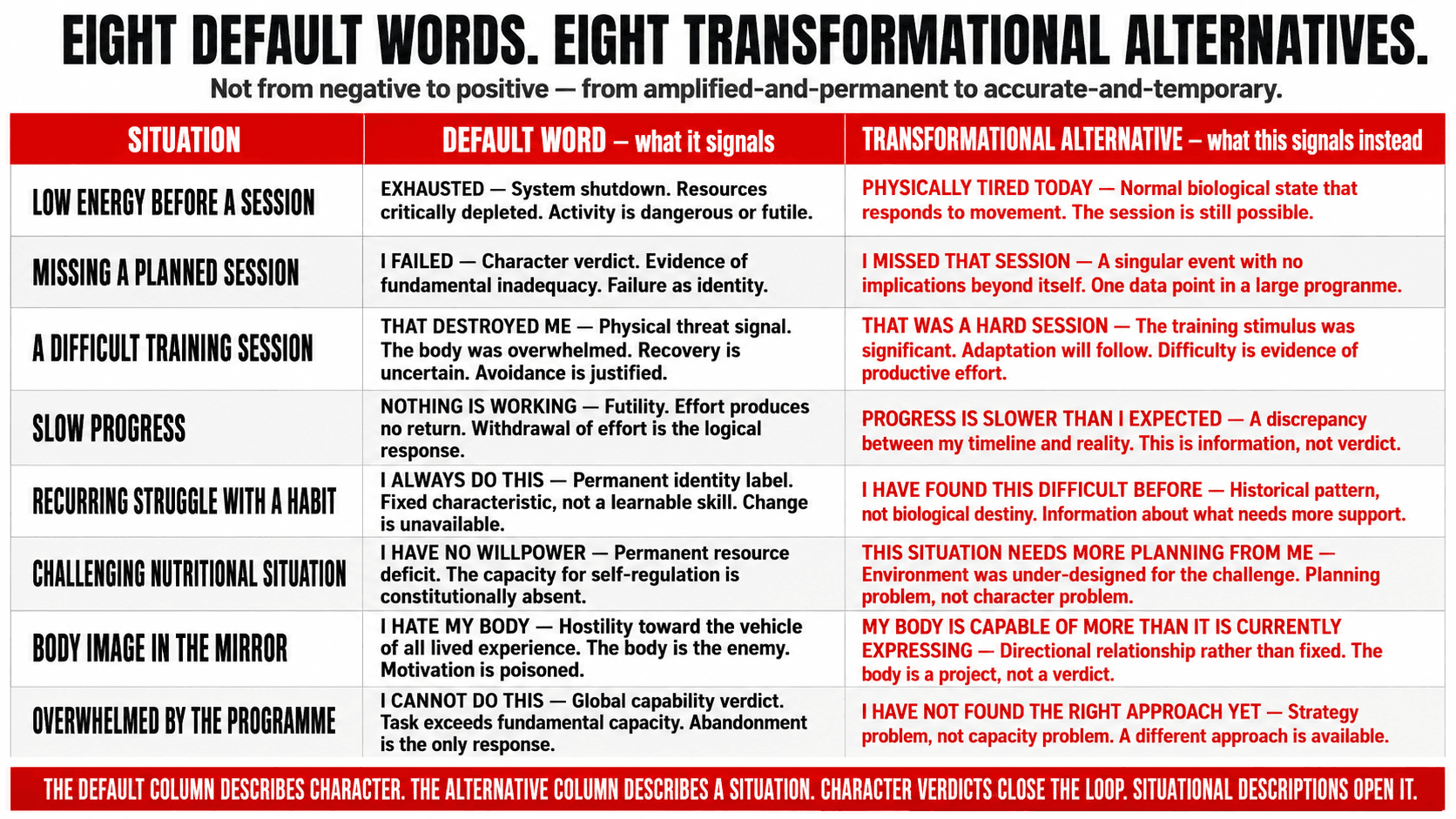
The table below maps the most common habitual negative words I hear in health behaviour contexts, the physical and neurological state each word generates, and the transformational alternative that is equally honest but significantly less amplifying. The transformation is not about pretending things are fine when they are not. It is about describing what is actually happening with precision rather than with theatrical intensity, and observing what the more accurate description does to the experience.
TABLE: Transformational Vocabulary for Health Behaviour — Default Words vs Transformational Alternatives
| Situation | Default Word | What it signals to the nervous system | Transformational Alternative | What this signals instead |
|---|---|---|---|---|
| Low energy before a session | Exhausted | System shutdown. Resources critically depleted. Activity is dangerous or futile. The nervous system prepares for rest or avoidance. | Physically tired today | Normal biological state that responds to movement. The session is still possible and will likely improve the state rather than worsen it. |
| Missing a planned session | I failed | Character verdict. Evidence of fundamental inadequacy. Failure as identity rather than event. Activates shame and the avoidance behaviour that shame produces. | I missed that session | A singular event with no implications beyond itself. One data point in a large programme. Recoverable immediately with the next scheduled behaviour. |
| A difficult training session | That destroyed me | Physical threat signal. The body was overwhelmed. Repetition of this experience is dangerous. Recovery is uncertain. Avoidance is justified. | That was a hard session | The training stimulus was significant. Adaptation will follow. Difficulty is evidence of productive effort, not damage. The next session is still available. |
| Slow progress toward a goal | Nothing is working | Futility signal. Effort produces no return. The situation is unresponsive to action. Withdrawal of effort is the logical response. | Progress is slower than I expected | There is a discrepancy between my timeline and the reality. This is information, not verdict. The approach may need adjustment. The outcome is still available. |
| Recurring struggle with a habit | I always do this | Permanent identity label. The behaviour is a fixed characteristic, not a learnable skill. Change is not available because this is simply who I am. | I have found this difficult before | Historical pattern, not biological destiny. It has been difficult in the past. That is information about what needs more support, not a ceiling on what is possible. |
| Facing a challenging nutritional situation | I have no willpower | Permanent resource deficit. The capacity for self-regulation is constitutionally absent in this person. The situation is hopeless because the tool for managing it does not exist. | This situation needs more planning from me | The environment was under-designed for the challenge it presented. This is a planning and environment problem, not a character problem. It is entirely solvable. |
| Body image in the mirror | I hate my body | Deep hostility toward the vehicle of all lived experience. The body is the enemy. Working with it feels like serving something deserving of contempt. Motivation is poisoned at its source. | My body is capable of more than it is currently expressing | The relationship is directional rather than fixed. The body is a project, not a verdict. Improvement is framed as a direction of travel rather than a judgement of current failure. |
| Feeling overwhelmed by the programme | I cannot do this | Global capability verdict. The task exceeds the person's fundamental capacity. Effort is futile because the ceiling has been reached. Abandonment is the only rational response. | I have not found the right approach yet | The current strategy has not produced the result. That is a strategy problem, not a capacity problem. A different approach is available and has not yet been tried. |
| The transformation is not from negative to positive. It is from amplified and permanent to accurate and temporary. The default column describes character. The alternative column describes a situation. Character verdicts close the loop. Situational descriptions open it. | ||||
Ethan Kross and the Inner Voice: When the Internal Monologue Becomes the Obstacle
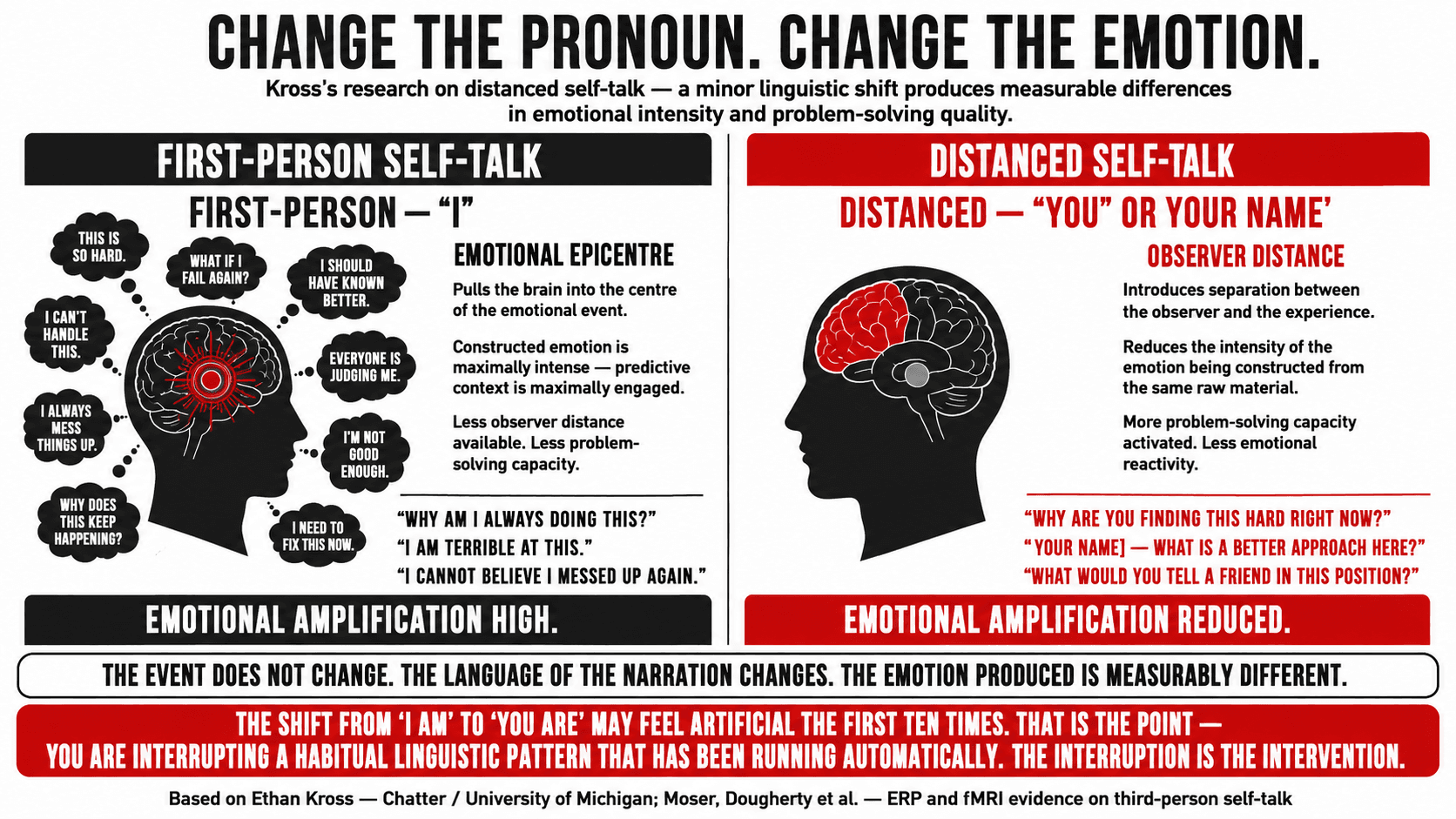
Ethan Kross's research on the inner voice, published in Chatter and developed across decades of experimental psychology at the University of Michigan, provides some of the most rigorous empirical documentation available for what Robbins describes in practical terms. Kross and his colleagues found that the quality of a person's inner self-talk is a stronger predictor of their performance under pressure, their emotional regulation in difficult circumstances, and their long-term wellbeing than almost any other single variable they examined. The person who has a hostile, ruminating, catastrophising inner voice is not simply unhappy. They are working under a cognitive and physiological handicap that measurably impairs their ability to perform the behaviours they are trying to perform (5).
One of Kross's most practically significant findings concerns what he calls distanced self-talk: the practice of addressing oneself in the second or third person rather than the first person when narrating difficult experiences. Instead of why am I always doing this, the distanced form is why does Tanvir always do this, or more powerfully, why are you finding this hard right now. Kross found that this apparently minor shift in linguistic perspective produces measurable differences in both the emotional intensity of the experience and the quality of the problem-solving behaviour that follows it. The third-person perspective activates a degree of observer distance that is not available in the first-person narrative, reducing the emotional amplification that the first-person I generates (5).
The mechanism connects directly to what Barrett describes in her emotion construction model. The first-person narrative in a difficult moment pulls the brain into the centre of the emotional event, where the constructed emotion is maximally intense because the predictive context is maximally engaged. The distanced perspective introduces a separation between the observer and the experience that reduces the intensity of the emotion being constructed from the same raw material. The event does not change. The language of the narration changes. The emotion produced is measurably different (2).
Key Insight: The next time you catch yourself using a first-person catastrophic self-description in a health behaviour context, try narrating it from the outside. Instead of I am terrible at this, try saying to yourself, you are finding this hard right now. The shift from I am to you are may feel artificial the first ten times you do it. That is the point. You are interrupting a habitual linguistic pattern that has been running automatically. The interruption is the intervention.
The Self-Talk Pattern Audit: Twelve Common Health Behaviour Contexts and Their Limiting Language
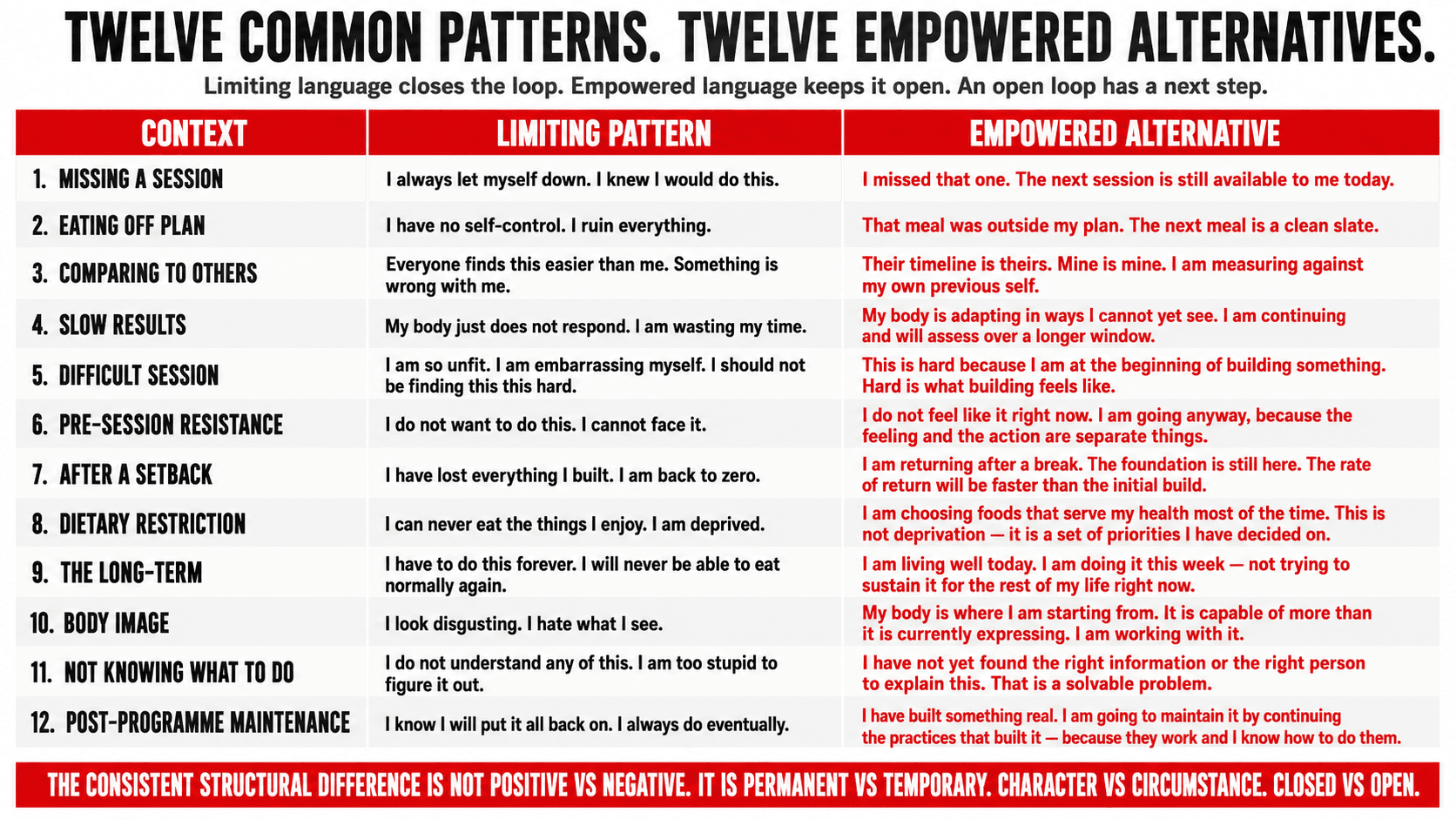
The patterns below represent the twelve most common limiting self-talk structures I encounter in health behaviour coaching. Each is mapped against its neurological and behavioural consequence and its empowered alternative. The empowered alternatives are not affirmations. They are honest, accurate descriptions of the same situation using language that describes circumstances rather than character, temporary states rather than permanent ones, and problems that have solutions rather than verdicts that have none.
TABLE: Self-Talk Pattern Audit — Limiting Patterns, Consequences, and Empowered Alternatives
| Context | LIMITING SELF-TALK PATTERN | Neurological Consequence | EMPOWERED ALTERNATIVE | What This Produces Instead |
|---|---|---|---|---|
| Missing a session | I always let myself down. I knew I would do this. | Confirms permanent identity as unreliable. Makes the next session feel futile before it begins. | I missed that one. The next session is still available to me today. | Keeps the identity intact and the next behaviour accessible. One event, not a pattern. |
| Eating off plan | I have no self-control. I ruin everything. | Shame and global self-criticism. Activates the what-the-hell effect: if it is already ruined, I might as well continue. | That meal was outside my plan. The next meal is a clean slate. | Closes the deviation without the cascade. The next meal is genuinely available as a restart. |
| Comparing to others | Everyone finds this easier than me. Something is wrong with me. | Global deficiency verdict. Comparison hijacks intrinsic motivation and replaces it with permanent inadequacy. | Their timeline is theirs. Mine is mine. I am measuring against my own previous self. | Restores the internal locus of evaluation. Progress becomes visible because it is being measured on the right scale. |
| Slow results | My body just does not respond. I am wasting my time. | Learned helplessness. The situation is experienced as unresponsive to effort, so effort is withdrawn. | My body is adapting in ways I cannot yet fully see. I am going to continue and assess over a longer window. | Preserves the effort while extending the evaluation timeline. Behaviour continues. |
| Difficult session | I am so unfit. I am embarrassing myself. I should not be finding this this hard. | Shame as the primary emotional experience of the training session. Training becomes associated with humiliation. | This session is hard because I am at the beginning of building something. Hard is what building feels like. | Reframes the difficulty as developmental rather than evidence of inadequacy. Hard sessions become positive data. |
| Pre-session resistance | I do not want to do this. I am so tired. I cannot face it. | The feeling is treated as reliable information about capability. Because I do not want to, I therefore cannot. | I do not feel like it right now. I am going anyway, because the feeling and the action are separate things. | Decouples motivation from action. The behaviour is not contingent on the emotional state preceding it. |
| After a setback period | I have lost everything I built. I am back to zero. There is no point starting again. | Neural pathway thinning is catastrophised as complete erasure. The architecture of prior progress is invisible. | I am returning after a break. The foundation is still here. The rate of return will be faster than the initial build. | Accurately describes the neurological reality. Myelinated pathways do not disappear in a short break. They thin. Return is faster. |
| Dietary restriction | I can never eat the things I enjoy. This is miserable. I am deprived. | The health practice is framed as the removal of pleasure. Deprivation narrative makes the behaviour psychologically unsustainable. | I am choosing foods that serve my health most of the time. This is not deprivation. It is a set of priorities I have decided on. | Agency replaces victimhood. The behaviour is chosen rather than imposed. The psychological experience of the same food choices changes. |
| Facing the programme long-term | I have to do this forever. I will never be able to eat normally again. | The full duration of the change is compressed into a single overwhelming present moment. Permanence feels like a prison sentence. | I am living well today. I am not trying to sustain this for the rest of my life right now. I am doing it this week. | Brings the frame back to the manageable present. The long-term is assembled from the sum of present-day choices, not experienced all at once. |
| Body image | I look disgusting. I hate what I see. | Deep hostility toward the body poisons the motivation to improve it. You do not invest effort in things you feel contempt for. | My body is where I am starting from. It is capable of more than it is currently expressing. I am working with it. | Directional relationship replaces contemptuous one. Improvement is framed as collaboration rather than punishment. |
| Not knowing what to do | I do not understand any of this. I am too stupid to figure it out. | Intellectual self-dismissal closes the loop on learning. If the capacity to understand is absent, seeking understanding is futile. | I have not yet found the right information or the right person to explain this to me. That is a solvable problem. | Keeps the inquiry open. The limitation is informational, not constitutional. Getting help is now the logical next step. |
| Post-programme maintenance | I know I will put it all back on. I always do eventually. | Permanent pessimistic attribution. The future is certain, negative, and beyond influence. Effort in the present is robbed of its meaning. | I have built something real. I am going to maintain it by continuing the practices that built it, because they work and I know how to do them. | The maintenance phase is framed as a continuation of the building phase, not a holding pattern before inevitable reversal. |
| The consistent structural difference between limiting and empowered self-talk is not positive versus negative. It is permanent versus temporary, character versus circumstance, closed versus open. Limiting language closes the loop. Empowered language keeps it open. An open loop has a next step. A closed loop does not. | ||||
Identity Language: The Words That Build the Person Rather Than Describe Them
Beyond the management of negative self-talk, there is the active construction of identity through language, which is the positive face of the same principle. The words habitually used to describe the self in health behaviour contexts are not merely descriptions of a pre-existing identity. They are, over time and with repetition, the construction of that identity. James Clear's work on identity-based habit formation draws on a large body of social psychological research to make this point: the language of identity, I am the kind of person who trains, I am someone who prioritises my health, I am an active person, is not aspirational fiction. Used habitually and backed by even imperfect behavioural evidence, it is the mechanism through which that identity is neurologically constructed (6).
Robbins makes the same point from a different angle in his discussion of identity-level change versus behaviour-level change. A person who describes themselves as someone who is trying to get fit is holding their health behaviour at the level of an attempted action. A person who describes themselves as a healthy, active person is holding their health behaviour at the level of identity expression. These two self-descriptions produce different automatic responses to every situation that presents a health behaviour choice. The question of whether to train does not arise in the same way for the person who is an active person as it does for the person who is trying to get fit. The identity description has already answered it (1).
I pay close attention to the first words a new client uses to describe themselves in relation to their health. Those words are the current programme. Not the programme they want to be following. The one that is actually running. I am terrible with food is a programme. I have never been athletic is a programme. I know what to do, I just cannot make myself do it is a programme. Each of these sentences is an instruction to the nervous system about who this person is and what range of behaviour is available to them. One of the first pieces of work we do together is to audit that language and replace the instructions that are running the wrong programme.
Key Insight: Write three sentences that begin with the words I am, describing yourself in relation to your health. Be honest. Write what you actually say to yourself, not what you think you should say. Then examine each sentence for the programme it is running. Is it permanent or temporary? Is it a character verdict or a description of a current circumstance? Is it an identity that contracts or one that expands? Rewrite each sentence as an identity statement that is honest about the current reality but directional about the trajectory. That rewrite is not a lie. It is the first statement of the programme you are choosing to run instead.
The Programme You Speak Into Existence
The language audit I am describing is not a one-off exercise. It is an ongoing practice of attention to the most pervasive and most underestimated influence on health behaviour available to any person: the internal monologue that runs without interruption across every waking hour of every day of the programme. Most people give enormous attention to the what and the how of their health: the training programme, the nutritional protocol, the supplements, the sleep routine. Almost nobody gives systematic attention to the internal language that either reinforces or dismantles everything else.
The reason Robbins' transformational vocabulary framework has remained genuinely useful in my coaching practice over many years is that it is not theoretical. It produces observable changes in behaviour within days of consistent application, because the behaviour is already downstream of the language. Change the language and the behaviour follows, not because of the power of positive thinking but because the neurological instruction set has been updated. The nervous system is responsive to words. It always has been. The question is whether you are directing that responsiveness deliberately or allowing it to run on whatever habitual programme it built years ago.
I work one-to-one with clients online globally. When we begin working together, one of the earliest things I do is listen carefully to the language. Not as a diagnostic curiosity but because the words a person uses about themselves and their health are, with a consistency that I have observed without exception over fifteen years, the most accurate available predictor of how the programme will go if the language is left unchanged. It is also the most accessible point of change. You cannot always change the programme immediately. You can always change the word you use to describe how you feel about it.
Work with Me
Get a personalised coaching plan built around your goals, your schedule, and your life.
Enquire NowReferences
- Robbins T. Awaken the Giant Within: How to Take Immediate Control of Your Mental, Emotional, Physical and Financial Destiny. New York: Simon and Schuster; 1991.
- Barrett LF. How Emotions Are Made: The Secret Life of the Brain. New York: Houghton Mifflin Harcourt; 2017.
- Ellis A, Harper RA. A New Guide to Rational Living. North Hollywood: Wilshire Book Company; 1975.
- Gross JJ. The emerging field of emotion regulation: an integrative review. Review of General Psychology. 1998; 2(3): 271-299.
- Kross E. Chatter: The Voice in Our Head, Why It Matters, and How to Harness It. New York: Crown; 2021.
- Clear J. Atomic Habits: An Easy and Proven Way to Build Good Habits and Break Bad Ones. London: Random House Business; 2018.
- Kross E, Bruehlman-Senecal E, Park J, et al. Self-talk as a regulatory mechanism: how you do it matters. Journal of Personality and Social Psychology. 2014; 106(2): 304-324.
- Moser JS, Dougherty A, Mattson WI, et al. Third-person self-talk facilitates emotion regulation without engaging cognitive control: converging evidence from ERP and fMRI. Scientific Reports. 2017; 7(1): 4519.