
The Motivational Fuel That Burns Out
Purpose-driven health behaviour is the single most durable motivational structure available to a person pursuing any long-term change in their physical condition. The pattern I have observed is consistent enough to be stated without qualification: the people whose health practice lasts indefinitely are not the people with the best programme, the most discipline, or the most naturally athletic starting point. They are the people whose health practice is connected, explicitly and deliberately, to something they care about at a level deeper than the physical result the practice produces.
The majority of people who begin a health programme do so for outcomes. They want to lose a specific amount of weight, fit into a specific size of clothing, achieve a specific body composition, or reach a performance benchmark of some kind. These are legitimate starting points. They provide the initial energy that gets the programme under way. They focus the attention during the early weeks when the behaviour is new and the motivation is high. And they are, almost without exception, insufficient as a motivational foundation for the full duration of a meaningful change programme, because they have a structural property that makes them progressively less useful as the programme continues.
Outcome-based motivation is front-loaded. The distance between the current state and the desired outcome is greatest at the beginning of the programme, when the motivation is also highest. As the programme progresses and the outcome is approached, or as the timeline extends and the outcome remains stubbornly unreached, the motivational fuel of the outcome diminishes. The person who was highly motivated by the prospect of losing fifteen kilograms becomes less motivated as they approach the target, because the gap that was driving the behaviour is closing. And if the target is reached, the fuel disappears entirely, which is the mechanism behind the weight regain that follows so many successful programmes.
Purpose, by contrast, is not front-loaded. A person whose health practice is connected to being present and energetic for their children does not lose motivational fuel as their fitness improves, because the children are still there and the purpose is not diminished by the progress. A person whose health practice is connected to their professional longevity and the quality of their cognitive performance does not reach a point at which the purpose has been fully served. The why that connects the health behaviour to something the person genuinely cares about is not depleted by proximity to the outcome. It is renewed by it.
“He who has a why to live for can bear almost any how.” — Friedrich Nietzsche
Simon Sinek's Golden Circle: Why Most Health Programmes Are Built From the Outside In
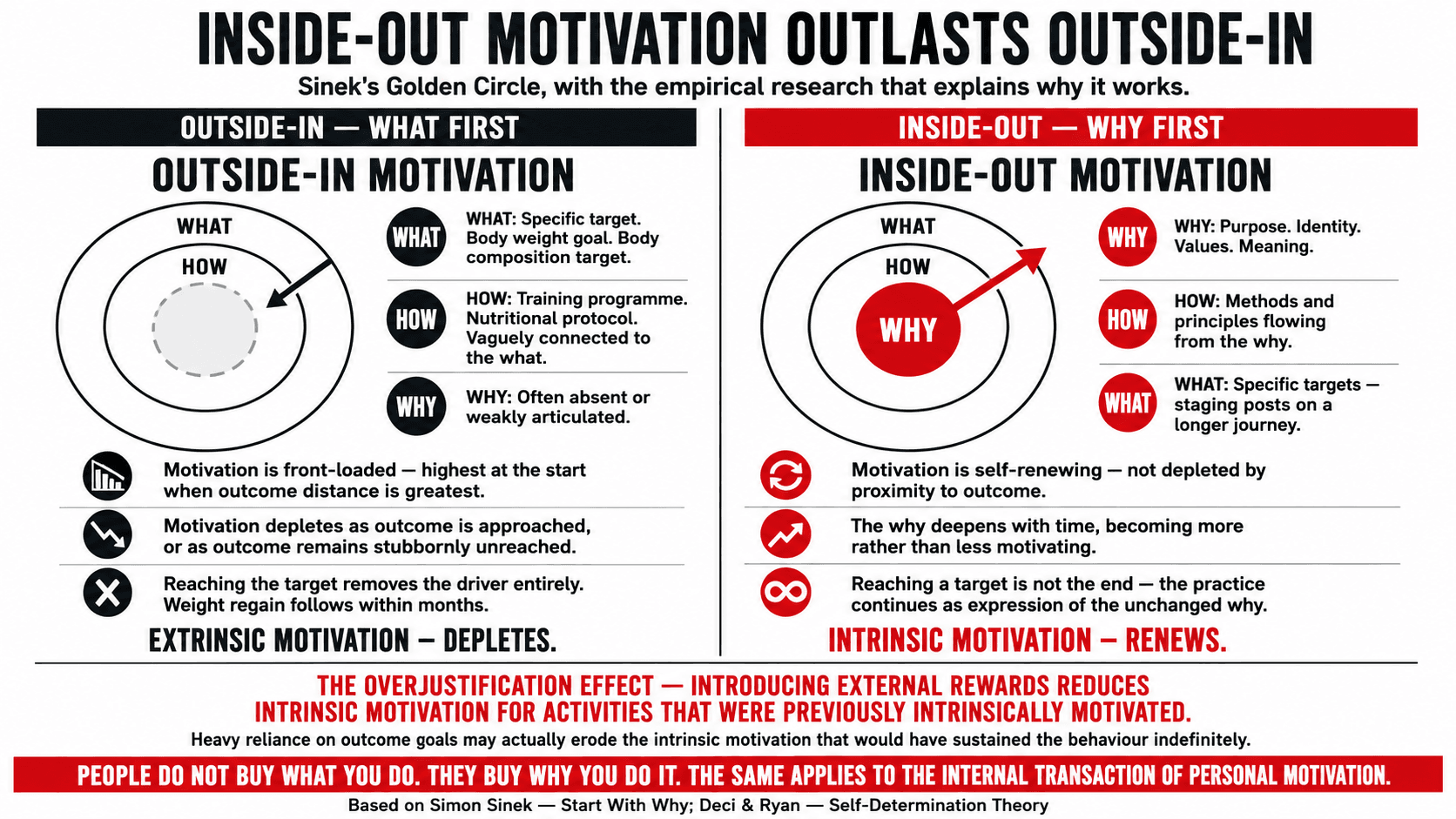
Simon Sinek's Golden Circle framework, developed initially as an analysis of why certain organisations and leaders inspire sustained loyalty while others merely generate temporary compliance, maps directly and with compelling precision onto the question of why certain health programmes last while the majority do not. The Golden Circle consists of three concentric rings: the outermost ring is What, the middle ring is How, and the innermost ring is Why. Sinek's observation is that most organisations, and most people, communicate and operate from the outside in: they start with what they do, describe how they do it, and either never articulate or only vaguely gesture toward why (1).
The organisations and leaders who inspire genuine sustained commitment operate from the inside out. They start with why: with the purpose, the belief, the reason that the work exists beyond its immediate product. The what and the how follow from the why and are energised by it. The same architecture applies, with equal force, to the individual pursuing a sustained health practice. The person who begins with what, a specific body weight or body composition target, and proceeds to how, a training programme and nutritional protocol, without ever establishing why, has built their motivation on the most fragile and most front-loaded part of the structure. The person who begins with why, and builds their what and how as expressions of that deeper purpose, has built their motivation on the most durable layer of the architecture.
Edward Deci and Richard Ryan's self-determination theory provides the empirical underpinning for what Sinek describes in motivational terms. Their research distinguishes between intrinsic motivation, which arises from the inherent satisfaction and personal meaning of the activity, and extrinsic motivation, which is driven by external rewards, social approval, or the achievement of external outcomes. A large body of research across multiple decades consistently shows that intrinsic motivation is associated with greater persistence, higher quality of engagement, better wellbeing, and more durable behaviour change than extrinsic motivation, even when the initial performance of the extrinsically motivated individual is comparable (2).
Outcome goals are a form of extrinsic motivation. They motivate behaviour by offering a future reward, the achievement of the target, in exchange for the present behaviour. Purpose-driven motivation is a form of intrinsic motivation. It motivates behaviour because the behaviour is itself an expression of something the person genuinely values. The difference in durability between these two motivational structures is not marginal. Research on the overjustification effect, the tendency for the introduction of external rewards to reduce intrinsic motivation for activities that were previously intrinsically motivated, suggests that heavy reliance on outcome goals may actually erode the intrinsic motivation that would have sustained the behaviour indefinitely (2).
Key Insight
Ask yourself why you want to be healthier. When you have an answer, ask why that matters. When you have that answer, ask why that matters. By the third or fourth iteration of this question, you are likely to have arrived at something that is genuinely important to you at the level of your values rather than your preferences. That is the level at which durable motivation lives. The outcome goals that sit above it are useful targets. They are not the foundation.
The Golden Circle Applied to Health: Building Your Motivation from the Inside Out
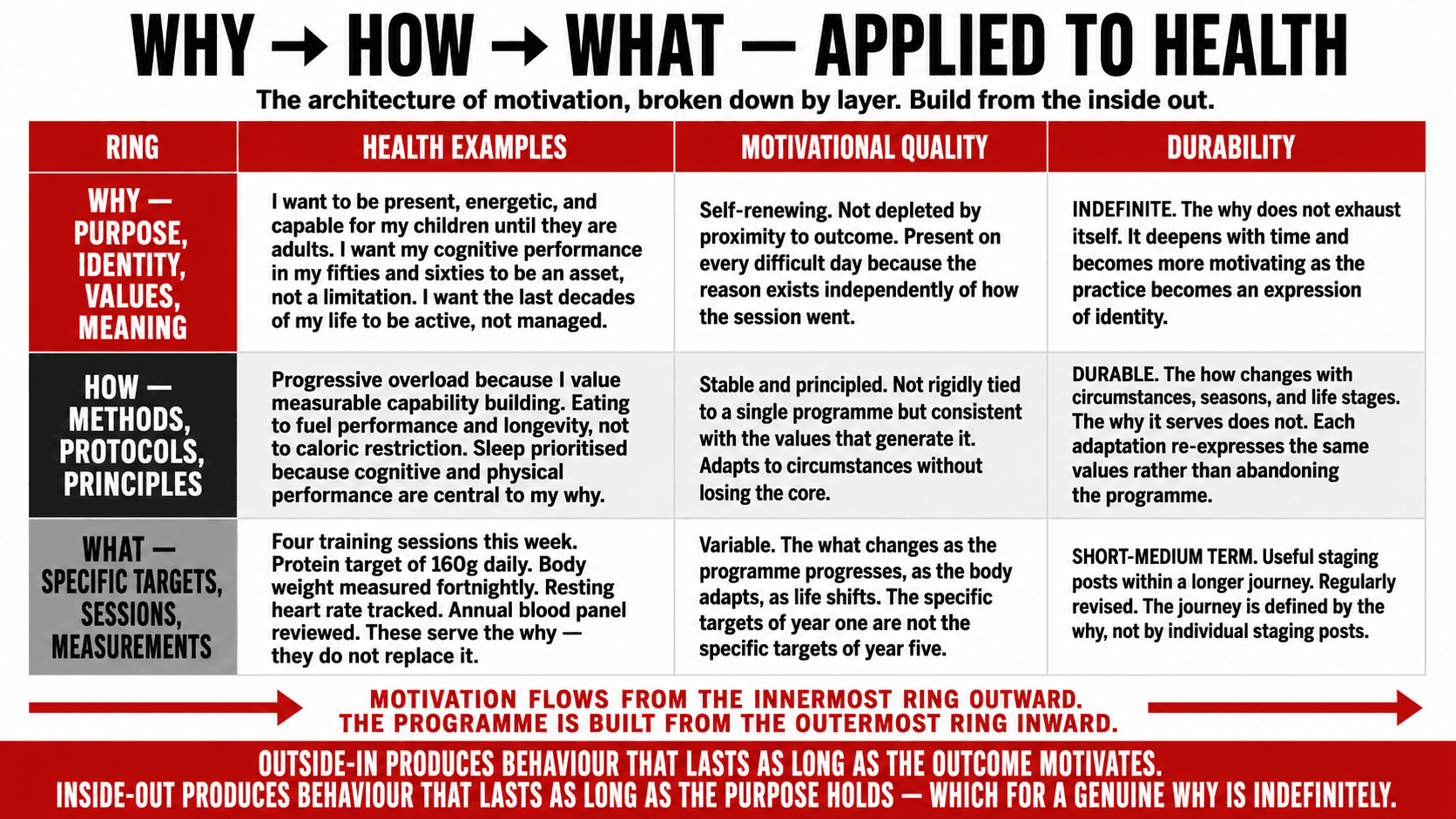
The three rings of the Golden Circle, when applied to health behaviour, produce a specific architecture of motivation that runs from the innermost why through to the outermost what. The direction of motivation matters as much as its presence. Motivation running from the outside in is front-loaded, outcome-dependent, and progressively depleted as the programme extends. Motivation running from the inside out is self-renewing, purpose-anchored, and independent of whether the outcome has been fully reached.
| Ring | What This Layer Contains | Health Examples | Motivational Quality | Durability Over Time |
|---|---|---|---|---|
| WHY — Purpose, Identity, Values, Meaning | The reason that exists beyond the physical result. Why does your health matter to you at the level of your deepest values? Who are you doing this for, including yourself? What kind of person do you want to be and for how long? | I want to be present, energetic, and capable for my children until they are adults. I want to work at the highest level without physical capacity being the constraint. I want the last decades of my life to be active, not managed. | Self-renewing. Not depleted by proximity to outcome. Present on every difficult day because the reason exists independently of how the session went. | Indefinite. The why does not exhaust itself. It deepens with time and becomes more rather than less motivating as the health practice becomes an expression of identity. |
| HOW — Methods, Protocols, Daily Habits, Principles | The specific practices and principles through which the why is expressed. Not the single programme but the approach to health that is consistent with the values and identity at the centre. | I train with progressive overload because I value the measurable expression of capability building. I eat to fuel performance and longevity rather than to a specific caloric restriction. I prioritise sleep because cognitive and physical performance are central to my why. | Stable and principled. Not rigidly tied to a single programme but consistent with the values that generate it. Adapts to life circumstances without losing the core. | Durable. The how changes with circumstances, seasons, and life stages. The why it serves does not. Each adaptation is a re-expression of the same values rather than an abandonment of the programme. |
| WHAT — Specific Targets, Sessions, Meals, Measurements | The concrete, measurable, time-bounded specifics that translate the why and the how into daily action. Useful for tracking and for short-term motivation. Not the foundation. | Four training sessions this week. Protein target of 160 grams daily. Body weight measured fortnightly. Resting heart rate tracked. Sleep hours logged. Annual blood panel reviewed. These specifics serve the why. They do not replace it. | Variable. The what changes as the programme progresses, as the body adapts, as life circumstances shift. The specific targets of year one are not the specific targets of year five. | Short to medium term. The specific targets are regularly revised. They are useful staging posts within a longer journey. The journey itself is defined by the why, not by the individual staging posts. |
The direction of motivation is the critical variable. Outside-in (what then how then why) produces behaviour that lasts as long as the specific outcome motivates it. Inside-out (why then how then what) produces behaviour that lasts as long as the purpose holds, which for a genuine why is indefinitely. The programme is built from the outermost ring inward. The motivation flows from the innermost ring outward.
Viktor Frankl and the Irreducible Power of Meaning
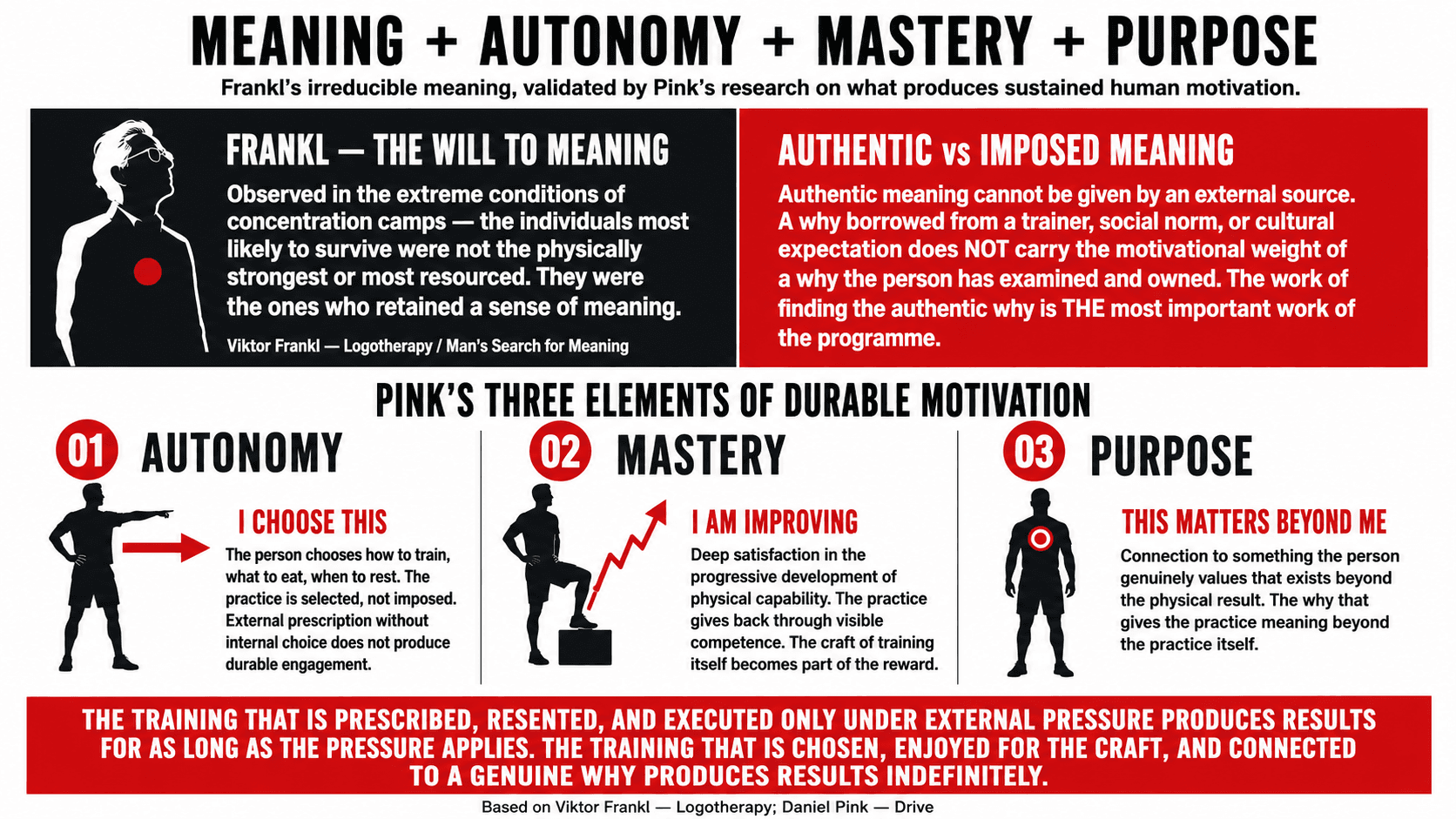
Viktor Frankl's logotherapy, the therapeutic framework he developed initially in the concentration camps of the Second World War and subsequently elaborated into a comprehensive theory of human motivation, provides the most extreme test case available for the claim that purpose sustains behaviour under conditions that would otherwise make it impossible. Frankl observed, in circumstances of physical deprivation and psychological suffering that cannot be overstated, that the individuals most likely to survive were not the physically strongest or the most resourced but the ones who had retained a sense of meaning in their experience. The will to meaning, in Frankl's formulation, is not a luxury available to those whose basic needs are met. It is the primary motivational driver of human behaviour, active even under conditions in which all other drivers have been stripped away (3).
Frankl's Nietzsche quotation is the formulation he returned to most often: he who has a why to live for can bear almost any how. In health behaviour terms, the translation is direct. The person who has a genuine why for their health practice can bear the difficult sessions, the slow weeks, the periods of disrupted sleep, the social occasions that require a different choice from the one that would be easier, and the years of consistent effort that precede the full expression of the change they are building. The person whose motivation is only a what, a target weight or a physique goal, has no comparable resource when the how becomes genuinely difficult.
Frankl distinguished between the meaning that is found in suffering and the meaning that is imposed on it, and his framework insists that authentic meaning cannot be given to a person by an external source. It must be discovered by the individual as genuinely their own. In health behaviour terms, this means that a why that is borrowed from a trainer, a social norm, or a cultural expectation about what a healthy body should look like does not carry the motivational weight of a why that the person has genuinely examined and owned. The work of identifying the authentic personal why is not a soft preliminary to the hard work of the programme. It is the most important work of the programme.
Daniel Pink's research on intrinsic motivation, drawn together in Drive, identifies three elements that produce the most durable human motivation: autonomy, mastery, and purpose. The most durable health practices tend to share all three. The person chooses how to train, finds deep satisfaction in the progressive development of physical capability, and connects the whole practice to something they genuinely value. The training that is prescribed, resented, and executed only under external pressure produces results for as long as the external pressure applies. The training that is chosen, enjoyed for the craft of it, and connected to a genuine why produces results indefinitely (4).
Key Insight
The authentic personal why has a specific quality that distinguishes it from the borrowed or conventional why. It is slightly embarrassing to say out loud. It refers to something specific rather than general. It connects the health behaviour to a person, a responsibility, or a version of life that the person can picture with some specificity. If your why is to be healthier or to look better, you have not yet reached the authentic why. Those are valid aspirations, but they are not yet the level at which durable motivation lives. Keep asking the question.
Outcome-Driven vs Purpose-Driven Health Behaviour: How the Response Differs at Every Critical Juncture
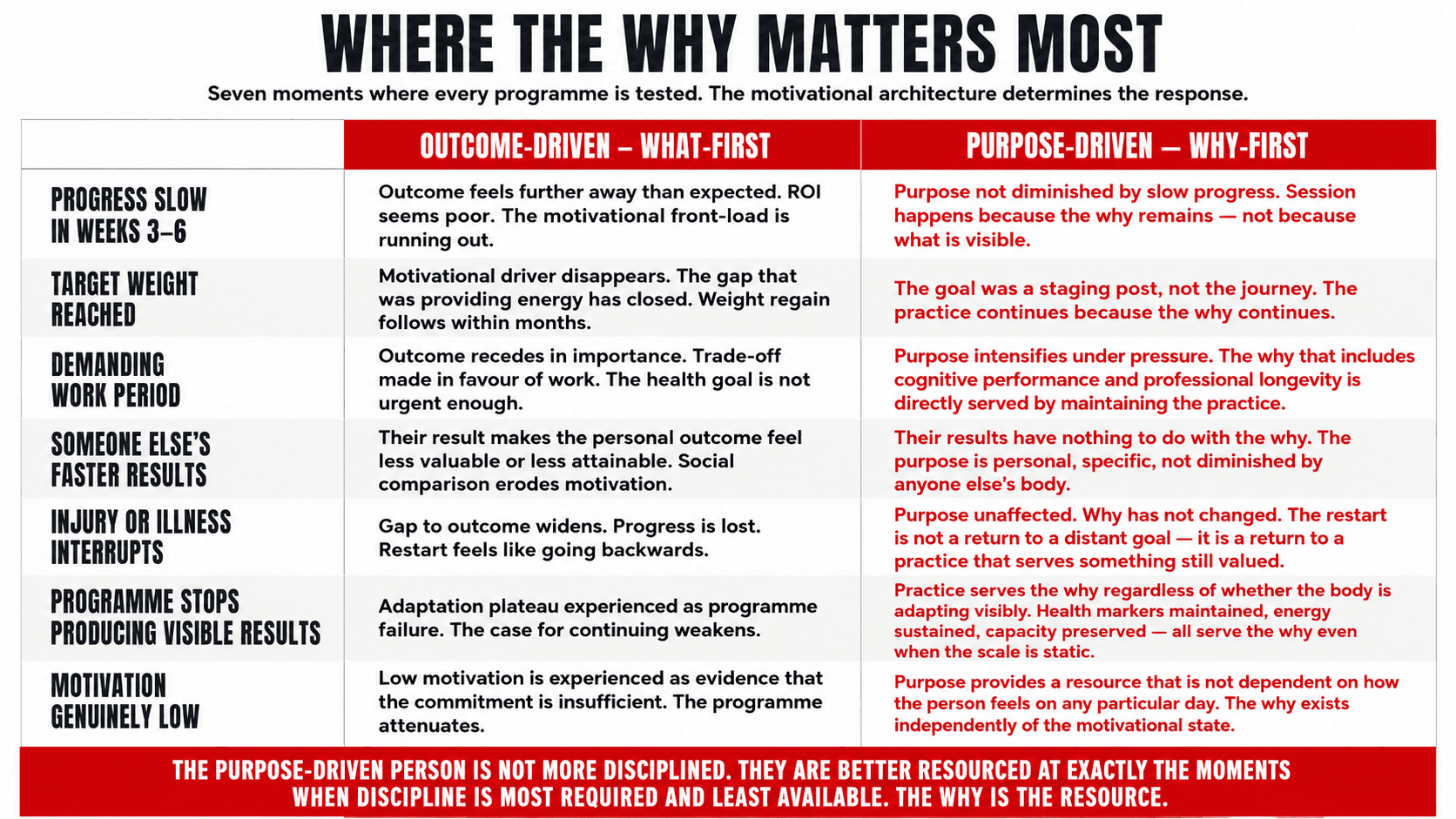
The difference between outcome-driven and purpose-driven health behaviour is most visible not in the easy weeks but in the critical moments when the programme is under pressure. The seven scenarios below represent the most common junctures at which a health programme is most likely to be abandoned or sustained. The response of the outcome-driven and the purpose-driven person to each scenario is characteristically different, and the difference is entirely a function of the motivational architecture underlying the behaviour.
| Critical Juncture | Outcome-Driven Response (What-first motivation) | Purpose-Driven Response (Why-first motivation) |
|---|---|---|
| Progress is slow in weeks three to six | The outcome feels further away than expected. The return on effort seems poor. The question of whether this is working arises and begins to undermine consistency. The motivation front-load is running out. | The purpose is not diminished by slow progress. The reason for training has nothing to do with how fast the results are appearing. The session happens because the why remains, not because the what is visible. |
| The target weight or body composition goal is reached | The motivational driver disappears. The gap that was providing the energy has closed. The behaviour has no clear driver in its absence and begins to attenuate. Weight regain or detraining follows, often within months. | The purpose is not served by reaching a specific target. It is served by the sustained practice. The goal was a staging post within a longer journey, not the journey itself. The practice continues because the why continues. |
| A very demanding work period leaves minimal time and energy | The outcome goal recedes in importance when competing with the professional pressure. The trade-off is made in favour of work because the health outcome is not as immediately urgent as the professional deadline. | The purpose may actually intensify under professional pressure. The why that includes cognitive performance, sustained energy, and long-term professional longevity is directly served by maintaining the health practice during demanding periods. |
| Comparison with someone achieving faster results | The outcome comparison is disheartening. Their result makes the personal outcome feel less valuable or less attainable. Social comparison erodes the motivation. | The purpose has nothing to do with their results. The why is personal, specific, and not diminished by someone else's body composition or training performance. The comparison simply is not relevant to the practice. |
| An injury or illness disrupts training for several weeks | The gap between current state and outcome goal widens. Progress is lost. The restart feels like going backwards. The motivational cost of restarting is high. | The purpose is unaffected by the interruption. The why has not changed. The restart is not a return to a distant goal. It is a return to a practice that serves something the person still values for the same reasons. |
| The programme stops producing visible results | Adaptation plateau is experienced as programme failure. The outcome that was motivating the behaviour is no longer forthcoming. The rational case for continuing weakens. | The purpose is served by the practice regardless of whether the body is currently adapting visibly. The health markers being maintained, the energy sustained, the capacity preserved, all serve the why even when the scale is static. |
| Motivation is genuinely low for an extended period | Low motivation is experienced as evidence that the commitment is insufficient. The outcome goal does not provide enough pull to overcome the absence of feeling. The programme attenuates. | The purpose provides a motivational resource that is not dependent on how the person feels on any particular day. The why exists independently of the motivational state. The practice continues because of what it serves, not because of how it feels. |
The purpose-driven person is not more disciplined than the outcome-driven person. They are better resourced at exactly the moments when discipline is most required and least available. The why is the resource. Without it, the difficult moments are met with willpower alone. With it, they are met with something that does not deplete.
Building Your Personal Health Mission: A Structured Process for Finding the Why That Holds
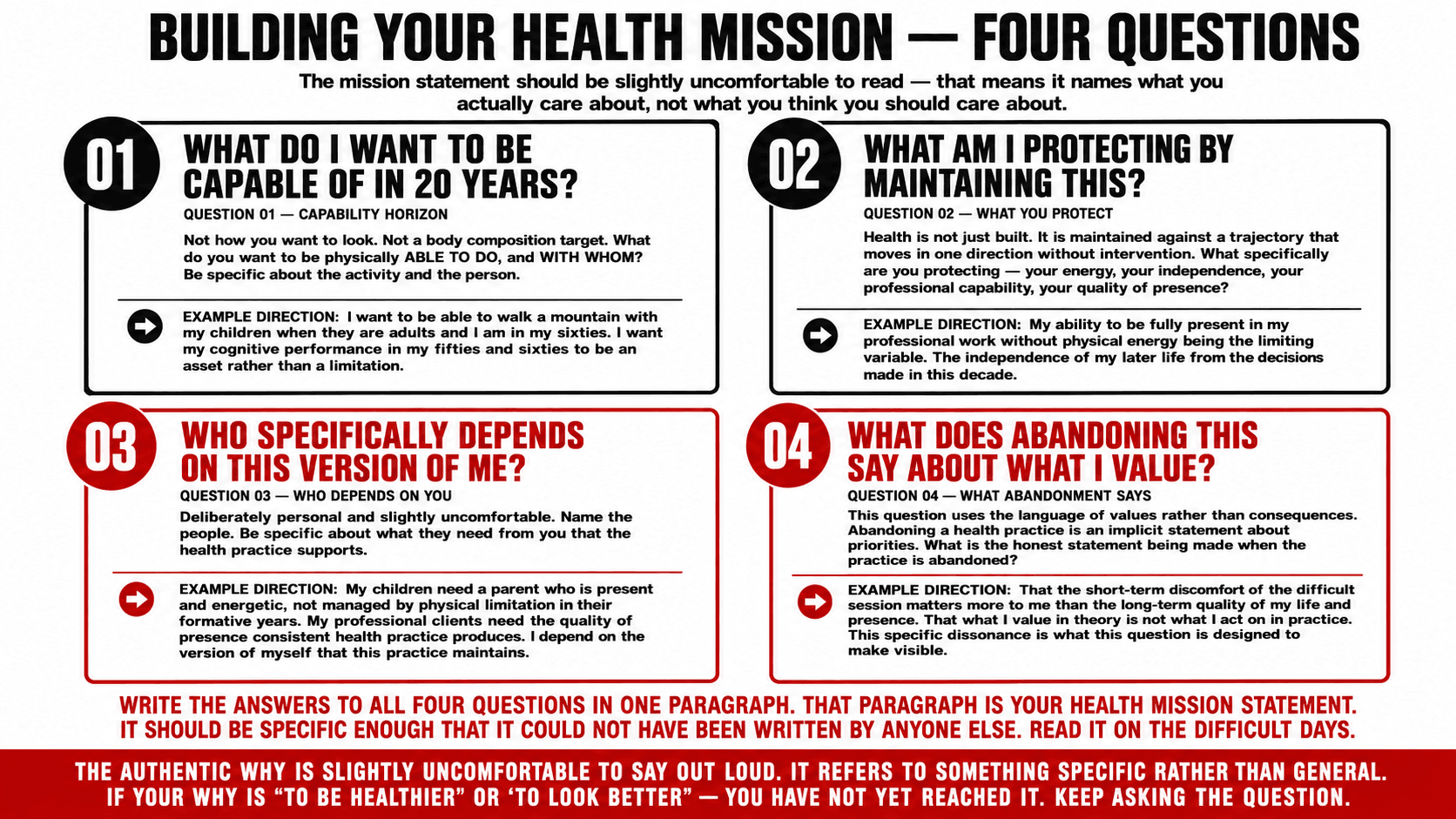
A health mission statement is not a motivational poster sentiment. It is a specific, personal, and honest articulation of why your health practice matters to you at the level of your values, your relationships, and the kind of life you want to be capable of living. Done well, it is the document you return to on the difficult days when the what and the how are not providing sufficient pull. Done badly, it is a borrowed aspiration dressed in personal language. The difference between the two is specificity and honesty.
The process below walks through the construction of a genuine personal health mission in four questions. The answers to these questions, combined, should produce something that is slightly uncomfortable to read because of how specifically it names what you actually care about rather than what you think you should care about.
| The Question | How to Answer It Honestly | Example Answer (template to personalise, not copy) |
|---|---|---|
| Question 1: What do I want to be capable of in twenty years? | Not how you want to look. Not a body composition target. What do you want to be physically able to do, and who do you want to be able to do it with? Be specific about the activity and the person. | I want to be able to walk a mountain with my children when they are adults and I am in my sixties. I want to play with my grandchildren at a level of energy and physical capability that I choose rather than at a level determined by my physical decline. I want my cognitive performance in my fifties and sixties to be an asset rather than a limitation. |
| Question 2: What am I protecting by maintaining this? | Health is not just built. It is maintained against a trajectory that moves in one direction without intervention. What specifically are you protecting: your energy, your independence, your professional capability, your quality of presence? | I am protecting my ability to be fully present in my professional work without physical energy being the limiting variable. I am protecting the independence of my later life from the decisions made in this decade. I am protecting my relationship with my own body from the consequence of consistent neglect. |
| Question 3: Who specifically depends on the version of me that this practice produces? | This question is deliberately personal and slightly uncomfortable. Name the people. Be specific about what they need from you that the health practice supports. | My children need a parent who is present and energetic, not managed by physical limitation in their formative years. My professional clients need the quality of presence and energy that consistent health practice produces. I depend on the version of myself that this practice maintains. |
| Question 4: What does abandoning this practice say about what I value? | This question uses the language of values rather than consequences. Abandoning a health practice is not just a behaviour. It is an implicit statement about priorities. What is the honest statement being made when the practice is abandoned? | Abandoning this practice says that the short-term discomfort of the difficult session matters more to me than the long-term quality of my life and presence. It says that what I value in theory is not what I act on in practice. That specific dissonance is what this question is designed to make visible. |
Write your answers to all four questions in one paragraph. That paragraph is your health mission statement. It should be specific enough that it could not have been written by anyone else. Read it on the difficult days. It is the why. Everything else is the how and the what.
The Mission Layer Brings Everything Else Together
This is the final article in the Mindset series, and it is deliberately placed last because it is the layer that gives everything else in the series its deepest structural support. The identity work in the first articles of this series is most powerful when the identity being built is in service of a genuine why. The habit architecture discussed through the middle of the series holds most durably when the habits are expressions of a purpose rather than means to an outcome. The commitment devices, the non-negotiable standards, and the resilience practices explored in the later articles are most accessible when there is a why strong enough to make the commitment feel worth the cost.
The neuroplasticity discussed in the previous article is most active under conditions of genuine engagement and meaning. Merzenich's research and Doidge's documentation both show that the brain's capacity for change is enhanced by the emotional and motivational significance of the experience. The person who is training in service of something they genuinely care about is bringing a quality of attention and emotional engagement to the practice that accelerates the myelination process compared to the person performing the same movements for an outcome they are only moderately invested in. The why is not separate from the physiology. It is a variable in it.
Simon Sinek's observation that people do not buy what you do, they buy why you do it applies with equal force to the internal transaction of personal motivation. You do not sustain a health practice because of what it produces in the short term. You sustain it because of why it matters, and that why is the layer that determines whether the practice continues through the full range of conditions it will encounter across the years required to produce a genuinely transformed relationship with health.
The most consistent pattern I observe across twenty-five years of training and fifteen years of professional coaching is this: the people who build health practices that last for decades rather than months are not unusually disciplined or unusually gifted. They are people who have found their specific, personal, honest why, and who have built their practice as an expression of it rather than as a means to an outcome that motivation will struggle to sustain. The why is not a soft question. It is the most important question in the programme.
I work one-to-one with clients online globally. Every coaching relationship begins with this question: not what do you want to achieve, but why does your health matter to you? The answer to the second question is the foundation on which everything else in the programme is built. If the foundation is genuine, the structure it supports will last.
Work with Me
Get a personalised coaching plan built around your goals, your schedule, and your life.
Enquire NowReferences
- Sinek S. Start With Why: How Great Leaders Inspire Everyone to Take Action. New York: Portfolio/Penguin; 2009.
- Deci EL, Ryan RM. Intrinsic Motivation and Self-Determination in Human Behavior. New York: Plenum; 1985.
- Frankl VE. Man's Search for Meaning. Boston: Beacon Press; 1959 (originally published 1946).
- Pink DH. Drive: The Surprising Truth About What Motivates Us. New York: Riverhead Books; 2009.
- Deci EL, Koestner R, Ryan RM. A meta-analytic review of experiments examining the effects of extrinsic rewards on intrinsic motivation. Psychological Bulletin. 1999; 125(6): 627-668.
- Ryan RM, Deci EL. Self-determination theory and the facilitation of intrinsic motivation, social development, and well-being. American Psychologist. 2000; 55(1): 68-78.
- Steger MF, Kashdan TB. The unbearable lightness of meaning: well-being and unstable meaning in life. Journal of Positive Psychology. 2007; 2(2): 103-115.
- Baumeister RF, Vohs KD. The pursuit of meaningfulness in life. In: Snyder CR, Lopez SJ, eds. Handbook of Positive Psychology. Oxford: Oxford University Press; 2002.