
The Wrong Diagnosis That Keeps Producing the Same Result
Systems-based health behaviour is the concept that resolves the most persistent and most demoralising cycle I encounter in coaching: the person who is genuinely motivated, who has tried multiple times, who has achieved results and then lost them, who describes themselves as lacking willpower or consistency or accountability, and who has concluded, with the particular exhaustion of someone who has been in this cycle for years, that the problem is something constitutional about them. They are not disciplined enough. They do not want it badly enough. They cannot be trusted with their own health.
This diagnosis is almost always wrong. Not always, but almost always. The problem is not the person. The problem is the architecture of the attempt. They are trying to produce reliable, consistent, long-term behaviour change using motivation as the primary mechanism, and motivation, as I have described elsewhere in this series, is the least reliable mechanism available for producing that kind of behaviour. It peaks at the point of decision, when the gap between the current state and the desired state is most vivid and the emotional charge of the intention is highest. It then declines, reliably and predictably, as the initial charge dissipates and the daily reality of the work takes over.
The person who is waiting to feel motivated enough to train is waiting for a physiological state that arrives inconsistently, stays briefly, and is crowded out by every competing demand that a full adult life generates. They are not weak. They are using the wrong tool for the job. Motivation is an excellent ignition mechanism and a poor sustaining mechanism. Systems are poor ignition mechanisms and excellent sustaining ones. The intelligent approach uses both in the right order: motivation to start, systems to continue. Most people never install the systems, and then diagnose themselves as lacking the motivation that was never designed to carry the full load on its own.
“You do not rise to the level of your goals. You fall to the level of your systems.” — James Clear
Why Goals Without Systems Produce Temporary Change at Best
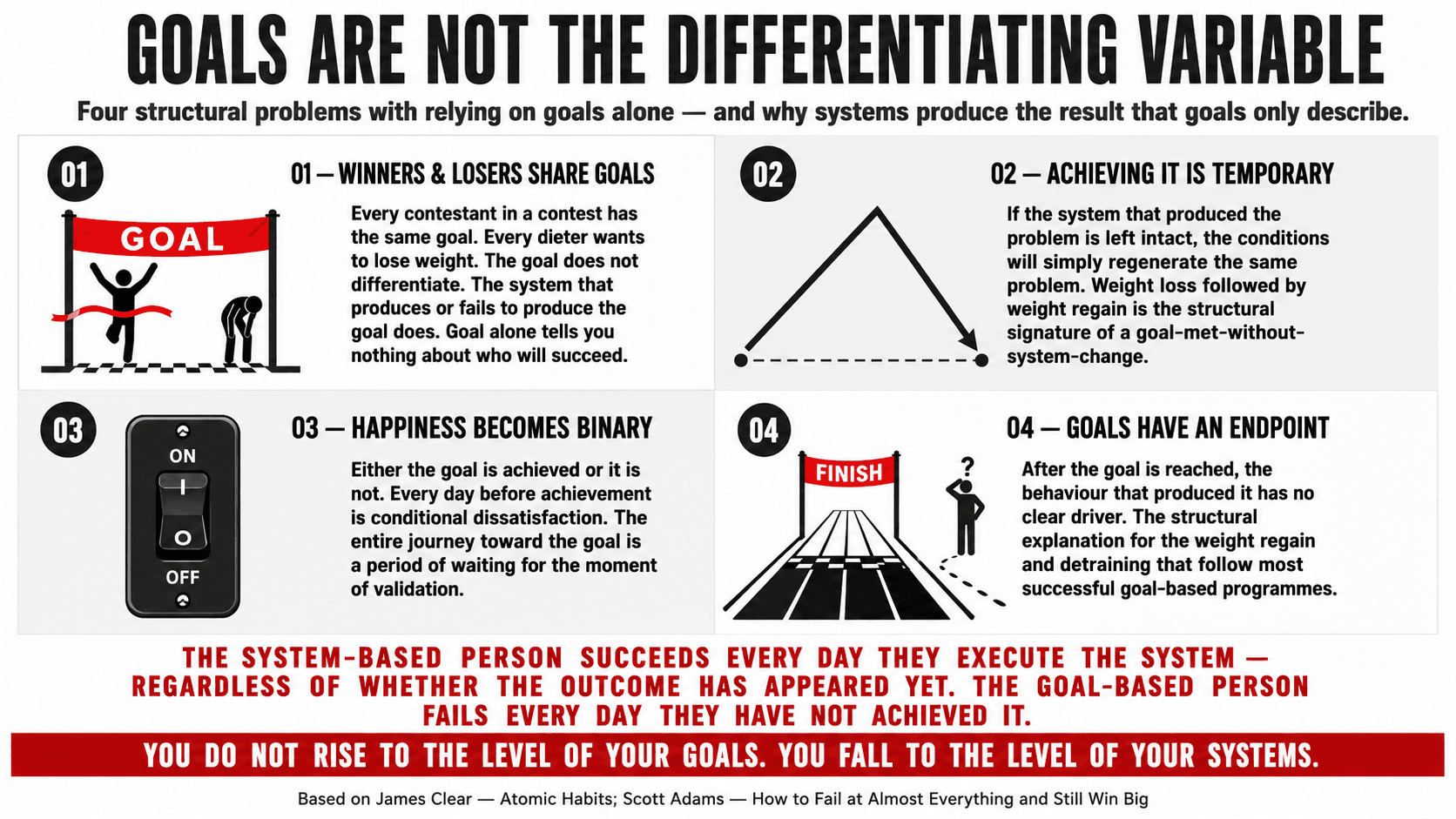
James Clear's articulation of the goals versus systems distinction in Atomic Habits is the clearest and most practically grounded treatment of this idea available, and it is worth engaging with directly because it reframes the entire question of health behaviour change in a way that is both more honest and more useful than most of what the health and fitness industry offers. Clear's observation is that goals and systems are not the same thing and should not be treated as though they are. A goal is a desired outcome. A system is the collection of daily processes that produces that outcome. A person can share a goal with someone and produce completely different outcomes depending on whether the system matches the goal or not (1).
Clear identifies four problems with relying on goals alone. Winners and losers often share the same goals, which means the goal is not the differentiating variable. Achieving a goal produces only temporary change if the system that produced the problem is left intact, because the conditions will simply regenerate the same problem over time. Goals restrict happiness to a binary state: either achieved or not achieved, which makes the entire journey toward the goal a period of conditional dissatisfaction. And goals have an endpoint, after which the behaviour that produced them is no longer clearly motivated, which is the structural explanation for the weight regain and detraining that follow most successful goal-based health programmes (1).
Scott Adams, creator of Dilbert and author of How to Fail at Almost Everything and Still Win Big, arrives at the same conclusion from an explicitly personal and pragmatic direction. Adams argues that systems are superior to goals not merely as a motivational philosophy but as a practical life strategy. His definition of a system is any approach that has a reasonable chance of improving the person's odds of success across multiple domains over time, regardless of whether a specific outcome is achieved on any particular day. The person following a system is succeeding every day they execute the system, regardless of whether the outcome has appeared yet. The person following a goal is failing every day they have not achieved it (2).
The practical consequence of this distinction is significant for how people experience their health programmes day to day. The goal-based person who completes a training session in a week when the scale showed no change has, in their own accounting, made no progress. The system-based person who completes the same session has executed the system. They have succeeded today regardless of the scale, because today's metric is whether the system ran, not whether the outcome has arrived. This is not a semantic trick. It is a fundamentally different relationship with the daily behaviour, and it produces a fundamentally different emotional experience of the programme across the months it takes to produce visible change.
Key Insight
Ask yourself honestly: do you have a goal or do you have a system? A goal describes where you want to end up. A system describes what Tuesday looks like, what the kitchen contains, what time training happens, what happens when the difficult moment arrives, and how recovery from a setback is handled. If you can describe your goal clearly but hesitate when asked to describe your system in the same detail, the goal is the decoration and the missing system is the structure. Decoration does not produce behaviour. Structure does.
Motivation vs Systems: The Eight Dimensions That Determine Which One You Are Actually Running
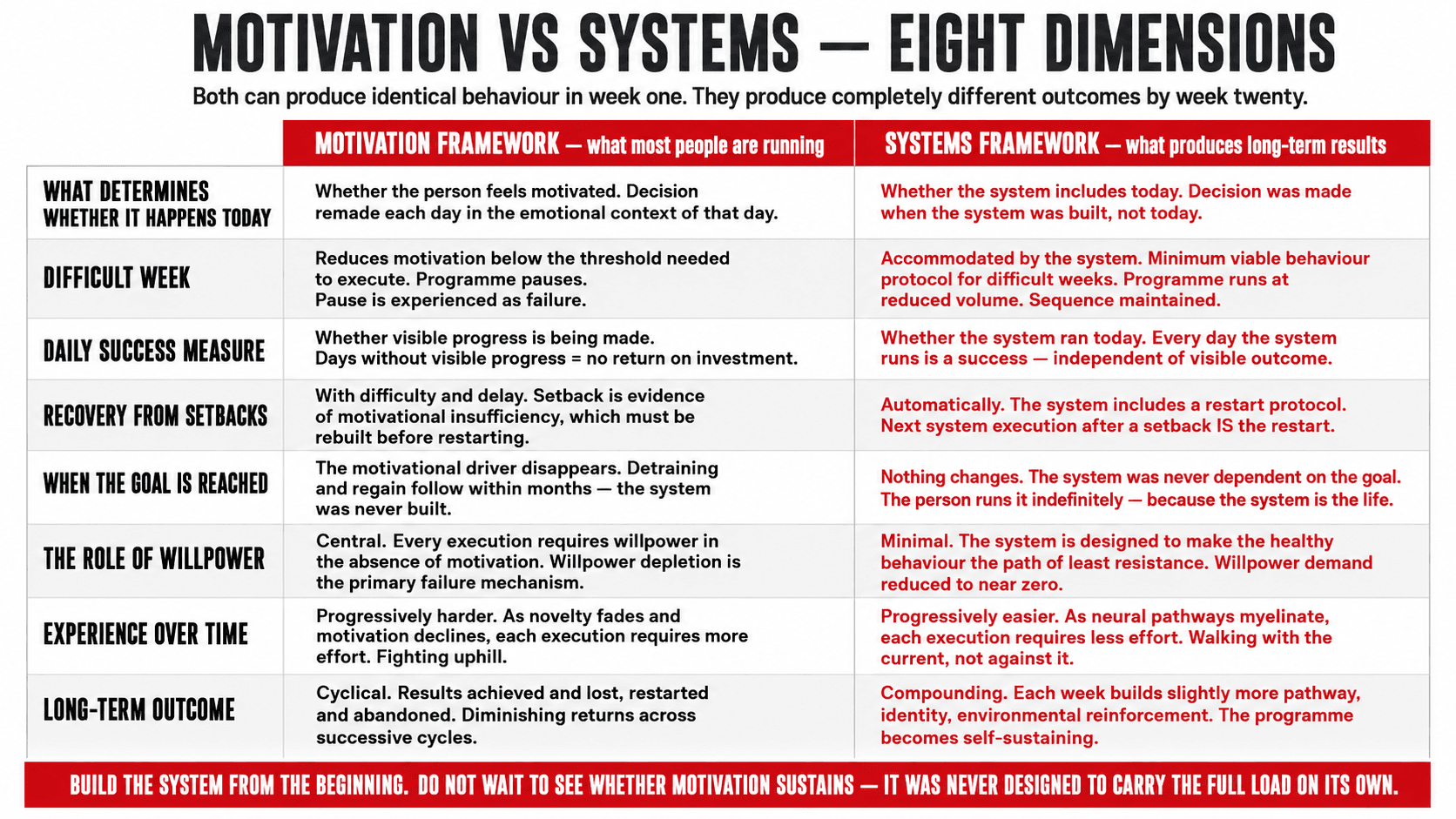
The motivation framework and the systems framework produce different experiences of the same health programme from day one. Both can produce identical behaviour in the early weeks, when motivation is high and the novelty of the programme sustains the effort. The divergence appears in weeks four through twelve, when novelty has worn off, the daily grind of the work has replaced the initial excitement, and the only thing between the person and the exit is whatever sustaining mechanism they built at the start.
| Dimension | Motivation Framework (What most people are running) | Systems Framework (What produces consistent long-term results) |
|---|---|---|
| What determines whether the behaviour happens today | Whether the person feels motivated. The decision is remade each day in the emotional context of that day: the energy level, the workload, the mood, the weather. The behaviour is at the mercy of all of them. | Whether the system includes today. The behaviour happens because the system is running, not because today's emotional state is favourable. The decision was made when the system was built, not today. |
| What happens in a difficult week | The difficult week reduces motivation below the threshold needed to execute the behaviour. The programme pauses, or stops. The pause is experienced as failure, which further reduces motivation for the restart. | The difficult week is accommodated by the system. The system includes a minimum viable behaviour protocol for difficult weeks. The programme does not pause. It runs at reduced volume. The sequence is maintained. |
| How success is measured daily | Whether visible progress is being made toward the outcome. Days without visible progress are experienced as no return on investment. The motivation to invest tomorrow is reduced by today's invisible return. | Whether the system ran today. Every day the system runs is a success day, independent of visible outcome. The person is succeeding every day they execute the process, even when the result has not yet appeared. |
| How recovery from setbacks works | With difficulty and delay. The setback is evidence of motivational insufficiency, which the person must rebuild before restarting. The longer the delay between setback and restart, the harder the restart becomes. | Automatically. The system includes a restart protocol. The next system execution after a setback is the restart. There is no motivational rebuilding required because the behaviour is not contingent on the motivational state. |
| What happens when the goal is reached | The motivational driver disappears. The behaviour that produced the result has no clear driver in the absence of the goal. Detraining and regain follow, often quickly, because the system was never built. | Nothing changes. The system was never dependent on the goal for its execution. The person who built a system runs it indefinitely, because the system is the life, not the means to an outcome that was eventually reached. |
| The role of willpower | Central. Every decision to execute the behaviour in the absence of motivation requires willpower. The daily willpower demand is high and cumulative. Willpower depletion is the primary mechanism of programme failure. | Minimal. The system is designed to make the healthy behaviour the path of least resistance. Good system design reduces the willpower demand of healthy behaviour to near zero for its standard execution. |
| The experience of the programme over time | Progressively harder. As novelty fades and initial motivation declines, each execution of the behaviour requires more effort than the one before. The programme feels like fighting uphill. | Progressively easier. As the system runs and the neural pathways for the behaviours myelinate, each execution requires less effort than the previous one. The programme feels like walking with rather than against the current. |
| Long-term outcome | Cyclical. Results achieved and lost, restarted and abandoned, with diminishing returns across successive cycles as each failure accumulates evidence for the limiting belief that this is simply how it is for me. | Compounding. Each week the system runs builds slightly more neural pathway, slightly more identity, slightly more environmental reinforcement. The programme becomes progressively more self-sustaining over time. |
The motivation framework and the systems framework can produce identical behaviour in week one. They produce completely different outcomes in week twenty. The divergence is invisible at the start and decisive at the end. Build the system from the beginning. Do not wait to see whether motivation sustains.
BJ Fogg, Friction, and the Architecture of Easy
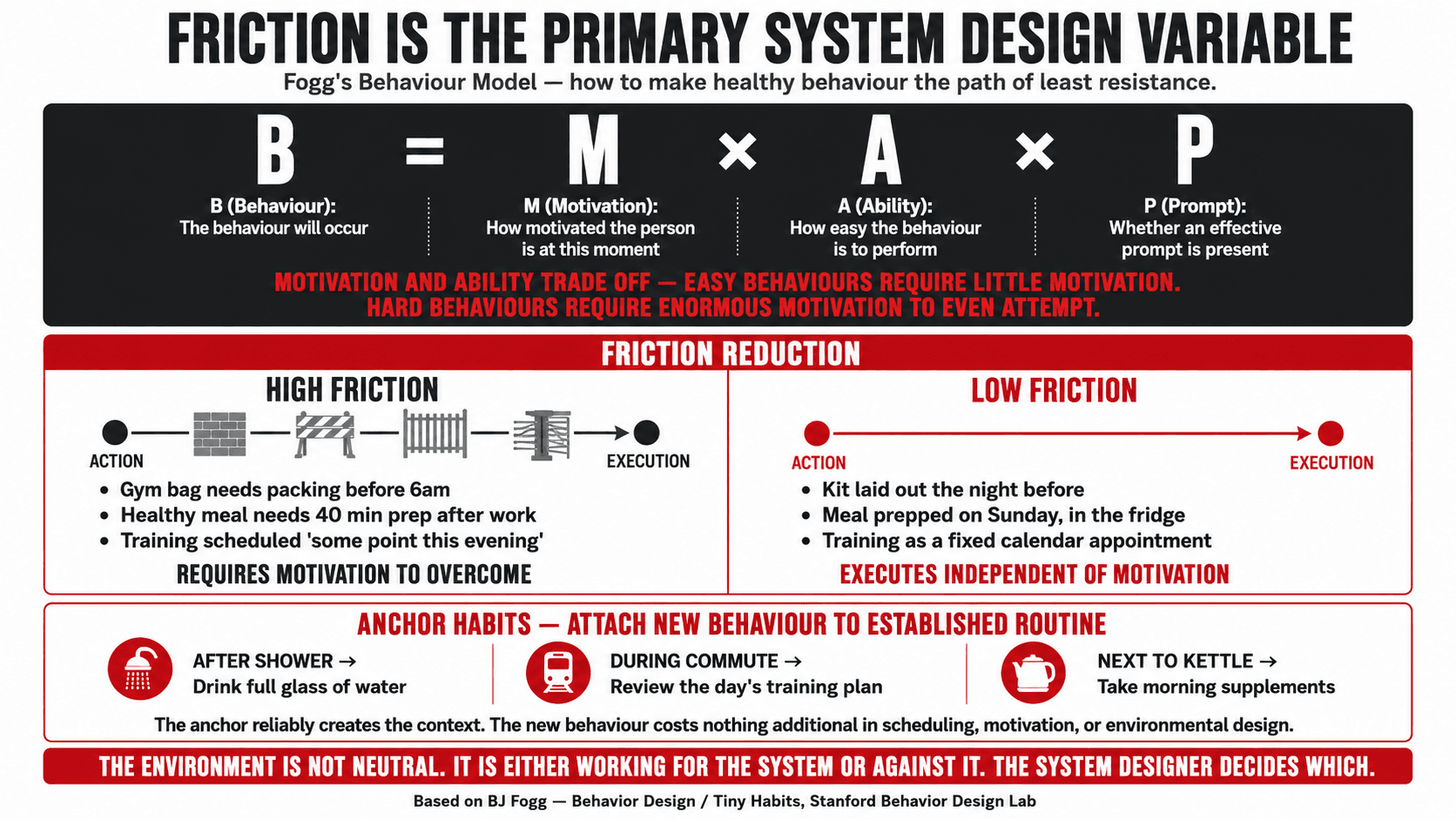
BJ Fogg's behaviour design research at Stanford, developed over two decades and most accessibly presented in Tiny Habits, provides the most granular available framework for understanding how systems work at the level of individual behaviour design. Fogg's central insight is that behaviour is a function of three variables: motivation, ability, and a prompt. At any given moment, the probability that a behaviour will occur depends on the intersection of how motivated the person is, how easy the behaviour is to perform, and whether an effective prompt is present. The critical insight for system design is that motivation and ability trade off against each other: a behaviour that is extremely easy to perform requires very little motivation to execute, and a behaviour that is extremely difficult to perform requires enormous motivation even to attempt (3).
The system designer's primary tool is friction management. Friction is the practical difficulty of performing a behaviour in its current environmental and logistical context. High-friction healthy behaviours require more motivation to execute than low-friction ones. The gym bag that needs to be packed before a 6am session is a friction point. The gym kit already laid out the night before has removed it. The healthy meal that requires forty minutes of preparation after a depleted day of work is a friction point. The meal prepped on Sunday afternoon and waiting in the fridge has removed it. The training session scheduled at an ambiguous some point this evening is a friction point. The training session blocked as a fixed calendar appointment at a specific time is a friction point reduced.
The reverse application of the same principle is equally important. While healthy behaviours should be made as frictionless as possible, unhealthy behaviours should have friction deliberately added to them. The biscuits on the kitchen counter are a zero-friction temptation. The same biscuits behind a cupboard door, inside an opaque container, on a high shelf, have three friction points between the impulse and the action. The research on food environment and dietary behaviour consistently shows that proximity and visibility of food are among the strongest predictors of consumption, independent of the person's stated dietary intentions. The environment is not neutral. It is either working for the system or against it, and the system designer decides which (4).
Fogg also identifies the concept of the anchor habit: an existing behaviour that is already reliable and automatic, to which a new behaviour can be attached as an immediate successor. The shower is an anchor. Drinking a full glass of water immediately after the shower is a new behaviour with near-zero additional friction because the anchor reliably creates the context in which it occurs. The commute is an anchor. A specific podcast, or five minutes of deliberate breathing, or a brief review of the day's training plan during the commute is a new behaviour that costs nothing additional in terms of scheduling, motivation, or environmental design. Anchor habits are the structural scaffolding on which new system behaviours are most efficiently and reliably built (3).
Key Insight
Audit your current health programme for its five highest friction points. These are the specific moments where the gap between what you intend to do and what you actually do is widest. Write them down precisely. Then design a specific friction reduction for each one. Not a motivational strategy. A physical, logistical, environmental change that makes the healthy behaviour easier to do than not do. The system does not appeal to your better nature. It makes your better nature the path of least resistance.
The System Audit: Ten Common Health Behaviour Friction Points and Their Structural Fixes
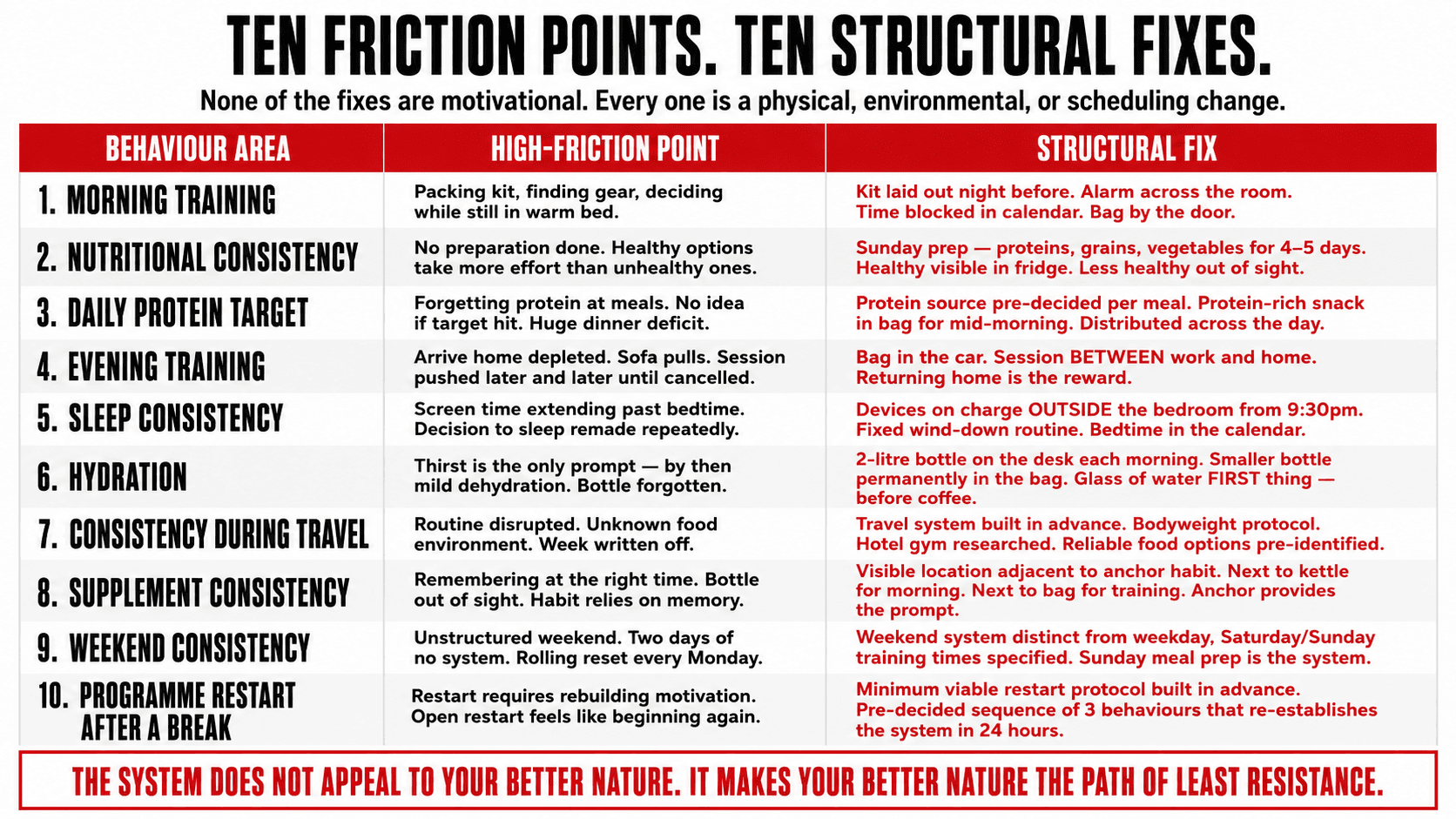
The ten friction points below represent the most common places where health programmes break down not because the person lacks motivation but because the environment and logistics of the behaviour have not been designed. The fix in each case is not a motivational intervention. It is a structural one: a specific physical, environmental, or scheduling change that reduces the activation energy for the healthy behaviour and, where relevant, increases the friction for the competing unhealthy alternative.
| Behaviour Area | Current High-Friction Point | The Structural System Fix | What Friction Is Removed |
|---|---|---|---|
| Morning training | Deciding whether to get up, packing kit, finding gym gear, committing to the session while still in the comfort of bed. | Kit laid out the night before. Alarm placed across the room. Training time entered as a fixed calendar event. Bag by the door. Decision made at night when energy is available, not in the morning when the bed is warm. | Removes the morning decision, the kit-packing friction, the scheduling ambiguity, and the activation energy of the cold start. The only remaining step is execution. |
| Nutritional consistency | Arriving at mealtimes with no preparation done. Defaulting to whatever requires least effort or is most immediately available. Healthy choices requiring more time and decision than unhealthy ones. | Two-hour meal prep session each Sunday. Proteins, grains, and vegetables prepared and portioned for four to five days. Healthy options visible and immediately accessible in the fridge. Less healthy options out of sight, behind a cupboard, or not purchased. | Removes the mealtime decision and the preparation barrier. The healthy meal now requires less effort than the alternative. The system makes good nutrition the default rather than the deliberate choice. |
| Protein targets across the day | Forgetting to eat protein at certain meals. Not knowing whether the daily target has been met. Arriving at dinner with a large deficit requiring a single enormous protein meal. | Protein source decided and prepared for each of three main meals during Sunday prep. A protein-rich snack in the bag or desk drawer for mid-morning and afternoon. The target is distributed across the day and requires no in-the-moment decision. | Removes the daily protein calculation and the forgetfulness that disrupts the target. The system distributes the behaviour across fixed points in the day rather than relying on memory and decision under a depleted state. |
| Evening training after work | Arriving home after a depleted day. Sitting down briefly. The pull of the sofa competing with the pull of the gym. The session is pushed to later and later until it does not happen. | Training bag in the car, not the house. Session happens between work and home, not after arrival home. The commute route passes the gym. Returning home is the reward for completing the session rather than the context in which the session must be motivated from scratch. | Removes the transition point between work and home where the session is most vulnerable. The system places the session in the only available window where the competing pull of the sofa does not yet exist. |
| Sleep consistency | Evening screen time extending past the intended sleep time. The decision to go to bed remade repeatedly as programmes continue or the phone remains in hand. | Devices on charge outside the bedroom from 9:30pm. A fixed wind-down routine that begins at the same time each evening and signals the nervous system that the day is ending. Sleep time entered in the calendar with the same status as a morning meeting. | Removes the device-in-hand barrier to sleep onset, the repeated decision about when to actually stop, and the blue light disruption of melatonin production. The routine is the system. The decision was made when the routine was designed. |
| Hydration | Drinking inadequate water by default because carrying a bottle requires remembering to fill it and take it. Thirst arriving as the only prompt, by which point mild dehydration is already established. | A two-litre bottle filled and placed on the desk each morning. A smaller bottle permanently in the training bag. A glass of water as the first action after waking, before coffee, before anything else. Visual cues rather than memory prompts. | Removes the daily filling decision, the forgetting-the-bottle point, and the absence of visual cue that makes water consumption an act of deliberate memory rather than an automatic environmental response. |
| Consistency across travel | Travel disrupts the routine. The gym is different or absent. The food environment is unpredictable. The system built for the home environment does not transfer, and the week is written off. | A travel system built in advance, separate from the home system. A bodyweight training protocol that requires no equipment. Research of the hotel gym or nearest facility before departure. A list of reliable high-protein food options at the most likely meal locations. | Removes the uncertainty about what to do in a non-standard environment. The travel system is the answer to a question that has been answered in advance rather than improvised under pressure in a strange hotel room on a depleted Tuesday evening. |
| Supplement consistency | Remembering to take supplements at the right time each day. The bottle in a cupboard out of sight. The timing ambiguous. The habit relying on memory rather than environment. | Supplements in a visible location adjacent to an anchor habit: next to the kettle for morning supplements, next to the training bag for pre or post training protocols. The anchor provides the prompt. The visibility removes the memory requirement. | Removes the daily memory requirement by replacing it with a visual prompt in the physical location where the anchor behaviour already occurs. The supplement habit piggybacks on the existing automatic behaviour. |
| Weekend consistency | The week's routine does not apply to the weekend, which is unstructured. Two or three days of no system produces a rolling reset that the weekday system then has to work against. | A weekend system distinct from the weekday system that accommodates the different schedule without abandoning the core behaviours. Specific training times for Saturday and Sunday. Meal prep is part of Sunday rather than an optional activity. The weekend is structured, differently, but structured. | Removes the assumption that structure is only for weekdays. The weekend system acknowledges the different rhythm while maintaining the core behaviours at a defined minimum. Two days outside the system across every week is twenty-eight days per quarter of no system. |
| Programme restart after a break | Restarting after a break requires rebuilding motivation that has partially dissipated. The restart feels like beginning again. The high activation energy of the restart keeps it perpetually one day away. | A minimum viable restart protocol designed in advance: the specific session to do on the first day back, the specific meal to eat, the specific time to wake. The restart is a single pre-decided sequence of three behaviours that re-establishes the system in twenty-four hours. It requires no motivational rebuild. It requires only execution of the protocol. | Removes the paralysis of the open restart, where the absence of a specific plan makes the restart as cognitively demanding as building the programme from scratch. The restart protocol is the bridge between the break and the system. It was built before it was needed. |
Notice that none of the fixes in the right column are motivational. None of them require the person to feel differently about the behaviour. Every fix is a physical, environmental, scheduling, or logistical change that alters the probability of the behaviour occurring independent of the motivational state. This is the point. Systems do not depend on how you feel. They depend on what you have designed.
Why Accountability Without a System Is Just Recurring Guilt
Accountability is the other tool people reach for when the programme is not holding together, and it has the same structural limitation as motivation when it is applied without a supporting system. Accountability creates a social or contractual cost for non-compliance with the intended behaviour. That cost can be sufficient to produce the behaviour in the presence of a reasonable level of motivation. What it cannot do is produce the behaviour consistently in the absence of a functioning system, because the system is what determines whether the behaviour is achievable given the actual conditions of the person's life on any given day.
The person who is accountable to a coach or a training partner for four sessions a week, but whose kitchen contains no prepared food, whose training kit is not packed until the morning of the session, whose training time is not fixed in the calendar and competes with an unstructured evening for its slot, is accountable for a result that their system is not designed to produce. The accountability creates social pressure. The system creates the conditions in which the pressure is actionable. Without the system, accountability produces compliance for as long as the social cost of non-compliance exceeds the friction of the behaviour. When the friction is high enough and the accumulated depletion of a busy life reaches a threshold, the social cost yields. The person experiences the shame of letting the accountability partner or coach down, which adds guilt to the original problem and frequently reduces rather than increases their motivation for the restart.
Accountability is powerful and worth using. I use it as a coaching tool every day. But accountability is the enforcement mechanism for a system, not the substitute for one. The client I can help most effectively is the one whose system is well-designed and whose accountability structure reinforces a system that is already making the behaviour achievable. The client who is most difficult to help with accountability alone is the one whose system makes the behaviour genuinely difficult to execute and who is using the social cost of accountability to override the daily friction rather than remove it. The override produces compliance under observation. The system produces behaviour independent of observation.
Key Insight
The test of a good system is whether the behaviour still happens when nobody is watching. The accountability partner sees four sessions a week. The system produces four sessions a week whether or not they are being counted. If removing the accountability would significantly change the behaviour, the system is not yet carrying the load it needs to carry. Build the system to the level where the accountability is a reinforcement, not a requirement.
The Compounding Return on a System That Runs
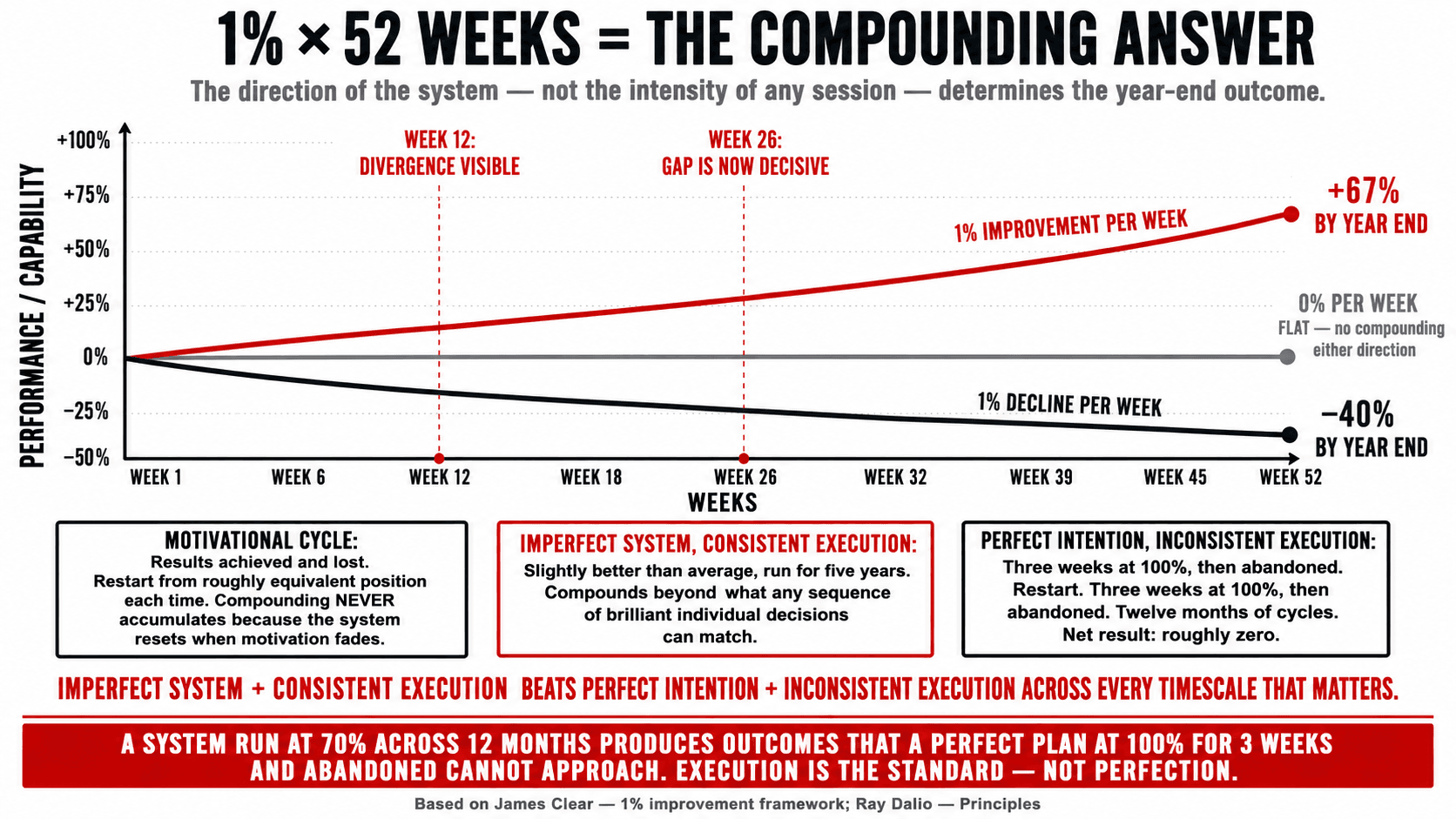
Ray Dalio's principles on systematised decision-making in the domain of investment and business management carry a direct application to personal health systems that Dalio himself has noted in the context of personal performance. His central insight is that a well-designed system, executed consistently over time, outperforms even exceptional individual decisions made case by case, because the system captures the accumulated learning of prior decisions, removes the variability introduced by emotional state and cognitive depletion, and compounds its effectiveness across every iteration. The system that is slightly better than average, run consistently for five years, produces returns that no sequence of brilliant individual decisions can match, because individual decisions are subject to all the variability and inconsistency that a system is specifically designed to eliminate (5).
James Clear's one percent improvement framework provides the arithmetic of this compounding. A system that produces a one percent improvement in health behaviour performance each week compounds to a result that is approximately sixty-seven percent better at the end of a year than it was at the start. A system that produces a one percent decline each week compounds in the opposite direction with equal force. The direction of the system, not the intensity of any particular session or the perfection of any particular week, is the variable that determines the outcome over a year-long programme (1).
The person who has been in the motivational cycle for years, achieving results and losing them, is not failing because they lack the intensity or the intelligence to succeed. They are producing cycles because the system resets when the motivation fades, which means the compounding never accumulates. Every restart is from a position roughly equivalent to the previous restart. The person who installs the system once and runs it imperfectly but consistently is producing compounding that does not reset when the motivation varies. Imperfect system plus consistent execution beats perfect intention plus inconsistent execution across every timescale that matters.
Key Insight
Design your system this week. Not your goals. Your system. Write down what Monday looks like, what the kitchen contains, what time training happens, what the restart protocol is, what happens when the difficult week arrives. Then run it imperfectly. Perfection is not the standard. Execution is. A system run at seventy percent across twelve months produces outcomes that a perfect plan run at one hundred percent for three weeks and abandoned cannot approach. The system is the answer. Build it before you need it to save you.
The System Is the Solution
When a client comes to me having failed repeatedly at health programmes they genuinely wanted to succeed at, my first question is not about their motivation. It is about their system. Walk me through your Monday. What time do you eat? Where is your food coming from? When does training happen and what triggers it? What does a difficult week look like in your system? What is your recovery protocol when you miss a session? These questions reveal the system, or the absence of it, faster and more accurately than any conversation about motivation, accountability, or how much the person wants to change.
The answers almost always contain the same structural finding: there is a goal and there is the intention to pursue it, but between the goal and the daily behaviour there is no designed architecture. The person is relying on motivation to bridge the gap between intention and action every single day, across every competing demand in a full adult life. The system I help them build is not complicated. It does not require extraordinary discipline or a perfectly controlled environment. It requires a set of specific, physical, logistical decisions made once, in advance, that reduce the activation energy for the healthy behaviour and increase the friction for the competing alternative. It requires a minimum viable behaviour protocol that keeps the sequence intact through difficult weeks. And it requires a restart protocol that makes the return after a break a single predetermined sequence of actions rather than a motivational challenge.
The person who builds this system is not a different person from the one who has been cycling through failed programmes. They are the same person with a different architecture. The motivation was always there. The accountability was sometimes there. The system is what was missing.
Work with Me
Get a personalised coaching plan built around your goals, your schedule, and your life.
Enquire NowReferences
- Clear J. Atomic Habits: An Easy and Proven Way to Build Good Habits and Break Bad Ones. London: Random House Business; 2018.
- Adams S. How to Fail at Almost Everything and Still Win Big: Kind of the Story of My Life. New York: Portfolio/Penguin; 2013.
- Fogg BJ. Tiny Habits: The Small Changes That Change Everything. New York: Houghton Mifflin Harcourt; 2019.
- Wansink B, Sobal J. Mindless eating: the 200 daily food decisions we overlook. Environment and Behavior. 2007; 39(1): 106-123.
- Dalio R. Principles: Life and Work. New York: Simon and Schuster; 2017.
- Gollwitzer PM, Sheeran P. Implementation intentions and goal achievement: a meta-analysis of effects and processes. Advances in Experimental Social Psychology. 2006; 38: 69-119.
- Thaler RH, Sunstein CR. Nudge: Improving Decisions About Health, Wealth, and Happiness. London: Penguin Books; 2009.
- Baumeister RF, Tierney J. Willpower: Rediscovering the Greatest Human Strength. New York: Penguin Press; 2011.