
If you have ever been in a fat loss phase that started well and then ground to a halt, you are not alone and you are not imagining it. Fat loss plateaus are one of the most common and most frustrating experiences in body composition coaching, and metabolic adaptation is the biological mechanism behind them. The problem is that most people do not understand what is actually happening in their body when progress stalls. They assume they are doing something wrong, that their metabolism is broken, or that they have hit some genetic limit. None of those things are true. What is happening is that your body is doing exactly what it evolved to do: fighting back against the energy deficit you have created, through a coordinated series of hormonal, neurological, and metabolic changes designed to slow weight loss and preserve your current body mass.
Understanding metabolic adaptation is not optional if you want to achieve lasting fat loss. It is the single most important concept that separates people who lose weight and keep it off from people who lose weight, regain it, lose it again, and spend years in a frustrating cycle of yo-yo dieting. Once you understand what your body is doing and why, you can plan for it, manage it, and ultimately outsmart it.
The typical scenario I see in my coaching practice looks like this. Someone starts a fat loss phase. For the first four to six weeks, results are excellent. The scale is moving, clothes are fitting better, energy is good. Then somewhere around weeks six to ten, progress slows. By weeks twelve to sixteen, the scale has stopped moving entirely, despite the person still doing everything they were doing at the start. This is where most people make one of two critical mistakes. Either they panic and slash calories further, which makes the adaptation worse, or they give up entirely and regain everything they lost. Both responses are driven by a misunderstanding of what metabolic adaptation is and how to manage it strategically.
What Metabolic Adaptation Actually Is
Metabolic adaptation, sometimes called adaptive thermogenesis, refers to the way your body reduces its total daily energy expenditure in response to a sustained calorie deficit. Crucially, this reduction goes beyond what would be predicted simply from the loss of body mass. When you lose weight, you expect to burn fewer calories because you are carrying less tissue. That is straightforward physics. Metabolic adaptation is the additional reduction on top of that, driven by your body's survival mechanisms actively working to close the gap between the energy coming in and the energy going out.
A comprehensive review published in the Journal of the International Society of Sports Nutrition by Trexler and colleagues examined the full scope of these adaptations. They found that energy restriction and weight loss produce reductions across every component of total daily energy expenditure: basal metabolic rate, exercise activity thermogenesis, non-exercise activity thermogenesis (known as NEAT), and the thermic effect of food. Due to adaptive thermogenesis, total daily energy expenditure drops to a level that exceeds what would be predicted from body mass losses alone. The review also found that these adaptations persist after the active weight loss period, even in people who have maintained their reduced weight for over a year (1).
In plain language, your body becomes more efficient at using energy when you diet. It burns less at rest, burns less during exercise, burns less through daily movement, and extracts more from the food you eat. Every single component of energy expenditure is affected. This is not a malfunction. This is your body's survival system working exactly as intended.
How Metabolic Adaptation Affects Every Component of Your Daily Energy Expenditure
Adapted from Trexler et al., Journal of the International Society of Sports Nutrition, 2014 (1). Every single component drops during a sustained deficit.
| Component | What It Is | How It Adapts During Fat Loss |
|---|---|---|
| Basal Metabolic Rate (BMR) | Energy burned at complete rest to maintain basic life functions. Accounts for 60 to 70% of total daily expenditure. | Decreases beyond what body mass loss alone would predict. Thyroid hormone (T3) drops, reducing metabolic rate at the cellular level (1). |
| Exercise Activity Thermogenesis (EAT) | Calories burned during structured exercise such as resistance training, running, or cycling. | Muscles become more efficient, meaning the same workout burns fewer calories than it did before the deficit (1). |
| Non-Exercise Activity Thermogenesis (NEAT) | All movement outside of structured exercise: walking, fidgeting, standing, household tasks, posture maintenance. | Often the largest and most underappreciated drop. People unconsciously move less, fidget less, and sit more as the deficit continues (1). |
| Thermic Effect of Food (TEF) | Energy used to digest, absorb, and process food. Typically 8 to 15% of calorie intake. | Drops because you are eating less food overall, and hormonal changes reduce digestive efficiency (1). |
The Biggest Loser Study: A Cautionary Tale
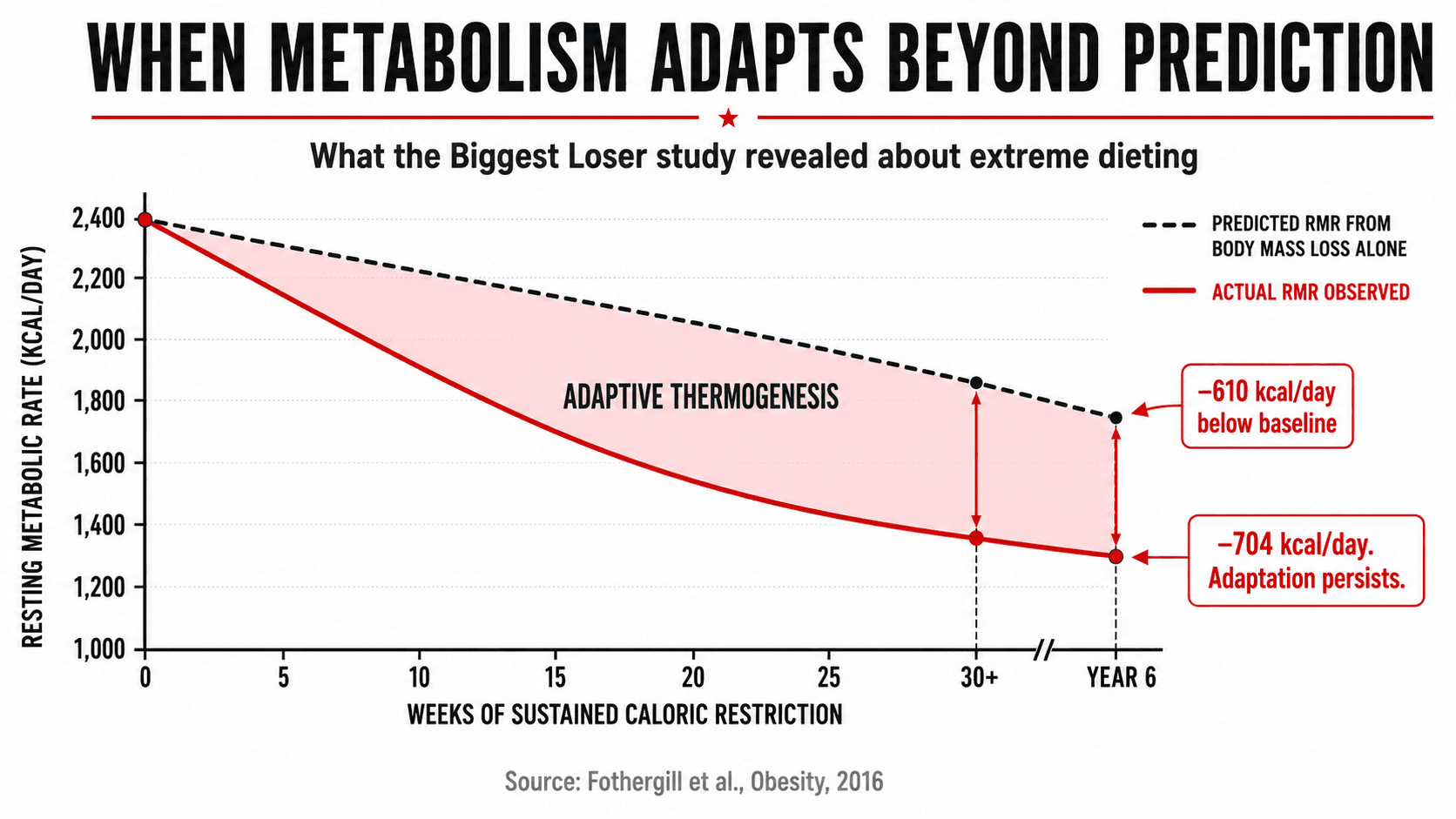
The most striking demonstration of metabolic adaptation in the scientific literature comes from a study published in the journal Obesity by Fothergill and colleagues, who followed 14 participants from the American television show The Biggest Loser. During the 30-week competition, participants lost an average of 58.3 kilograms through extreme dieting and exercise. Their resting metabolic rate decreased by 610 calories per day, which was far more than would be expected from their weight loss alone (2).
What makes this study so important is the six-year follow-up. By that point, participants had regained an average of 41 kilograms. Despite this substantial weight regain, their metabolic adaptation had not resolved. In fact, it had worsened. Their resting metabolic rate was 704 calories per day below baseline, and the adaptive component, the part that goes beyond what body composition changes would predict, was 499 calories per day. That means their bodies were burning roughly 500 calories per day less than would be expected for someone of their size, age, and composition (2). Six years later.
This study is often misinterpreted as proof that dieting permanently damages your metabolism. That is not what it shows. What it shows is that extreme, rapid weight loss produces extreme metabolic adaptation, and that the more aggressively you diet, the harder your body fights back. The lesson is not that fat loss is hopeless. The lesson is that how you approach fat loss matters enormously, and that aggressive crash dieting creates the worst possible conditions for long-term success.
Your Hormones Are Working Against You
Metabolic adaptation is not just about burning fewer calories. It also involves a coordinated hormonal assault on your appetite and food-seeking behaviour. A landmark study published in the New England Journal of Medicine by Sumithran and colleagues examined what happens to appetite-regulating hormones after weight loss. They enrolled 50 overweight or obese participants in a 10-week weight loss programme and then tracked their hormone levels for a full year afterwards (3).
The findings were striking. After weight loss, leptin levels, the hormone that signals fullness and suppresses appetite, dropped significantly. Ghrelin levels, the hormone that stimulates hunger, increased significantly. Peptide YY and cholecystokinin, both of which promote satiety, decreased. And here is the part that matters most: one year after the initial weight loss, these hormonal changes had not reversed. Leptin was still suppressed. Ghrelin was still elevated. Subjective hunger ratings were still significantly higher than baseline. Your body does not simply reset its hormonal environment after weight loss. It continues to push you towards regaining the weight, and it does so for at least 12 months and potentially much longer (3).
This is why willpower alone is never enough for sustained fat loss. You are not just fighting your own desire for food. You are fighting a coordinated biological programme that is actively increasing your hunger, reducing your satiety signals, making food more rewarding, and decreasing the calories you burn. Understanding this is the first step towards managing it rather than being overwhelmed by it.
Hormonal Changes That Persist After Weight Loss
Based on Sumithran et al., New England Journal of Medicine, 2011 (3) and Trexler et al., JISSN, 2014 (1). Your body fights weight loss on multiple fronts simultaneously.
| Hormone | Normal Role | Change After Weight Loss | Persistence at 1 Year |
|---|---|---|---|
| Leptin | Signals fullness, suppresses appetite, supports metabolic rate | Decreases significantly | Still suppressed (P<0.001) (3) |
| Ghrelin | Stimulates hunger and food-seeking behaviour | Increases significantly | Still elevated (P<0.001) (3) |
| Peptide YY | Promotes satiety after meals | Decreases significantly | Still suppressed (P<0.001) (3) |
| Cholecystokinin | Signals meal satisfaction, slows gastric emptying | Decreases significantly | Still suppressed (P=0.04) (3) |
| Insulin | Regulates energy storage and satiety signalling | Decreases significantly | Still altered (P=0.01) (3) |
| Thyroid (T3) | Primary regulator of metabolic rate | Decreases, slowing metabolism | Contributes to persistent REE reduction (1) |
| Subjective Hunger | Overall drive to eat | Increases significantly | Still elevated (P<0.001) (3) |
The NEAT Decline: The Silent Calorie Killer
Of all the components of metabolic adaptation, the decline in NEAT is the one that catches most people off guard. NEAT encompasses all the movement you do outside of structured exercise: walking to work, climbing stairs, fidgeting at your desk, standing instead of sitting, playing with your children, pottering around the house. For most people, NEAT accounts for a much larger proportion of daily calorie expenditure than their gym session does.
When you enter a calorie deficit, your NEAT drops unconsciously. You do not decide to move less. Your body makes that decision for you. You sit down more. You fidget less. You take the lift instead of the stairs without thinking about it. You stand for shorter periods. You walk more slowly. Over weeks and months, these tiny reductions compound into a significant drop in daily calorie expenditure that can reduce your deficit by hundreds of calories per day without you being aware of it. This is one of the primary reasons why step count tracking is such a powerful tool during a fat loss phase. It gives you a measurable proxy for NEAT that you can actively manage, which I covered in detail in my article on why your daily step count matters more than your gym session.
Why the Scale Stops Moving: The Maths of a Shrinking Deficit
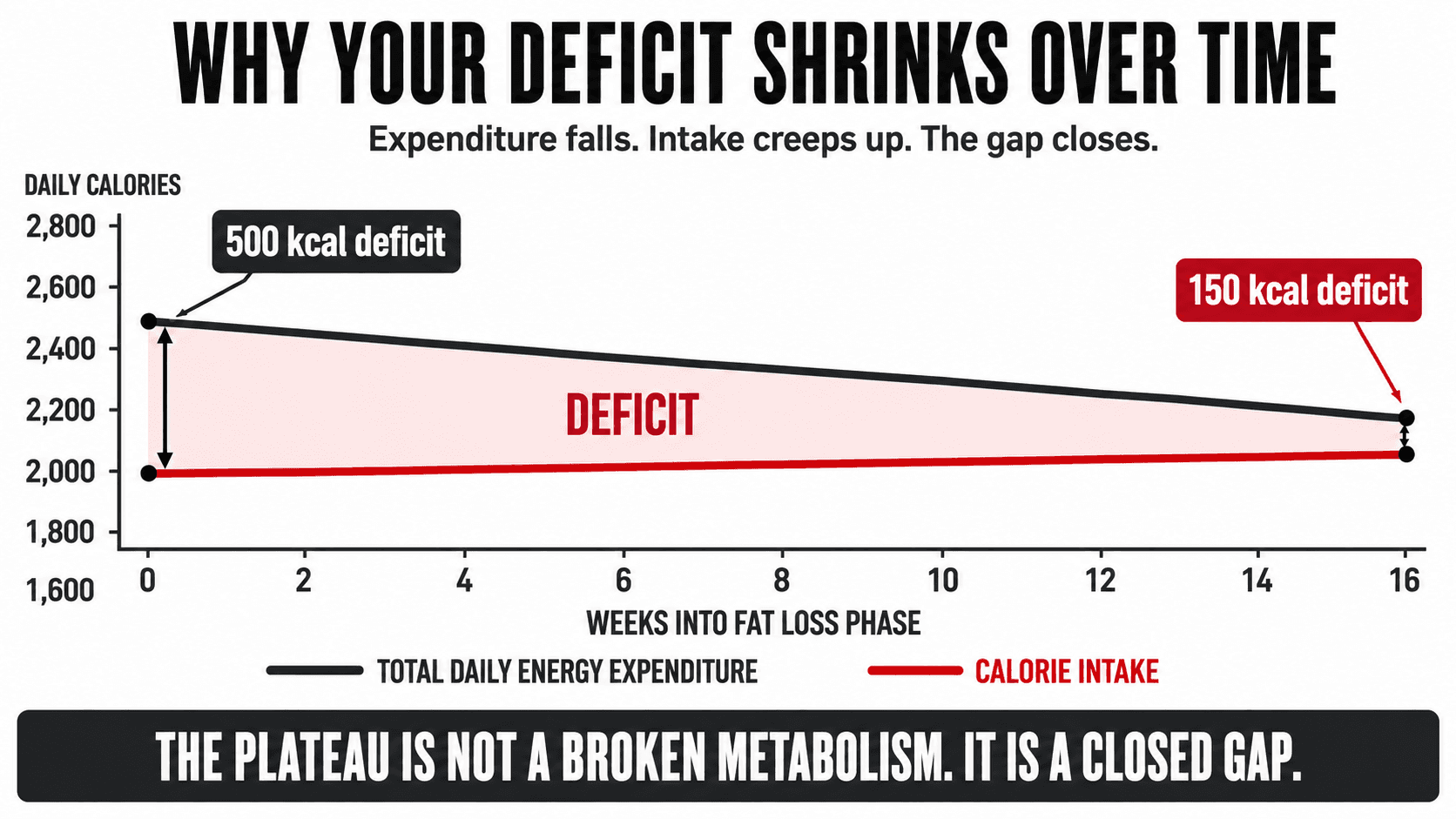
When most people hit a fat loss plateau, they assume something dramatic has gone wrong. In reality, the maths is quite simple. At the start of a fat loss phase, there is a meaningful gap between the energy coming in and the energy going out. As the weeks pass, the energy going out decreases through all the mechanisms described above, while the energy coming in often creeps up through small lapses in adherence that are amplified by increased hunger and reduced satiety. Eventually the two lines meet, the deficit disappears, and fat loss stops. This is not a broken metabolism. It is a closed gap.
Consider a practical example. A person starts a fat loss phase eating 2,000 calories per day with a total daily energy expenditure of 2,500 calories. That is a 500-calorie deficit, which should produce roughly 0.45 kilograms of fat loss per week. After 12 weeks, their BMR has dropped due to weight loss and hormonal changes, their NEAT has declined unconsciously, their exercise burns fewer calories due to improved efficiency and reduced body mass, and the thermic effect of food has decreased because they are eating less. Their total daily expenditure may now be closer to 2,150 calories. If they are still eating 2,000 calories, their deficit has shrunk from 500 to 150 calories per day, and any small dietary lapse or tracking error on top of that easily eliminates the remaining deficit entirely. The plateau is not a mystery. It is the predictable result of your body systematically closing the energy gap.
How to Break Through a Fat Loss Plateau
The good news is that metabolic adaptation is manageable when you understand it and plan for it. There are several evidence-based strategies that can help you break through a plateau and continue making progress.
The first and most important step is to verify that you are actually at a plateau and not simply experiencing normal weight fluctuations. A true plateau is defined as no meaningful change in body weight or body measurements over a period of at least three to four weeks, despite consistent adherence to your nutrition and training plan. A few days or even a week of stalled weight is normal and does not constitute a plateau. Water retention from training, sodium intake, hormonal cycles in women, stress, sleep quality, and bowel regularity can all mask fat loss on the scale for days or weeks at a time. Before you change anything, make sure the plateau is real.
If the plateau is genuine and adherence has been confirmed, the next step is to reassess your calorie intake. As discussed above, the deficit you started with has likely shrunk. A modest reduction in calories, typically 100 to 200 per day, can reopen the gap. This should come primarily from carbohydrates or fats rather than protein, as maintaining high protein intake is critical for preserving muscle mass during a deficit. A review published in the Journal of the International Society of Sports Nutrition by Helms and colleagues recommended protein intakes of 2.3 to 3.1 grams per kilogram of lean body mass for lean, resistance-trained individuals in a calorie deficit to maximise muscle retention (4). For most of my clients, I set protein between 1.8 and 2.5 grams per kilogram of total body weight depending on their starting composition, training status, and dietary preferences. Good protein sources include chicken, fish, turkey, eggs, Greek yoghurt, tofu, tempeh, seitan, soy protein, pea protein, lentils, and legumes.
The Case for Diet Breaks
One of the most promising strategies for managing metabolic adaptation comes from the MATADOR study, published in the International Journal of Obesity by Byrne and colleagues. The study, whose name stands for Minimising Adaptive Thermogenesis And Deactivating Obesity Rebound, compared continuous dieting against an intermittent approach where two-week blocks of energy restriction were alternated with two-week blocks of eating at maintenance calories (5).
The results were significant. The intermittent group lost more fat (12.3 kilograms versus 8.0 kilograms) despite both groups spending the same total number of weeks in a deficit. The intermittent group also showed a smaller reduction in resting energy expenditure after adjusting for body composition changes, suggesting that the diet breaks attenuated the metabolic adaptation. Six months after the study ended, the intermittent group had maintained more of their weight loss than the continuous group (5).
This is consistent with what I have observed in over fifteen years of coaching. Structured diet breaks of one to two weeks at maintenance calories, strategically placed every six to twelve weeks of continuous dieting, help to partially reverse the hormonal and metabolic adaptations that accumulate during a sustained deficit. They provide a physical and psychological reset that improves adherence, reduces hunger, restores some metabolic rate, and ultimately produces better long-term results than grinding through a continuous deficit until you burn out or give up.
Continuous Dieting vs Intermittent Dieting with Diet Breaks
Based on Byrne et al., International Journal of Obesity, 2018 (5). Intermittent dieting with structured breaks produced better outcomes across every metric.
| Outcome | Continuous Dieting (CON) | Intermittent with Breaks (INT) |
|---|---|---|
| Fat Mass Loss | 8.0 kg | 12.3 kg |
| Fat-Free Mass Loss | 1.2 kg | 1.8 kg (not significantly different) |
| Metabolic Adaptation (adjusted REE reduction) | 749 kJ/day | 360 kJ/day (significantly less) |
| 6-Month Weight Loss Retention | Lower | Superior |
Refeed Days: A Smaller Scale Intervention
While full diet breaks of one to two weeks offer the most robust metabolic reset, refeed days can provide smaller but meaningful benefits within a continuous dieting phase. A refeed day involves temporarily increasing calorie intake to approximately maintenance level, with the additional calories coming predominantly from carbohydrates. The rationale is that carbohydrate intake is closely linked to leptin production, and increasing carbohydrate intake even briefly can partially restore suppressed leptin levels, improve thyroid function, and replenish muscle glycogen stores that support training performance (1).
I typically programme one refeed day per week for clients who are in a moderate deficit, and two per week for clients who are leaner or deeper into a prolonged fat loss phase. These are not cheat days. They are structured, planned increases in carbohydrate intake within a specific calorie target. The difference matters. A cheat day with no structure can easily produce a 3,000 to 5,000 calorie surplus that wipes out the entire weekly deficit. A refeed day that brings intake to maintenance, primarily through carbohydrates, while keeping protein high and fat moderate, typically adds only 300 to 600 calories above the deficit day intake and provides genuine physiological benefits.

Other Strategies That Help
Beyond calorie adjustments and diet breaks, several other interventions can help manage metabolic adaptation during a fat loss plateau. Increasing daily step count is one of the simplest and most effective. Because NEAT declines unconsciously during a deficit, deliberately increasing your walking target can directly counteract one of the biggest contributors to the shrinking deficit. If your step count has dropped from 10,000 at the start of your fat loss phase to 7,000 without you noticing, restoring it adds meaningful calorie expenditure without any additional stress on recovery.
Maintaining or increasing resistance training volume, where recovery allows, helps to preserve lean mass and maintain the metabolic rate associated with that tissue. This is particularly important during a sustained deficit where the body is prone to catabolising muscle for energy, especially if protein intake is insufficient. Prioritise compound movements that recruit large amounts of muscle mass, such as squats, deadlifts, rows, presses, and lunges, and maintain training intensity even if total volume needs to be modestly reduced as the deficit progresses.
Sleep quality and stress management also play critical roles. As I covered in my article on sleep and fat loss, poor sleep increases cortisol, suppresses leptin, elevates ghrelin, and impairs insulin sensitivity, all of which compound the effects of metabolic adaptation. Managing stress through practical strategies like walking, breathing exercises, and realistic time management reduces cortisol-driven appetite increases and fluid retention that can mask fat loss on the scale.
Top Tips for Managing Metabolic Adaptation and Breaking Through Fat Loss Plateaus
Expect the Plateau. It Is Not a Failure. Metabolic adaptation is a normal, predictable biological response to sustained energy restriction. Every person who diets will experience it to some degree. Planning for it rather than being surprised by it is the difference between long-term success and another failed attempt.
Confirm the Plateau Is Real Before Changing Anything. Weight fluctuates daily due to water, sodium, hormonal cycles, stress, fibre intake, and bowel regularity. A genuine plateau means no meaningful change in scale weight or body measurements over three to four consecutive weeks with confirmed adherence. Do not make knee-jerk changes based on a few bad days on the scale.
Make Small Calorie Adjustments, Not Dramatic Cuts. If the plateau is confirmed and adherence is solid, reduce calories by 100 to 200 per day. Take this from carbohydrates or fats, not protein. Dramatic calorie cuts accelerate metabolic adaptation, increase muscle loss, and reduce adherence. Small, strategic adjustments are always more sustainable.
Programme Structured Diet Breaks Every 6 to 12 Weeks. The MATADOR study showed that alternating periods of dieting with periods at maintenance calories produced greater fat loss, less metabolic adaptation, and better weight maintenance than continuous dieting (5). A one to two week break at maintenance calories provides a physical and psychological reset.
Use Refeed Days Strategically Within Each Dieting Block. One to two days per week where carbohydrate intake is increased to maintenance level can partially restore suppressed leptin, support training performance, and improve psychological adherence. These should be planned and tracked, not unstructured cheat days.
Track Your Step Count and Defend Your NEAT. NEAT is the component of energy expenditure that drops most silently during a deficit. Set a daily step target and hold yourself to it throughout your fat loss phase, even on rest days. If your step count has declined since the start of your diet, restoring it can reopen a meaningful portion of your deficit.
Keep Protein High to Protect Muscle Mass. Aim for 1.8 to 2.5 grams per kilogram of body weight from high quality sources including chicken, fish, eggs, Greek yoghurt, tofu, tempeh, seitan, soy protein, lentils, and legumes. Muscle mass is metabolically active tissue, and losing it during a deficit makes every subsequent week of dieting harder.
Do Not Chase the Scale. Use Multiple Metrics. Track body weight, waist circumference, progress photographs, gym performance, and how your clothes fit. The scale is one data point, and it is heavily influenced by water, sodium, and glycogen. Clients who rely solely on the scale are the most likely to make emotional decisions that undermine their progress.
Play the Long Game. Sustainable fat loss is a series of dieting phases interspersed with maintenance phases. It is not a single continuous grind. If you have been dieting for more than 16 weeks, it is almost certainly time for a maintenance phase of at least four to eight weeks before resuming. This is not giving up. This is strategy.
The Bottom Line
Fat loss plateaus are not a sign that something is broken. They are a predictable consequence of your body's sophisticated survival mechanisms responding to sustained energy restriction. Metabolic adaptation reduces every component of your daily energy expenditure, from your basal metabolic rate to your unconscious daily movement. Hormonal changes increase hunger, reduce satiety, and persist for at least 12 months after weight loss. The more extreme the deficit and the faster the weight loss, the more aggressive these adaptations become.
But these adaptations are manageable when you understand them and plan accordingly. Moderate calorie deficits, structured diet breaks, strategic refeed days, high protein intake, resistance training, defended step counts, and a willingness to play the long game rather than chasing rapid results will all help you break through plateaus and maintain your results once you get there. The science is clear: slow and strategic beats fast and aggressive every single time.
I have worked with clients who had been stuck for months or even years, cycling through increasingly restrictive diets that produced diminishing returns. In almost every case, the solution was not to eat less. It was to eat smarter, build in recovery periods, and approach fat loss as a phased strategy rather than a single sustained assault. If your progress has stalled and you are not sure what to do next, get in touch through trperformancecoaching.com. I work one-to-one with clients online globally, across all dietary backgrounds including vegetarian, vegan, and plant-based. I will help you understand exactly where you are, what your body is doing, and how to move forward with confidence.
Work with Me
Get a personalised coaching plan built around your goals, your schedule, and your life.
Enquire NowReferences
- Trexler ET, Smith-Ryan AE, Norton LE. Metabolic adaptation to weight loss: implications for the athlete. Journal of the International Society of Sports Nutrition. 2014; 11(1): 7.
- Fothergill E, Guo J, Howard L, Kerns JC, Knuth ND, Brychta R, Chen KY, Skarulis MC, Walter M, Walter PJ, Hall KD. Persistent metabolic adaptation 6 years after The Biggest Loser competition. Obesity. 2016; 24(8): 1612-1619.
- Sumithran P, Prendergast LA, Delbridge E, Purcell K, Shulkes A, Kriketos A, Proietto J. Long-term persistence of hormonal adaptations to weight loss. New England Journal of Medicine. 2011; 365(17): 1597-1604.
- Helms ER, Zinn C, Rowlands DS, Brown SR. A systematic review of dietary protein during caloric restriction in resistance trained lean athletes: a case for higher intakes. International Journal of Sport Nutrition and Exercise Metabolism. 2014; 24(2): 127-138.
- Byrne NM, Sainsbury A, King NA, Hills AP, Wood RE. Intermittent energy restriction improves weight loss efficiency in obese men: the MATADOR study. International Journal of Obesity. 2018; 42(2): 129-138.