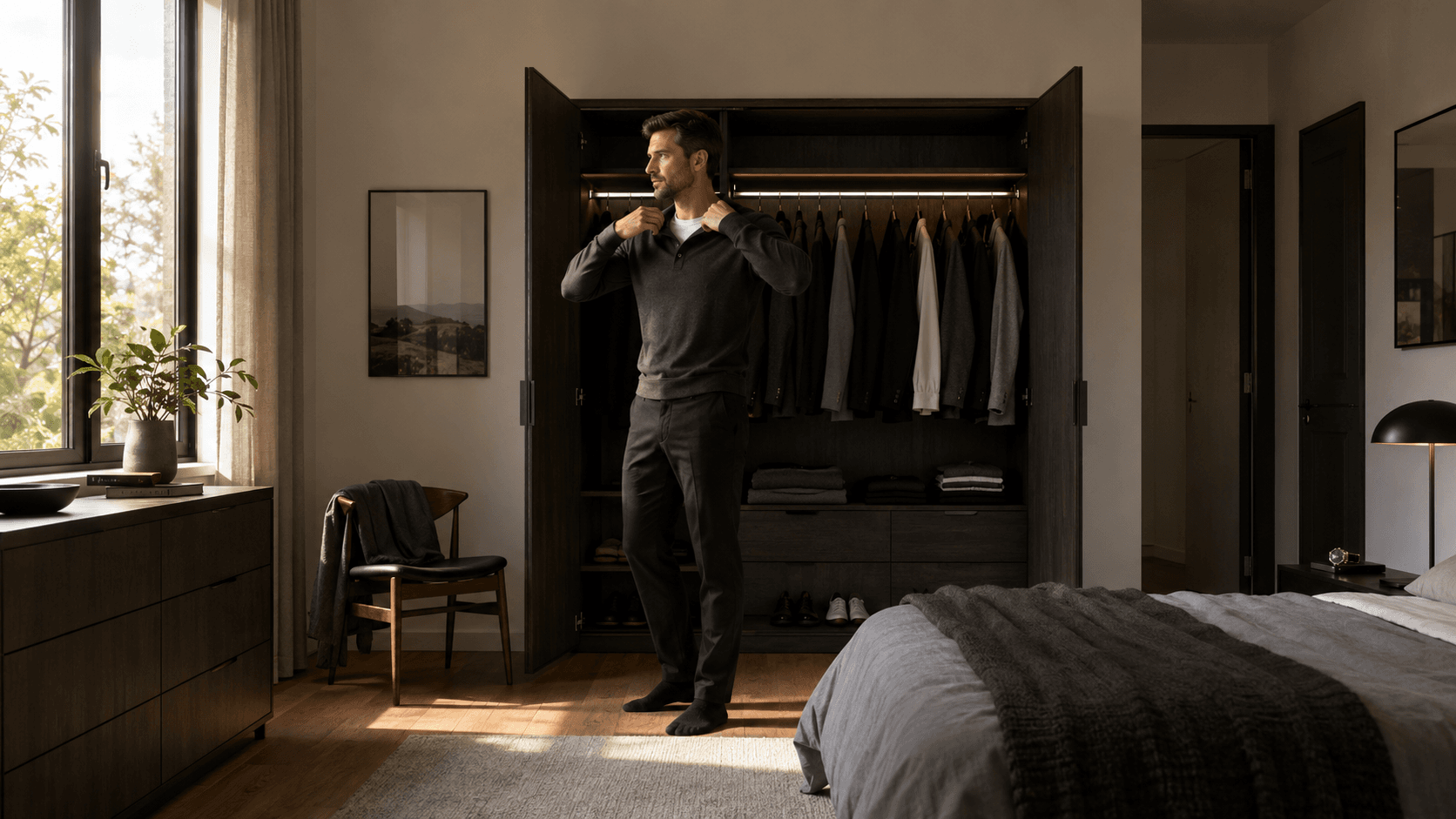
The Wardrobe Your Brain Is Reading Every Morning
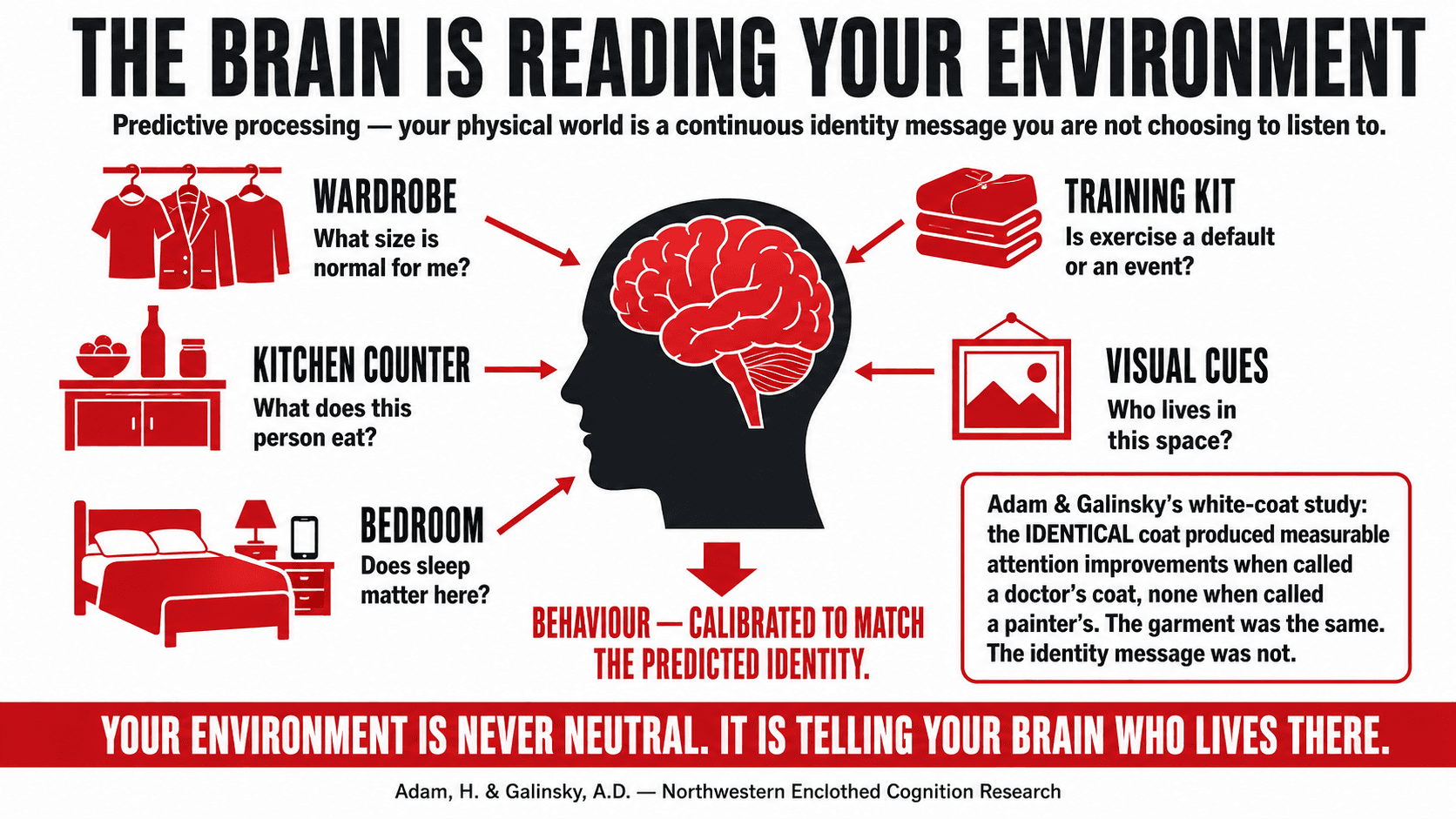
Environmental identity cues and health behaviour form a relationship that most people have never examined and almost nobody considers when designing a health programme. The physical environment that surrounds a person each day is not a neutral backdrop to their behaviour and choices. It is an active communication system, sending a continuous stream of identity messages that the brain reads, processes, and responds to below the threshold of conscious awareness. The clothes hanging in the wardrobe, the mirror seen first thing in the morning, the food visible on the counter, the training kit packed or unpacked, the state of the home workspace, the images on the wall — each of these is a signal. And the brain is listening to all of them, all the time, calibrating its sense of who this person is and what this person does.
The research on enclothed cognition from Northwestern University demonstrated this with a clarity that is difficult to dismiss. Hajo Adam and Adam Galinsky found that wearing a white lab coat produced measurable improvements in sustained attention and careful analytical performance in test subjects, but only when the coat was described as a doctor’s coat. The identical coat described as a painter’s coat produced no such effect. The physical garment was identical. The identity message it communicated was not. The brain translated the identity signal of the coat into a change in cognitive performance that was objectively measurable. The clothes were not simply covering the body. They were telling the brain who the wearer was, and the brain was responding accordingly (1).
This is not a peripheral finding. It has direct, practical, and immediately actionable implications for anyone attempting to build a new health identity. The clothes in the wardrobe, the ones worn daily, the ones chosen to face the world in, are sending an identity message to the brain every time they are put on. If that identity message is inconsistent with the person being built, the brain receives a daily signal that the old story is still the correct one.
“We are what we repeatedly do. Excellence, then, is not an act, but a habit.”
— Aristotle
The Neuroscience of Environmental Identity Cues: How the Brain Processes What It Sees
The brain’s sensitivity to environmental cues is a fundamental feature of its predictive processing architecture. The brain does not wait for experience to arrive and then interpret it neutrally. It generates predictions about what is likely to happen, based on the patterns of what has happened before, and filters incoming information through those predictions. The physical environment is one of the most powerful generators of these predictions. A bedroom that looks exactly as it did for the last five years tells the brain that this is the context for the last five years of behaviour. A kitchen that contains the same foods, arranged in the same way, in the same positions, is a powerful cue for the eating behaviour those conditions have historically produced (2).
This is the same principle that underlies the habit loop research discussed in Article 4 of this series, but applied specifically to the static physical environment rather than to dynamic behavioural triggers. Where the habit loop describes the triggering of behaviour by discrete contextual cues, the identity cue environment describes the constant background signal emitted by the physical world the person inhabits every day. It is not a single trigger. It is a persistent ambient message about who this person is, and it is being processed continuously.
Wendy Wood’s research on habit and context provides the mechanistic explanation for why environment change is so effective at producing behaviour change even without any change in motivation, knowledge, or intention. When the physical context changes, the habitual behaviour patterns associated with that context lose their automatic trigger. The brain, encountering a new environment, must engage its deliberate decision-making systems rather than running the habituated response. This is the mechanism behind why people often find it easier to begin new health habits when they move to a new home, start a new job, or return from a holiday: the contextual cues for the old habits are temporarily absent, and the window for establishing new patterns is open (3).
Key Insight: You do not need to move house to access this mechanism. You need to change the identity signals in your existing environment deliberately enough that the brain begins to receive a different message about who inhabits it. This is not interior design. It is applied psychology. The question is not whether your environment looks good. The question is what story your environment is telling your brain every morning.
Enclothed Cognition: What Your Clothing Is Telling Your Brain About Who You Are
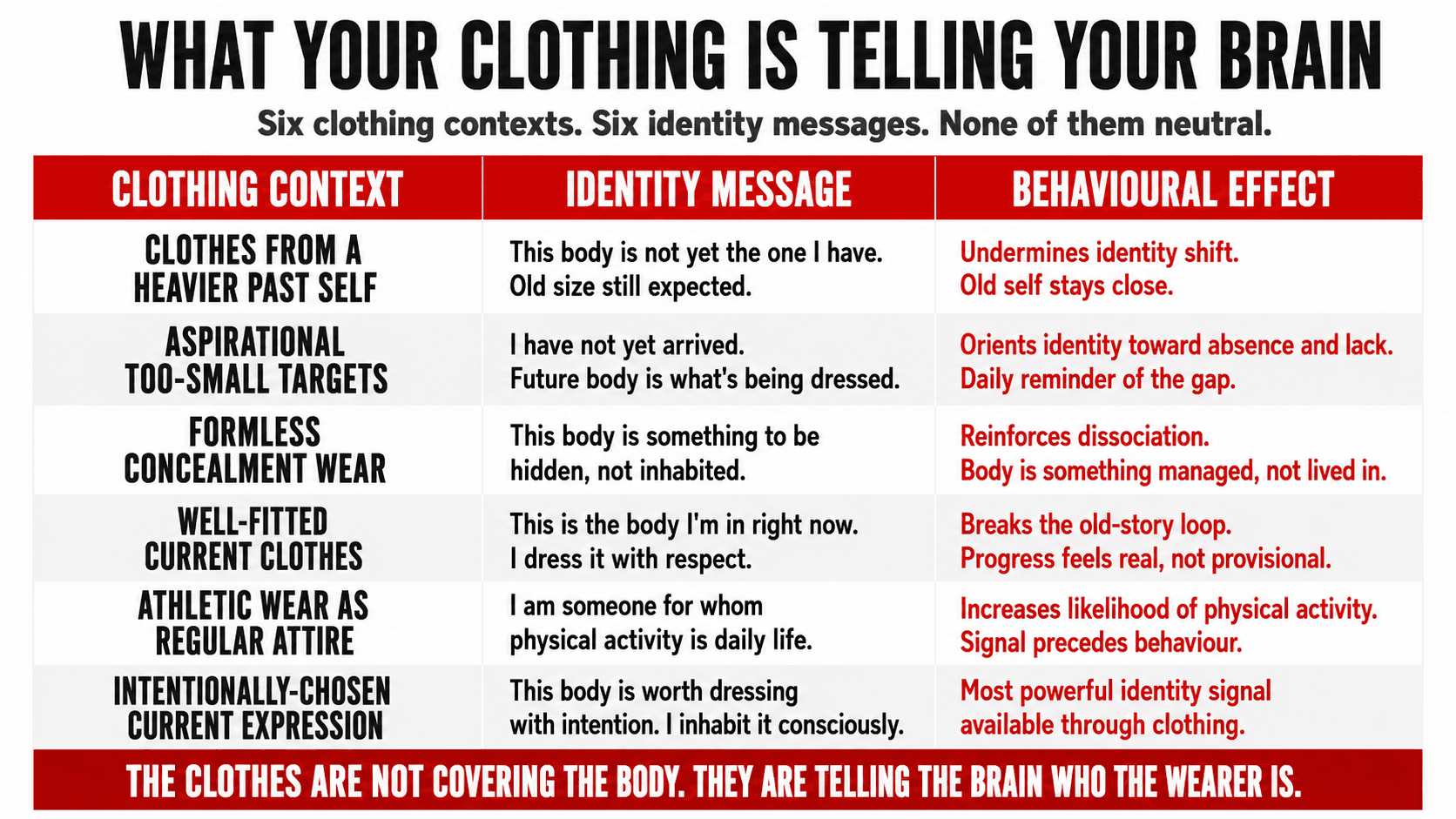
The enclothed cognition research extends well beyond the laboratory. In daily life, the clothing a person chooses communicates an identity message not only to other people but to the person themselves. The choice to wear clothing that fits well and reflects the identity being built is not vanity. It is a deliberate identity signal to the brain that has measurable effects on confidence, self-perception, and the willingness to engage in behaviours consistent with that identity.
| Clothing Context | The Identity Message to the Brain | The Behavioural Effect |
|---|---|---|
| Clothes retained from a significantly heavier past self. Loose, concealing, worn as default. | This body is not yet the body I have. I am still the person these clothes were bought for. The old size is still where I expect to be. | Reduces the psychological distance between current self and old self. Undermines the identity shift by making the old identity feel like the current one. |
| Clothes bought as aspirational targets: too small, waiting to be worn when the goal is reached. | I have not yet arrived. The future body is what is being dressed. The current body is the problem to be solved before getting dressed properly. | Orients identity toward absence and lack. The aspirational wardrobe is a daily reminder of the gap rather than a confirmation of the progress made. |
| Comfortable, formless clothing worn as default regardless of context. Chosen for concealment rather than expression. | This body is something to be hidden rather than inhabited. Physical presence is something to be minimised rather than expressed. | Reinforces the dissociation from the body that makes health investment feel external rather than personal. The body is something managed, not something lived in. |
| Transitional: well-fitting clothes for the current body, not the old one or the aspirational one. | This is the body I am in right now. I dress it with respect for where it currently is rather than shame for where it has been or anxiety about where it is going. | Breaks the old-story loop. The brain receives confirmation that the current body is the one being inhabited and invested in. Progress feels real rather than provisional. |
| Active wear and training kit worn as regular daily attire or kept prominently accessible. | I am someone for whom physical activity is part of daily life, not a special occasion requiring preparation. | Enclothed cognition research suggests that wearing athletic clothing increases the likelihood of physical activity. The signal precedes and facilitates the behaviour. |
| Well-fitted clothes chosen to express the current identity rather than conceal the current body. | This body is worth dressing with intention. I inhabit this body consciously and with investment rather than tolerating it until something changes. | The most powerful identity signal available through clothing. The person who dresses their current body with intention and precision is sending a daily message that the identity they are building is already real. |
The Identity Objects: What Else in Your Environment Is Anchoring the Old Story
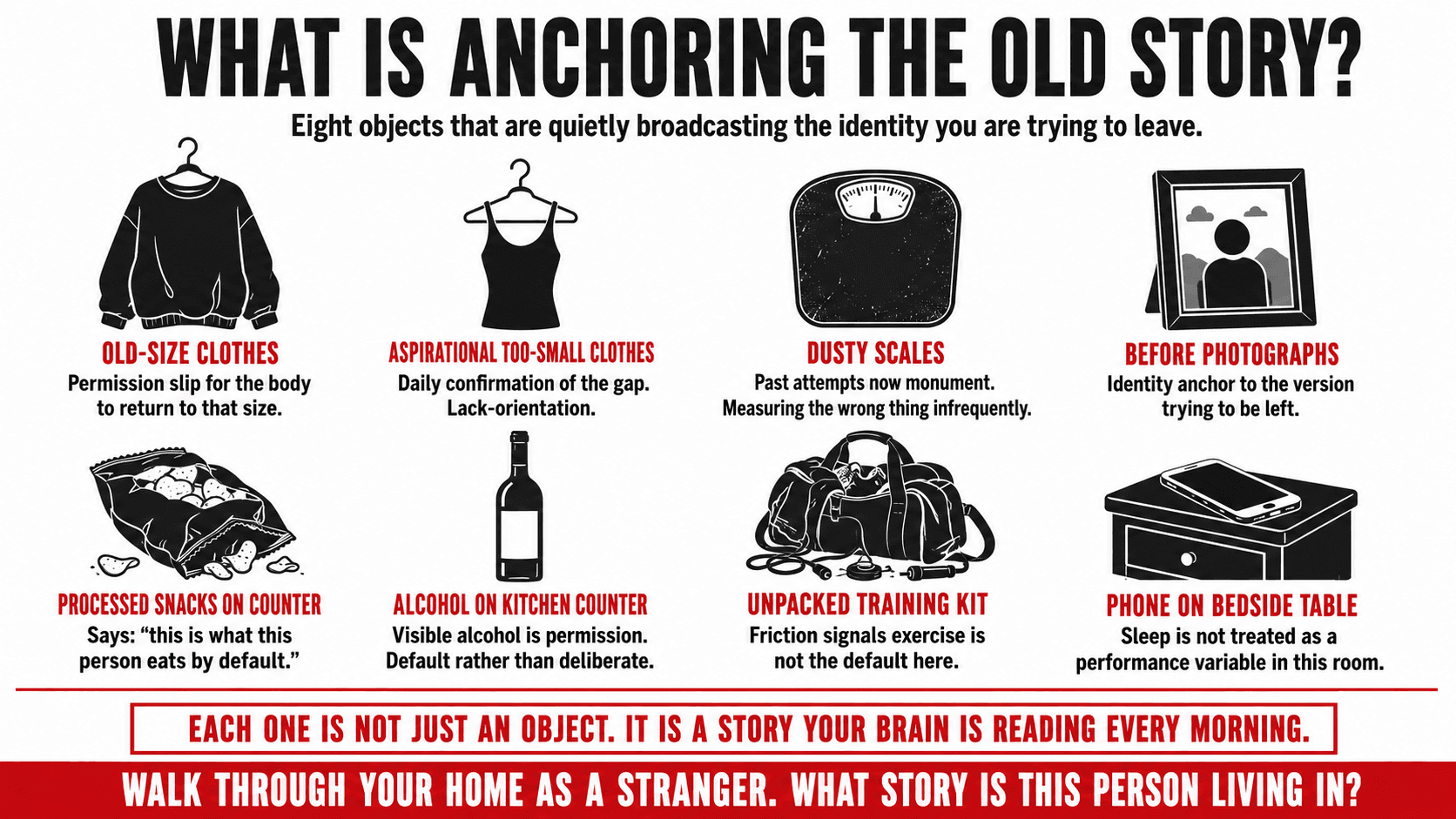
Clothing is the most immediate and most frequently encountered environmental identity signal, but it is far from the only one. The physical environment is dense with objects, arrangements, and visual cues that are each carrying a story about the person who inhabits them. Many of these objects were acquired in a different chapter of a person’s life, carry the identity of that chapter with them, and continue broadcasting that identity long after the person has begun to move away from it.
The food environment in the kitchen is the most directly impactful identity signal after clothing. A kitchen whose counter surfaces are occupied by the foods of the old pattern, whose visible storage communicates the old eating identity, and whose arrangement makes the healthy choice the effortful one is not a neutral space. It is an active signal system broadcasting the old food identity to the brain every time it is entered. The research on food environment and eating behaviour is unambiguous on this point: what is visible, accessible, and positioned prominently is what gets eaten, regardless of what the person consciously intends to eat. The environment determines behaviour more reliably than intention when the two are in conflict (4).
The physical state of the home more broadly — the degree of order or disorder, the presence or absence of objects associated with health and physical capability, the images and visual cues present in the spaces spent most time in, the general quality of the environment — all contribute to the ambient identity message. This is not an argument for aesthetic perfectionism. It is an argument for environmental intentionality: the deliberate construction of a physical environment whose ambient identity signal is consistent with the identity being built, rather than the preservation of an environment that is a museum of the identity being left.
The scales, the measuring tape, the before photographs, the clothes kept from a previous significantly different body, the exercise equipment gathering dust, the self-help books bought and never read, the meal plan printed and abandoned — each of these is not simply an object. It is a story. And the brain is reading all of them, simultaneously, continuously, calibrating its sense of what kind of person lives here and what this person does and does not do.
Key Insight: Walk through your home slowly and look at it as though you are a stranger assessing what kind of person lives there. What story does the kitchen tell about the person’s relationship with food? What does the bedroom communicate about their relationship with sleep and recovery? Is there any visible evidence in this home that a person who takes their health seriously lives here? The audit does not require a dramatic overhaul. It requires the addition of one or two clear identity signals — training kit visible and ready, a bowl of fruit on the counter, a water bottle in the morning position — and the removal of the objects that are broadcasting the loudest contradictory messages.
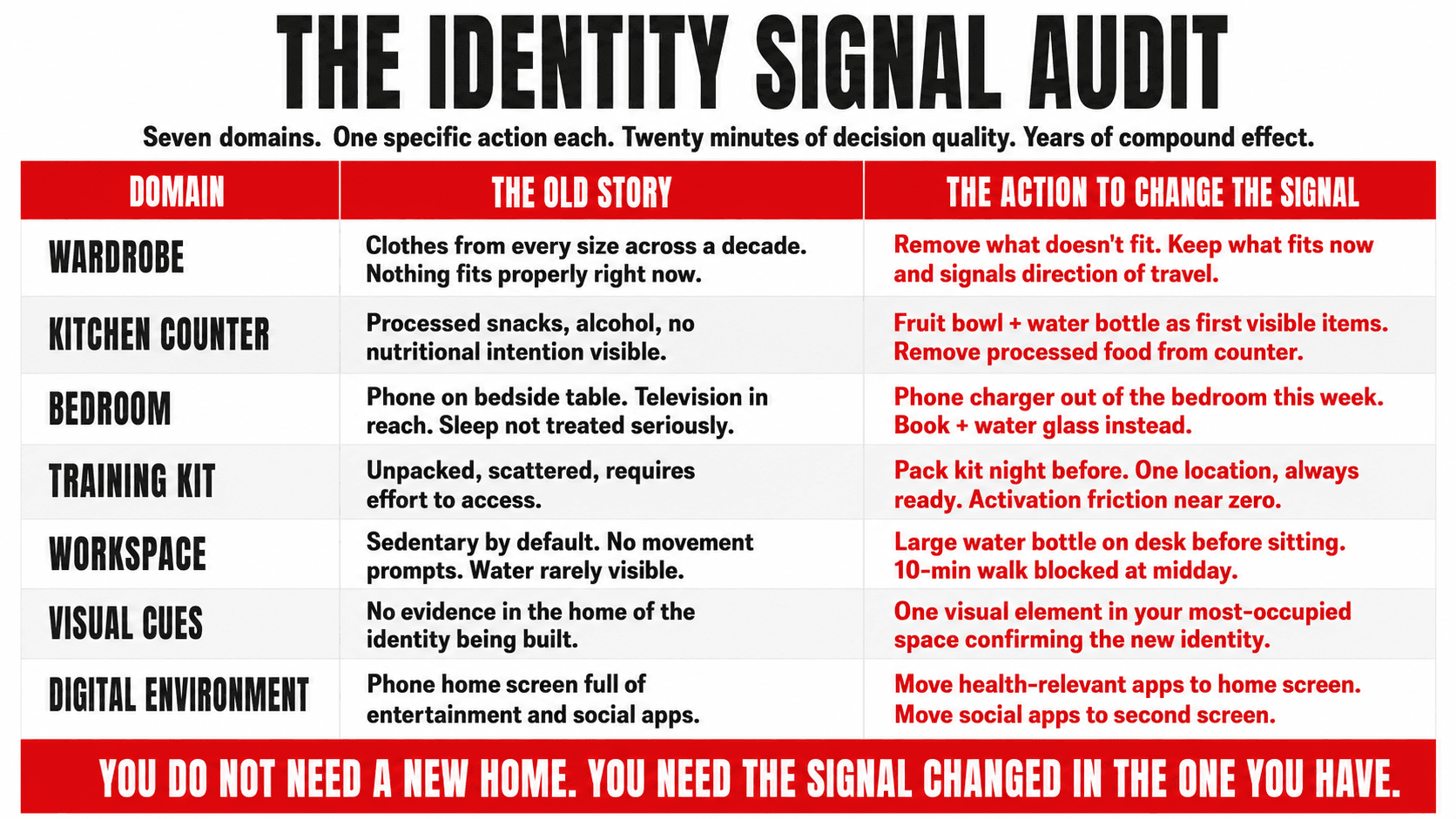
The Identity Signal Audit: Mapping What Your Environment Is Saying About You
The identity signal audit applies the enclothed cognition principle to the full physical environment rather than to clothing alone. For each domain of the home and daily life environment, the audit identifies the old story currently being broadcast, the identity-locking effect of that story, the new story that would be consistent with the identity being built, and the specific action required to change the signal.
| Domain | The Old Story Currently Being Broadcast | The Identity-Locking Effect | The Specific Action |
|---|---|---|---|
| Wardrobe | Clothes from every size across a decade. The biggest items still present and accessible. Nothing that fits the body right now particularly well. | Daily reinforcement that size fluctuation is normal for this person. No clear commitment to a current identity. | Remove clothing that does not fit the current body or the direction of travel. Keep what fits now and what signals where you are going. |
| Kitchen counter | Visible processed snacks, alcohol on the counter, nothing communicating nutritional intention. Food of convenience within immediate reach. | The brain reads the kitchen as belonging to someone for whom convenience food is the default. Confirms the old food identity on every entry. | Remove visible processed foods from counter surfaces. Place a fruit bowl and a filled water bottle as the first visible things on every entry to the kitchen. |
| Bedroom environment | Phone on bedside table. Television within reach of the bed. No clear sleep ritual indicated by the environment. Disorder that communicates low investment in the recovery environment. | The bedroom is not signalling that the person treats sleep as a performance variable. The environment supports late-screen use and disturbed sleep. | Move the phone charger out of the bedroom this week. Replace with a book and a glass of water. The environment change precedes the behaviour change. |
| Training equipment and kit | Training kit scattered or unpacked. Equipment in storage or difficult to access. Preparing for exercise requires a process of location and preparation that introduces friction. | The friction of accessing training equipment communicates that exercise is not the default. The environment is configured for sedentary behaviour. | Pack training kit the night before every session. Create a single location where kit is always ready. Reduce the activation friction to near zero. |
| Workspace environment | Sedentary default. No prompts for movement. Desk environment optimised for extended sitting without breaks. Water rarely within reach. | The workspace communicates that physical movement during the working day is unusual and effortful rather than normal and expected. | Place a large water bottle on the desk before sitting down. Block a ten-minute walk into the calendar at midday. These are environmental cues, not willpower decisions. |
| Visual cues and images | No visual evidence in the living environment of the identity being built. Possibly images from the old chapter that reinforce the old story. | The absence of any identity-confirming visual cue makes the new identity feel like an aspiration rather than a present reality. | Choose one visual element for the most frequently occupied space that confirms the new identity. It does not need to be visible to others. It needs to be visible to you. |
| Digital environment | Phone home screen occupied by social media and entertainment apps that provide immediate dopamine and pull toward sedentary consumption. | The phone environment makes the unhealthy choice the path of least resistance on every phone interaction. | Move health-relevant apps to the phone home screen. Move social media apps to a secondary screen requiring deliberate navigation to access. |
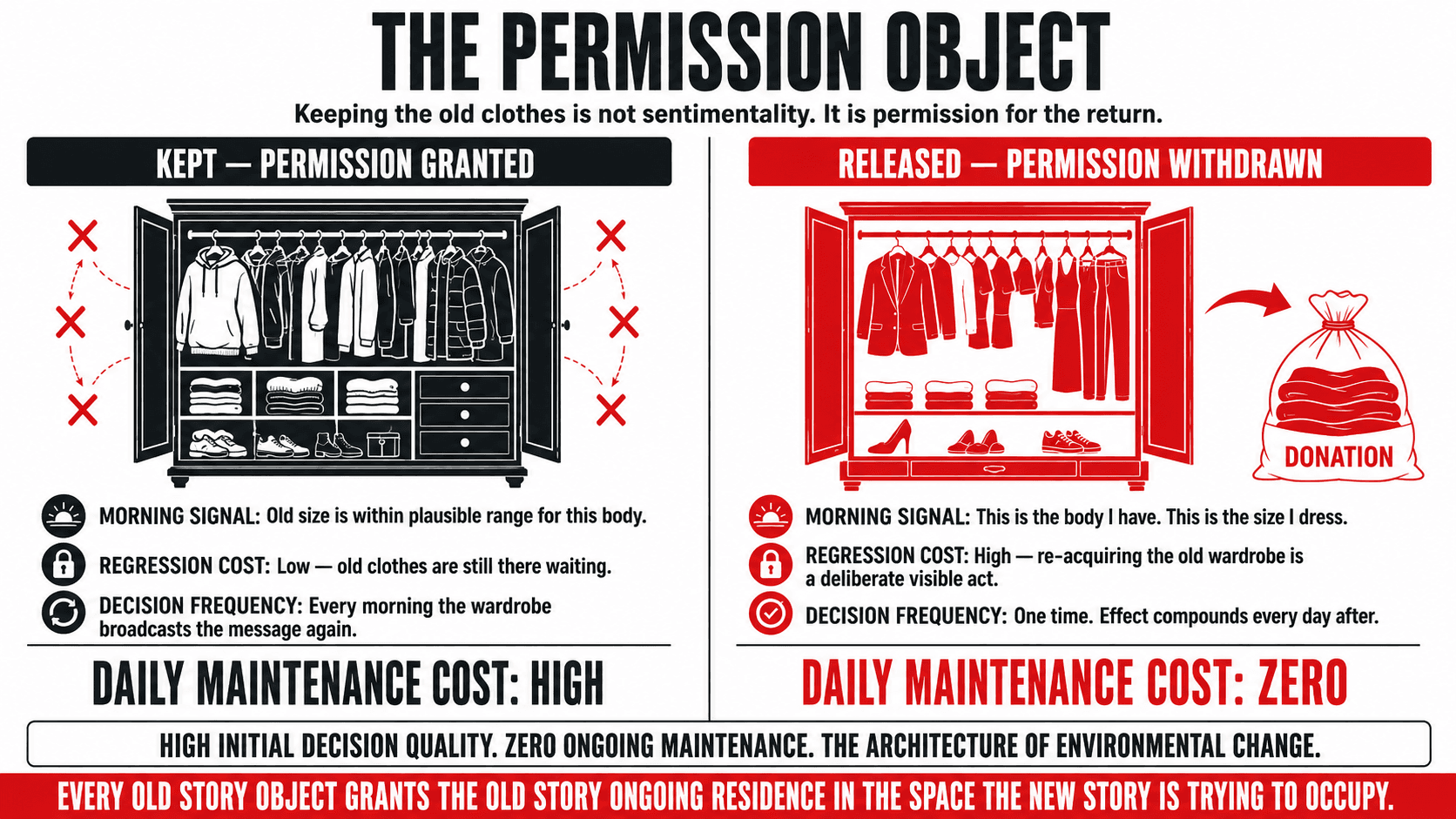
The Permission Object: Why Keeping the Old Clothes Is Not Sentimentality — It Is Permission
One of the most psychologically honest observations about the environmental identity cue is that keeping the clothes from a significantly heavier past self, or from a period of poor health, is not simply harmless nostalgia or prudent preparation for fluctuation. It is, at a neurological level, granting permission for the return. The brain, encountering those clothes in the wardrobe every day, registers their presence as a signal that their size is within the range of normal for this person. The body has been that size before. The clothes confirm it. The wardrobe, read by the predictive processing system, includes that size in the plausible range of future states.
This is the argument for releasing the old clothes that is most commonly encountered with resistance. People hold onto them for practical reasons, for financial reasons, for sentimental reasons, and for the same reason they hold onto the eating habits and the sedentary patterns and the limiting beliefs: because releasing them requires committing to the new story in a way that makes returning to the old one a more deliberate and visible act. The person who has given away the old clothes has raised the practical and psychological cost of returning to the old size. That is not a trivial psychological adjustment. It is a structural commitment device that changes the calculus of regression (5).
The principle applies beyond clothing. The person who removes the visible alcohol from the kitchen counter has not prevented themselves from drinking. They have added friction to the decision and removed the permission that its visible presence was granting. The person who removes the processed snacks from the accessible kitchen shelf has not eliminated the possibility of eating them. They have changed the default from thoughtless to deliberate. Every old story object retained in the environment grants the old story ongoing residence in the space the new story is trying to occupy.
“The first step toward change is awareness. The second step is acceptance.”
— Nathaniel Branden
Key Insight: The release of old-story environmental objects is a one-time investment with a long-term compound return. Giving the old clothes away does not require willpower every morning. It changes the morning signal once and permanently. The decision is made once. Its effect operates every day thereafter. This is the architecture of environmental change: high initial investment of decision quality, zero ongoing maintenance cost.
The Transition Wardrobe: Dressing the Body You Are Building, Not the Body You Had
The practical question that arises from the enclothed cognition argument is not philosophical. It is immediate and specific: what should a person wear when they are in the process of a significant health transformation and their body is genuinely between identities? The answer is clear and consistent across the research and the coaching practice: dress the body you have right now, not the body you used to have and not the body you are working toward.
The person who wears clothes that fit them well at their current stage of transformation receives a daily confirmation from their physical environment that the transformation is real, that progress has occurred, and that the current body is worth inhabiting and investing in rather than concealing until a better version arrives. This confirmation is not a reward for having reached the goal. It is a daily identity signal that the journey is real and the person on it is worth dressing with intention at every point along the way.
The aspiration wardrobe — the items bought in target sizes, hung prominently as motivation — is a more complex case. The research on approach versus avoidance motivation, discussed in Article 10, is relevant here: the aspirational item that generates motivational approach toward the desired state is useful. The aspirational item that generates daily confirmation of the gap between current and desired, producing a sense of lack rather than a sense of direction, is not. The honest question about any aspirational item is which of these effects it actually produces in the person looking at it. If the answer is the latter, its prominence in the wardrobe is working against the transformation rather than for it.
Key Insight: This week, identify three items in your wardrobe that belong to the old story — that fit a past version of you, that you wear to conceal rather than express, or that you are holding as permission slips for regression. Release them. Not to a distant storage space where they remain symbolically accessible. Release them entirely. Then identify one item of clothing that, worn today, tells your brain that the person wearing it takes their health seriously. Wear it deliberately and notice what it does to your posture, your engagement, and your relationship with the decisions you make in it.
How Environmental Identity Design Is Part of Every Programme I Build
The environment design conversation is always early in a new coaching relationship because the environment is the cheapest and most durable modification available to the programme. A training plan costs energy to execute. A nutritional strategy costs both money and daily decision quality to maintain. An environmental redesign costs an afternoon and operates automatically thereafter.
I am not asking clients to create a perfect environment. I am asking them to identify the two or three environmental signals that are broadcasting the loudest old-story messages and to replace them with signals consistent with the identity being built. The training kit packed and visible. The kitchen counter cleared of visible processed foods. The old clothes released. The phone charger moved out of the bedroom. These are not dramatic actions. Their cumulative effect on the daily identity signal received by the brain is, however, significant and compounding.
The environment does not need to be aspirational. It needs to be honest about who is moving in and what they are doing. The wardrobe, the kitchen, the bedroom, and the workspace are either confirming the old story every day or announcing the new one. They are never neutral. I work one-to-one with clients online globally. The environmental identity audit is built into the first two sessions.
Work with Me
Get a personalised coaching plan built around your goals, your schedule, and your life.
Enquire NowReferences
- Adam H, Galinsky AD. Enclothed cognition. Journal of Experimental Social Psychology. 2012; 48(4): 918–925.
- Clark A. Surfing Uncertainty: Prediction, Action, and the Embodied Mind. Oxford: Oxford University Press; 2015.
- Wood W, Neal DT. A new look at habits and the habit-goal interface. Psychological Review. 2007; 114(4): 843–863.
- Wansink B, Cheney MM. Super Bowls: serving bowl size and food consumption. JAMA. 2005; 293(14): 1723–1728.
- Ariely D. Predictably Irrational: The Hidden Forces That Shape Our Decisions. London: Harper Collins; 2008.
- Johnson C. Dress and the Body. Oxford: Berg; 1997.
- Festinger L. A Theory of Cognitive Dissonance. Stanford: Stanford University Press; 1957.