
The Exit Route Is the Problem
Making health non-negotiable is the single most decisive structural shift available to any person pursuing a lasting health transformation, and the most consistently avoided one. The reason it is avoided is that it requires the elimination of something that feels like wisdom and security: the exit route. The option to stop. The comfort of knowing that the commitment is not absolute, that if things get hard enough or uncomfortable enough or inconvenient enough, there is a door marked out, and walking through it is always possible.
The exit route feels like sanity. It feels like self-compassion, like flexibility, like the pragmatic recognition that life is unpredictable and rigid commitments are naive. And in most areas of life it is all of those things. In health behaviour, it is the primary mechanism of failure. Not because the difficult circumstances it promises to protect against are not real. They are real. But because the knowledge that the exit exists changes the relationship with difficulty in the critical early and middle phases of a programme, in a way that makes the difficult periods more likely to trigger exit rather than navigation.
This is what Hernando Cortez understood in 1519 when he ordered the burning of his ships on the coast of Mexico. His soldiers, numbering roughly six hundred against an empire of millions, knew that retreat was the rational response to the odds they faced. Cortez eliminated rational retreat as an option. With no ships and no way home, the only direction available was forward. The soldiers, stripped of the exit route, directed every cognitive and physical resource toward success. The burned ship metaphor has persisted across five centuries of leadership literature not because it is a colourful historical anecdote but because it precisely describes a psychological mechanism that changes performance under pressure: the elimination of the alternative (1).
“If you want to take the island, burn the boats.”
— Tony Robbins
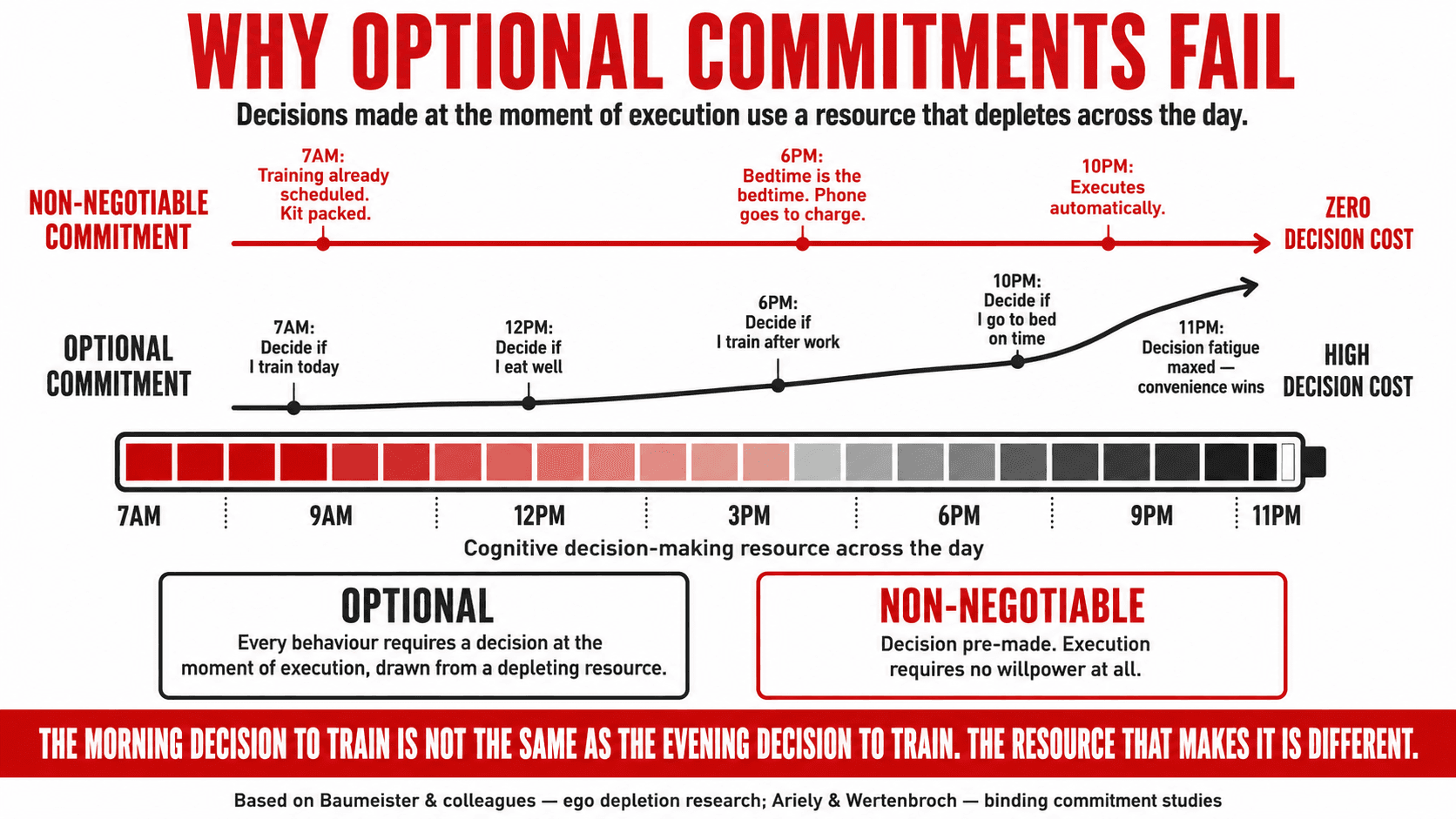
The Psychology of the Optional Commitment: Why Keeping the Door Open Guarantees You Will Eventually Walk Through It
Dan Ariely and Klaus Wertenbroch’s research on self-imposed deadlines demonstrated that people who set binding commitments with real consequences outperform people who set flexible commitments with no consequences, even when the flexible group is free to set whatever deadlines they choose. The binding commitment activates a different relationship with the approach of the deadline: not the comfortable renegotiation available to the person whose commitment has no structural weight, but the focused execution of the person for whom the alternative to completion is a real and present cost (2).
Applied to health behaviour, the optional commitment is one in which the person reserves the right to revise the decision based on how they feel at the moment the execution is required. The session can be skipped if they are tired enough. The nutritional protocol can be suspended if the social occasion is sufficiently inconvenient. The bedtime can flex if the evening is enjoyable enough. Each of these reservations feels reasonable in the abstract. In practice, they mean that every execution of the health behaviour is a decision to be made against the competing pull of the immediate, the convenient, and the comfortable. And the immediate, the convenient, and the comfortable win that competition with a frequency that the optional commitment cannot survive across six months.
The research on ego depletion from Baumeister, Vohs, and colleagues provides the neurological basis for why the optional commitment fails: decision-making draws on a cognitive resource that depletes with use across a day. The person whose health behaviours require a decision at the moment of execution, rather than being pre-decided and therefore automatic, is making those decisions from a progressively more depleted resource as the day advances. The morning decision to train is easier than the evening decision to train, for the same programme, the same person, and the same level of motivation, because the decision-making resource is fuller in the morning. Making the behaviour non-negotiable removes the decision from the moment of execution entirely (3).
Key Insight: The phrase non-negotiable does not mean inflexible in its execution. A non-negotiable training commitment means that training will happen this week. The specific session time may flex. The format may adapt to available time and energy. But the decision about whether it happens is not on the table. The question is only which version of it happens today. That reframe converts the commitment from a rigid demand to a structural certainty, and structural certainties survive difficult weeks in a way that flexible intentions cannot.
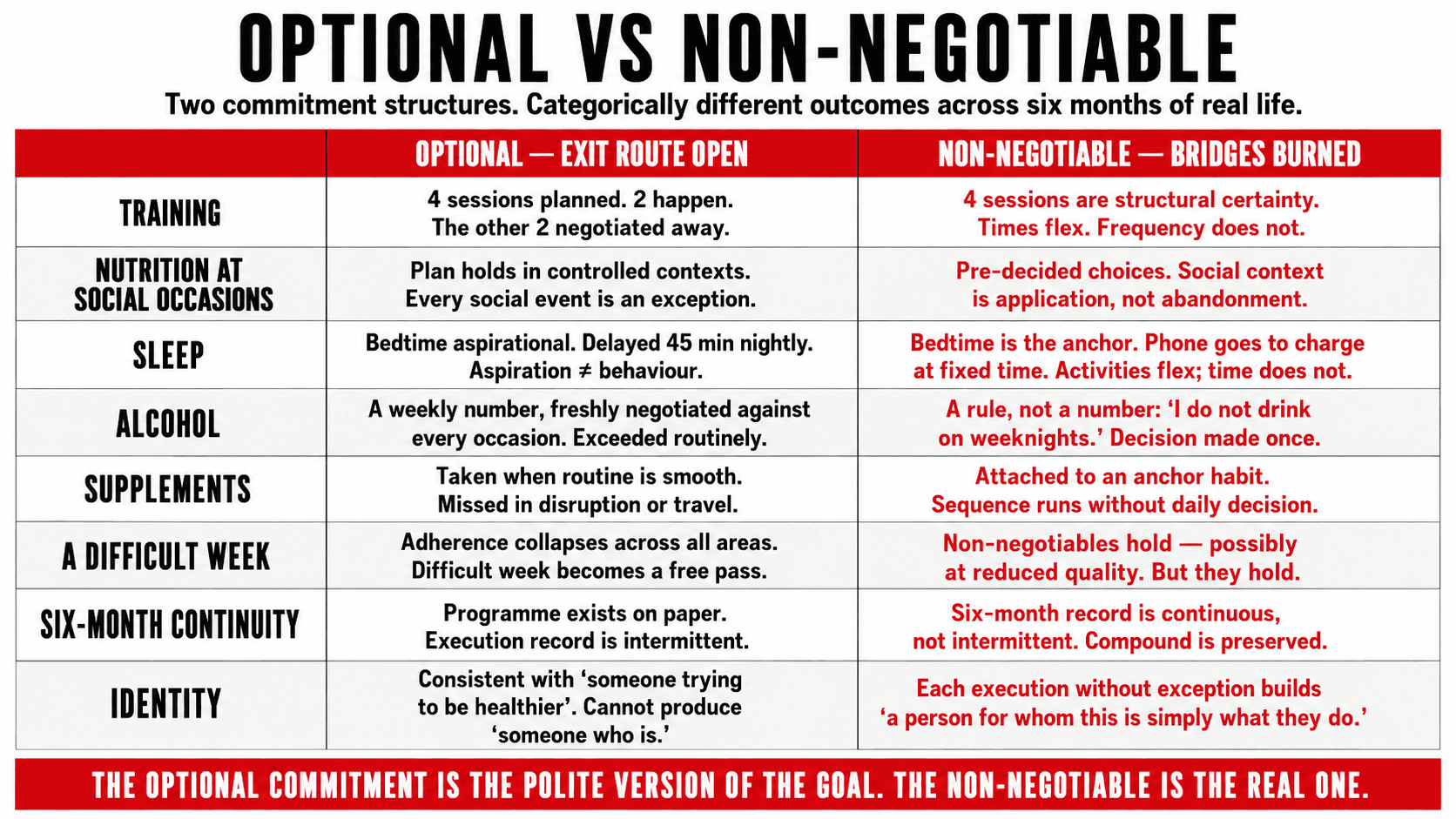
Optional vs Non-Negotiable: What Each Commitment Structure Produces Across Eight Health Domains
The distinction between an optional and a non-negotiable health commitment is not a matter of degree. It is a structural difference that produces categorically different outcomes when tested under the real conditions of a demanding, imperfect life.
| Domain | Optional Commitment (The exit route is open) | Non-Negotiable Commitment (The bridges are burned) |
|---|---|---|
| Training frequency | Four sessions planned. Two typically happen. The other two are negotiated away by tiredness, scheduling conflicts, and the competing pull of easier evenings. The plan is maintained on paper, abandoned in practice. | Four sessions are a structural certainty. The specific times flex. The days may move. But the week does not end without four sessions. This is not a goal. It is simply what the week contains. |
| Nutritional quality at social occasions | The plan holds well in controlled contexts. Every social occasion is treated as an exception. A month of social occasions means a month of nutritional inconsistency framed as a temporary deviation. | Pre-decided choices for every social context. The social occasion is not an exception to the nutritional approach. It is a context in which the nutritional approach is applied with appropriate flexibility but without abandonment. |
| Sleep schedule | Target bedtime is aspirational. On weekday evenings with interesting television or social media, it is consistently delayed by forty-five minutes to an hour. The aspiration exists. The behaviour does not match it. | Bedtime is a non-negotiable anchor. The phone goes to charge at a specific time. The wind-down sequence begins at a specific time. The specific activities vary. The time does not. |
| Alcohol management | A number is set for the week. Each occasion where alcohol is available involves a fresh decision against the competing pull of the social norm and the immediate pleasure. The number is regularly exceeded. | A specific rule, rather than a number aspiration, governs each context. Not: I will try to limit to two. Instead: I do not drink on weeknights. The decision is made once and does not resurface at each occasion. |
| Supplement consistency | Taken most mornings when the routine is running smoothly. Missed when travel, disruption, or a hurried morning interrupts the usual sequence. Inconsistent enough to undermine the investment. | Supplements are attached to a specific anchor habit via the habit stack. They happen as part of a sequence that does not require a daily decision. Missing them requires active deviation from the sequence. |
| Response to a difficult week | Difficult week produces reduced adherence across all areas simultaneously, because each decision is being made individually against the same depleted resource. The difficult week becomes a free pass. | The non-negotiables hold through the difficult week, possibly at reduced quality. But they hold. The training happens. The nutritional foundation is maintained. The week does not become an unstructured gap in the record. |
| Programme continuity across months | A series of optional commitments does not survive six months without accumulating a significant number of weeks in which the optional quality of the commitment was exercised. The programme exists on paper across six months. The actual execution record is intermittent. | Non-negotiable commitments do not accumulate permission to be skipped. They may execute at reduced quality during difficult periods. But they do not go unexecuted. The six-month record is continuous, not intermittent. |
| Identity relationship with health | A person whose health commitments are optional cannot build the identity of a healthy person from them. An optional commitment is consistent with the identity of someone trying to be healthier. It cannot produce the identity of someone who simply is. | Non-negotiable commitments accumulate as identity evidence at a rate that optional commitments cannot match. Each execution without exception builds the self-concept of a person for whom health is simply what they do. |
The optional commitment is the polite version of the health goal. It asks for participation when conditions allow. The non-negotiable commitment is the real one. It does not ask for participation. It is simply what happens, because the alternative has been removed.
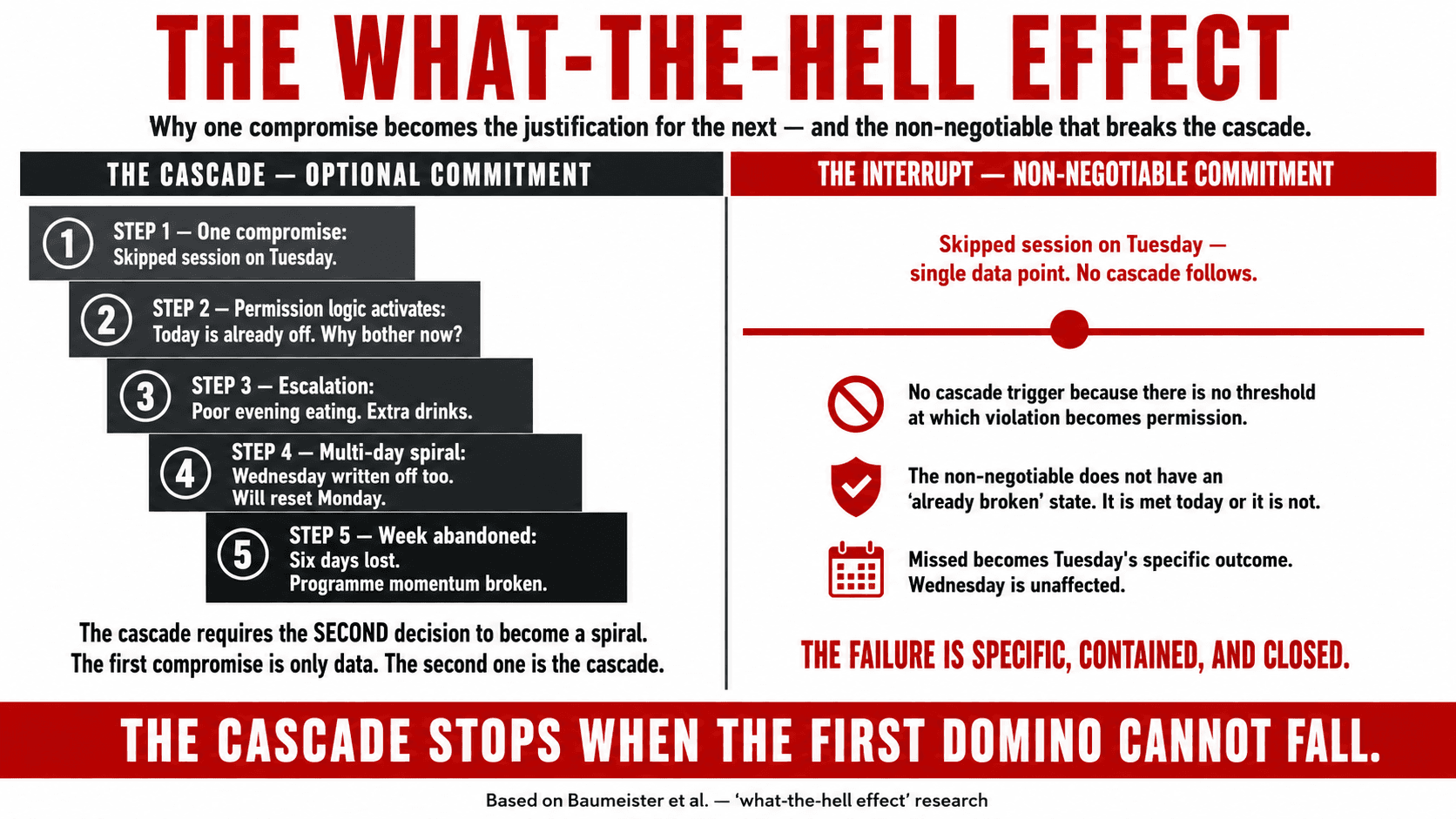
The Negativity Spiral: Why One Compromise Becomes the Justification for the Next
Negativity in health behaviour compounds in a specific and well-documented pattern. It does not begin as a catastrophic event. It begins as a single compromise: the session skipped on a Tuesday because the morning was difficult, the meal that abandoned the nutritional protocol because the day was stressful, the bedtime that extended by two hours because the evening was enjoyable. None of these single events is significant in itself. Their significance lies in what they produce in the person’s relationship with the commitment the following day.
Roy Baumeister and colleagues identified what they called the what-the-hell effect in the context of dietary restraint: the phenomenon by which a single violation of a dietary commitment, rather than producing recommitment, produces an escalation of violation. The person who breaks their dietary rule at lunch does not simply break it once. They use the break as justification for breaking it further at dinner. The logic: the commitment has already been violated today; further violation does not meaningfully worsen the situation; therefore the violation escalates. This mechanism is not limited to dietary behaviour. It applies across every domain where an optional commitment meets a single moment of failure (4).
The non-negotiable commitment does not eliminate failure. Nothing eliminates failure. What it changes is the relationship with failure after it occurs. The person whose commitment is non-negotiable does not have access to the what-the-hell logic, because the non-negotiable does not have a threshold at which violation becomes permission for further violation. There is no threshold. There is simply the non-negotiable, which was not met today and will be met tomorrow. The failure is specific, contained, and closed. It does not open a door to the permission for progressive abandonment.
The neurological basis for the negativity spiral lies in the same reward circuitry that drives the optional commitment’s failure. A negative emotional state reduces prefrontal cortex activity and increases amygdala reactivity, tilting the decision-making system toward immediate reward and away from long-term investment. The negative spiral is self-reinforcing: each compromise produces a small reduction in self-efficacy, which produces a slightly more negative emotional state, which makes the next compromise slightly more likely. The non-negotiable interrupts this spiral at its inception because it removes the initial compromise from the available decision set (5).
Key Insight: Identify the specific commitment that, when broken, most reliably triggers a cascade of further breaks in the same period. This is your highest-leverage non-negotiable. It is not the commitment you are most likely to break. It is the commitment whose breaking produces the most downstream damage. Make that one non-negotiable first, before any other. The cascade stops when the first domino cannot fall.
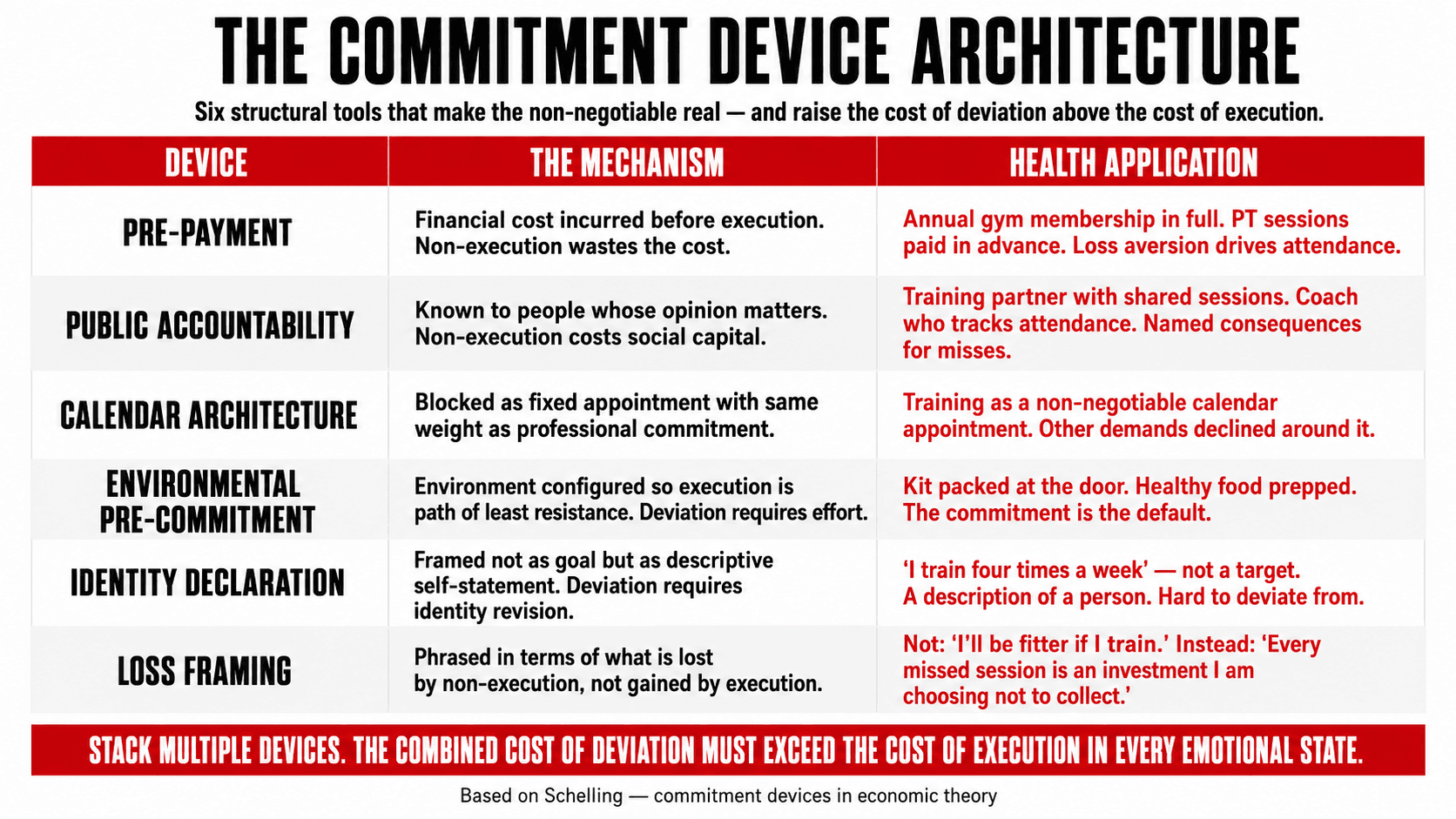
The Commitment Device Architecture: Structural Tools That Make Non-Negotiable Real
A commitment device is any mechanism that binds a future decision in advance by raising the cost of deviation beyond the cost of execution. The concept was formalised in economics by Thomas Schelling, who described commitment devices as a method of managing the conflict between the present self, which prefers immediate comfort, and the future self, which values long-term outcomes. The most elegant commitment devices are those that remove the decision from the moment of execution entirely, so that executing the commitment requires no more willpower than not executing it would have (6).
The architecture of a non-negotiable health commitment is built on commitment devices that operate at multiple levels simultaneously: social, structural, financial, and environmental. Each device adds a layer of cost to the deviation from the non-negotiable, and the combined effect of multiple layers makes the alternative to execution psychologically and practically more expensive than execution.
| Commitment Device | The Mechanism | Health Application Example | Strength of Bind |
|---|---|---|---|
| Pre-payment | Financial cost of the commitment is incurred before execution is required. Non-execution does not recover the cost and wastes it. | Annual gym membership paid in full. Personal training sessions booked and paid in advance. The financial cost of cancellation makes attendance the rational choice. | Strong. Financial loss aversion is one of the most reliable drivers of follow-through in behavioural economics research. |
| Public accountability | The commitment is known to people whose opinion matters to the person. Non-execution incurs a social cost in the form of visible inconsistency between stated and actual behaviour. | Training partner who has committed to the same sessions. A coach who tracks attendance. A check-in structure with specific named consequences for non-execution. | Variable. Strongest when the social relationship is genuinely valued and the accountability is specific rather than passive. |
| Calendar architecture | The commitment is blocked in the calendar as a fixed appointment with the same inviolability as a professional commitment. Alternative demands on the time are declined. | Training sessions entered as non-negotiable calendar appointments, not as aspirational placeholders. Treated with the same firmness as a client meeting. | Moderate to strong. Requires the consistent application of the same standard to health appointments as professional ones. |
| Environmental pre-commitment | The environment is arranged so that executing the commitment is the path of least resistance and deviating requires active effort to create the alternative. | Training kit packed and placed at the door the night before. Healthy food prepared and accessible. The commitment is the default. The deviation requires effort. | Strong for behaviour initiation. Weaker for behaviour continuation once outside the prepared environment. |
| Identity declaration | The commitment is framed not as a goal or intention but as an identity statement. Non-execution is not a missed session. It is behaviour inconsistent with who the person is. | I train four times per week is not a target. It is a description of a person. Deviation requires revising the identity description, which is psychologically costly. | Very strong when the identity has been genuinely internalised. Weak when the identity declaration is aspirational rather than descriptive of current self-concept. |
| Loss framing | The commitment is framed in terms of what is lost by non-execution rather than what is gained by execution. Loss aversion produces stronger motivation than equivalent gain framing. | Not: I will be fitter if I train. Instead: every session I miss is an investment I have already made in the programme that I am choosing not to collect. | Strong in the short term. Requires careful management to prevent the loss framing from becoming anxiety-driven rather than rational-commitment-driven. |
The most robust non-negotiable commitment is supported by multiple commitment devices simultaneously. Pre-payment plus calendar architecture plus environmental pre-commitment plus identity framing creates a structure where the cost of deviation exceeds the cost of execution across every emotional state the person is likely to encounter.
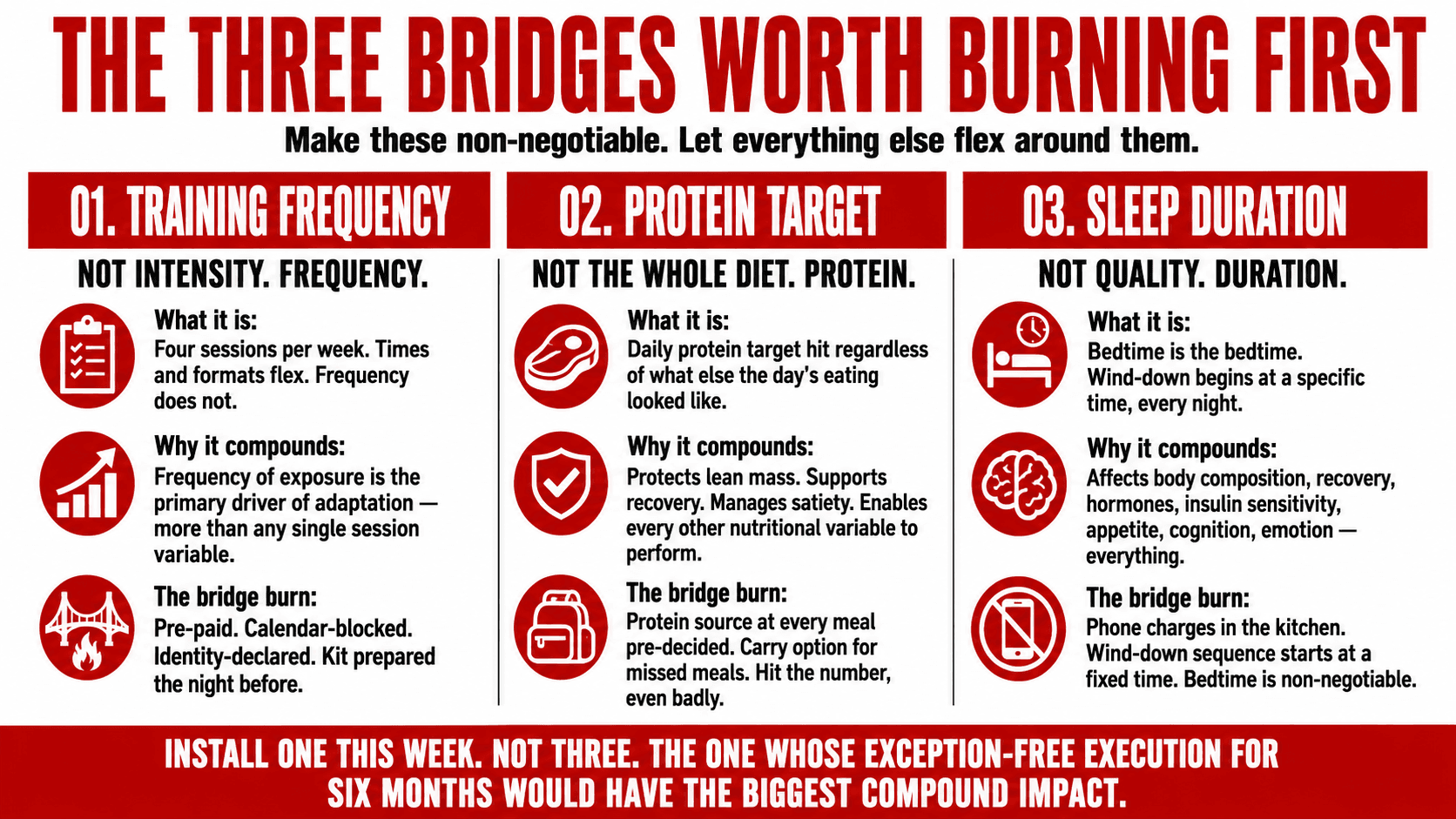
Burning the Bridges: The Three Health Behaviours Most Worth Making Non-Negotiable
Not every health behaviour requires the same level of structural commitment. Some behaviours are flexible by nature and benefit from adaptability. Others are foundational: their consistent execution enables everything else, and their consistent failure undermines everything else. These are the behaviours worth making non-negotiable, because the compound return on their consistent execution is disproportionate to the cost of the commitment.
The first is training frequency. Not training intensity, not training duration, not the specific modality. Training frequency. The person who trains four times per week at varying intensities and durations, consistently, week after week across twelve months, produces categorically better results than the person who trains eight times in a good week and zero times in a difficult one. Frequency of exposure to the training stimulus is the primary driver of adaptation, more than any single session variable. Making training frequency non-negotiable, even at the cost of session quality in difficult weeks, produces the compound return that inconsistent high-intensity training cannot.
The second is protein intake. Not the entire nutritional strategy. Not caloric precision. The protein target. The person who hits their protein target every day, regardless of what else the day’s eating looked like, is protecting lean mass, supporting recovery, and managing satiety in a way that creates the conditions for every other nutritional variable to perform as intended. Protein is the nutritional non-negotiable because it is the variable whose consistent presence most directly enables the physical adaptations that training is producing. Everything else can flex. The protein target, across the relevant studies and across fifteen years of coaching practice, is the variable that most rewards consistent non-negotiable treatment.
The third is sleep duration. Not sleep quality, which is partially beyond direct control. Sleep duration. The decision about when to go to bed is within complete control, every night. The decision about when to pick up the phone in the evening, when to start the wind-down sequence, when to accept that the day is finished. Matthew Walker’s sleep research is unambiguous about the downstream effects of insufficient sleep on every variable that a health programme is trying to improve: body composition, muscle recovery, hormonal regulation, insulin sensitivity, appetite management, cognitive performance, and emotional regulation. Sleep is not the absence of training. It is the most important recovery session of the day, and making the bedtime non-negotiable is one of the most powerful single commitments available (7).
Key Insight: Choose one non-negotiable to install this week. Not three. One. The one that, if it happened every single day or every single week without exception for six months, would have the largest compound impact on your health. Build the commitment device architecture around it. Pre-pay where possible. Add it to the calendar as an unmovable appointment. Arrange the environment to make its execution the path of least resistance. Declare the identity statement that goes with it. Then burn the bridge behind it and do not look back.
The Negativity Loop Disruption Protocol: Breaking the Spiral Before It Cascades
The negativity spiral does not announce itself. It arrives as a single reasonable-sounding thought at a specific difficult moment, and its trajectory from that thought to a multi-day deviation from the programme is determined by whether the person has a pre-decided response protocol or whether they are improvising against a well-established cognitive pattern in real time.
| The Entry Trigger | The Automatic Negative Thought | The Cognitive Reframe | The Behaviour Response |
|---|---|---|---|
| Missed a session | I have already broken the week. The programme has been disrupted. I might as well eat what I want tonight and start fresh next week. | One missed session is a data point, not a verdict. The programme has not been disrupted. Today has been disrupted. Tomorrow is unaffected by today. | Execute the minimum viable version of the next scheduled behaviour. A fifteen-minute walk is not the session. It is the signal that the cascade has been interrupted. |
| Poor nutritional day | I have already eaten badly today. The day is compromised. I will be strict tomorrow. Tonight is written off. | The what-the-hell effect is a cognitive pattern, not an accurate assessment of the situation. One poor meal does not change the week’s nutritional average meaningfully. The next meal does. | Make the next food decision from the programme rather than from the permission the first deviation appeared to grant. The cascade requires two decisions, not one, to become a spiral. |
| Scale weight increased | The programme is not working. I have been strict and the weight has gone up. There is no point continuing if the results are going in the wrong direction. | Scale weight is dominated by water, glycogen, and digestive content, not by fat mass. A three-day average is more accurate than a single day reading. One up day means nothing about the programme. | Check a three-day average rather than a single reading. Compare to the same day two weeks ago, not yesterday. Continue the programme without change. |
| Social occasion caused deviation | I cannot maintain this programme with my social life. The two are incompatible. I will have to choose one or the other. | A social occasion that produced a deviation from the nutritional protocol is a single event. It is not evidence of incompatibility. It is evidence that the social navigation strategy needs refinement. | Return to the programme the morning after the occasion without drama or extended compensation. Restrictive compensation after a deviation produces a worse nutritional outcome than simply returning to the standard protocol. |
| Motivation is absent | I do not feel like doing this today. If I am not motivated, the session will be poor quality and not worth doing. I will wait until I feel more like it. | Waiting for motivation is waiting for an emotional state that is not the driver of the behaviour. The non-negotiable does not require motivation. It requires execution. Quality follows consistency, not mood. | Execute the minimum viable session. Ten minutes of any training is better than zero and interrupts the pattern of waiting for motivation before acting. The motivation often arrives after initiation, not before. |
The cascade requires the second decision to become a spiral. The protocol interrupts it at the first decision by replacing the automatic negative thought with an accurate reframe and a specific minimum viable behaviour that re-establishes the non-negotiable without requiring the programme to restart.
You Do Not Owe Anyone an Explanation
One of the most practically important and least-discussed aspects of making health non-negotiable is the social dimension of the commitment. The person who trains at 6am has a partner who may not share their schedule. The person who declines the second course at dinner is at a table where everyone else ordered it. The person who leaves the social occasion at ten o’clock because they have an early session has friends who stay until midnight.
The pressure to explain these choices, to justify the commitment to the people around you, to make the non-negotiable feel less non-negotiable in social contexts, is one of the most reliable ways to erode it. Explanation invites negotiation. The person who explains why they are not drinking tonight has opened a conversation about whether that reasoning is sufficient. The person who simply does not drink tonight has made a decision that is not on the table for discussion.
Robert Cialdini’s research on social influence is relevant here in a specific and perhaps unexpected way: the person who offers reasons for a commitment invites evaluation of those reasons, which invites counter-arguments, which creates cognitive pressure against the commitment. The person who does not offer reasons has removed the invitation. You do not owe anyone an explanation for what you eat, when you go to bed, whether you train, or what you drink. The commitment is yours. It serves your health, your identity, and your future self. Its justification to the social environment around you is not a requirement for its validity (8).
This is not antisocial behaviour. The person who trains consistently, eats well, sleeps adequately, and manages their health intelligently is not withdrawing from social life. They are structuring it around a foundation that makes them more capable, more energetic, more present, and more valuable to the people in their life than the alternative would produce. The non-negotiable is not a barrier to a full life. It is the architecture that makes one possible.
“The most common form of despair is not being who you are.”
— Søren Kierkegaard
Key Insight: The next time someone asks why you are not drinking, why you are leaving early, or why you are not eating what everyone else is eating, try saying simply: I am fine, thank you, and changing the subject. No explanation required. No apology offered. No invitation to negotiate the commitment. The non-negotiable does not require social permission. It requires only the decision to hold it, quietly, without drama, and without explanation.
How Non-Negotiables Are Built Into Every Programme From the First Session
In the first session with a new client, one of the most important conversations I have is about which health behaviours they are willing to make genuinely non-negotiable. Not aspirationally non-negotiable. Structurally non-negotiable, backed by commitment devices that give the commitment real weight and remove the exit route from the decision set.
I am not asking for perfection. I am asking for three things that happen every week without exception. Three anchor behaviours whose execution is guaranteed regardless of how the rest of the week unfolds. The training frequency. The protein target. The sleep schedule. Everything else can flex around these three. But these three are not on the table, and the programme I build is designed to protect them first, before optimising anything else.
The clients who produce the most significant and most durable transformations are not the ones with the most sophisticated programmes. They are the ones who identified their three non-negotiables early, built the commitment device architecture around them, and then let everything else in the programme flex, adapt, and improve around that fixed foundation. The bridge is burned. The direction is forward. The only question is how far. I work one-to-one with clients online globally. The non-negotiable conversation is where the lasting programme begins.
Work with Me
Get a personalised coaching plan built around your goals, your schedule, and your life.
Enquire NowReferences
- Schwartz B. The Paradox of Choice: Why More Is Less. New York: Harper Perennial; 2004.
- Ariely D, Wertenbroch K. Procrastination, deadlines, and performance: self-control by precommitment. Psychological Science. 2002; 13(3): 219–224.
- Baumeister RF, Bratslavsky E, Muraven M, Tice DM. Ego depletion: is the active self a limited resource? Journal of Personality and Social Psychology. 1998; 74(5): 1252–1265.
- Baumeister RF, Heatherton TF, Tice DM. Losing Control: How and Why People Fail at Self-Regulation. San Diego: Academic Press; 1994.
- Ochsner KN, Gross JJ. The cognitive control of emotion. Trends in Cognitive Sciences. 2005; 9(5): 242–249.
- Schelling TC. Self-command in practice, in policy, and in a theory of rational choice. American Economic Review. 1984; 74(2): 1–11.
- Walker M. Why We Sleep: The New Science of Sleep and Dreams. London: Penguin; 2017.
- Cialdini RB. Influence: The Psychology of Persuasion. New York: Harper Business; 2006.