
Cardio for fat loss is one of the most misunderstood topics in the entire fitness industry. If you have ever jumped on a treadmill, looked down at the screen showing “calories burned” and thought you were making serious progress, I need to be honest with you. You have probably been misled. Most people who come to me for coaching have been doing some form of cardio for months, sometimes years, and wondering why their body has not changed. The answer is almost always the same. They are doing too much of the wrong type, at the wrong time, with no structure around it.
Cardio is a tool. A useful one when applied correctly. A counterproductive one when it is not. This guide is going to break it all down for you in plain language so you understand exactly when to add cardio, what type to use, and what mistakes to avoid. No jargon. No fads. Just evidence and practical application.
Why Most People Get Cardio Wrong
Here is what I see time and time again. Someone decides to lose weight. They start running three or four times a week. Or they join a spin class. Or they spend 45 minutes on the cross trainer every day. In the first couple of weeks, the scale drops. They feel great. Then everything stalls. So they do more cardio. Still nothing. They eat less. They feel exhausted. Their mood drops. Their body looks the same. They give up.
This cycle is not a failure of willpower. It is a failure of strategy. The reason it happens is that most people treat cardio as the primary driver of fat loss when it should be a secondary tool. The primary drivers are nutrition and resistance training. Cardio is the accelerator you add once those foundations are locked in.
Understanding Energy Balance: The Foundation of Fat Loss
Before we talk about types of cardio, you need to understand one fundamental concept. Fat loss comes down to energy balance. If you consume more energy than you burn, you store fat. If you burn more energy than you consume, you lose fat. It is not more complicated than that at the most basic level. Here is a simple diagram to show how it works.
| Energy In | vs | Energy Out |
|---|---|---|
| Food + Drink | BMR + NEAT + Exercise + TEF | |
| If IN > OUT | = | Fat stored |
| If IN < OUT | = | Fat lost |
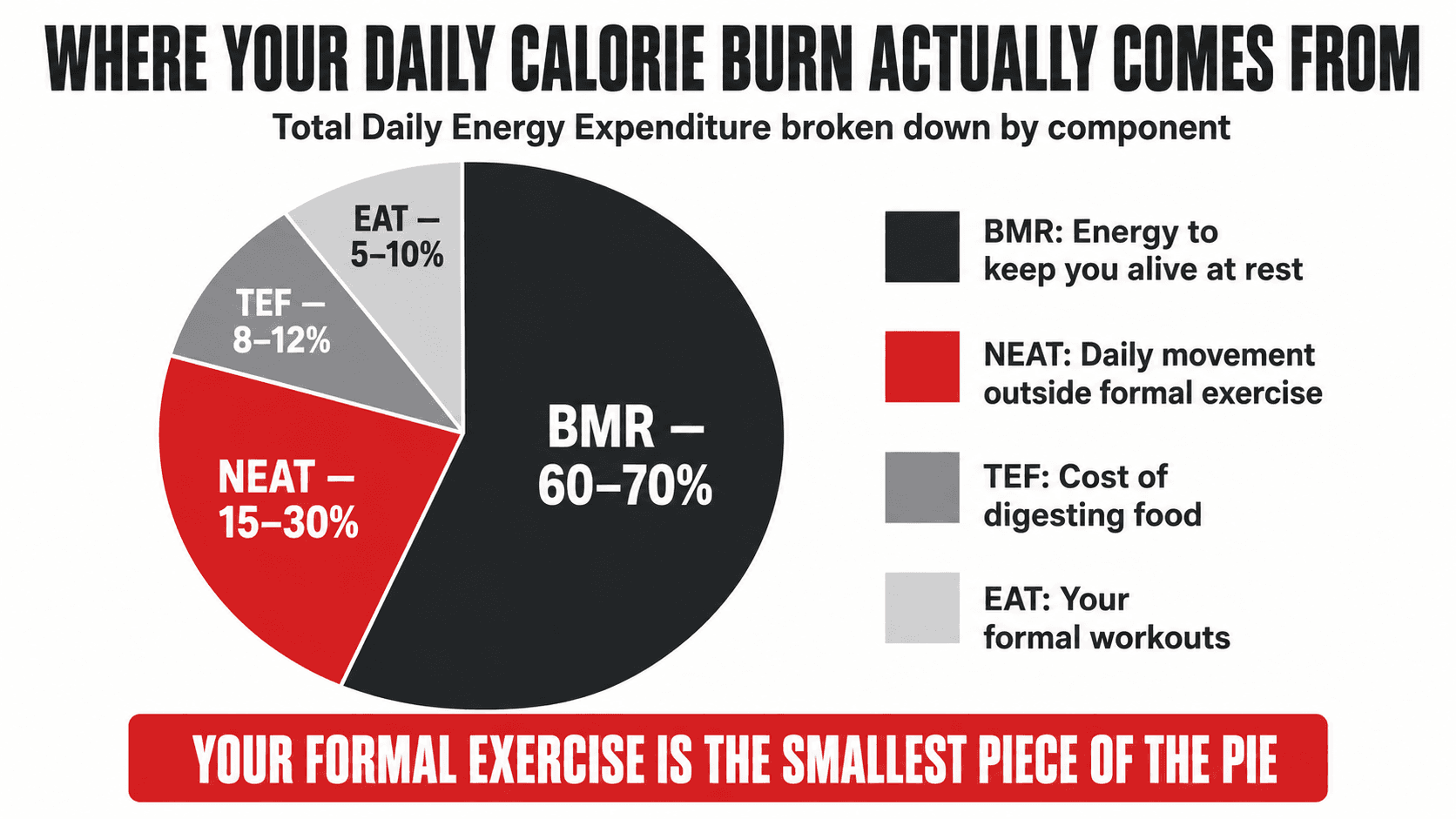
Your total daily energy expenditure, which is the total number of calories you burn each day, is made up of four components. Most people only think about exercise, but exercise is actually one of the smallest contributors. Here is a breakdown of what really makes up your daily calorie burn.
| YOUR TOTAL DAILY ENERGY EXPENDITURE (TDEE) EXPLAINED | |
|---|---|
| BMR (60–70%) | Basal Metabolic Rate. The calories your body burns just to stay alive: breathing, pumping blood, brain function. This is the biggest chunk of your daily burn and it happens even while you sleep. |
| NEAT (15–30%) | Non-Exercise Activity Thermogenesis. Everything you do that is not formal exercise: walking to the shops, cooking, cleaning, fidgeting, taking the stairs. This is hugely important and massively underestimated. |
| TEF (8–12%) | Thermic Effect of Food. The energy your body uses to digest and absorb the food you eat. Protein has the highest thermic effect, which is another reason a high protein diet matters. |
| EAT (5–10%) | Exercise Activity Thermogenesis. Your gym sessions, runs, classes, and any planned exercise. For most people, this is the smallest piece of the puzzle. |
Look at those numbers carefully. Your planned exercise, including all your cardio sessions, typically accounts for only 5 to 10 percent of your total daily energy expenditure. Meanwhile, NEAT accounts for 15 to 30 percent. Professor James Levine of the Mayo Clinic, who coined the term NEAT, found that it can vary by as much as 2,000 calories per day between two people of a similar size depending on their daily activity levels (1). That is an extraordinary number and it tells you something critical: how active you are outside of the gym matters far more than what you do inside it.
Top Tip
Before adding formal cardio, make sure you are hitting at least 8,000 to 10,000 steps per day. This alone can make a bigger difference to your fat loss than any treadmill session.
What Happens When You Just Do More Cardio
When you rely on cardio alone to create a calorie deficit, several things happen that work against you. First, your body adapts to the stimulus. The same 30 minute run that burned a meaningful number of calories in week one becomes metabolically cheaper as your body becomes more efficient. You burn fewer calories doing the same work.
Second, excessive cardio, particularly moderate intensity steady state work like jogging, can elevate cortisol, your primary stress hormone. Chronically elevated cortisol promotes fat storage, particularly around the midsection, disrupts sleep and impairs recovery (2). If you are already stressed from work, family and life in general, piling on hours of cardio adds another stressor to an already overloaded system.
Third, and this is the one most people miss entirely, when you diet aggressively and do lots of cardio without resistance training, a significant portion of the weight you lose comes from muscle, not just fat. Research published in Obesity Reviews found that calorie restriction alone can result in 20 to 30 percent of total weight loss coming from lean mass (3). That means you may weigh less on the scale but your body composition, the ratio of muscle to fat, barely changes. You end up what many in the industry call “skinny fat.”
Common Mistake
Doing more cardio and eating less food is not always the answer. If you have been in a calorie deficit for weeks and fat loss has stalled, adding more cardio on top of less food is the fastest way to crash your energy, mood and metabolism.
When to Actually Add Cardio for Fat Loss
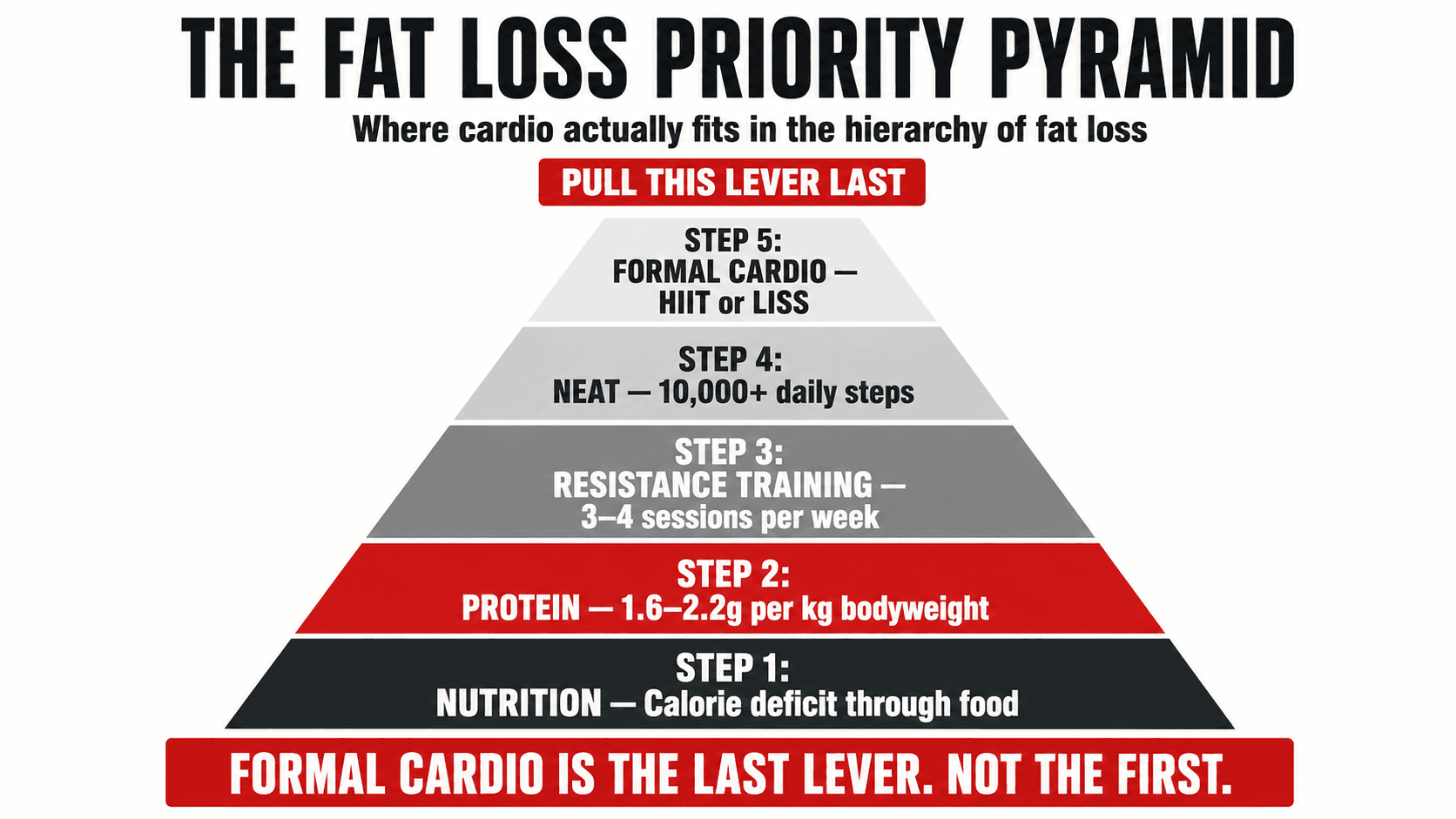
In my coaching, I follow a very specific order of operations. I do not add cardio on day one for most clients. Here is the sequence I use and I would encourage you to think about it the same way.
| THE FAT LOSS PRIORITY PYRAMID (Start at the Bottom) | |
|---|---|
| Step 5 | Add formal cardio sessions (HIIT and/or LISS) to increase the calorie deficit further. This is the last lever to pull, not the first. |
| Step 4 | Increase daily movement (NEAT). Walk more. Take stairs. Stand at your desk. Aim for 10,000+ steps. |
| Step 3 | Resistance train 3 to 4 times per week. This preserves muscle, keeps your metabolism elevated and shapes your body. |
| Step 2 | Hit your protein target. For most people, 1.6 to 2.2g per kilogram of bodyweight per day (4). |
| Step 1 | Get your nutrition right. Establish a moderate calorie deficit through food. This is where fat loss starts. |
Cardio enters the picture when your nutrition is dialled in, your resistance training is consistent and your NEAT is solid, but fat loss has slowed because your body has adapted to the current deficit. At that point, instead of cutting more food, you add cardio to increase energy expenditure. This gives you more room to eat, which keeps your energy up and your adherence high.
Top Tip
Think of cardio as a way to increase your calorie deficit without having to eat less food. This is far more sustainable than constantly cutting calories.
The Three Types of Cardio You Need to Know About
There are really only three categories of cardio you need to understand. Forget the complicated systems and fancy class names. It all comes down to intensity. Let me explain each one in simple terms.
1. HIIT: High Intensity Interval Training
HIIT involves short bursts of very hard effort followed by periods of rest or low intensity recovery. Think of sprinting as hard as you can for 20 to 30 seconds, then walking or resting for 60 to 90 seconds, and repeating that cycle. A full HIIT session typically lasts between 15 and 25 minutes.
A 2024 umbrella review published in Sports Medicine, which synthesised 16 systematic reviews covering 79 randomised controlled trials, found that interval training was effective for reducing body fat percentage, fat mass and waist circumference in healthy adults compared to non-exercising controls (5). However, when compared directly to moderate intensity continuous training, the differences in fat loss were small and often not statistically significant. What HIIT does offer is significant time efficiency. You can achieve comparable fat loss results in roughly 40 percent less time than traditional steady state cardio.
HIIT also produces a meaningful afterburn effect known as excess post-exercise oxygen consumption, or EPOC. This means your metabolic rate remains elevated for hours after the session ends. Research in the International Journal of Exercise Science found that a 30 minute resistance style circuit elevated resting metabolic rate for at least 14 hours post exercise in trained women (6). HIIT produces a similar effect.
Top Tip
If you are short on time, HIIT is your best option. But limit it to two or three sessions per week maximum. It is demanding on your nervous system and too much of it will interfere with your recovery from weight training.
2. LISS: Low Intensity Steady State Cardio
LISS is exactly what it sounds like. Low intensity, sustained activity at a consistent pace. Walking, easy cycling, swimming at a relaxed pace, or using the cross trainer at a conversational effort level. Sessions typically last 30 to 60 minutes.
LISS does not burn as many calories per minute as HIIT, but it has several advantages that make it incredibly valuable, especially for people who are already training hard with weights. It is very easy to recover from. It does not tax your central nervous system. It can actually enhance recovery by promoting blood flow to sore muscles. And it reduces cortisol rather than spiking it, which is why it works well for stressed, busy people.
For my clients who work long hours, have family commitments and are already doing three to four resistance training sessions per week, LISS is often the cardio of choice. A 30 to 45 minute brisk walk, preferably outdoors, gives them fresh air, headspace and an additional calorie burn without adding another stressor to their week.
Top Tip
When your body fat gets lower and your calories are already reduced, switch your cardio emphasis from HIIT to LISS. Your body is under more stress at this point and the last thing it needs is more high intensity work.
3. Moderate Intensity Cardio (Jogging, Steady Running)
This sits between HIIT and LISS and is often the default for most people. Jogging at a steady pace for 30 to 45 minutes. It is the most popular form of cardio and, honestly, it is the least useful for most people chasing fat loss.
Moderate intensity cardio creates a level of fatigue that interferes with your recovery from resistance training but does not provide the metabolic benefits of true HIIT. It is hard enough to stress the body but not hard enough to trigger the afterburn effect. If you enjoy running and it is part of your mental health routine, by all means keep it in. But I would limit it to one or two sessions per week and not let it replace either HIIT or LISS.
Cardio Comparison: HIIT vs LISS vs Moderate Intensity
| HIIT | LISS | Moderate | |
|---|---|---|---|
| Session length | 15–25 mins | 30–60 mins | 30–45 mins |
| Calories per minute | High | Low to moderate | Moderate |
| Afterburn (EPOC) | Significant | Minimal | Low |
| Recovery demand | High | Very low | Moderate |
| Stress on nervous system | High | Very low | Moderate |
| Muscle preservation | Good | Good | Fair |
| Ideal frequency | 2–3x per week | 3–6x per week | 1–2x per week |
| Best for | Time efficiency | Recovery and volume | Enjoyment only |
| Beginner friendly | Not ideal | Excellent | Moderate |

The Secret Weapon: NEAT
I mentioned NEAT earlier but it deserves its own section because it is that important. NEAT stands for Non-Exercise Activity Thermogenesis and it includes every movement you make that is not sleeping, eating or formal exercise. Walking to the station, climbing stairs, cooking dinner, playing with your kids, even fidgeting at your desk.
Professor Levine's research at the Mayo Clinic found that obese individuals spent approximately 2.5 hours more per day seated than their lean counterparts (7). If those individuals simply adopted the daily movement patterns of the lean group, they could burn an additional 350 calories per day without ever setting foot in a gym. Over a week that is 2,450 extra calories. Over a month that is nearly one kilogram of fat loss from movement alone.
Here is why this matters for you. When you go on a diet and reduce your calories, your body naturally down-regulates NEAT as a survival mechanism. You move less without even realising it. You fidget less. You take the lift instead of the stairs. You sit instead of stand. Research has shown that NEAT can decrease by around 150 calories per day during calorie restriction (8). This is one of the hidden reasons fat loss stalls.
Top Tip
Track your daily step count. When you are dieting and fat loss slows, check your steps before adding formal cardio. If they have dropped, the fix is not more gym time. It is more walking.

How to Put This All Together: A Practical Action Plan
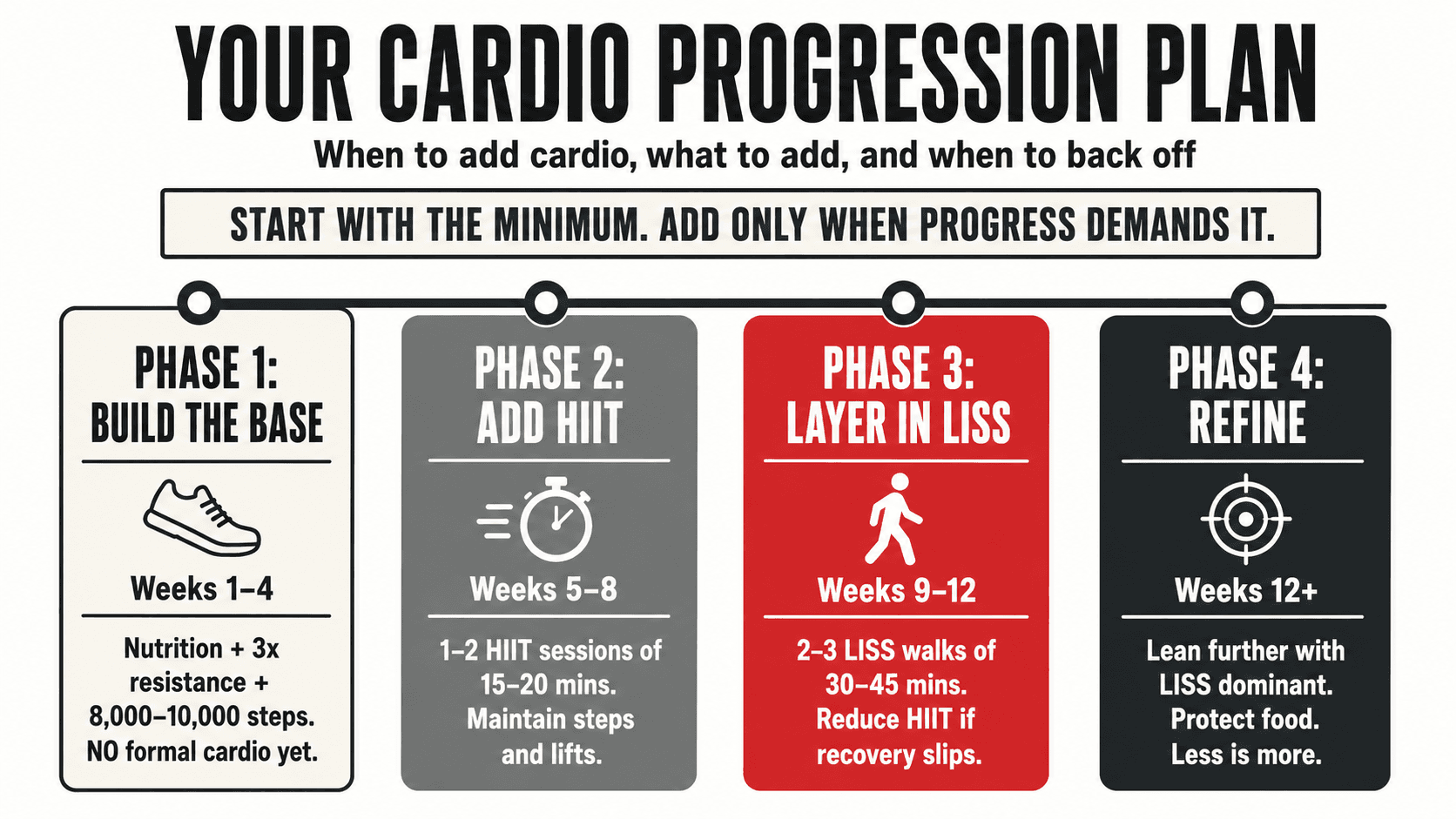
Here is exactly how I would structure cardio for someone who wants to lose body fat effectively and sustainably. This is the approach I use with my coaching clients and it works whether you are a complete beginner or someone who has been training for years.
| YOUR CARDIO PROGRESSION PLAN | |
|---|---|
| Phase 1 (Weeks 1–4) | Focus entirely on nutrition and resistance training (3x per week). Get daily steps to 8,000–10,000. No formal cardio needed yet. |
| Phase 2 (Weeks 5–8) | If fat loss slows, add 1–2 HIIT sessions per week (15–20 mins each). Keep step count at 10,000+. |
| Phase 3 (Weeks 9–12) | Add 2–3 LISS sessions (30–45 min brisk walks). You can reduce HIIT to 1–2 sessions if recovery is suffering. |
| Phase 4 (Weeks 12+) | Adjust based on progress. If body fat is getting low and energy is dropping, shift to LISS dominant cardio and protect your food intake. Less is often more at this stage. |
Top Tip
Always start with the minimum effective dose of cardio. You can always add more later. You cannot undo the fatigue and stress of doing too much too soon.
A Quick Note on Nutrition and Dietary Inclusivity
Everything I have written above only works if your nutrition is right. And when I say nutrition, I mean it for everyone, not just people who eat meat. I am a lifelong vegetarian myself and I coach clients across every dietary background: omnivores, vegetarians, vegans, and everything in between.
Regardless of your dietary preference, the same principles apply. You need adequate protein to preserve muscle tissue during fat loss. You need a moderate calorie deficit that does not leave you starving. And you need consistency. Good protein sources include chicken, turkey, fish and eggs for omnivores. For vegetarians and vegans, tofu, tempeh, seitan, lentils, chickpeas, soy protein, pea protein isolate, Greek yoghurt (or plant based alternatives) and mock meats all work brilliantly. The key is hitting your targets, not following a specific ideology.
Top Tip
Aim for 1.6 to 2.2 grams of protein per kilogram of bodyweight per day, regardless of your dietary preference. This is the range supported by the International Society of Sports Nutrition for active individuals (4).
Five Things to Avoid With Cardio
Let me be direct about the mistakes I see people make repeatedly. These are the things that waste time, stall progress and leave people frustrated.
| Mistake | Why It Hurts You | What to Do Instead |
|---|---|---|
| Doing cardio before weights | Depletes energy for resistance training which is more important for body composition | Always do weights first. Cardio after or on separate days |
| Trusting calorie counters on machines | Machines overestimate calorie burn by 30–50%. This creates a false sense of progress | Ignore the calorie display. Focus on effort and consistency |
| Doing HIIT every day | Overtrains the nervous system, raises cortisol, kills recovery and leads to burnout | Cap HIIT at 2–3 sessions per week with rest days between |
| Using cardio to “earn” food | Creates an unhealthy relationship with food and exercise | Eat according to your plan. Use cardio to support the deficit, not justify eating |
| Skipping resistance training for cardio | Lose muscle, lower metabolism, end up “skinny fat” | Prioritise weights 3–4x per week. Add cardio on top, never instead |
The Bottom Line
Cardio is a tool in your fat loss toolkit and it is a useful one when applied intelligently. But it is not the foundation. Nutrition comes first. Resistance training comes second. Daily movement and NEAT come third. Formal cardio comes last, and only when you need it to push past a plateau or increase your calorie deficit without cutting more food.
If you are a complete beginner, start by walking more and eating better. If you have been training for a while and results have stalled, look at your nutrition compliance before adding more cardio. And if you are already doing everything right and need that extra push, use HIIT for efficiency and LISS for sustainability. Combine the two and you have a system that works.
I work one-to-one with clients online globally, building bespoke fat loss programmes around real lives, real schedules and real dietary preferences. Whether you are a meat eater, vegetarian, vegan, or something in between. Whether you are dealing with Type 2 diabetes, PCOS, hypertension or simply want to look and feel better. I build programmes that are evidence based, sustainable, and designed specifically for you.
If you want to stop guessing and start making real progress, get in touch through trperformancecoaching.com and let me show you what structured coaching can do.
Work with Me
Get a personalised coaching plan built around your goals, your schedule, and your life.
Enquire NowReferences
- Levine JA. Nonexercise activity thermogenesis (NEAT): environment and biology. American Journal of Physiology: Endocrinology and Metabolism. 2004;286(5):E675-E685.
- Hackney AC. Stress and the neuroendocrine system: the role of exercise as a stressor and modifier of stress. Expert Review of Endocrinology and Metabolism. 2006;1(6):783-792.
- Lopez P, Taaffe DR, Galvao DA, Newton RU, et al. Resistance training effectiveness on body composition and body weight outcomes in individuals with overweight and obesity across the lifespan: A systematic review and meta-analysis. Obesity Reviews. 2022;23(5):e13428.
- Jager R, Kerksick CM, Campbell BI, et al. International Society of Sports Nutrition Position Stand: protein and exercise. Journal of the International Society of Sports Nutrition. 2017;14:20.
- Tsai YW, Hsu CC, Li TH, Chen MJ, et al. Efficacy of Interval Training in Improving Body Composition and Adiposity in Apparently Healthy Adults: An Umbrella Review with Meta-Analysis. Sports Medicine. 2024;54(10):2587-2608.
- Sevits KJ, Melanson EL, Swibas T, et al. EPOC Comparison Between Resistance Training and High-Intensity Interval Training in Aerobically Fit Women. International Journal of Exercise Science. 2021;14(2):1027-1035.
- Levine JA, Vander Weg MW, Hill JO, Klesges RC. Non-Exercise Activity Thermogenesis: The Crouching Tiger Hidden Dragon of Societal Weight Gain. Arteriosclerosis, Thrombosis, and Vascular Biology. 2006;26(4):729-736.
- Villablanca PA, Alegria JR, Mookadam F, Holmes DR, Wright RS, Levine JA. Nonexercise Activity Thermogenesis in Obesity Management. Mayo Clinic Proceedings. 2015;90(4):509-519.