
Most people use the words cardiovascular training and aerobic training interchangeably. Walk into any gym, open any fitness app, scroll any Instagram page, and you will see the two terms treated as if they mean exactly the same thing. They do not. And the fact that most people, including many personal trainers, cannot explain the difference is one of the reasons so many training programmes fail to deliver the results people are working so hard for.
From executives managing high blood pressure and Type 2 diabetes to women navigating PCOS and menopause, from first time gym goers to competitive athletes. Understanding the difference between cardiovascular and aerobic training is not academic trivia. It is the foundation of how I structure every single programme I write. And once you understand it, you will immediately see why your current approach to cardio might be leaving results on the table.
Why This Confusion Costs You Results
When you cannot tell these two things apart, several problems follow. You end up training in only one way, usually slow and steady, because that is what most people think cardio means. You avoid high intensity work because you have been told it is not cardio. You neglect the anaerobic energy systems that are critical for metabolic health, fat loss, and performance. And worst of all, you build a programme that trains one aspect of your fitness while completely ignoring others.
The result is a body that is reasonably efficient at jogging but lacks the metabolic power, muscular endurance, and cardiovascular resilience it needs to truly thrive. If you have ever wondered why hours of cardio have not changed your body the way you expected, the answer probably starts here.
What Is Cardiovascular Training, Really?
Cardiovascular training is any form of exercise that places a demand on your heart and blood vessels. The word itself tells you: cardio refers to the heart, vascular refers to the blood vessels. Any activity that forces your heart to pump harder and faster, and your blood vessels to deliver more oxygen and nutrients to working muscles, is cardiovascular training (1).
This is a broad category. It includes steady state jogging, yes. But it also includes HIIT sprints on a bike, heavy sled pushes, circuit training with weights, high rep resistance training with short rest periods, and even vigorous manual labour. If your heart rate is elevated and your circulatory system is under load, you are doing cardiovascular training.
Key Point
Cardiovascular training is defined by the demand on your heart and blood vessels. It is not defined by the type of exercise, the speed you move, or how steady your pace is.
What Is Aerobic Training?
Aerobic training is one specific type of cardiovascular training. The word aerobic means “with oxygen.” Aerobic exercise is any activity performed at an intensity low enough that your body can meet its energy demands primarily through the oxidative energy system, which requires a continuous supply of oxygen (2). This is the system that breaks down carbohydrates and fats in the presence of oxygen to produce adenosine triphosphate (ATP), the energy currency your muscles use to contract.
Aerobic training typically involves sustained, moderate intensity effort over longer durations. Think brisk walking, steady state jogging, easy cycling, swimming at a comfortable pace, or using an elliptical machine at a pace you could maintain while holding a conversation. At rest, your aerobic system is already your primary energy producer, contributing approximately 85 percent of your energy output (3). During aerobic exercise, this system simply scales up to meet the higher demand.
Key Point
Aerobic training is a subset of cardiovascular training. All aerobic training is cardiovascular, but not all cardiovascular training is aerobic.
The Three Energy Systems: Why This Matters for Your Training
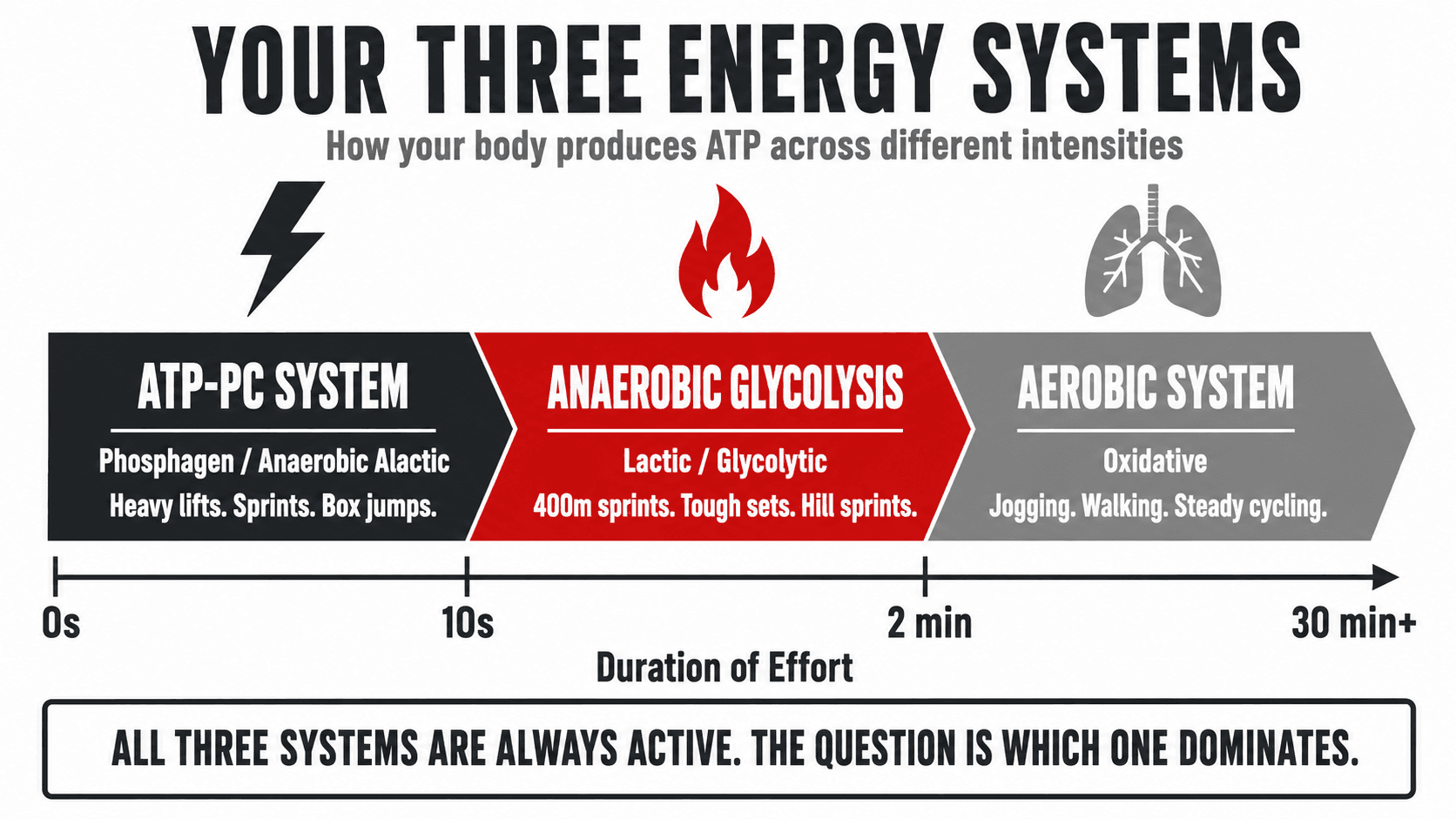
To truly understand the difference, you need a basic grasp of how your body produces energy. Your muscles run on ATP. Every single contraction, from blinking your eyes to pressing a heavy barbell overhead, requires ATP. Your body produces ATP through three energy systems, all of which are operating simultaneously at all times, but with one dominating depending on the intensity and duration of the effort (4).
| YOUR THREE ENERGY SYSTEMS | ||
|---|---|---|
| System | How It Works | When It Dominates |
| ATP-PC (Phosphagen) | Uses stored phosphocreatine to regenerate ATP instantly. No oxygen required. Very fast but very limited. | Maximal efforts lasting 0 to 10 seconds: a heavy deadlift, a short sprint, a box jump. |
| Anaerobic Glycolysis (Lactic) | Breaks down glucose without oxygen to produce ATP. Faster than aerobic but produces lactate as a byproduct. | High intensity efforts lasting 10 seconds to approximately 2 minutes: a 400 metre sprint, a tough set of 12 reps, a hill sprint. |
| Aerobic (Oxidative) | Uses oxygen to break down carbohydrates and fats for ATP. Slow but has virtually unlimited capacity. | Lower intensity efforts lasting longer than 2 to 3 minutes: jogging, walking, steady cycling, easy swimming. |
Here is what most people get wrong: they assume these systems operate like a switch. You are either aerobic or you are not. In reality, all three systems are contributing energy at all times. The question is which one is dominant (4). During a heavy set of squats, your ATP-PC system leads. During a 30 second assault bike sprint, anaerobic glycolysis takes over. During a steady 30 minute jog, your aerobic system is in charge. But all three are always active in the background.
This is why the distinction between cardiovascular and aerobic training matters. When you train aerobically, you are primarily developing your oxidative system and your heart's ability to pump blood efficiently at moderate outputs. When you train cardiovascularly at higher intensities, you are also developing your heart's stroke volume, your anaerobic threshold, your lactate clearance ability, and the structural strength of your blood vessels under peak demand (5).
Top Tip
A truly complete training programme trains all three energy systems. Most people only ever train one: the aerobic system. This is like only ever driving your car in second gear. It works, but you are not using the full engine.
What Counts as What: A Practical Breakdown
Now that you understand the difference, let me show you how common gym activities actually break down. This is where the confusion becomes most apparent, because several popular exercises that people call “cardio” are actually training different energy systems.
| Activity | Cardiovascular? | Aerobic? | Primary Energy System |
|---|---|---|---|
| Brisk walking (10,000 steps) | Yes | Yes | Aerobic (oxidative) |
| Steady state jogging (30 min) | Yes | Yes | Aerobic (oxidative) |
| Easy cycling (Zone 2) | Yes | Yes | Aerobic (oxidative) |
| Swimming laps (moderate pace) | Yes | Yes | Aerobic (oxidative) |
| Assault bike intervals (30 on/30 off) | Yes | No | Anaerobic glycolysis |
| Sled push/prowler sprints | Yes | No | ATP-PC + glycolysis |
| Battle ropes (30 second bursts) | Yes | No | Anaerobic glycolysis |
| Circuit training (short rest) | Yes | Partially | Mixed (glycolytic + aerobic) |
| Heavy resistance (sets of 5) | Mildly | No | ATP-PC (phosphagen) |
| Hill sprints (10 to 15 seconds) | Yes | No | ATP-PC + glycolysis |
Notice that several of the most effective fat loss and performance exercises, including sled pushes, assault bike intervals, and hill sprints, are cardiovascular but not aerobic. They place enormous demand on your heart and blood vessels but do not rely on the oxidative energy system as their primary fuel source. If you have been avoiding these because someone told you they are not cardio, they were wrong.

Why You Need Both Aerobic and Anaerobic Cardiovascular Training
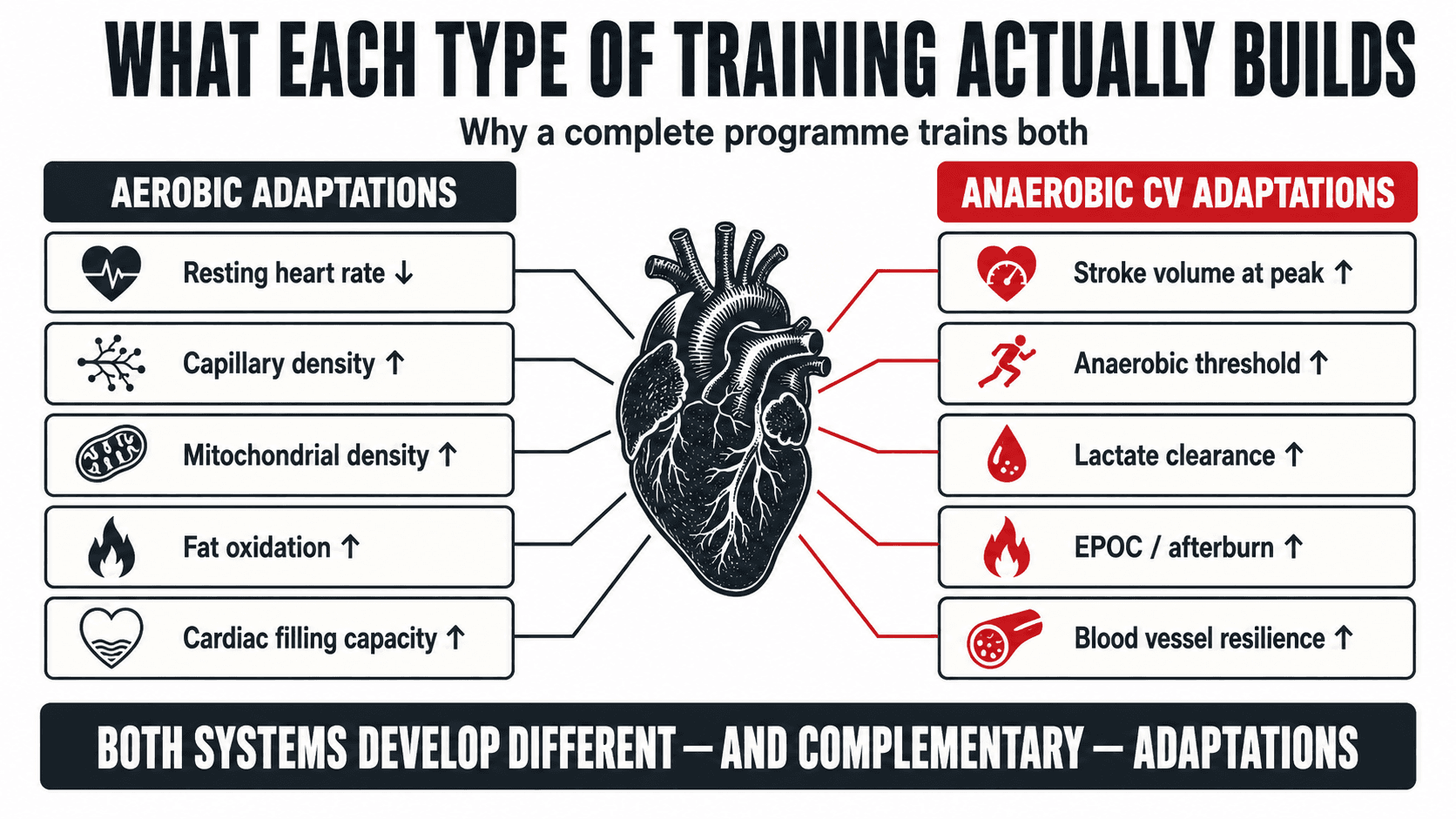
A truly resilient, high performing cardiovascular system is not built by one type of training alone. Aerobic work builds the base. It improves your heart's ability to fill with blood between beats (diastolic function), increases your capillary density so oxygen reaches more muscle fibres, and trains your body to use fat as a fuel source more efficiently (6). This is essential for long term health, daily energy, and recovery between sessions.
Anaerobic cardiovascular work builds the peak. It increases your heart's ability to pump blood forcefully (systolic function), raises your anaerobic threshold so you can work harder before fatigue sets in, and improves your body's ability to clear lactate and recover from intense efforts (5). A 2024 randomised controlled trial published in the European Heart Journal, known as the CardioRACE trial, enrolled 406 adults with overweight or obesity and found that combined aerobic and resistance exercise improved overall cardiovascular disease risk profile more effectively than aerobic or resistance training alone (7).
| WHAT EACH TYPE OF TRAINING DEVELOPS | |
|---|---|
| Aerobic Training | Resting heart rate reduction, capillary density, mitochondrial density, fat oxidation, VO2max base, cardiac output at moderate intensity, recovery capacity. |
| Anaerobic CV Training | Stroke volume at peak effort, anaerobic threshold, lactate clearance, EPOC (afterburn), power output, metabolic flexibility, blood vessel structural resilience. |
| Combined | Complete cardiovascular health, improved metabolic profile, better body composition, greater resilience against cardiovascular disease, improved performance across all intensities. |
The American Heart Association's 2023 scientific statement on resistance training and cardiovascular health reinforced that combining resistance training with aerobic training was associated with a 40 to 46 percent lower risk of all cause and cardiovascular mortality, compared to 18 to 29 percent for either type alone (8). That is not a marginal difference. It is nearly double the protection.
Top Tip
If your entire cardio programme is steady state jogging or walking, you are building a solid aerobic base but neglecting the anaerobic cardiovascular adaptations that protect your heart under peak stress, accelerate fat loss, and improve your day to day performance.
How to Structure a Programme That Trains Both Systems
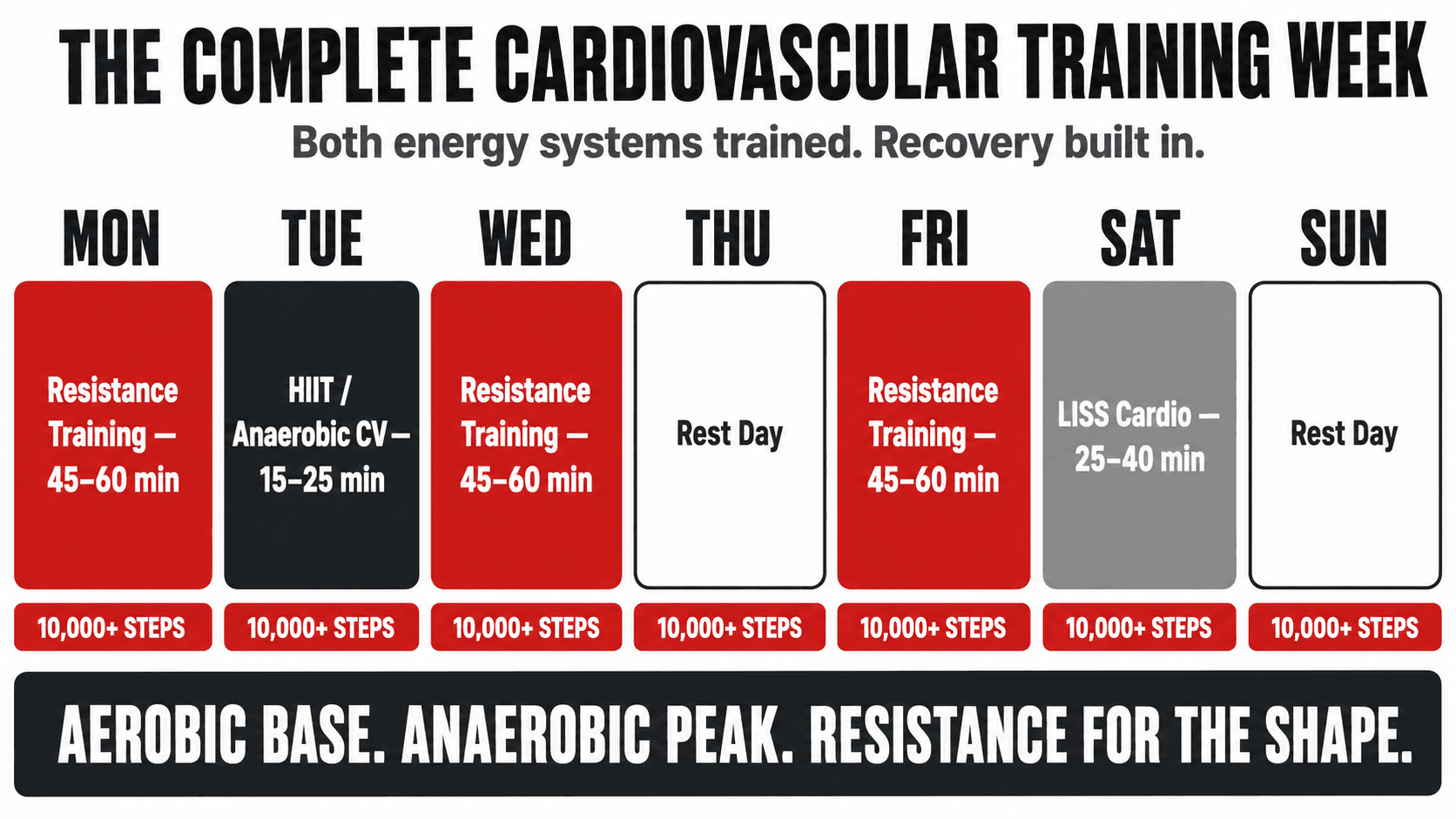
This is where theory becomes practice. Here is how I structure cardiovascular training for clients who want the full spectrum of benefits: fat loss, cardiovascular health, performance, and longevity. This framework works whether you are an omnivore, vegetarian, vegan, or anything in between, because nutrition supports the training, and I tailor macros and food sources to fit every dietary background.
| THE COMPLETE CARDIOVASCULAR TRAINING WEEK | |
|---|---|
| Daily | 10,000+ steps (walking). This is your aerobic foundation. Non-negotiable. It burns calories, improves recovery, manages stress, and costs zero recovery. |
| 2–3x per week | Resistance training sessions (45 to 60 minutes). These are the backbone of body composition change. They train your muscles, boost resting metabolic rate, and provide a mild cardiovascular stimulus. |
| 1–2x per week | HIIT or anaerobic cardiovascular sessions (15 to 25 minutes). Assault bike intervals, sled work, rowing sprints, hill sprints, or battle ropes. Short, intense, demanding. These build your anaerobic threshold and cardiovascular peak. |
| 1x per week | Low intensity steady state session (25 to 40 minutes). Easy cycling, swimming, incline treadmill walking. Active recovery that builds aerobic capacity without taxing your system. |
| 1–2x per week | Rest days. Not optional. Recovery is where your body consolidates every adaptation from training. Sleep, nutrition, and hydration do the heavy lifting on these days. |
This structure ensures you are developing both your aerobic base and your anaerobic peak every single week. The exact split will depend on your goals, your fitness level, and any health conditions you are managing. For someone with hypertension, I may lean more heavily towards aerobic work initially with gradual introduction of higher intensity sessions. For someone who is already aerobically fit but struggling to shift body fat, I may bring in more HIIT and resistance work from day one.
What This Means If You Have a Health Condition
If you are managing Type 2 diabetes, hypertension, PCOS, or you are post-menopausal, this distinction is especially important.
| Condition | Aerobic Training Benefits | Anaerobic CV Training Benefits |
|---|---|---|
| Type 2 Diabetes | Improves insulin sensitivity, lowers fasting glucose, reduces HbA1c (9) | Increases GLUT4 translocation for glucose uptake, improves metabolic flexibility |
| Hypertension | Reduces systolic BP by 5 to 7 mmHg on average (10) | Improves blood vessel elasticity, enhances cardiac output under stress |
| PCOS | Reduces inflammation, improves hormonal profile, aids weight management | Accelerates fat loss, improves metabolic rate, reduces insulin resistance |
| Post-menopause | Supports bone density (when combined with impact), cardiovascular protection | Preserves lean mass, maintains metabolic rate, reduces visceral fat |
The evidence is clear across all of these conditions: a combination of aerobic and anaerobic cardiovascular training, alongside resistance training, provides the most comprehensive health benefits. One type alone is never optimal. The research supports this across every population I work with, and the results I see in my clients confirm it every single week.
Fuelling Both Systems: A Note on Nutrition
Your energy systems run on fuel, and the type of training you do influences the fuel you need. Aerobic training relies heavily on fat oxidation and moderate carbohydrate use. Anaerobic training runs primarily on stored glycogen from carbohydrates. This is why I never put clients on extremely low carbohydrate diets when they are training at high intensities. You need adequate carbohydrate to fuel anaerobic work, adequate protein to repair and preserve muscle, and adequate fat for hormonal health.
For omnivores, this typically means chicken, fish, eggs, lean beef, rice, potatoes, oats, vegetables, and healthy fats. For vegetarians and vegans, it means tofu, tempeh, seitan, lentils, chickpeas, pea protein, soy protein, sweet potatoes, rice, oats, nuts, seeds, and plant based dairy alternatives. The principles are identical. The food sources adapt to your preference. I hit my targets every single day as a lifelong vegetarian, and so do my vegan and plant based clients.
Top Tip
If you are doing HIIT sessions and feeling flat, weak, or unable to maintain intensity, the first thing I check is carbohydrate intake. Anaerobic training demands glycogen. If you have cut carbs too aggressively, your performance and your results will suffer.
Five Common Mistakes People Make With Cardiovascular Training
| COMMON MISTAKES AND HOW TO FIX THEM | |
|---|---|
| Mistake 1 | Only doing aerobic training. If your entire cardio plan is steady jogging or walking on an incline, you are missing the anaerobic stimulus your body needs for metabolic health and fat loss. |
| Mistake 2 | Doing HIIT every day. Anaerobic cardiovascular training is highly demanding. Two to three sessions per week is the sweet spot. More than that and you risk overtraining, elevated cortisol, and impaired recovery. |
| Mistake 3 | Skipping resistance training. Neither aerobic nor anaerobic cardio builds significant muscle. Resistance training is the only form of exercise that preserves and builds lean tissue during a calorie deficit. |
| Mistake 4 | Ignoring daily steps. Walking is the most underrated cardiovascular tool available. 10,000 steps per day contributes more to your total daily energy expenditure than most formal cardio sessions. |
| Mistake 5 | Thinking one type fits all conditions. Someone with uncontrolled hypertension needs a different approach than someone with well managed Type 2 diabetes. Personalisation matters. |

The Bottom Line
Cardiovascular training and aerobic training are not the same thing. Cardiovascular training is any exercise that challenges your heart and blood vessels. Aerobic training is one specific subset of cardiovascular training that uses the oxidative energy system as its primary fuel source. A complete programme trains both the aerobic system and the anaerobic cardiovascular pathways, because they develop different adaptations that are both essential for health, fat loss, and performance.
If your current approach to cardio has been limited to jogging, easy cycling, or walking on a treadmill, you are not doing anything wrong. But you are doing something incomplete. Adding two structured anaerobic sessions per week, whether through assault bike intervals, sled work, rowing sprints, or circuit training, will change the way your body responds to training, the way it looks, and the way it performs.
I work one-to-one with clients online globally. Whether you are a meat eater, vegetarian, vegan, or anything in between. Whether you are managing diabetes, hypertension, PCOS, post-menopause, or simply want to build a leaner, stronger, more resilient body. I structure every programme around evidence and personalise every detail to your life, your goals, and your dietary preference.
If you are ready to stop guessing and start training with a programme that actually makes sense, get in touch through trperformancecoaching.com.
Work with Me
Get a personalised coaching plan built around your goals, your schedule, and your life.
Enquire NowReferences
- Myers J. Exercise and cardiovascular health. Circulation. 2003;107(1):e2-e5.
- Gastin PB. Energy system interaction and relative contribution during maximal exercise. Sports Medicine. 2001;31(10):725-741.
- Margolis LM, Wilson MA, Whitney CC, et al. Exercising with low muscle glycogen content increases fat oxidation and decreases endogenous, but not exogenous, carbohydrate oxidation. Metabolism. 2019;97:1-8.
- Gastin PB. Energy system interaction and relative contribution during maximal exercise. Sports Medicine. 2001;31(10):725-741.
- Patel H, Alkhawam H, Madanieh R, Shah N, Kosmas CE, Vittorio TJ. Aerobic vs anaerobic exercise training effects on the cardiovascular system. World Journal of Cardiology. 2017;9(2):134-138.
- Holloszy JO, Coyle EF. Adaptations of skeletal muscle to endurance exercise and their metabolic consequences. Journal of Applied Physiology. 1984;56(4):831-838.
- Lee DC, Brellenthin AG, Lanningham-Foster L, Kohut ML, Li Y. Aerobic, resistance, or combined exercise training and cardiovascular risk profile in overweight or obese adults: the CardioRACE trial. European Heart Journal. 2024;45(13):1127-1142.
- Paluch AE, Boyer WR, Franklin BA, et al. Resistance exercise training in individuals with and without cardiovascular disease: 2023 update: a scientific statement from the American Heart Association. Circulation. 2024;149:e217-e231.
- Colberg SR, Sigal RJ, Yardley JE, et al. Physical activity/exercise and diabetes: a position statement of the American Diabetes Association. Diabetes Care. 2016;39(11):2065-2079.
- Cornelissen VA, Smart NA. Exercise training for blood pressure: a systematic review and meta-analysis. Journal of the American Heart Association. 2013;2(1):e004473.