
Cardio is surrounded by more myths than any other topic in the fitness industry. The fat burning zone. Fasted cardio. More is better. You have to do an hour a day. Machines tell you how many calories you have burned. If you have believed any of these, you are not alone. Most people have. And most people are still getting worse results than they should because of it.
I have heard every cardio myth imaginable, and I have watched them hold people back from real, lasting progress. This article is going to take the seven biggest cardio myths, break them apart with evidence, and give you the truth so you can finally stop wasting time and start getting results.
Fair warning: some of this will challenge what you have believed for years. That is a good thing.
Myth 1: You Need to Stay in the “Fat Burning Zone” to Burn Fat
| THE MYTH | THE REALITY |
|---|---|
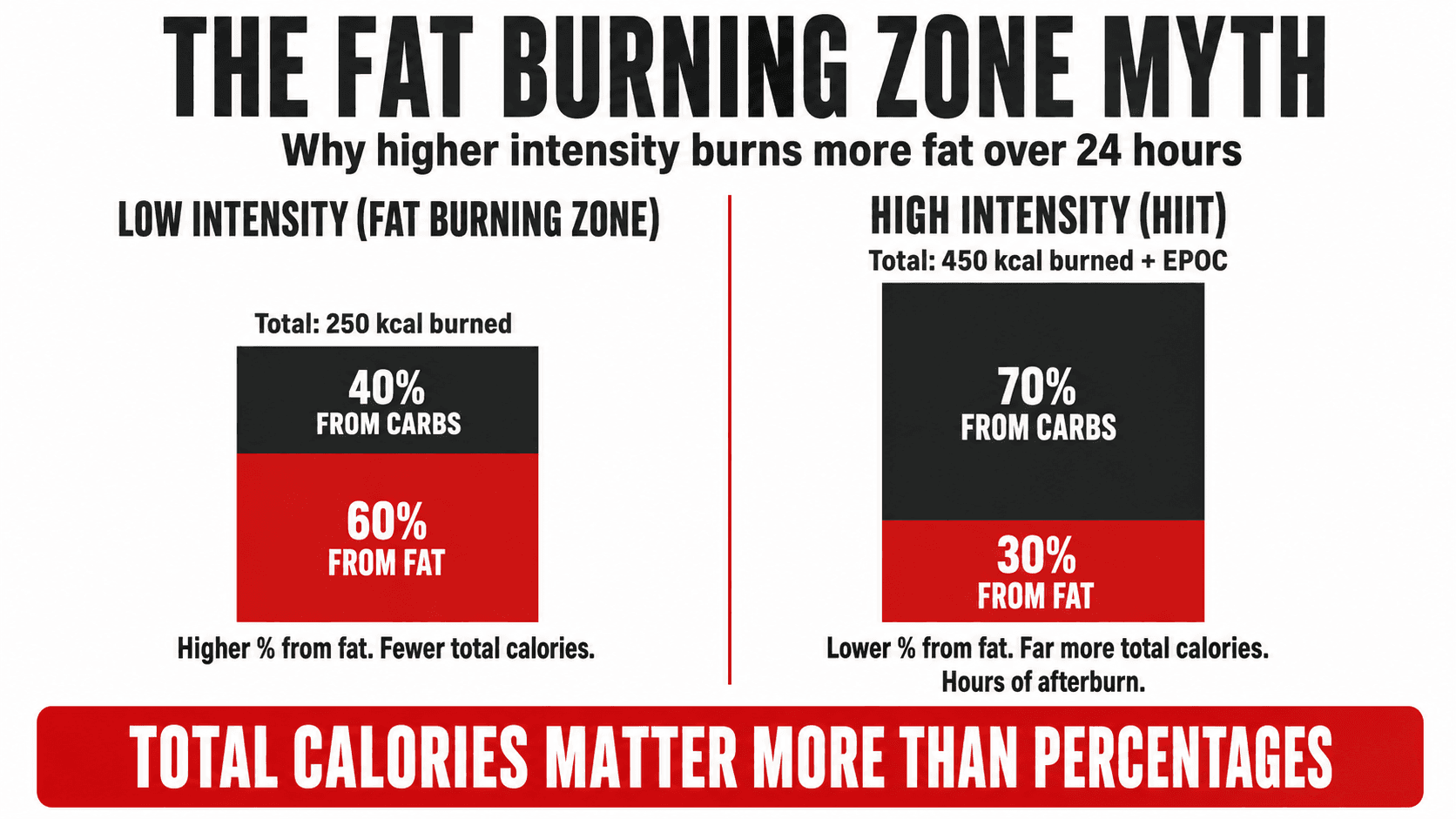
| If you exercise at a low intensity (50 to 65% of your max heart rate), you burn a higher percentage of fat. So low intensity cardio is the best way to lose body fat. | You burn a higher PERCENTAGE of fat at low intensity, but you burn fewer TOTAL calories. Higher intensity work burns more total energy, more total fat over 24 hours, and elevates your metabolism after the session. |
This is probably the most persistent myth in the entire fitness industry. It is plastered on cardio machines in every gym. And it is based on a half truth that has been catastrophically misinterpreted.
Yes, at lower exercise intensities your body uses a higher proportion of fat as fuel compared to carbohydrates. That part is physiologically accurate. But here is what the charts on those machines do not tell you: at rest, approximately 85 percent of the calories you burn come from fat (1). By that logic, the most effective fat burning exercise would be sleeping. Obviously that is absurd.
What actually matters for fat loss is total calorie expenditure over a 24 hour period, not the ratio of fat to carbohydrate used during any single session. Research by Carey (2009) in the Journal of Strength and Conditioning Research found that the overlap between the so-called fat burning zone and the aerobic training zone was so substantial that the distinction between them was essentially meaningless for practical training purposes (2). Higher intensity exercise burns more total calories per minute and, crucially, creates a significantly greater afterburn effect through excess post-exercise oxygen consumption (EPOC), meaning your metabolism stays elevated for hours after the session ends.
Top Tip
Ignore the heart rate zone charts on cardio machines. Focus on total effort and total work done. A 20 minute HIIT session will contribute more to your fat loss than 40 minutes of walking on a treadmill at the so-called fat burning pace.
Myth 2: Fasted Cardio Burns More Fat
| THE MYTH | THE REALITY |
|---|---|
| If you do cardio on an empty stomach first thing in the morning, your body has no glycogen to use, so it goes straight to burning stored fat. This accelerates fat loss. | While you may oxidise slightly more fat during a fasted session, your body compensates later in the day. Over 24 hours, total fat loss is identical whether you train fasted or fed. |
This myth was popularised in the late 1990s and has refused to die despite overwhelming evidence against it. The idea sounds logical: if you have not eaten, your body must burn fat for fuel. But the human body does not work in isolated hourly windows. It operates on a 24 hour energy balance.
A landmark study by Schoenfeld et al. (2014), published in the Journal of the International Society of Sports Nutrition, directly tested this. Twenty young women were placed on a calorie controlled diet and randomly assigned to either fasted or fed cardio for four weeks. Both groups lost a significant amount of weight and fat, but there was no meaningful difference between the two groups (3). The researchers concluded that body composition changes were similar regardless of whether someone ate before training.
A subsequent systematic review and meta-analysis by Vieira et al. (2016) in the British Journal of Nutrition analysed 27 studies involving 273 participants and reached the same conclusion: while fasted exercise increased fat oxidation during the session itself, this did not translate into greater fat loss over time (4).
Top Tip
Whether you eat before cardio or not makes no meaningful difference to fat loss. Choose whichever approach helps you perform better and feel better. Personally, some of my clients feel sharper training fasted, while others feel weak and nauseous. Go with what works for you.
Myth 3: The More Cardio You Do, the More Fat You Lose
| THE MYTH | THE REALITY |
|---|---|
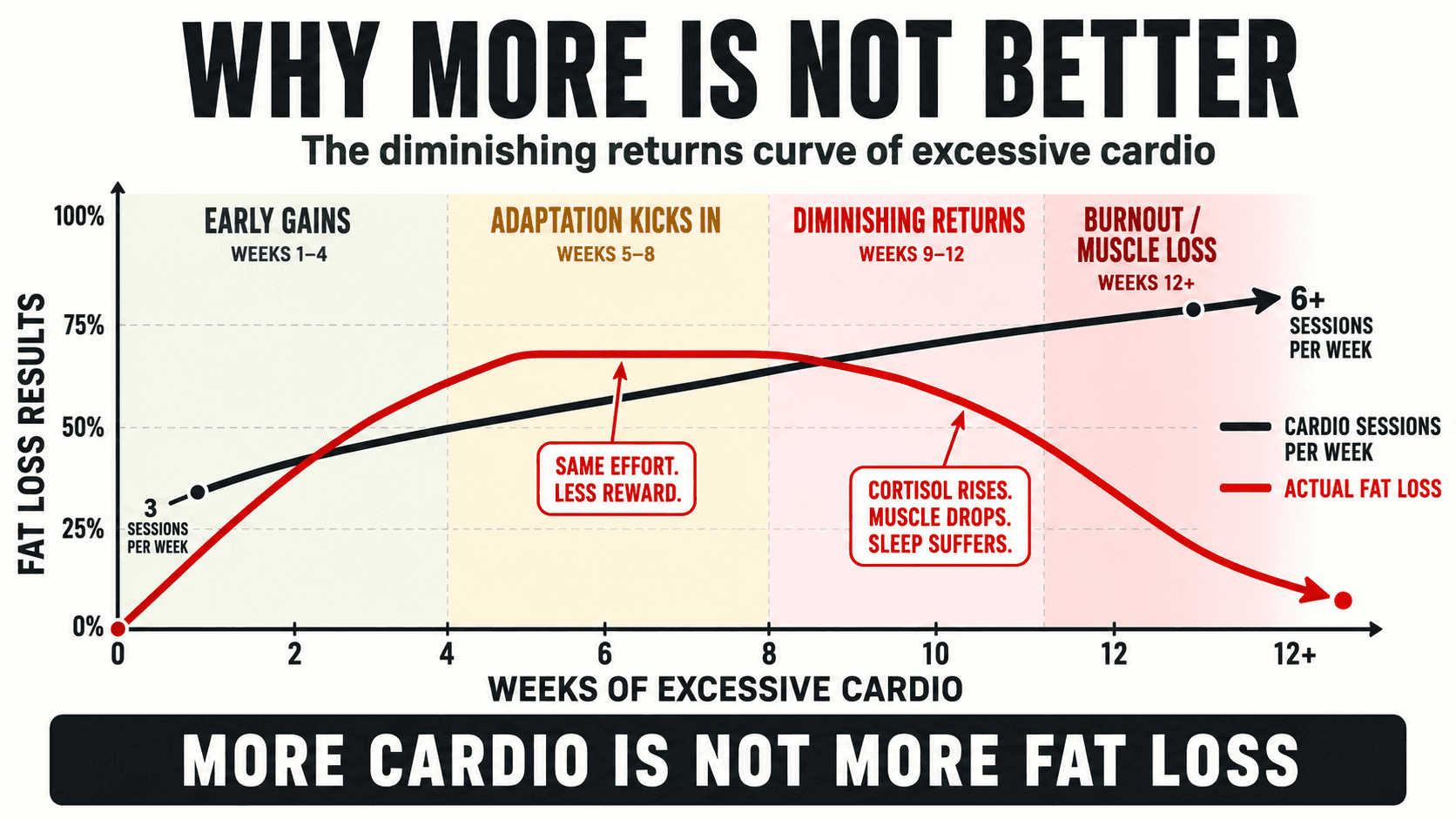
| If some cardio is good, more must be better. To lose fat faster, just add more cardio sessions to your week. | Beyond a certain point, additional cardio provides diminishing returns and can actively harm your progress by increasing cortisol, impairing recovery, and promoting muscle loss. |
This is the myth that does the most damage. It leads people into a destructive cycle: diet harder, do more cardio, eat less, add more sessions, feel terrible, look the same. I have lost count of the number of clients who have come to me doing six or seven cardio sessions per week alongside a very low calorie diet and wondering why they are exhausted but not lean.
The problem is threefold. First, your body adapts to cardio. The same session that burned a meaningful number of calories in week one becomes metabolically cheaper as your cardiovascular system becomes more efficient. Second, excessive cardio, especially moderate intensity steady state work, chronically elevates cortisol, your primary stress hormone, which promotes fat storage around the midsection and disrupts sleep (5). Third, without resistance training to provide a muscle preservation stimulus, a large proportion of weight lost during aggressive cardio and calorie restriction comes from lean tissue, not just fat. A 2022 meta-analysis in Obesity Reviews covering 116 studies found that resistance training was essential for preserving lean mass during calorie restriction (6).
| THE DIMINISHING RETURNS OF EXCESSIVE CARDIO | |
|---|---|
| Weeks 1–4 | Cardio is new. Body responds well. Calorie deficit works. Fat loss is visible. Energy is good. |
| Weeks 5–8 | Body begins adapting. Same sessions burn fewer calories. Fat loss slows. Temptation to add more sessions. |
| Weeks 9–12 | Cortisol rises. Sleep quality drops. Appetite increases. Muscle tissue starts being sacrificed for energy. You feel flat. |
| Weeks 12+ | Metabolic adaptation is significant. Body actively resists further fat loss. You are doing maximum effort for minimum return. Burnout, injury, or both follow. |
Top Tip
Start with the minimum amount of cardio that produces results and only add more when progress genuinely stalls. For most people, two to three formal cardio sessions per week alongside resistance training and 10,000 daily steps is more than enough.
Myth 4: The Calorie Counter on the Machine Is Accurate
| THE MYTH | THE REALITY |
|---|---|
| The treadmill says I burned 600 calories in 45 minutes. That means I can eat 600 extra calories today. | Research consistently shows that cardio machines overestimate calorie burn by 30 to 50 percent. Some machines are even further off. You probably burned 300 to 400 calories, not 600. |
This myth does not just waste your time. It actively sabotages your diet. If you believe you burned 600 calories and eat accordingly, but you actually burned 350, you have just eaten yourself out of a calorie deficit. Studies have shown that the algorithms used by most cardio machines are based on generalised formulas that do not account for individual differences in fitness level, body composition, movement efficiency or metabolic rate (7). The result is a number that looks impressive on the screen but has very little relationship to what actually happened in your body.
I tell every single client the same thing: never eat based on what a machine tells you. Eat based on your nutrition plan. Use cardio to widen the deficit. Do not let a screen give you permission to eat more.
Myth 5: Cardio Is the Best Exercise for Losing Weight
| THE MYTH | THE REALITY |
|---|---|
| To lose weight, you should focus on cardio. Weights are for building muscle, not losing fat. | Resistance training is more effective for long term body composition change. It preserves muscle, elevates resting metabolic rate, and changes how your body looks at the same weight. |
This might be the most costly myth of all, because it steers people towards the least effective approach. Yes, a single cardio session burns more calories than a single resistance training session of similar duration. But that is a spectacularly misleading way to measure effectiveness.
Resistance training preserves and builds muscle tissue. Muscle is metabolically active, meaning it burns calories even at rest. A 2020 meta-analysis by MacKenzie-Shalders et al. in the Journal of Sports Sciences found that exercise interventions involving resistance training increased resting metabolic rate by an average of 96 calories per day (8). That may not sound like much, but over a year it adds up to roughly 35,000 additional calories burned, the equivalent of around 4.5 kilograms of fat, just from having more muscle on your frame.
Cardio does not build muscle. In many cases, excessive cardio during a calorie deficit actively breaks muscle down. This is why I always tell clients that their training week should be built around three to four resistance training sessions. Cardio is added on top as an accelerator, never as the foundation.
| Cardio Only | Resistance + Cardio | |
|---|---|---|
| Calories burned during session | Higher | Moderate |
| Calories burned after session (EPOC) | Low to moderate | Significant |
| Effect on resting metabolic rate | Neutral or negative | Positive (increased) |
| Muscle preservation in a deficit | Poor | Excellent |
| Long term body composition change | Minimal | Transformative |
| Risk of “skinny fat” appearance | High | Very low |
| Sustainability | Low (burnout risk) | High (progressive, varied) |
Top Tip
If you only have three days per week to train, make all three resistance training sessions. You can add cardio through daily walking. Prioritise weights over cardio every single time.

Myth 6: Running Is the Best Form of Cardio
| THE MYTH | THE REALITY |
|---|---|
| Running is the gold standard of cardiovascular fitness. Everyone should be running for health and fat loss. | Running is one option among many. For fat loss specifically, it ranks poorly compared to HIIT, walking, rowing, and sled work because of its high recovery cost, joint impact, and interference with resistance training. |
Running is the default for most people because it requires no equipment and no gym membership. And for cardiovascular health, it is perfectly fine. But for fat loss and body composition, it is one of the least efficient options available.
Moderate intensity jogging creates enough fatigue to interfere with your leg training but not enough intensity to trigger a significant afterburn effect. It produces repetitive joint impact that can lead to overuse injuries, particularly in the knees, hips and ankles. And a 2025 meta-analysis found that aerobic training alone preserved 0.88 kilograms less fat-free mass than resistance training (9), meaning regular joggers who do not lift weights are losing muscle alongside fat.
If you love running for your mental health, keep it. One to two sessions per week is absolutely fine. But do not make it the cornerstone of your fat loss programme. Walking, bike intervals, rowing and sled work are all superior options when body composition is the goal.
Myth 7: You Need to Do Cardio Every Day to Lose Fat
| THE MYTH | THE REALITY |
|---|---|
| To lose fat you need to be doing some form of cardio every single day. Rest days are wasted days. | Rest and recovery are when your body adapts, repairs muscle tissue, and regulates hormones. Strategic rest is not laziness. It is essential to your results. |
This myth comes from a place of good intentions but leads to overtraining, burnout and plateaus. Your body does not improve during exercise. It improves during recovery from exercise. The training session provides the stimulus. Sleep, nutrition and rest provide the adaptation. If you never allow your body to recover, you never get the results from the work you put in.
For most people I coach, the optimal training week includes three to four resistance sessions, two to three formal cardio sessions (a mix of HIIT and LISS), and daily walking of at least 10,000 steps. That leaves room for one to two genuine rest days, which are not days off from progress. They are days where progress happens beneath the surface.
Top Tip
Rest days are not optional. They are where your body builds the muscle, regulates the hormones, and consolidates the adaptations that make you leaner and stronger. Schedule them with the same discipline you schedule your training.

What Actually Works: The Evidence Based Approach to Cardio for Fat Loss
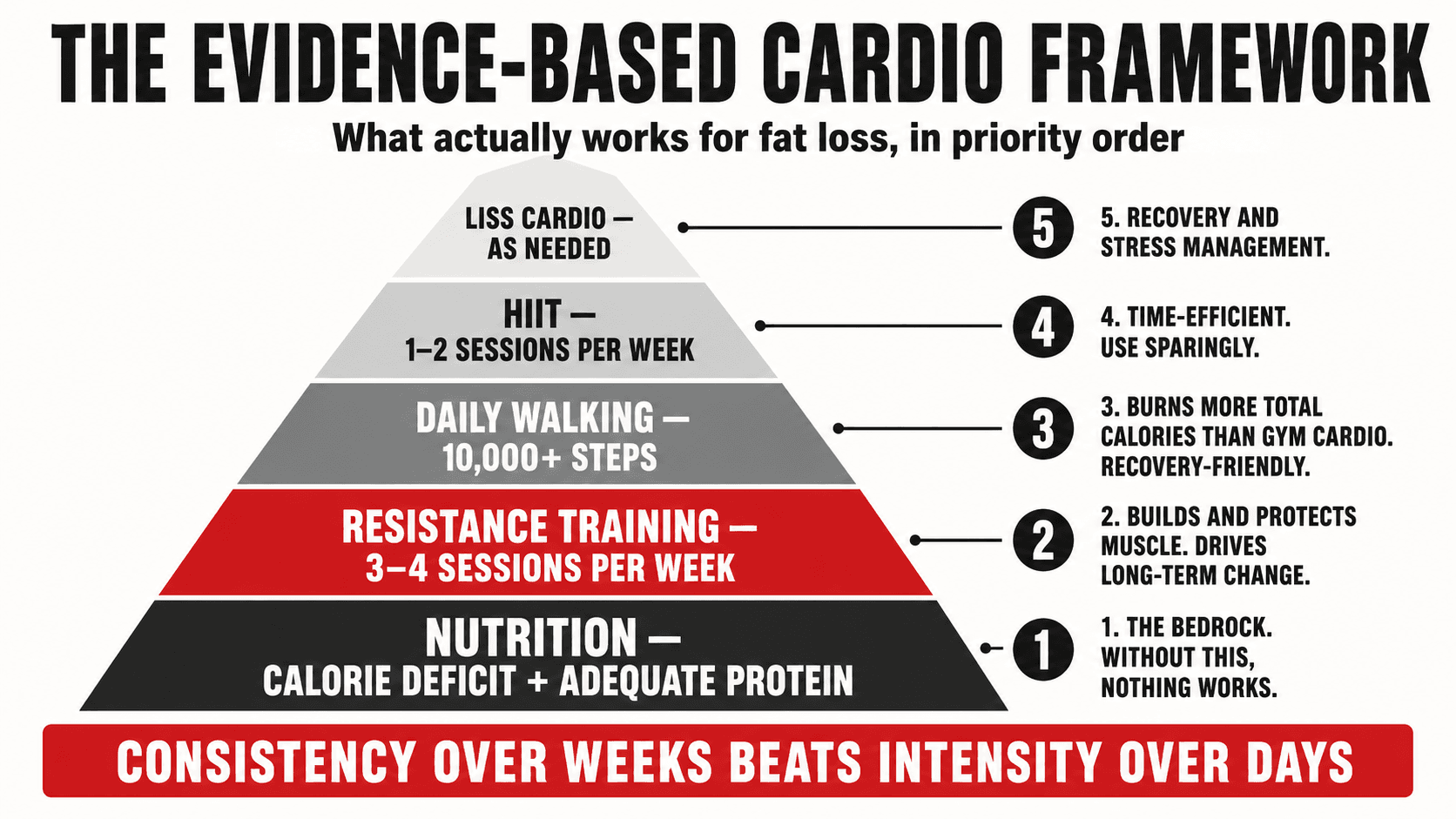
Now that we have cleared out the myths, here is what the evidence actually supports. This is the framework I use with every client, whether they are a complete beginner or an experienced trainee.
| THE CARDIO TRUTH: WHAT THE EVIDENCE SAYS | |
|---|---|
| TRUTH 1 | Nutrition creates the calorie deficit. Cardio widens it. You cannot out-train a bad diet. Get your food right first. |
| TRUTH 2 | Resistance training is the most important form of exercise for body composition. Three to four sessions per week should be your foundation. |
| TRUTH 3 | Walking (NEAT) is the most underrated fat loss tool. 10,000+ steps per day can make a bigger difference than any gym cardio session. |
| TRUTH 4 | HIIT is time efficient and metabolically powerful, but cap it at two to three sessions per week. More is not better. |
| TRUTH 5 | Low intensity steady state cardio (walking, easy cycling) is excellent for recovery, stress management and additional calorie burn without taxing your system. |
| TRUTH 6 | Protein intake of 1.6 to 2.2g per kg bodyweight per day is essential for preserving muscle during fat loss, regardless of your dietary preference (10). |
| TRUTH 7 | Consistency over weeks and months matters infinitely more than any single session. The best programme is the one you actually follow. |
A Note on Nutrition for Every Dietary Background
I am a lifelong vegetarian and I coach clients across every dietary preference: omnivores, vegetarians, vegans, and everything in between. The principles of fat loss do not change based on what you eat. You still need a calorie deficit. You still need adequate protein. You still need consistency. The only thing that changes is the food sources.
For omnivores: chicken, turkey, fish, eggs, lean beef, Greek yoghurt and cottage cheese are all excellent protein sources. For vegetarians and vegans: tofu, tempeh, seitan, lentils, chickpeas, edamame, soy protein, pea protein isolate, plant based Greek yoghurt, and high protein mock meats are equally effective. I hit my protein targets every day as a vegetarian. It is entirely achievable with the right planning.
The Bottom Line
Almost everything you have been told about cardio has been oversimplified, misinterpreted, or flat out wrong. The fat burning zone is a misleading label on a machine. Fasted cardio is a preference, not an advantage. More cardio does not mean more fat loss. The calorie counter on your treadmill is fiction. And running is not the best way to get lean.
What works is simple but it requires discipline: eat in a moderate calorie deficit with adequate protein, train with weights three to four times per week, walk every day, add two to three strategic cardio sessions when needed, and rest properly. That is the formula. It is not glamorous. It does not sell magazines. But it works, every single time, for every single person who applies it consistently.
I work one-to-one with clients online globally. Whether you are a meat eater, vegetarian, vegan, or anything in between. Whether you are dealing with Type 2 diabetes, hypertension, PCOS, menopause, or simply want to look and feel the best you ever have. I build bespoke programmes around real lives, real schedules and real goals.
If you are ready to stop following myths and start following evidence, get in touch through trperformancecoaching.com and let me show you what structured, intelligent coaching can do.
Work with Me
Get a personalised coaching plan built around your goals, your schedule, and your life.
Enquire NowReferences
- Margolis LM, Wilson MA, Whitney CC, et al. Exercising with low muscle glycogen content increases fat oxidation and decreases endogenous, but not exogenous, carbohydrate oxidation. Metabolism. 2019;97:1-8.
- Carey DG. Quantifying differences in the “fat burning” zone and the aerobic zone: implications for training. Journal of Strength and Conditioning Research. 2009;23(7):2090-2095.
- Schoenfeld BJ, Aragon AA, Wilborn CD, Krieger JW, Sonmez GT. Body composition changes associated with fasted versus non-fasted aerobic exercise. Journal of the International Society of Sports Nutrition. 2014;11(1):54.
- Vieira AF, Costa RR, Macedo RC, Coconcelli L, Kruel LF. Effects of aerobic exercise performed in fasted v. fed state on fat and carbohydrate metabolism in adults: a systematic review and meta-analysis. British Journal of Nutrition. 2016;116(7):1153-1164.
- Hackney AC. Stress and the neuroendocrine system: the role of exercise as a stressor and modifier of stress. Expert Review of Endocrinology and Metabolism. 2006;1(6):783-792.
- Lopez P, Taaffe DR, Galvao DA, Newton RU, et al. Resistance training effectiveness on body composition and body weight outcomes in individuals with overweight and obesity across the lifespan: A systematic review and meta-analysis. Obesity Reviews. 2022;23(5):e13428.
- Lam YY, Ravussin E. Analysis of energy metabolism in humans: A review of methodologies. Molecular Metabolism. 2016;5(11):1057-1071.
- MacKenzie-Shalders K, Kelly JT, So D, Coffey VG, Byrne NM. The effect of exercise interventions on resting metabolic rate: A systematic review and meta-analysis. Journal of Sports Sciences. 2020;38(14):1635-1649.
- Campbell BI, et al. Comparison of concurrent, resistance, or aerobic training on body fat loss: a systematic review and meta-analysis. Journal of the International Society of Sports Nutrition. 2025;22(1):2507949.
- Jager R, Kerksick CM, Campbell BI, et al. International Society of Sports Nutrition Position Stand: protein and exercise. Journal of the International Society of Sports Nutrition. 2017;14:20.