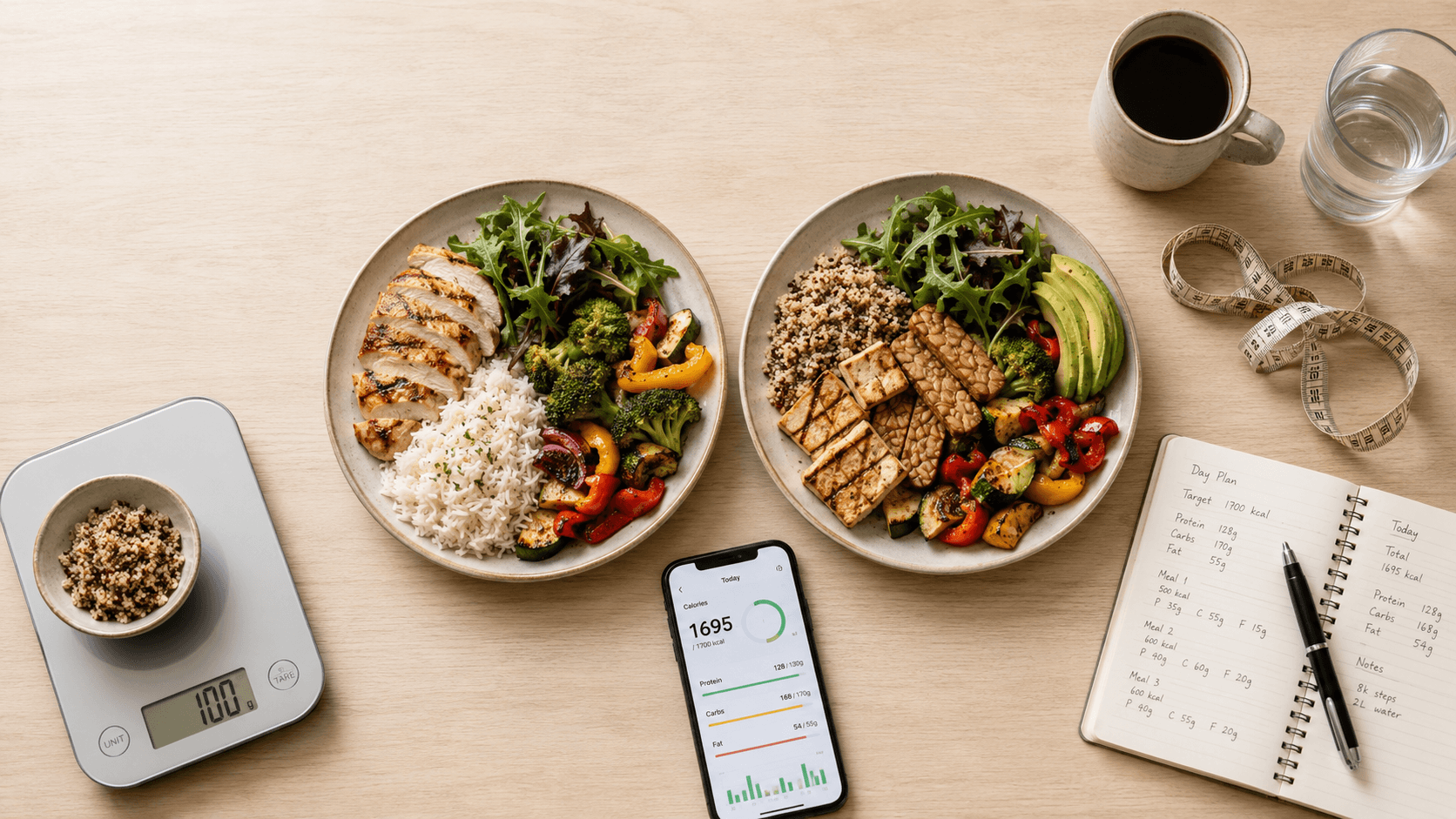
Every year a new diet emerges claiming to be the secret to fat loss. Intermittent fasting. Keto. Carnivore. Vegan cleansing. Juice detoxes. Each one promises to be the breakthrough you have been waiting for, the one thing that will finally make fat loss work. And every year, people jump from one approach to the next, convinced that the method is what matters most. It is not. The single non-negotiable rule that underpins every successful fat loss outcome, regardless of the dietary approach used, is the calorie deficit. You must consume less energy than your body expends over a sustained period of time. Without that, nothing else you do will produce fat loss. This has been true for as long as human physiology has existed, and it will remain true no matter what trends emerge next.
Many of them arrive having tried multiple diets, often with temporary success followed by regain, and they are searching for something different. What I tell them is that every diet they have tried that worked, even temporarily, worked because it created a calorie deficit. And every diet that stopped working did so because the deficit disappeared. Understanding this principle deeply, not just intellectually but practically, is the foundation upon which everything else in fat loss is built.
The consequence of not understanding the calorie deficit is that you become permanently vulnerable to marketing. You end up believing that specific foods cause fat gain or that certain meal timings unlock fat burning or that eliminating one macronutrient is the key. You spend months or years bouncing between systems, never understanding the underlying mechanism, and never building the knowledge that would allow you to take control of your own body composition permanently. You are essentially navigating without a map, and every new diet book becomes a new set of wrong directions. The calorie deficit is the map. Once you understand it, every dietary decision you make becomes clearer.

What Is a Calorie Deficit and Why Is It Non-Negotiable?
A calorie deficit occurs when your body uses more energy than it takes in from food and drink over a given period of time. When this happens, your body must source the missing energy from its internal reserves, primarily stored body fat but also to some extent glycogen and, if protein intake and resistance training are insufficient, muscle tissue. This is not a theory or an opinion. It is a direct consequence of the first law of thermodynamics, the principle of energy conservation, applied to biological systems. Energy cannot be created or destroyed, only converted from one form to another. If your body needs 2,500 calories to function on a given day and you consume 2,000, the remaining 500 must come from somewhere. That somewhere is your body's stored energy (1).
A comprehensive review published in the American Journal of Clinical Nutrition by Hall and colleagues established that body weight change is fundamentally associated with an imbalance between the energy content of food consumed and the energy expended by the body to maintain life and perform physical work (1). This principle holds regardless of the macronutrient composition of the diet, the timing of meals, the types of food consumed, or any other variable. It is the foundational law that governs all fat loss outcomes. Buchholz and Schoeller reviewed this question explicitly, asking whether a calorie truly is a calorie, and concluded that while high-protein diets may produce slightly greater energy expenditure, the differences are small and the overall principle of energy balance holds (2).
The Energy Balance Equation: What Determines Whether You Gain, Lose, or Maintain Weight
Based on the energy balance framework reviewed by Hall et al., American Journal of Clinical Nutrition, 2012 (1). This principle applies regardless of dietary approach.
| Energy State | What Is Happening | What You Experience |
|---|---|---|
| Calorie Surplus | Energy in exceeds energy out | Excess energy stored as body fat (and some muscle if training and protein are adequate). Body weight increases over time. |
| Energy Balance | Energy in equals energy out | No net change in stored energy. Body weight remains stable over time. This is maintenance. |
| Calorie Deficit | Energy out exceeds energy in | Body draws on stored energy reserves, primarily body fat. Body weight decreases over time. This is the requirement for fat loss. |
Why Every Diet That Has Ever Worked for Fat Loss Created a Deficit
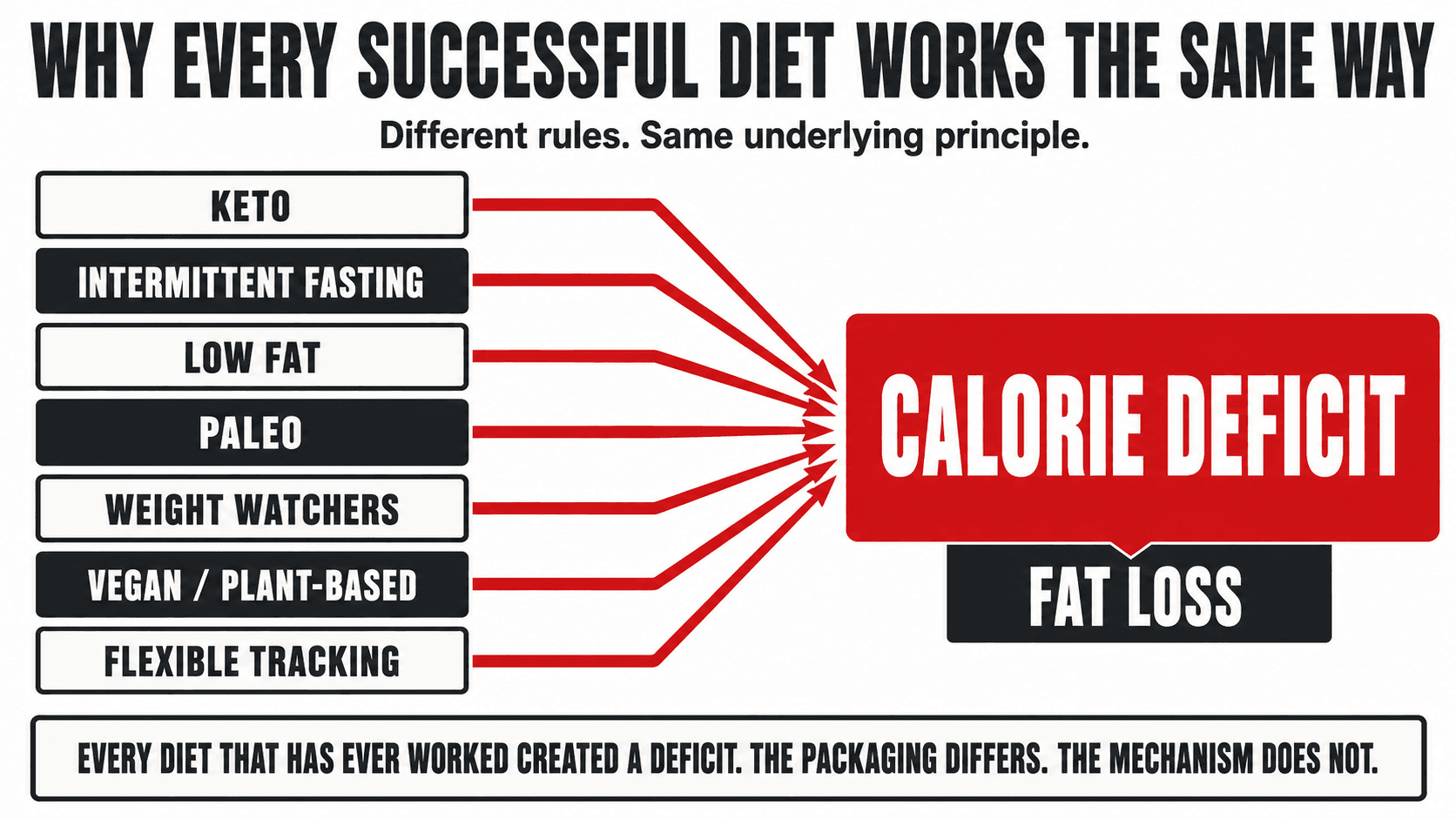
This is the point that most people struggle with, because the diet industry has a financial incentive to keep you confused. Every single diet that has produced fat loss in any individual, at any point in history, did so by creating a calorie deficit. Keto works by eliminating an entire macronutrient group, which naturally reduces food variety and total calorie intake. Intermittent fasting works by compressing your eating window, which for most people results in fewer total calories consumed. Low-fat diets work by reducing the most calorie-dense macronutrient. Paleo works by eliminating processed foods, which tend to be the most calorically dense and easiest to overconsume. Weight Watchers works by assigning points that correlate with calorie content. Juice cleanses work because liquid calories from vegetables and fruit are very low compared to normal food intake.
None of these approaches work because of any magical property unique to the diet itself. They work because the rules of each diet, when followed, result in fewer calories consumed. The mechanism is always the same. The packaging is different. This is why I never prescribe a single dietary approach to all my clients. Some prefer eating in a time-restricted window. Some prefer tracking calories precisely. Some prefer following a structured meal plan without counting anything. Some are vegetarian, some are vegan, some eat meat. The approach does not matter as long as it reliably creates and maintains a calorie deficit that the individual can sustain.
Not All Calories Are Created Equal: Why Food Quality Still Matters
Now, before anyone accuses me of saying you can eat whatever you want as long as you are in a deficit, let me be clear: while the calorie deficit is the non-negotiable requirement for fat loss, the quality and composition of your calories profoundly affect how easy it is to maintain that deficit, how much muscle you retain, how satisfied you feel, and how healthy you remain throughout the process.
The thermic effect of food, which is the energy your body expends digesting and processing what you eat, differs significantly between macronutrients. A review by Westerterp published in Nutrition and Metabolism found that protein has the highest thermic effect at 20 to 30 percent of its calorie content, meaning that for every 100 calories of protein you eat, 20 to 30 calories are used up simply processing it. Carbohydrate has a thermic effect of 5 to 10 percent, and fat has the lowest at 0 to 3 percent (3). This means a diet higher in protein effectively creates a slightly larger deficit than an identical calorie intake from fat, while also being more satiating and better for preserving lean mass during energy restriction.
Thermic Effect of Food by Macronutrient
Thermic effect values from Westerterp KR, Nutrition and Metabolism, 2004 (3). A higher protein intake effectively increases your energy expenditure and supports muscle retention during a deficit.
| Macronutrient | Thermic Effect | What This Means Practically |
|---|---|---|
| Protein | 20 to 30% | Of 100 calories of protein consumed, 20 to 30 calories are used in digestion and processing. Protein is the most metabolically expensive macronutrient to process. Prioritise protein-rich foods: chicken, fish, eggs, Greek yoghurt, tofu, tempeh, seitan, soy protein, lentils, legumes, pea protein. |
| Carbohydrate | 5 to 10% | Of 100 calories of carbohydrate consumed, 5 to 10 are used in digestion and processing. Fibre-rich carbohydrate sources tend to sit at the higher end. Choose whole grains, oats, potatoes, rice, fruit, and vegetables. |
| Fat | 0 to 3% | Of 100 calories of fat consumed, only 0 to 3 are used in processing. Fat is efficiently stored with minimal metabolic cost. Essential in moderation but easy to overconsume. Sources include olive oil, nuts, avocado, seeds, and oily fish. |
| Alcohol | 10 to 30% | Alcohol has a variable thermic effect but provides 7 calories per gram with no nutritional value and suppresses fat oxidation. As I discussed in my article on alcohol and fat loss, it creates significant additional barriers to maintaining a deficit. |
A review by Helms and colleagues in the International Journal of Sport Nutrition and Exercise Metabolism recommended that resistance-trained individuals in a calorie deficit consume 2.3 to 3.1 grams of protein per kilogram of lean body mass to maximise muscle retention during fat loss (4). This applies whether your protein is coming from chicken and fish, or from tofu, tempeh, seitan, soy protein, pea protein, lentils, and legumes. The source matters less than the total amount. Protein protects your muscle, keeps you full, and costs more energy to process. In a calorie deficit, it is the single most important macronutrient to get right.
How to Calculate Your Calorie Deficit
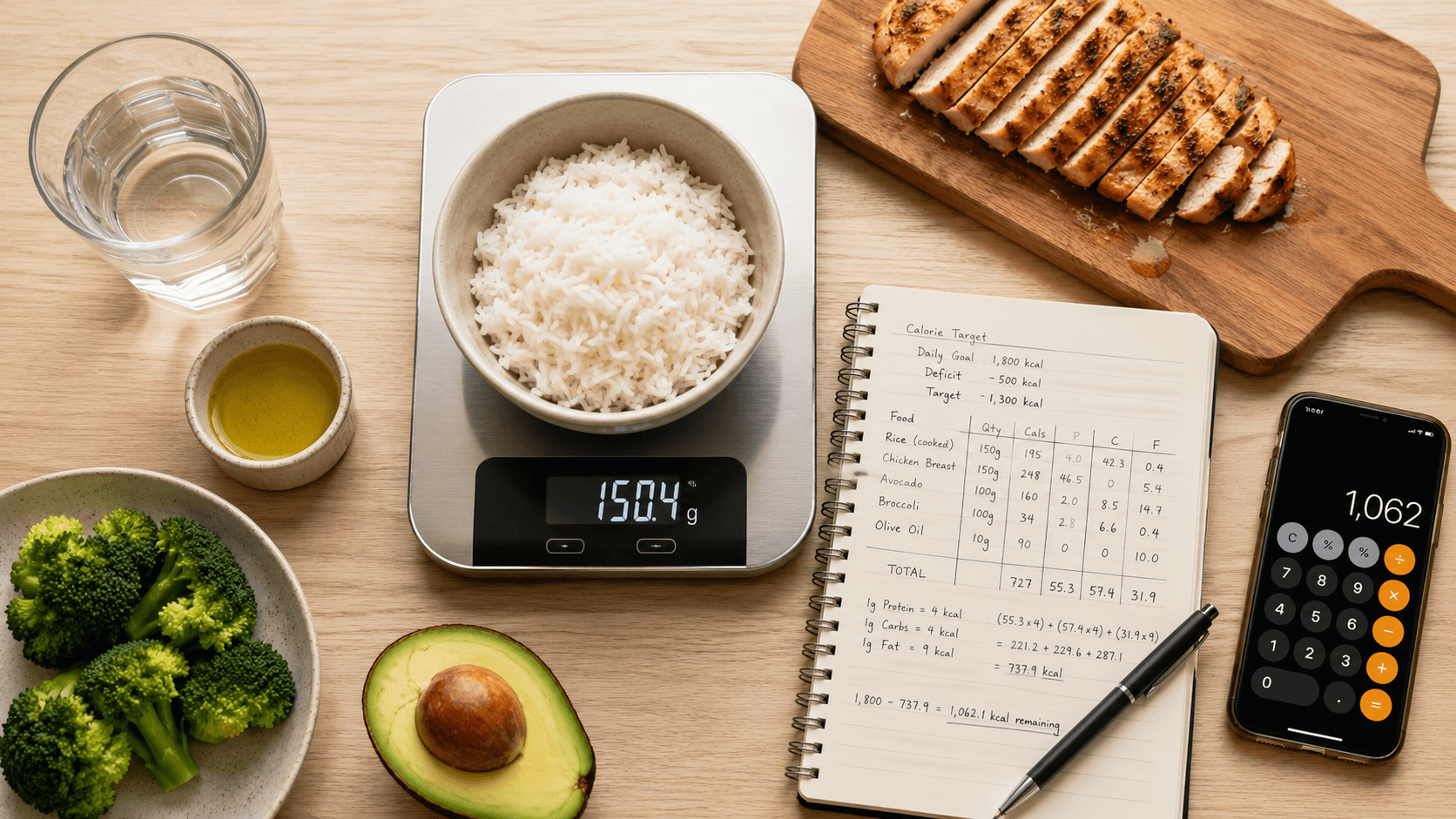
Establishing your calorie deficit starts with estimating your Total Daily Energy Expenditure, which is the total number of calories your body uses in a 24-hour period. This includes your basal metabolic rate, the thermic effect of food, and all your physical activity from structured exercise to daily movement and NEAT. There are several approaches to estimating this, and I want to be upfront: all of them are estimates. No calculator, formula, or wearable device will give you a perfectly accurate number. The goal is to establish a reasonable starting point and then adjust based on what actually happens over the following weeks.
For most people, a practical starting point is to multiply your body weight in kilograms by a factor that reflects your general activity level. Someone who is sedentary with a desk job and low step count might use a factor of 28 to 30 calories per kilogram. Someone who is moderately active with regular training and a reasonable step count might use 32 to 35. Someone who is highly active with a physically demanding job and high training volume might use 37 to 40. Once you have your estimated maintenance calories, you subtract from that number to create your deficit.
Recommended Calorie Deficit Sizes by Goal and Starting Point
These are general guidelines. Individual deficit size should be determined by body fat percentage, training status, dietary history, hormonal health, and personal preferences.
| Deficit Size | Daily Deficit | Expected Fat Loss Rate | Best Suited For |
|---|---|---|---|
| Conservative | 250 to 350 kcal | 0.2 to 0.35 kg per week | Already lean clients (under 18% body fat men, under 28% women). Muscle preservation is paramount. Long-term sustainable approach. |
| Moderate | 400 to 600 kcal | 0.4 to 0.6 kg per week | The sweet spot for most clients. Meaningful rate of fat loss with manageable hunger, good training performance, and strong muscle retention. |
| Aggressive | 700 to 1,000 kcal | 0.7 to 1.0 kg per week | Clients with significant fat to lose (over 30% body fat). Higher starting body fat provides more available energy from fat stores, reducing muscle loss risk. Should be time-limited. |
| Very Aggressive | 1,000+ kcal | 1.0+ kg per week | Only for clinically obese individuals under professional supervision. High risk of muscle loss, metabolic adaptation, and unsustainability. Requires very high protein intake and resistance training. |
Why Bigger Is Not Always Better: The Case Against Crash Dieting
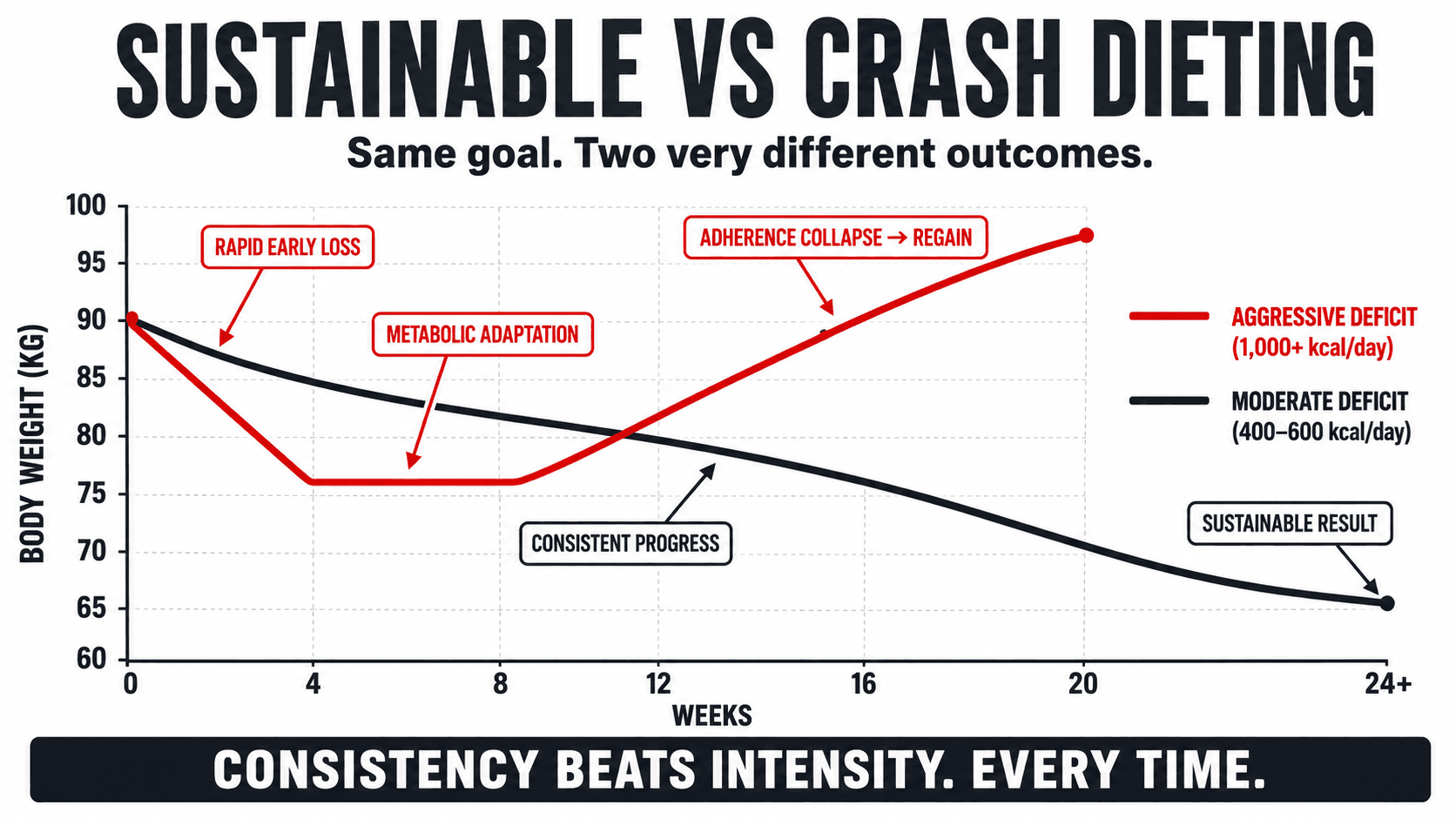
The temptation is always to make the deficit as large as possible. If 500 calories produces fat loss, surely 1,000 will produce twice as much. In the short term, this is partially true. You will lose weight faster. But a disproportionate amount of that weight will come from muscle tissue rather than fat, particularly if protein intake is inadequate and resistance training is absent. You will also trigger aggressive metabolic adaptation, where your body systematically reduces its energy expenditure to close the gap between intake and output.
A comprehensive review by Trexler and colleagues published in the Journal of the International Society of Sports Nutrition outlined how energy restriction triggers reductions in basal metabolic rate, the thermic effect of food, exercise activity thermogenesis, and non-exercise activity thermogenesis. Critically, they found that the magnitude of this adaptive response often exceeds what would be predicted from the loss of body mass alone, a phenomenon known as adaptive thermogenesis (5). In practical terms, this means your body fights back harder than you expect, and the bigger the deficit, the harder it fights. This is why crash diets produce rapid initial weight loss followed by stalls, frustration, binge eating, and regain. The body is not designed to tolerate prolonged severe energy restriction without resistance.
In my coaching, a moderate deficit of 400 to 600 calories per day is the default starting point for most clients. It produces meaningful, visible fat loss of approximately half a kilogram per week while preserving training performance, maintaining energy levels, and allowing for a sustainable relationship with food. This is not glamorous. It does not sell diet books. But it works consistently, and the results last because the process is something people can actually maintain.
How to Create a Deficit Without Counting Calories
I know that not everyone wants to track calories. Some people find it tedious, some find it triggering, and some simply have lifestyles that make precise tracking impractical. The good news is that you do not have to count calories to be in a calorie deficit, provided you have reliable alternative strategies for controlling your intake.
Building your meals around a high-protein source, plenty of vegetables, and a moderate portion of complex carbohydrates naturally creates a lower-calorie, high-satiety meal without any maths. Using your hand as a portion guide is another practical approach: a palm-sized portion of protein, a fist of vegetables, a cupped hand of carbohydrates, and a thumb-sized portion of fats at each meal. Reducing liquid calories, minimising snacking, cooking more meals at home, and eating more slowly all contribute to a lower overall calorie intake without requiring a food diary or an app.
For my vegetarian, vegan, and plant-based clients specifically, I pay close attention to protein sources that are naturally lower in calorie density. Tofu, tempeh, seitan, and soy protein are particularly useful because they deliver high protein per calorie compared to many other plant-based foods. Lentils and legumes are excellent but also carry significant carbohydrate, so portioning matters when creating a deficit. Combining these protein sources with high-volume vegetables and moderate whole grains creates satisfying, nutrient-dense meals that support fat loss without feeling restrictive.
Tracking Your Deficit: How to Know It Is Working
The calorie deficit itself is invisible. You cannot see it, feel it, or measure it directly. What you can measure are the outcomes it produces, and those outcomes tell you whether your deficit is real or theoretical. Body weight measured under consistent conditions, first thing in the morning after using the bathroom, averaged over each week to account for daily fluctuations, is the most accessible metric. If your weekly average weight is trending downward over two to three weeks, your deficit is working. If it is static or increasing, your deficit is smaller than you think or no longer exists.
Beyond the scale, waist circumference, progress photographs taken under the same lighting and conditions every two to four weeks, how your clothes fit, and your energy levels in training all provide useful data. I always advise clients to use multiple metrics rather than relying on the scale alone, because water retention, hormonal fluctuations, digestive contents, and other variables can mask genuine fat loss on any given day or even across an entire week. As I discussed in my article on metabolic adaptation and fat loss plateaus, the body's response to a calorie deficit is dynamic. Your deficit does not remain static. As you lose weight, your energy expenditure decreases, and your deficit shrinks unless you adjust.

The Deficit Is the Foundation, Not the Entire Building
I want to finish by putting the calorie deficit in its proper context. It is the absolute foundation of fat loss. Without it, nothing works. But a calorie deficit alone does not produce the best possible outcome. What you eat within that deficit determines how much muscle you retain, how satisfied you feel, and how healthy you remain. Your resistance training programme determines whether your body loses fat while preserving or even building lean tissue. Your daily step count, as I covered in my article on walking and fat loss, determines the sustainability of your energy expenditure across weeks and months. Your sleep quality, your stress management, your hydration, and your consistency all influence the speed, the quality, and the permanence of your results.
The calorie deficit is the engine. Everything else is the vehicle that surrounds it. You need both. But without the engine, you go nowhere.
Top Tips for Creating and Maintaining a Calorie Deficit for Fat Loss
Accept That the Deficit Is Non-Negotiable. No food, supplement, training method, or meal timing strategy can override the need for a calorie deficit. If you are not losing fat, you are not in a deficit, regardless of what you think you are eating. Until you accept this, you will remain stuck.
Start With a Moderate Deficit and Adjust From There. A 400 to 600 calorie daily deficit is sustainable for most people and produces consistent fat loss of approximately 0.5 kilograms per week. Larger deficits are only appropriate for individuals with significant fat to lose and should be time-limited.
Prioritise Protein Above All Other Macronutrients. Aim for 1.6 to 2.4 grams per kilogram of body weight, or higher if you are very lean. Protein preserves muscle, increases satiety, and has the highest thermic effect of any macronutrient. Whether from animal or plant sources, hit your protein target first and build the rest of your diet around it.
Use Your Step Count to Protect the Expenditure Side of the Equation. Do not reduce calories further when you can increase energy expenditure through walking instead. As I covered in my article on daily step count and fat loss, NEAT is the most variable and controllable component of your daily energy expenditure. Defend your steps.
Measure Outcomes Over Weeks, Not Days. Body weight fluctuates daily due to water retention, sodium intake, hormonal shifts, digestive contents, and more. Compare weekly averages over two to three week periods. If your weekly average is trending down consistently, your deficit is real.
Do Not Chase Speed. Chase Sustainability. The best deficit is the one you can maintain for as long as it takes to reach your goal. A 300-calorie deficit you can sustain for 20 weeks will produce more fat loss than a 1,000-calorie deficit you abandon after three weeks. Consistency beats intensity.
Adjust as You Go. Your deficit will shrink as you lose weight because your body requires fewer calories at a lower body weight. Plan to make small adjustments every four to six weeks: a slight reduction in calories, a small increase in step count, or a combination of both. Do not wait until progress stalls completely before adjusting.
Stop Looking for Shortcuts and Start Building Knowledge. Every pound of fat you lose through understanding energy balance and controlling your deficit is a pound you know how to keep off permanently. Every pound you lose through a fad diet you do not understand is a pound you are likely to regain. Invest in your own nutrition education.
The Bottom Line
The calorie deficit is the one rule of fat loss that will never change. It is grounded in the laws of physics, confirmed by every controlled study ever conducted on human energy metabolism, and observed in every successful fat loss outcome in recorded history. No diet, supplement, superfood, or biohack will ever replace it. What changes, and what makes the difference between a miserable crash diet and a sustainable body transformation, is how you create and maintain that deficit. That is where coaching, knowledge, and strategy come in.
If you want help building a calorie deficit that works for your body, your goals, your schedule, and your dietary preferences, get in touch through trperformancecoaching.com. I work one-to-one with clients online globally, across all dietary backgrounds including vegetarian, vegan, and plant-based. Whether you are starting your first fat loss phase or breaking through a long-standing plateau, the principles are the same. Let me help you apply them properly.
Work with Me
Get a personalised coaching plan built around your goals, your schedule, and your life.
Enquire NowReferences
- Hall KD, Heymsfield SB, Kemnitz JW, Klein S, Schoeller DA, Speakman JR. Energy balance and its components: implications for body weight regulation. American Journal of Clinical Nutrition. 2012; 95(4): 989-994.
- Buchholz AC, Schoeller DA. Is a calorie a calorie? American Journal of Clinical Nutrition. 2004; 79(5): 899S-906S.
- Westerterp KR. Diet induced thermogenesis. Nutrition and Metabolism. 2004; 1(1): 5.
- Helms ER, Zinn C, Rowlands DS, Brown SR. A systematic review of dietary protein during caloric restriction in resistance trained lean athletes: a case for higher intakes. International Journal of Sport Nutrition and Exercise Metabolism. 2014; 24(2): 127-138.
- Trexler ET, Smith-Ryan AE, Norton LE. Metabolic adaptation to weight loss: implications for the athlete. Journal of the International Society of Sports Nutrition. 2014; 11(1): 7.