
If you asked most people what the best exercise for fat loss is, they would say running, cycling, swimming, or some form of cardio. They would picture themselves on a treadmill, soaked in sweat, burning through calories minute by minute. That is the image the fitness industry has sold for decades, and it is fundamentally misleading. Cardio has its place, but if I had to choose a single type of exercise that would produce the best fat loss outcome for a client, it would be resistance training every single time. It is not even a close contest, and the science backs this up comprehensively. Resistance training for fat loss is the most powerful, most protective, and most transformative exercise modality available to anyone pursuing a body composition change.
One of the most common mistakes I see with new clients is that they have spent months or years prioritising cardio while neglecting the weights room entirely. They have lost weight, certainly, but they have lost muscle alongside fat, leaving them lighter but not leaner, not stronger, and not in better shape. Many of them look softer than they expected at their goal weight because the weight they lost included a significant proportion of the very tissue that gives the body its shape and definition. This is the fundamental problem with a cardio-first approach to fat loss, and it is the reason resistance training must be the centrepiece of any intelligent fat loss programme.
The consequences of ignoring resistance training during fat loss are severe and often irreversible in the short term. Without the stimulus that resistance training provides, your body has no strong reason to preserve muscle tissue during a calorie deficit. Your metabolic rate drops faster than it needs to. Your body composition deteriorates even as the number on the scale goes down. You become what is sometimes called skinny fat: lighter, but with a higher proportion of body fat relative to lean mass than when you started. And the worst part is that when you regain the weight, as the majority of dieters do, you gain back predominantly fat rather than muscle, leaving you in a worse position than before you started dieting.

Muscle Is the Engine of Fat Loss
To understand why resistance training is so critical for fat loss, you need to understand the relationship between muscle mass and metabolic rate. Muscle tissue is metabolically active. It requires energy to maintain even at rest. The more muscle you carry, the higher your basal metabolic rate, which is the largest component of your daily energy expenditure, typically accounting for 60 to 70 percent of total calories burned. Every kilogram of muscle mass contributes to your daily calorie burn without you doing anything. When you lose muscle during a diet, you are permanently reducing the size of your metabolic engine, making it harder to maintain a deficit and easier to regain fat in the future.
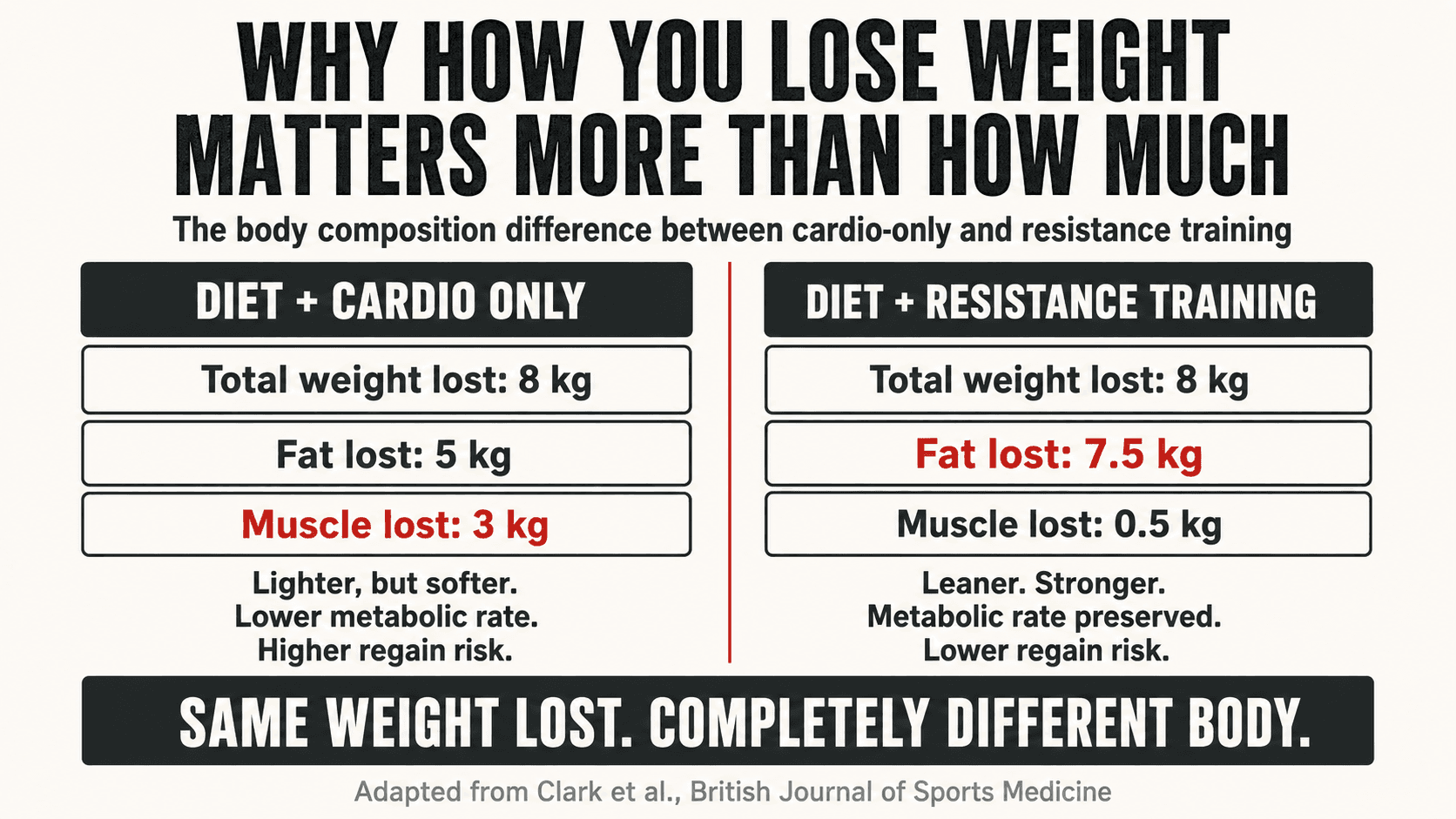
A comprehensive systematic review and meta-analysis published in the British Journal of Sports Medicine examined 25 randomised controlled trials comparing dietary weight loss with resistance exercise to diet-only interventions in adults with overweight or obesity. The results were unequivocal: adding resistance training to a calorie deficit had no effect on total body mass lost but resulted in significantly greater fat mass loss, preservation of fat-free mass, and greater improvements in muscle strength compared to dieting alone (1). In plain terms, the resistance training groups lost the same amount of weight but more of that weight came from fat and less from muscle. That is the definition of a better outcome.
What Happens When You Diet With vs Without Resistance Training
| Outcome | Diet Only | Diet + Resistance Training |
|---|---|---|
| Total Weight Lost | Significant weight loss | Similar total weight loss |
| Fat Mass Lost | Moderate fat loss. Some weight lost is lean tissue. | Greater fat loss. More of the weight lost comes from actual body fat. |
| Muscle Mass | Significant muscle loss, typically 25% or more of total weight lost. | Muscle largely preserved. In some cases, muscle gained even in a deficit. |
| Metabolic Rate | Declines substantially due to loss of metabolically active tissue. | Better maintained due to preserved muscle mass. |
| Strength | Decreases as muscle is lost. | Maintained or improved. |
| Body Composition at Goal Weight | Lighter but often still soft. Higher body fat percentage relative to lean mass. | Leaner, more defined, stronger, and healthier at the same weight. |
| Long-Term Weight Maintenance | Higher risk of regain due to reduced metabolic rate and loss of lean tissue. | Lower risk of regain due to preserved metabolic rate and muscle function. |
Adapted from findings in the systematic review by Clark et al., British Journal of Sports Medicine, 2024 (1). Adding resistance training to a diet fundamentally changes the quality of weight lost.
Resistance Training Burns More Calories Than You Think
There is a persistent myth that resistance training does not burn many calories. This is only true if you look at the calories burned during the session itself, and even then it is a narrow view. A well-structured resistance training session lasting 45 to 60 minutes burns approximately 200 to 400 calories depending on the individual, the exercises, and the intensity. That is less than an equivalent duration of steady-state cardio, which is where the comparison usually stops. But the comparison should not stop there, because resistance training creates an elevated metabolic demand that persists long after you leave the gym.
This phenomenon is known as Excess Post-Exercise Oxygen Consumption, or EPOC. A study by Schuenke and colleagues published in the European Journal of Applied Physiology measured metabolic rate for 48 hours following a 31-minute high-intensity resistance training session consisting of bench press, power cleans, and squats performed to failure. They found that resting metabolic rate was significantly elevated at 14, 19, and 38 hours post-exercise (2). The mean metabolic rate across both post-exercise days was significantly higher than baseline. In practical terms, a single resistance training session elevated calorie burn for nearly two full days after the workout ended. Steady-state cardio, by contrast, typically returns metabolic rate to baseline within one to two hours.
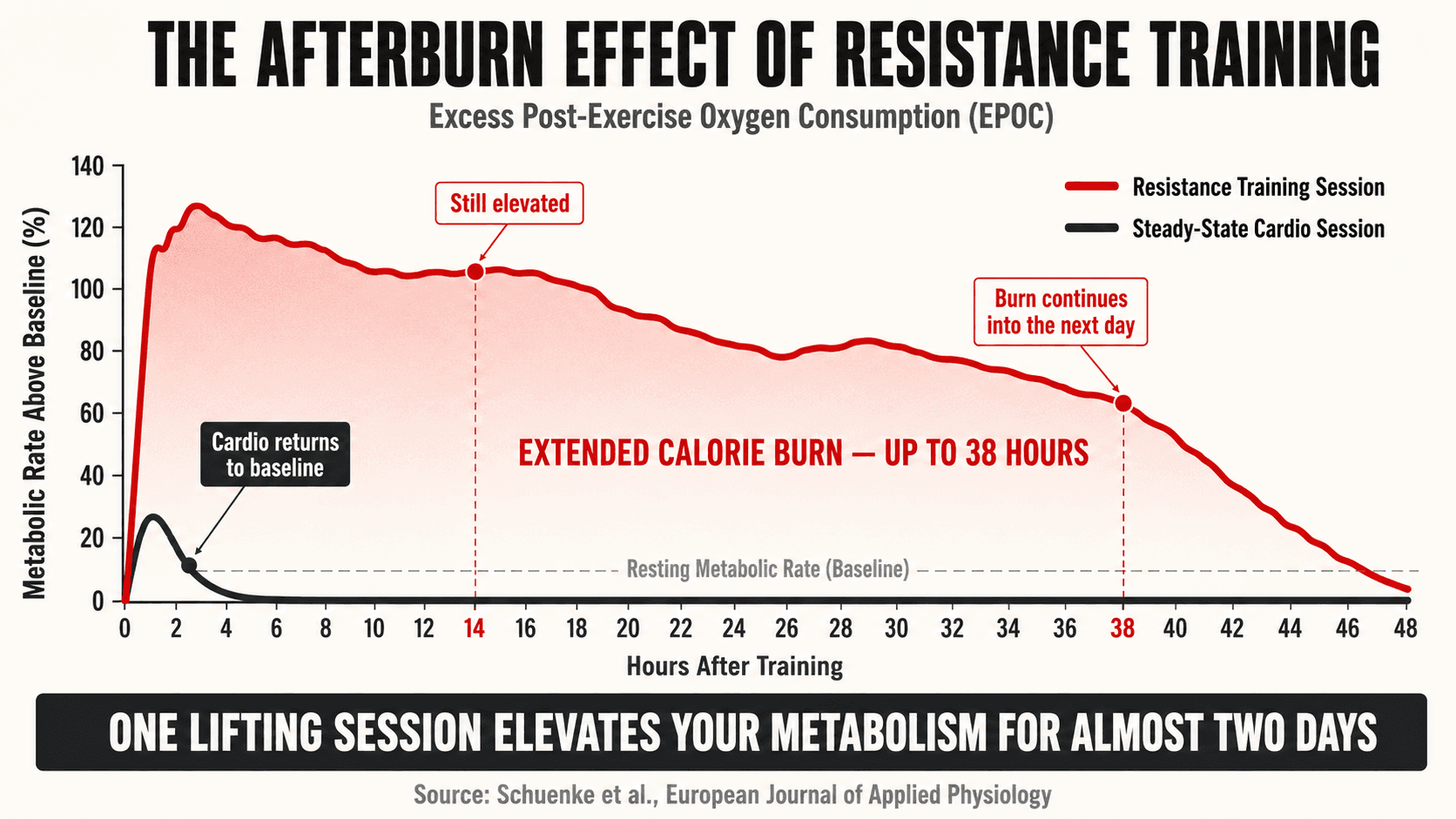
When you factor in the acute calorie burn during the session, the prolonged EPOC effect, and the ongoing metabolic advantage of carrying more muscle mass, resistance training contributes substantially more to your weekly energy expenditure than a simple calorie-per-minute comparison would suggest.
Why Cardio Alone Fails for Body Composition
Let me be clear about something: I am not against cardio. Walking, which I covered extensively in my article on step count and fat loss, is the single most underrated fat loss tool available. But there is a critical difference between low-intensity walking and moderate-to-high-intensity cardio performed as the primary exercise modality during a calorie deficit.
A systematic review and meta-analysis comparing aerobic training, resistance training, and concurrent training (a combination of both) for body composition found that resistance training alone preserved significantly more fat-free mass than aerobic training alone during fat loss interventions. When both modalities were combined, fat loss was similar to aerobic training alone, but fat-free mass preservation improved due to the resistance training component (3). The practical implication is stark: if you are doing cardio without resistance training, you are accepting unnecessary muscle loss. And if you are doing resistance training alongside your cardio, the resistance training is doing the heavy lifting when it comes to protecting your body composition.
The problem with relying on cardio for fat loss is also one of diminishing returns and compensation. As you get fitter, the same cardio session burns fewer calories. Your body adapts to become more efficient, which is the opposite of what you want for fat loss. Meanwhile, increasing cardio volume comes at a cost: it fatigues you, it can impair recovery from resistance training, it increases appetite in many people, and it can suppress non-exercise activity thermogenesis, the spontaneous daily movement that, as I covered in my articles on NEAT and step count, accounts for a far larger proportion of your daily energy expenditure than your workouts.
The Right Kind of Resistance Training for Fat Loss
Not all resistance training is created equal when it comes to fat loss outcomes. The type of training that produces the best body composition results during a calorie deficit prioritises compound movements that recruit large muscle groups across multiple joints. Squats, deadlifts, bench press, overhead press, rows, lunges, and pull-ups form the backbone of an effective fat loss resistance training programme. These exercises create the largest metabolic demand per unit of time, stimulate the most muscle tissue, and produce the strongest hormonal response.
A meta-regression by Murphy and Koehler published in the International Journal of Sport Nutrition and Exercise Metabolism found that energy deficits exceeding approximately 500 calories per day prevented gains in lean mass even with resistance training, though strength gains were maintained (4). This has important practical implications: if your deficit is moderate and your training is well-structured with appropriate volume and intensity, you can not only preserve but potentially gain muscle while losing fat, particularly if you are relatively new to resistance training or returning after a break. This is the holy grail of body recomposition, and it is most achievable when resistance training is the primary exercise modality.
Resistance Training Guidelines for Fat Loss
| Training Variable | Recommendation for Fat Loss |
|---|---|
| Frequency | 3 to 4 sessions per week. This provides sufficient stimulus for muscle preservation while allowing adequate recovery in a calorie deficit. Most clients do well with an upper/lower split or a push/pull/legs rotation. |
| Exercise Selection | Prioritise compound movements: squats, deadlifts, bench press, overhead press, rows, pull-ups, lunges, hip thrusts. These recruit the most muscle mass per exercise and create the greatest metabolic demand. |
| Volume | 10 to 20 working sets per muscle group per week distributed across your training sessions. Start at the lower end during aggressive deficits and increase during moderate deficits or maintenance phases. |
| Intensity (Load) | Train in the 6 to 15 repetition range for most exercises, using loads that bring you close to failure within that range. Heavy compound lifts in the 6 to 8 range build and preserve strength. Higher rep work in the 10 to 15 range accumulates volume efficiently. |
| Proximity to Failure | Train within 1 to 3 reps of failure on most working sets. This ensures sufficient mechanical tension to stimulate muscle protein synthesis. Going to absolute failure on every set is unnecessary and impairs recovery in a deficit. |
| Progressive Overload | Aim to maintain or gradually increase the weight on the bar over time. Strength maintenance during a deficit is a strong signal that muscle is being preserved. Accept that progress will be slower than during a surplus. |
| Rest Periods | 2 to 3 minutes between heavy compound sets. 60 to 90 seconds between isolation exercises. Adequate rest ensures quality performance, which matters more for muscle preservation than rushing through sets. |
These are general guidelines. Individual programmes should be tailored to training history, injury status, available equipment, and recovery capacity.
Resistance Training for Every Body
One of the most damaging myths in the fitness industry is that resistance training is only for young, fit, already-athletic people. In reality, it is arguably most beneficial for the populations who are least likely to do it: older adults, people with significant weight to lose, individuals with metabolic conditions like Type 2 diabetes or hypertension, and women concerned about hormonal health during and after menopause.
A systematic review and meta-analysis of 114 randomised controlled trials involving over 4,000 participants with overweight and obesity found that supervised resistance training combined with caloric restriction was the most effective intervention for reducing body fat percentage and whole-body fat mass across all age groups and both sexes. Critically, the review also found that resistance training alone was the most effective intervention for increasing lean mass, whereas caloric restriction without resistance training consistently resulted in lean mass losses of 1.5 kilograms or more in middle-aged and older adults (5). For anyone in those demographics who is dieting without lifting weights, the research is unambiguous: you are losing muscle you cannot afford to lose.

For my vegetarian, vegan, and plant-based clients, resistance training works identically regardless of dietary background, provided protein intake is adequate. This means prioritising high-protein plant sources such as tofu, tempeh, seitan, soy protein, pea protein, lentils, legumes, and supplementing with plant-based protein powders where needed to reach the recommended 1.6 to 2.4 grams per kilogram of body weight. The muscle does not care where the protein comes from. It cares that it arrives in sufficient quantity, distributed across the day, and that the training stimulus is present to use it.
How to Combine Resistance Training With Everything Else
Resistance training does not exist in isolation. It works best when integrated with the other pillars of an effective fat loss programme. Here is how I structure this for my clients.
The calorie deficit, as I covered in my article on energy balance and fat loss, provides the thermodynamic requirement for fat loss. Without it, nothing happens. Resistance training preserves and builds muscle within that deficit, ensuring that the weight you lose is predominantly fat. Your daily step count, as I covered in my article on walking and fat loss, provides the bulk of your daily energy expenditure beyond your basal metabolic rate, creating a large, sustainable, recovery-friendly calorie burn. Protein intake, set at 1.6 to 2.4 grams per kilogram of body weight, provides the raw materials for muscle protein synthesis and the satiety to manage hunger. Sleep, which I covered in my article on sleep and fat loss, provides the hormonal environment in which recovery and adaptation occur. And consistency across all of these variables, maintained over weeks and months, is what produces lasting results.
The hierarchy is simple. The calorie deficit comes first. Resistance training comes second. Step count comes third. Protein comes fourth. Sleep comes fifth. Everything else, supplements, meal timing, specific cardio protocols, is detail that matters only after all five of these are in place.
The Fat Loss Hierarchy: What Matters Most to Least
| Priority | Factor | Why It Matters |
|---|---|---|
| 1 | Calorie Deficit | The non-negotiable requirement for fat loss. Without it, nothing else produces a reduction in body fat. |
| 2 | Resistance Training | Preserves muscle, maintains metabolic rate, shapes the body, elevates post-exercise calorie burn, and ensures the weight you lose is fat, not muscle. |
| 3 | Daily Step Count / NEAT | The largest variable component of daily energy expenditure. Contributes more to weekly calorie burn than gym sessions. Sustainable, recovery-friendly, works for all fitness levels. |
| 4 | Protein Intake | Supports muscle protein synthesis, increases satiety, has the highest thermic effect. Aim for 1.6 to 2.4g per kg bodyweight from any source: meat, fish, eggs, dairy, tofu, tempeh, seitan, soy, lentils, legumes. |
| 5 | Sleep | Regulates hunger hormones, supports recovery and muscle repair, maintains energy and adherence. Poor sleep undermines every other factor. |
| 6 | Everything Else | Supplements, meal timing, specific cardio protocols, food combinations. Only relevant once the first five factors are consistently in place. These are the details, not the foundations. |
Get the top five right consistently and the details take care of themselves.
Top Tips for Using Resistance Training to Maximise Fat Loss
Make Resistance Training Your Primary Exercise, Not an Afterthought. If you only have time for one type of exercise during a fat loss phase, choose resistance training. It is the only modality that simultaneously preserves muscle, maintains metabolic rate, and improves body composition. Walk for your cardio. Lift for your shape.
Train 3 to 4 Times Per Week With Compound Movements. Squats, deadlifts, presses, rows, and pull-ups should form the foundation of your programme. These exercises recruit the most muscle mass, create the largest metabolic demand, and produce the most significant hormonal response. Isolation work is useful but secondary.

Track Your Strength as a Proxy for Muscle Retention. If your lifts are staying the same or gradually increasing during a fat loss phase, your muscle is being preserved. If your strength is dropping significantly, something needs adjusting: your deficit may be too aggressive, your protein may be too low, or your recovery may be inadequate.
Do Not Cut Volume Prematurely. A common mistake is to drastically reduce training volume during a calorie deficit in an attempt to manage fatigue. While some reduction may be appropriate as the deficit progresses, maintaining training volume as high as you can recover from is critical for preserving lean mass. Reduce frequency or volume only when recovery genuinely demands it.
Pair Resistance Training With Adequate Protein. Resistance training without sufficient protein is like building a house without bricks. Aim for 1.6 to 2.4 grams per kilogram of body weight, distributed across 3 to 4 meals per day. Whether from chicken, fish, eggs, dairy, tofu, tempeh, seitan, lentils, or protein supplements, the total daily intake is what matters most.
Use Cardio as a Supplement, Not a Substitute. Walking is your primary cardio tool during fat loss. It burns significant calories with zero recovery cost and does not interfere with resistance training. If you want additional cardio, add 1 to 2 moderate sessions per week, but never at the expense of your lifting sessions or your recovery from them.
Be Patient With the Scale. Resistance training can cause water retention in muscles, particularly when starting a new programme or increasing volume. This can mask fat loss on the scale. Trust your waist measurements, progress photos, how your clothes fit, and your strength in the gym. The scale will catch up.
Invest in Learning Proper Technique. Good form protects you from injury, allows you to train consistently for years, and ensures the target muscles receive the stimulus they need. If you are new to resistance training, invest time in learning the basic compound movements properly before chasing heavy weights. A coach, even for a few sessions, can make an enormous difference.
The Bottom Line
Resistance training is the single most important exercise modality for fat loss, and it is not even close. The research consistently demonstrates that adding resistance training to a calorie deficit produces greater fat loss, preserves significantly more muscle, maintains metabolic rate, and results in a fundamentally better body composition outcome than dieting alone or dieting with cardio. It elevates calorie burn for up to 38 hours after a single session. It is the only exercise that builds and protects the lean tissue that determines your shape, your strength, and your long-term metabolic health. And it works for everyone: men, women, young, old, beginners, and experienced trainees alike.
If you are currently dieting without resistance training, you are leaving results on the table. If you are doing hours of cardio while avoiding the weights room, you are actively working against your own body composition goals. The fix is straightforward: pick up the weights, follow a structured programme, eat enough protein, maintain your calorie deficit, and let the science do its work.
If you want a structured fat loss programme built around intelligent resistance training, tailored to your experience level, your goals, your schedule, and your dietary preferences, get in touch through trperformancecoaching.com. I work one-to-one with clients online globally, across all dietary backgrounds including vegetarian, vegan, and plant-based. Whether you have never touched a barbell or you have been training for years, I will build a programme that gets results.
Work with Me
Get a personalised coaching plan built around your goals, your schedule, and your life.
Enquire NowReferences
- Clark JE, Goon DT, Coetzee AR. Effect of resistance exercise on body composition, muscle strength and cardiometabolic health during dietary weight loss in people living with overweight or obesity: a systematic review and meta-analysis. British Journal of Sports Medicine. 2024; 58(17): 989-1000.
- Schuenke MD, Mikat RP, McBride JM. Effect of an acute period of resistance exercise on excess post-exercise oxygen consumption: implications for body mass management. European Journal of Applied Physiology. 2002; 86(5): 411-417.
- Lopez P, Taaffe DR, Galvao DA, Newton RU, Nonemacher ER, Wendt VM, Bassanesi RN, Turella DJ, Rech A. Resistance training effectiveness on body composition and body weight outcomes in individuals with overweight and obesity across the lifespan: a systematic review and meta-analysis. Obesity Reviews. 2022; 23(5): e13428.
- Murphy C, Koehler K. Energy deficiency impairs resistance training gains in lean mass but not strength: a meta-analysis and meta-regression. International Journal of Sport Nutrition and Exercise Metabolism. 2022; 32(4): 291-305.
- Weinheimer EM, Sands LP, Campbell WW. A systematic review of the separate and combined effects of energy restriction and exercise on fat-free mass in middle-aged and older adults: implications for sarcopenic obesity. Nutrition Reviews. 2010; 68(7): 375-388.