
The Most Dangerous Moment in Any Health Transformation
The plateau of latent potential in fitness is the name for the period that ends the majority of health programmes that begin with genuine commitment and a well-designed approach. It is not the period when people struggle with motivation at the start. It is not the period when the results are visibly slow. It is the specific, neurologically predictable period that occurs roughly between weeks six and sixteen of a consistent programme, when the effort being applied is real and substantial, the approach is correct, and the visible results are minimal to none. This is the valley. And the valley is where most transformations die.
The valley is not a sign that something has gone wrong. It is a structural feature of how human physiology responds to training and nutritional change. Understanding its nature precisely, knowing what is actually happening below the surface of what is visible in the mirror or on the scale, and having a specific cognitive and behavioural strategy for navigating it, are the three things that separate the people who walk through the valley and emerge from the other side from the people who turn back at its lowest point.
James Clear describes this phenomenon as the plateau of latent potential: a period during which genuine adaptations are occurring beneath the threshold of external visibility, the ice that is forming below zero before it freezes, the bamboo that is building its root system for years before the visible shoot appears above ground. The adaptations are real. They are measurable by a physician or a coach with the right tools. They simply do not look like the transformation the person expected to see on the timeline they expected to see it. And in the absence of visible confirmation, the brain, running its perpetual pattern-matching and prediction function, generates the conclusion that the programme has stopped working (1).
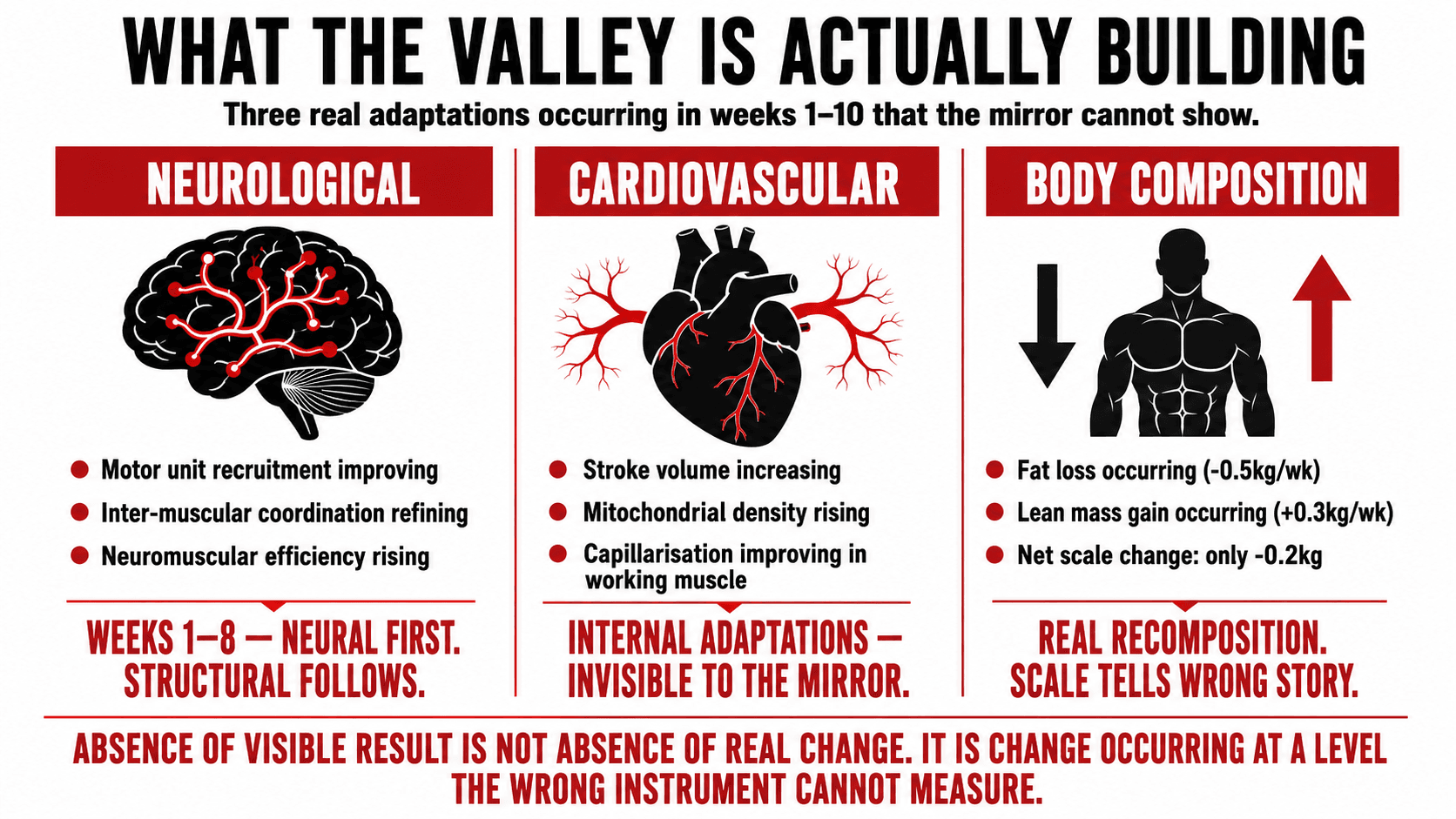
What the Physiology Actually Looks Like in the Valley: The Invisible Accumulation
The critical insight about the valley is that the absence of visible results does not indicate the absence of real physiological change. It indicates that the change is occurring at a structural level that precedes the visible outcomes the person is measuring. Understanding specifically what is accumulating below the surface during the valley period changes the emotional experience of being in it from one of futile effort to one of invisible investment.
At the cellular level, the first six to twelve weeks of a resistance training programme produce adaptations that are primarily neurological rather than structural. The strength improvements that occur in the early weeks of training, which can be substantial, are driven by improvements in motor unit recruitment, inter-muscular coordination, and neuromuscular efficiency rather than by meaningful increases in muscle fibre size. The brain is learning to use the muscle it already has more effectively. Actual hypertrophy, the structural increase in muscle fibre cross-sectional area that produces visible changes to body shape, typically becomes significant only after the neurological adaptations are established, often around weeks eight to twelve of a consistent programme (2).
Cardiovascular adaptation follows a similar pattern. The first measurable cardiovascular improvements following the initiation of an aerobic training programme are internal: increased stroke volume, improved cardiac output, enhanced oxygen delivery to working muscle, and better metabolic efficiency at submaximal intensities. These improvements are real and clinically significant. They do not manifest as visible physical changes. They manifest as slightly lower perceived exertion at a given intensity, slightly better recovery between sessions, and marginal improvements in resting heart rate. The person measuring their progress in the mirror or on the scale will see nothing. The person measuring their resting heart rate, their training paces, and their recovery rate will see the valley filling with invisible adaptation (3).
Body composition change in the valley period is complicated by body water fluctuations, glycogen storage changes, and the simultaneous loss of fat and gain of lean mass that can produce net scale weight that is flat or even slightly elevated while genuine body recomposition is occurring. A person who is losing 0.5kg of fat per week while gaining 0.3kg of lean mass will show a scale weight change of only 0.2kg per week, a figure that feels insignificant and is frequently misread as programme failure. The correct measure of this period is body composition, not scale weight. The scale is telling the wrong story because it is measuring the wrong variable (4).
Key Insight: The single most important adjustment during the valley period is to change what you are measuring. Scale weight measured daily is the worst possible metric for a person in the valley because it is dominated by water fluctuations, glycogen storage, and digestive content that have no relationship to the fat loss and muscle gain that are actually occurring. Body measurements, progress photographs taken in consistent conditions, training performance data, and energy levels are all more accurate measures of whether the programme is working during the valley period than the number on the scale.
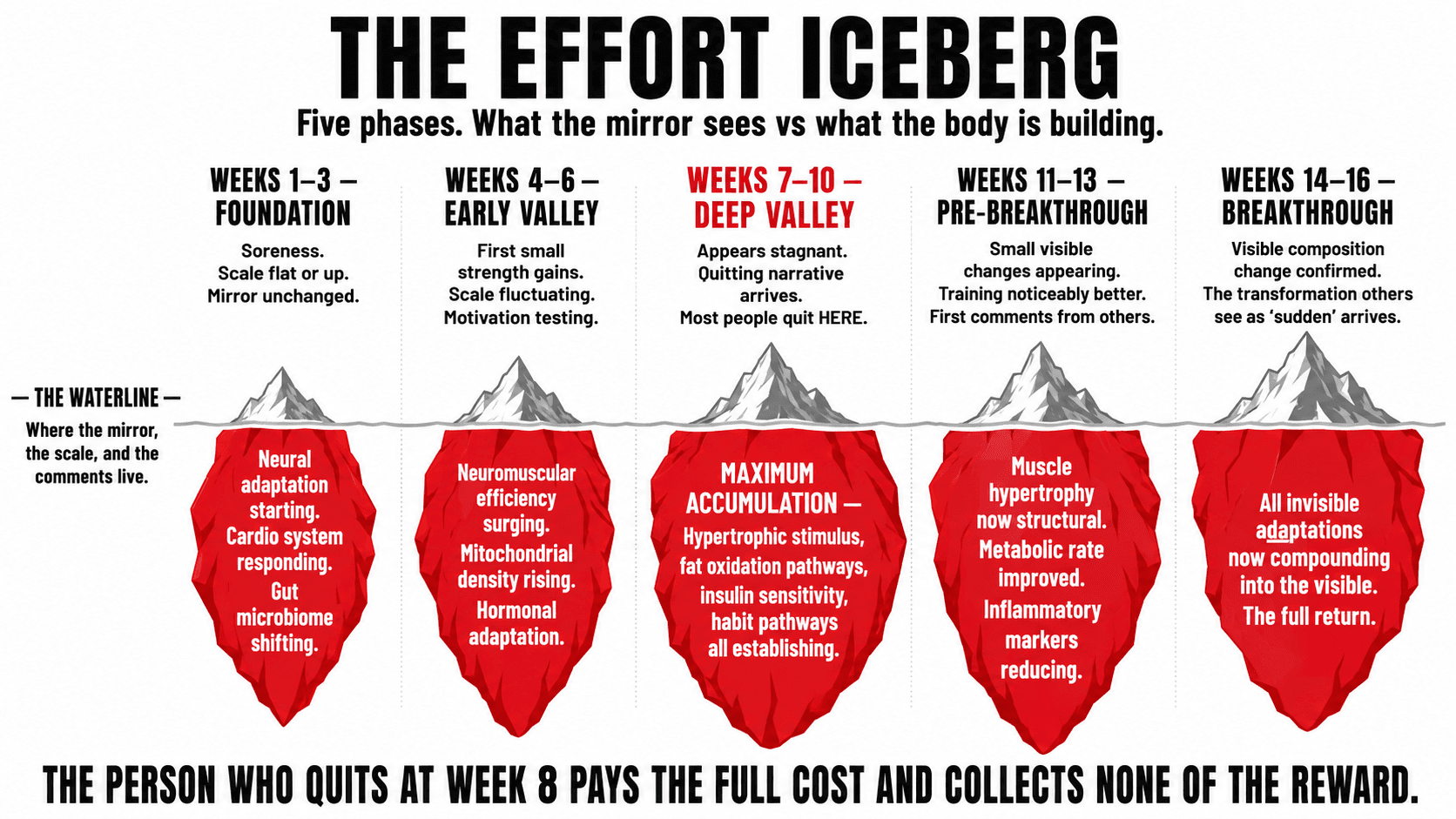
The Effort Iceberg: What Is Accumulating Below the Surface During Every Week You Stay
The iceberg model of progress visualises the relationship between visible and invisible adaptation across a typical programme timeline. What the person sees above the waterline, the scale number, the reflection in the mirror, the comments from others, is always a lagging indicator of what has been accumulating below it. The valley period is precisely the period when the above-waterline evidence is minimal and the below-waterline accumulation is at its most significant.
| Phase | Visible Above the Waterline | Accumulating Below the Waterline |
|---|---|---|
| WEEKS 1–3 Foundation | Soreness after sessions. Scale weight unchanged or slightly increased due to inflammation. Mirror shows nothing meaningful. Energy variable. | Neurological adaptations to training stimulus beginning. Motor unit recruitment improving. Cardiovascular system beginning to respond. Gut microbiome shifting toward health-supporting composition. |
| WEEKS 4–6 Early Valley | First small strength improvements. Soreness reducing. Scale weight flat or fluctuating. No visible body composition change. Motivation beginning to test. | Neuromuscular efficiency improving significantly. Mitochondrial density increasing in muscle cells. Capillarisation of working muscle improving oxygen delivery. Early hormonal adaptations to training. |
| WEEKS 7–10 Deep Valley | Minimal visible change. The appearance of stagnation. Scale may not have moved significantly. The period when most people misread the situation as programme failure. | Significant hypertrophic stimulus accumulating in muscle tissue. Fat oxidation pathways improving. Insulin sensitivity measurably better. Neural habit pathways of training and nutrition firmly establishing. |
| WEEKS 11–13 Pre-Breakthrough | Small but more consistent visible changes beginning. Training performance noticeably improving. Energy more stable. First comments from others may arrive. | Structural muscle hypertrophy now visually detectable. Resting metabolic rate improved from lean mass gain. Sleep quality measurably better. Inflammatory markers reducing. Blood markers shifting. |
| WEEKS 14–16 Breakthrough | Visible body composition change clear and confirmed. Training performance significantly better than week one. Scale movement now corresponding to genuine fat loss. Energy consistently high. | All invisible adaptations now manifesting above the waterline. The iceberg has grown large enough that even the visible portion is substantial. The compound return on weeks 1–13 now paying out simultaneously. |
The person who quits at week eight quit precisely when the below-waterline investment was at its largest and the above-waterline return was about to arrive. They paid the full cost and collected none of the reward. This is not bad luck. It is a timing error caused by measuring the wrong thing at the wrong moment.
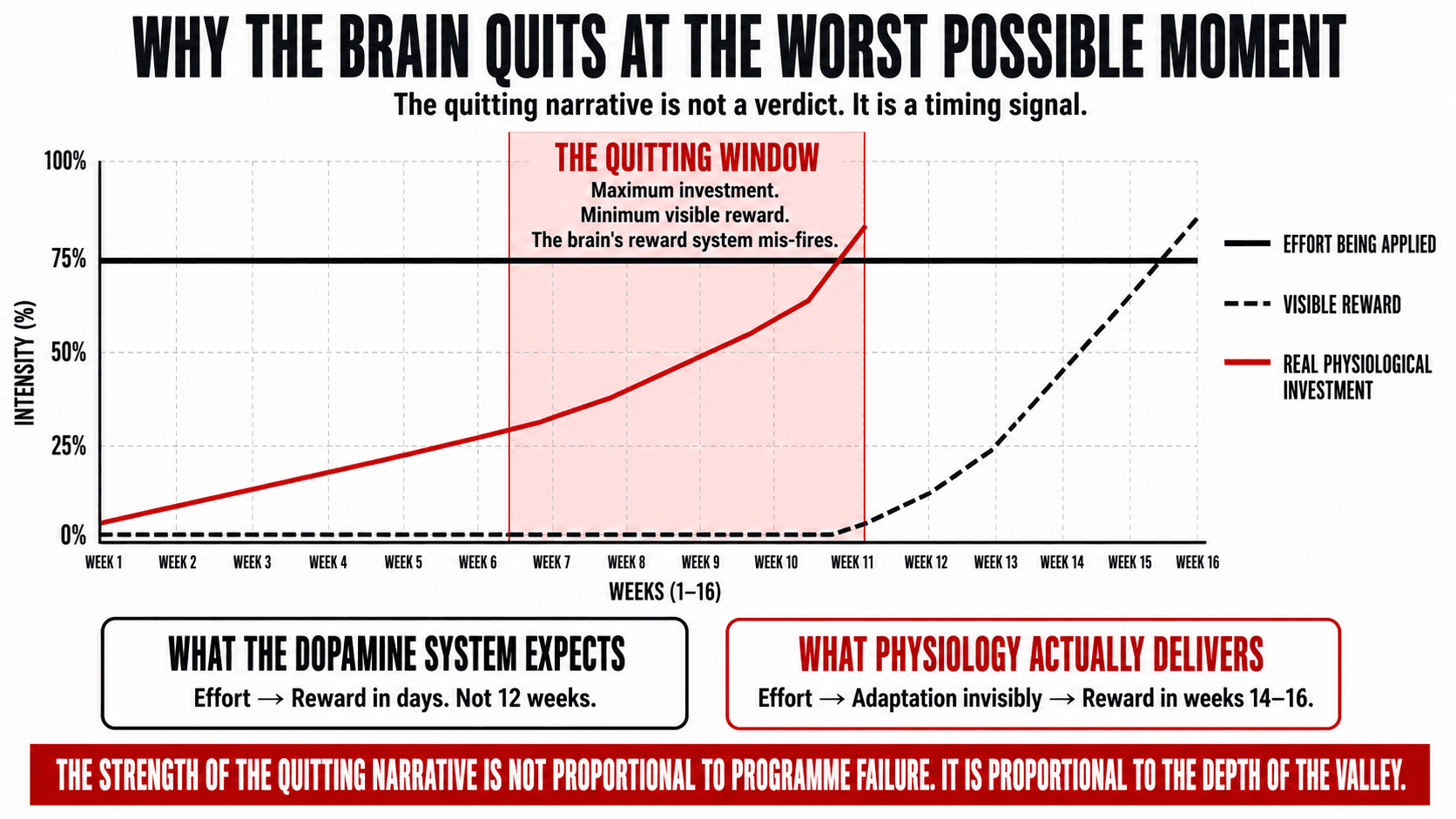
Why the Brain Generates the Quitting Narrative Precisely at the Worst Moment
The timing of the quitting impulse in health programmes is not random. It is neurologically predictable, and it corresponds almost exactly with the deep valley period for a specific reason: the brain’s prediction and reward systems are calibrated for a much shorter feedback loop than physical adaptation provides. The dopaminergic reward system, which reinforces behaviour based on the temporal proximity between effort and result, is designed for immediate or near-immediate feedback. When training consistently for six weeks produces no visible body composition change, the brain’s reward system delivers a signal that is neurologically indistinguishable from the signal produced by any other behaviour that fails to produce the expected return: reduce investment, redirect resources, consider alternatives (5).
This is not the brain being irrational. It is the brain applying an adaptive cognitive heuristic that works well across most domains of life and fails specifically in the domain of physical adaptation. The brain does not know that sixteen weeks of consistent effort produces compound returns that six weeks cannot. It knows that effort should produce results in a timeframe that matches the effort-to-reward ratio of most other valuable activities. Physical adaptation violates that ratio at precisely the period when it is most important to stay.
The quitting narrative itself — my body does not respond, this approach is not working for me, I need to try something different — is not a rational conclusion based on adequate evidence. It is the brain’s attempt to explain a pattern that its prediction system is incorrectly interpreting as programme failure. The person who understands the valley period understands that this narrative is a structural feature of the deep valley, not a genuine assessment of the programme’s effectiveness. They observe the narrative without acting on it. They understand that the strength of the quitting narrative at week eight is not proportional to the probability that the programme has failed. It is proportional to the depth of the valley.
“Nothing in life is to be feared, only to be understood. Now is the time to understand more, so that we may fear less.”
— Marie Curie
Key Insight: When the quitting narrative arrives — when the thought that this is not working begins to feel like a reasonable assessment rather than a predictable valley signal — ask one question before acting on it: am I in the valley? If the programme has been running for six to fourteen weeks with genuine adherence, the answer is almost certainly yes. The quitting narrative is not evidence that the programme has failed. It is evidence that you are in the valley, which is precisely where you need to stay.
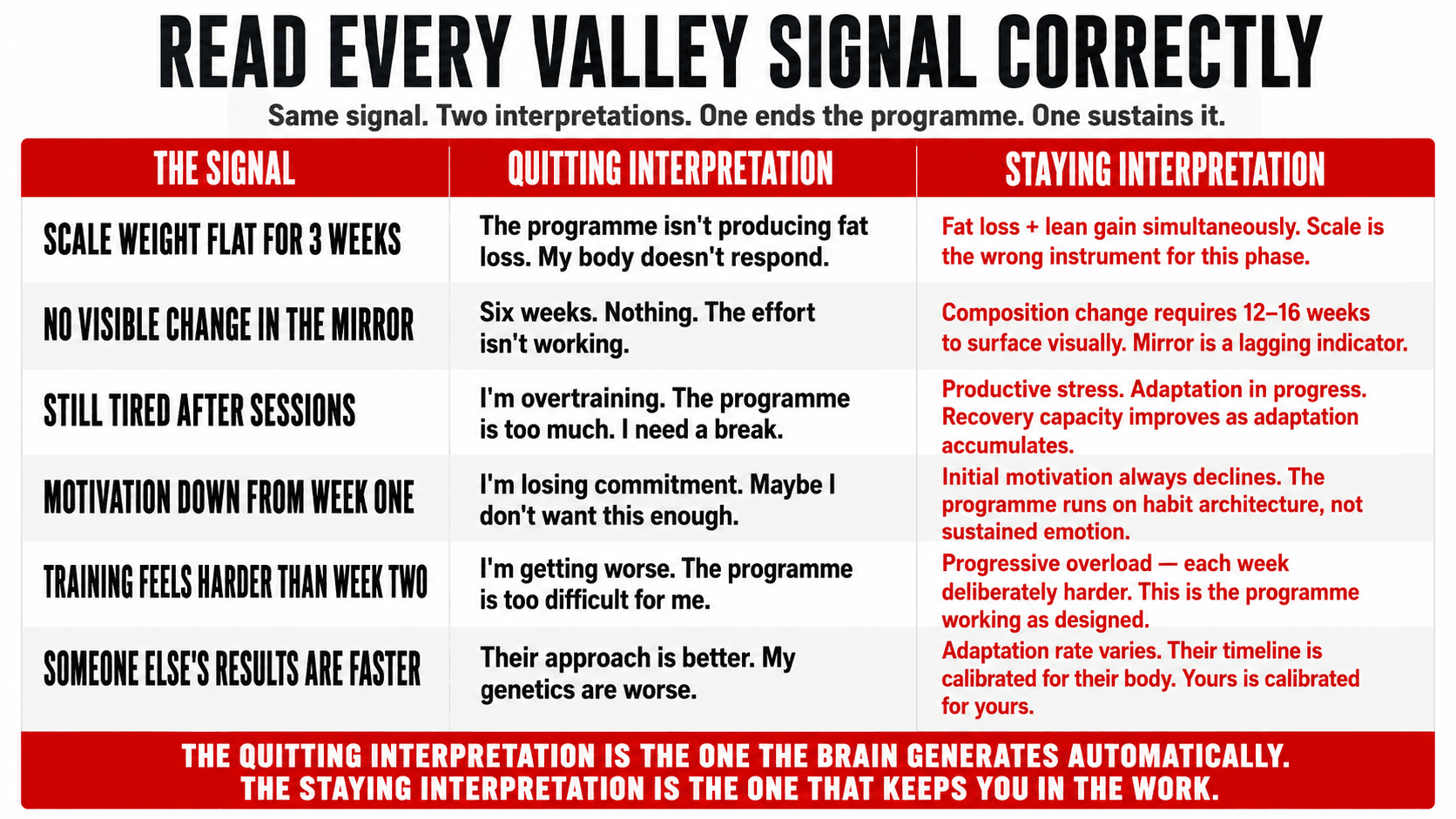
The Valley Reframe: How to Interpret Every Signal the Valley Generates
The valley period produces a series of specific signals that the person navigating it must interpret correctly in order to stay on the programme. Every one of these signals has a quitting interpretation and a staying interpretation. The quitting interpretation is the one the brain generates automatically. The staying interpretation is the one that requires understanding the valley’s structure.
| The Signal | Quitting Interpretation | Staying Interpretation |
|---|---|---|
| Scale weight has not moved in three weeks | The programme is not producing fat loss. My body does not respond to this approach. I need to try something different. | The scale measures total body weight including water, glycogen, lean mass, and fat. Fat loss and lean mass gain can be occurring simultaneously with a flat net weight. Body composition is changing. The scale is not the right instrument for this phase. |
| No visible change in the mirror | Nothing is happening. The effort is not producing results. I look exactly the same as I did six weeks ago. | Significant body composition change is occurring at a level that requires twelve to sixteen weeks to become visible in the mirror. The mirror is a lagging indicator. The below-waterline accumulation is not visible yet. That is expected, not a failure. |
| Still tired after sessions | My body is not recovering properly. The programme is too much. I am overtraining. I should take a break. | Post-training fatigue in the early and middle weeks of a programme is a normal physiological response to a training stimulus that exceeds current adaptation. It is a signal of productive stress, not of failure. Recovery capacity improves as adaptation accumulates. |
| Motivation has declined from week one levels | I am losing commitment. I do not want this enough. My motivation was not strong enough to sustain the programme. | Motivation always declines from its initial peak. The initial commitment is emotional and therefore transient. This is expected and structural. The programme is designed to run through the motivation plateau via habit architecture, not through sustained elevated motivation. |
| Training feels harder than it did at week two | I am getting worse, not better. The programme is too difficult for me at my current level. Something is wrong. | The programme is applying progressive overload, which means each week is deliberately harder than the one before it. The training feeling harder is evidence that the programme is working as designed, not evidence that it is not working. |
| Someone else on a similar programme is getting faster results | My programme is not right for me. My genetics are worse. I am doing something wrong. Their approach is better than mine. | Individual variation in adaptation rate is normal and well-documented. Comparison to another person’s timeline is not a valid measure of your programme’s effectiveness. Their programme is calibrated for their body. Yours is calibrated for yours. |
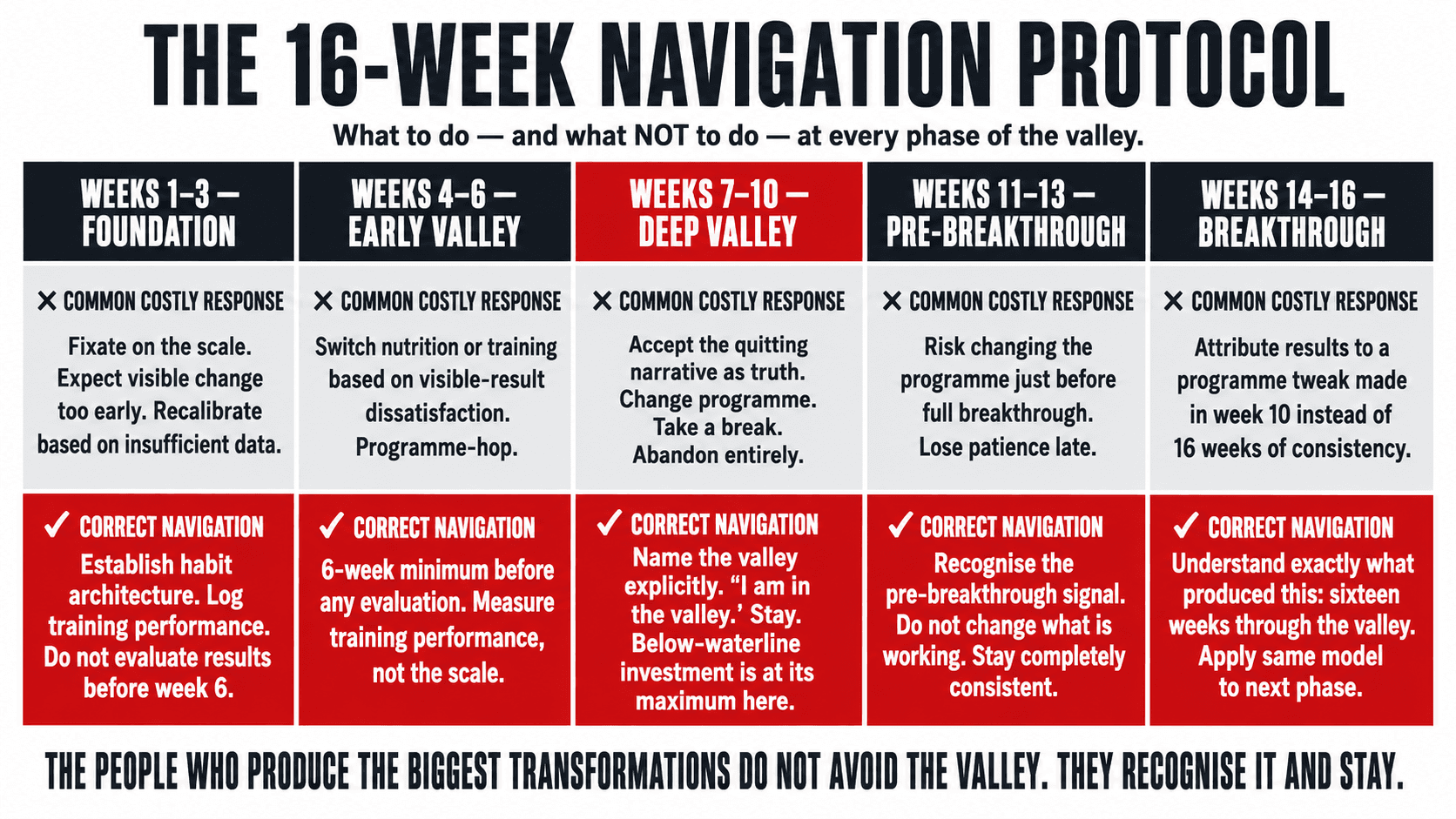
The Navigation Protocol: Specific Strategies for the Six to Sixteen Week Period
Understanding the valley is necessary but not sufficient for navigating it. Understanding provides the cognitive reframe. The navigation protocol provides the behavioural structure that makes staying through the valley executable rather than merely intellectually defensible.
| Week | The Signal to Watch For | The Common (Costly) Response | The Correct Navigation Response |
|---|---|---|---|
| Wks 1–3 | Energy variable. Soreness real. Scale not moving. Early enthusiasm present but untested. | Fixate on scale weight. Expect visible changes too early. Recalibrate protocol based on insufficient data. | Establish the habit architecture. Focus entirely on process execution. Do not evaluate results until week six minimum. Log training performance metrics instead of outcome metrics. |
| Wks 4–6 | Scale weight flat. Mirror showing nothing dramatic. Novelty of programme fading. First real test of commitment. | Switch nutritional approach or training methodology based on visible result dissatisfaction. Programme-hop. | Commit to a six-week minimum before any evaluation. Measure training performance: are sessions better than week one? Are recovery times improving? This data matters more than the scale. |
| Wks 7–10 | Deep valley. Genuine plateau of visible results. Quitting narrative arrives with force. This is the most dangerous period. | Accept the quitting narrative as accurate assessment. Change programme, take a break, or abandon entirely. The majority of failed programmes end here. | Name the valley explicitly. Tell yourself: I am in the valley. This is expected. The below-waterline accumulation is at its maximum. Change one process variable if needed but stay on the programme. |
| Wks 11–13 | Training performance improving measurably. Small visible changes beginning. The below-waterline accumulation starting to surface. Energy more consistent. | Interpret the improvement as evidence the initial plateau was normal but remain cautious. Risk of programme change just before full breakthrough. | Recognise the pre-breakthrough signal. Do not change anything that is working. The compound return is arriving. Stay completely consistent and the rate of visible change will accelerate. |
| Wks 14–16 | Visible results now clear and consistent. Training performance significantly better than baseline. The transformation others observe as sudden has been accumulating for twelve weeks. | Attribute results to the programme change made in week ten rather than the consistent effort of weeks one through thirteen. | Understand precisely what produced this outcome: sixteen weeks of consistent application through the valley. Apply the same understanding to the next phase. The valley will return at a higher baseline. |
What Elite Athletes Know About the Valley That Most People Do Not
The ability to navigate the valley without abandoning the programme is one of the primary psychological characteristics that distinguishes elite athletes from the merely talented. It is not that elite athletes do not experience the valley. They do, consistently, across every phase transition of their development. What distinguishes them is their interpretation of the valley period. They have, through accumulated experience of having been through the valley and out the other side, developed a reliable model of what the valley means.
Angela Duckworth’s research on grit identifies this explicitly as one of the defining characteristics of high-grit individuals: not the absence of difficult periods, but the interpretation of difficult periods as structural features of the development process rather than as evidence of inadequacy or failure. The high-grit athlete in the valley period is not experiencing less discomfort than the low-grit athlete. They are interpreting the discomfort as information about where they are in the development cycle rather than as a verdict on their capability (6).
Matthew Syed’s research on talent development adds the crucial practical observation: elite performers who navigate the valley most effectively are those who have coaches, mentors, or support systems that can verify from the outside that the programme is working when the athlete cannot verify it from the inside. The coach who has seen a hundred athletes through the same valley period can tell the athlete in week nine with complete accuracy: you are in the valley, the programme is working, what you are experiencing is expected and temporary. That external verification, when the athlete’s own perceptual system is generating inaccurate negative data, is not a luxury. It is the difference between staying and quitting for a substantial proportion of people in the most difficult period (7).
Key Insight: If you are currently in the valley — if the effort is real, the approach is correct, and the visible results appear to have stalled — the most valuable thing you can do is not change the programme. It is to find someone who can verify from the outside that the programme is working when you cannot see it from the inside. A coach who has tracked your baseline measurements. A training partner who has seen your performance improve. A blood marker comparison from week one to now. External verification during the valley is not weakness. It is intelligent use of a perspective that your own perceptual bias cannot provide.
The Valley in Nutrition: Why Metabolic Adaptation Is Not Programme Failure
The valley is not exclusively a training phenomenon. It occurs in the nutritional domain with equal consistency and is, if anything, more frequently misread as programme failure because its mechanism is less widely understood.
Metabolic adaptation, the physiological process by which the body reduces its resting metabolic rate in response to a sustained caloric deficit, is the nutritional equivalent of the deep valley. After several weeks of consistent caloric restriction, the body adapts by reducing energy expenditure through a combination of reduced non-exercise activity thermogenesis, reduced metabolic rate from lean mass loss, hormonal changes that increase appetite and reduce satiety signalling, and reduced exercise efficiency. The result is a plateau in weight loss that occurs even when the person’s adherence to their nutritional protocol is complete. The plateau is not evidence that the protocol has failed. It is evidence that it has been sufficiently consistent to trigger the body’s adaptive response (4).
The correct response to nutritional adaptation is a structured diet break — two to four weeks of eating at maintenance calories to allow the metabolic adaptations to partially reverse — followed by a return to the nutritional deficit. This approach, supported by substantial research on reverse dieting and diet periodisation, produces better long-term fat loss than the two most common responses to a nutritional plateau: further restricting calories, which deepens the adaptive response, or abandoning the protocol entirely on the grounds that it has stopped working.
Key Insight: A nutritional plateau that occurs after six or more weeks of consistent adherence is almost always metabolic adaptation, not programme failure. The correct diagnostic question is: has my adherence been genuine and consistent? If yes, the programme is working and has triggered a normal physiological response. The intervention is a structured maintenance period, not a new protocol. If adherence has been inconsistent, the plateau is an adherence problem, not an adaptation problem. The diagnostic distinction determines the correct response.
What Quitting in the Valley Has Cost and What Staying Through It Produces
Every person who has attempted a health programme and abandoned it in the six to sixteen week window has paid the full cost of the valley and collected none of the return. They experienced the soreness, the dietary discipline, the schedule restructuring, and the motivational management that the valley requires. They received, for that investment, the neurological and physiological adaptations that had accumulated below the waterline up to the point of quitting. They did not receive the compound return that those adaptations were about to produce.
The cumulative cost of repeatedly quitting in the valley is not simply the waste of the specific effort applied. It is the deposit made into the limiting belief file at each failure point, the narrative that the programme did not work, that the body does not respond, that lasting change is not available. That narrative makes the next attempt harder before it begins, because the person enters it carrying the cognitive weight of every previous valley exit. The valley, navigated correctly once, changes the relationship with the valley permanently. The person who has been through it and out the other side knows, with the certainty of personal experience, what the brain’s quitting narrative means and does not mean. That knowledge is one of the most durable assets in any long-term health transformation.
Clear’s formulation of the plateau of latent potential ends with the observation that the breakthrough is not a reward for exceptional effort or exceptional patience. It is the predictable mathematical output of the accumulation that has been building below the waterline throughout the valley period. The bamboo does not grow slowly for five years and then quickly for six weeks because of anything that changed in week five. It grows quickly in week five because of everything that was built in years one through four. The timing of the breakthrough is determined by the depth of the investment, not by the person’s response to the investment (1).
Key Insight: Identify your current valley status. If you are on a programme with genuine adherence and are between weeks six and sixteen, you are almost certainly in the valley. Do three things: change what you are measuring from outcome metrics to process metrics, name the quitting narrative as a valley signal rather than accurate programme data, and set a specific review date no earlier than week sixteen before drawing any conclusions about whether the approach is working. The valley is temporary. The breakthrough it precedes is permanent.
How I Build Valley Awareness Into Every Programme From the Start
The valley conversation is one I have in every first programme session, not because I expect every client to experience a difficult plateau, but because I know that most will, and the client who understands the valley before they enter it navigates it categorically differently from the client who encounters it without preparation.
When a client arrives at week eight or nine and reports that nothing is happening, I do not change the programme. I pull out the baseline measurements and compare them to the current ones. I review the training logs and compare week nine performance to week one performance. I look at the blood markers if we have them. And in almost every case, the objective data tells a completely different story from the subjective experience. The below-waterline investment is enormous and visible in the data. The above-waterline return has not yet arrived. The programme is working. The client is in the valley. They are not failing. They are approximately two to four weeks from the breakthrough.
The clients who produce the most significant transformations are not the ones who never enter the valley. They all enter it. They are the ones who, having been told in advance what it would feel like and what it would mean, recognise it correctly when it arrives and stay. I work one-to-one with clients online globally. The valley navigation is part of the programme from day one.
Work with Me
Get a personalised coaching plan built around your goals, your schedule, and your life.
Enquire NowReferences
- Clear J. Atomic Habits: An Easy and Proven Way to Build Good Habits and Break Bad Ones. London: Random House Business; 2018.
- Kraemer WJ, Ratamess NA. Fundamentals of resistance training: progression and exercise prescription. Medicine and Science in Sports and Exercise. 2004; 36(4): 674–688.
- Hoppeler H, Vogt M. Muscle tissue adaptations to hypoxia. Journal of Experimental Biology. 2001; 204(18): 3133–3139.
- Trexler ET, Smith-Ryan AE, Norton LE. Metabolic adaptation to weight loss: implications for the athlete. Journal of the International Society of Sports Nutrition. 2014; 11(1): 7.
- Dayan P, Niv Y. Reinforcement learning: the good, the bad and the ugly. Current Opinion in Neurobiology. 2008; 18(2): 185–196.
- Duckworth AL. Grit: The Power of Passion and Perseverance. New York: Scribner; 2016.
- Syed M. Bounce: The Myth of Talent and the Power of Practice. London: Fourth Estate; 2010.