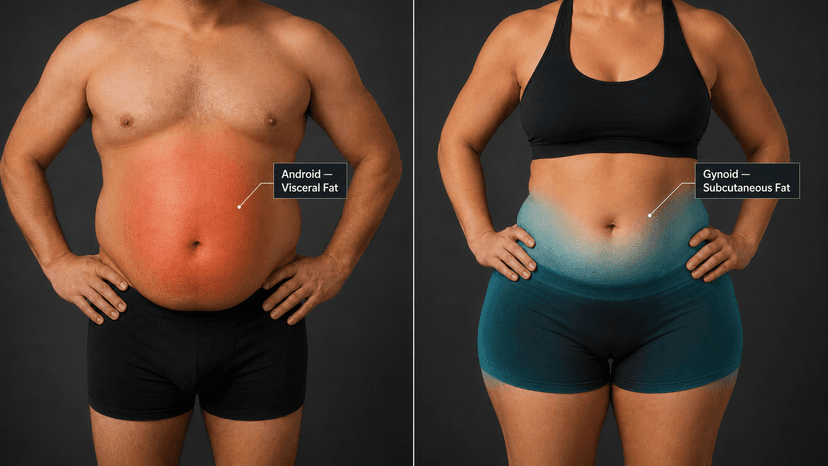
Fat loss personal responsibility is the conversation that makes people uncomfortable. In a culture that increasingly frames obesity as something that happens to people rather than something influenced by the choices people make, talking honestly about personal responsibility has become almost taboo. I understand why. The food environment is stacked against us. Ultra-processed food is cheap, convenient, and engineered to be overconsumed. Portion sizes have ballooned. Sedentary jobs have become the norm. Stress is chronic. Sleep is sacrificed. And there are genuine socioeconomic, genetic, and hormonal factors that make fat loss harder for some people than others. All of that is true. None of it removes the fact that what you eat, how you move, and how you live your life are ultimately within your control. And until you accept that, nothing will change.
I have coached hundreds of clients through body transformations. Men and women. Young and old. Meat eaters, vegetarians, and vegans. Clients with type 2 diabetes, type 1 diabetes, PCOS, hypertension, thyroid conditions, and a long list of other medical challenges. The ones who get results share one thing in common. It is not genetics. It is not their starting point. It is not their income or their schedule. It is ownership. They take complete responsibility for their actions, their food, their training, their sleep, and their daily habits. They stop looking for external reasons why they cannot and start building internal systems that ensure they will.

The Cost of Externalising Blame
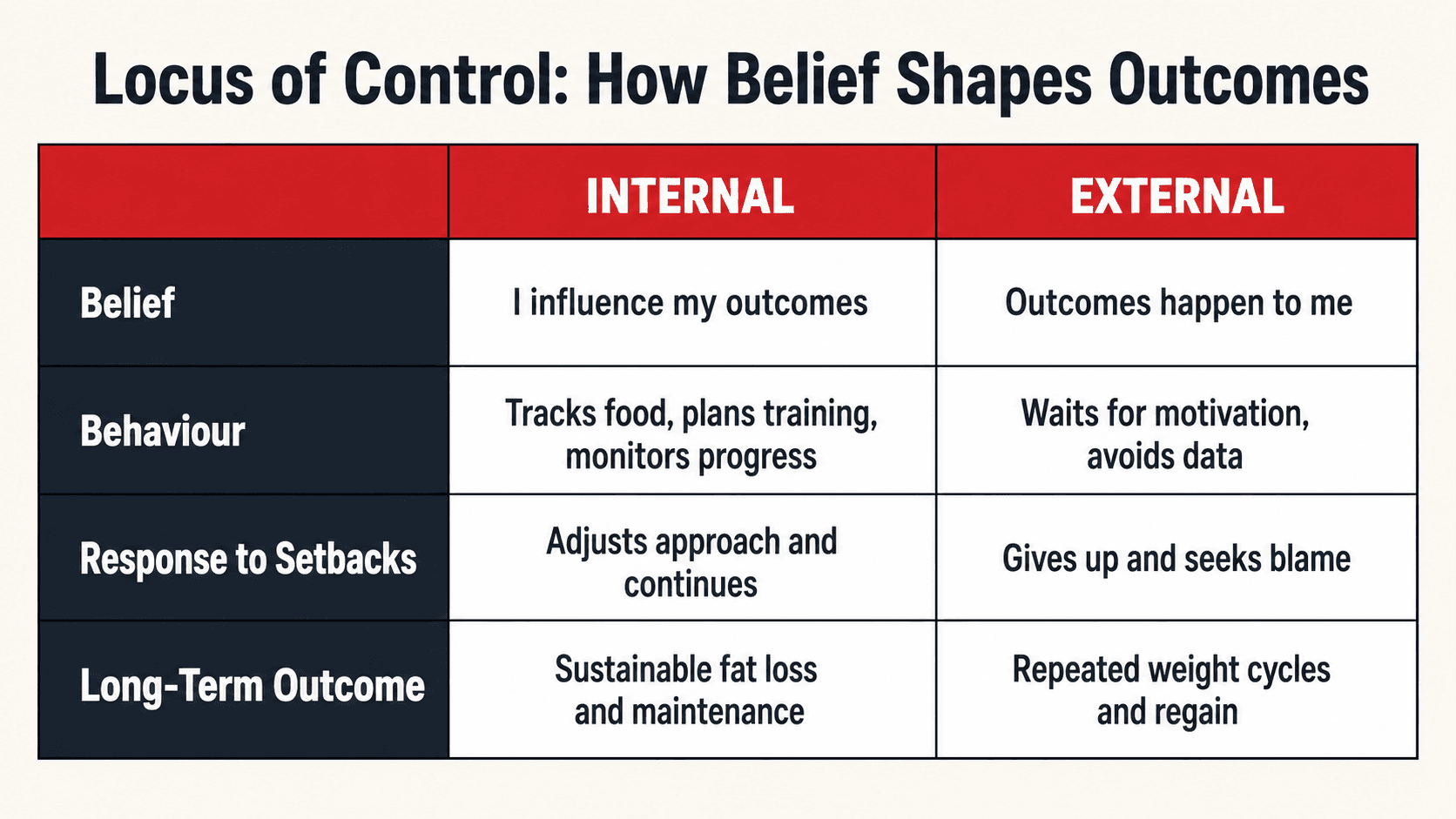
There is a well-established psychological concept called locus of control, first described by the psychologist Julian Rotter in 1966 (1). It refers to the degree to which a person believes they are in control of the events that affect their life. People with an internal locus of control believe their actions directly influence their outcomes. People with an external locus of control believe outcomes are determined by luck, fate, genetics, other people, or circumstances beyond their influence.
The research on locus of control and weight management is remarkably consistent. A study published in Behaviour Research and Therapy examined weight loss maintenance in individuals who had previously lost at least 10 percent of their body weight. The researchers found a significant interaction between locus of control and maintenance status, with those possessing an internal orientation being substantially more likely to maintain their weight loss, while those with an external orientation were more likely to regain (2). Individuals who believed their weight was within their control behaved accordingly. They monitored their food. They stayed active. They made adjustments when things drifted. Those who believed their weight was determined by forces beyond their control did the opposite. They waited for something external to fix the problem. And the weight came back.
A review published in Frontiers in Endocrinology confirmed this pattern, noting that internally focused individuals tend to succeed more often in weight loss than externally focused individuals (3). This is not a minor statistical curiosity. This is a fundamental predictor of whether someone will transform their body or spend the rest of their life talking about it.
When you externalise blame for your body composition, you hand over your power to change it. If you believe your weight is entirely the fault of your genetics, your metabolism, your thyroid, the food industry, your upbringing, or your schedule, then logically there is nothing you can do about it. That belief becomes self-fulfilling. It removes the motivation to act, because action feels pointless when you believe the outcome is predetermined. And so nothing changes. The weight stays. The health deteriorates. The frustration deepens. Not because change was impossible, but because the belief that change was impossible prevented the person from ever genuinely trying.
Acknowledging the Environment Without Surrendering to It
I want to be clear about something because this is a nuanced topic and nuance matters. I am not saying that obesity is purely a matter of personal choice and that everyone who is overweight simply needs to try harder. That is a simplistic and unhelpful position. The modern food environment is genuinely obesogenic. Ultra-processed foods are deliberately engineered to override satiety signals and drive overconsumption (4). They are aggressively marketed, widely available, and often cheaper calorie-for-calorie than whole foods. Socioeconomic deprivation limits access to quality food and safe environments for physical activity. Genetics influence appetite regulation, fat distribution, and metabolic rate. Hormonal conditions such as PCOS, hypothyroidism, and insulin resistance make fat loss objectively harder. Sleep deprivation and chronic stress elevate cortisol and disrupt appetite hormones in ways that promote fat storage. These are real factors and they deserve acknowledgement.
But acknowledging that the environment is difficult is not the same as accepting that you are powerless within it. A constructive approach to personal responsibility, as argued in a paper published in Health Affairs, involves recognising environmental barriers while still empowering individuals to make the best possible choices within their circumstances (5). The two positions are not in conflict. You can acknowledge that the food industry has made it harder to eat well while simultaneously choosing to eat well anyway. You can recognise that your genetics predispose you to store fat around your midsection while simultaneously committing to the calorie deficit and training programme that will reduce it. You can accept that your job is sedentary and stressful while simultaneously walking 10,000 steps a day and sleeping seven hours a night.
The environment loads the gun. Your daily habits pull the trigger. And your daily habits are within your control.
What Fat Loss Personal Responsibility Actually Looks Like in Practice
Personal responsibility is not a motivational slogan. It is a set of daily actions that compound over time into measurable results. When I talk about taking responsibility for your fat loss, I am talking about specific, concrete behaviours that you either do or do not do. There is no grey area.
It means tracking your food intake honestly, every day, even on the days when you overeat. Research consistently shows that self-monitoring of dietary intake is one of the strongest predictors of successful weight loss (6). It means following your training programme as written, not skipping sessions because you are tired or busy, not substituting the hard exercises for easier ones, not half-heartedly going through the motions. It means stepping on the scale regularly and confronting the data rather than avoiding it. It means sleeping seven to nine hours per night because you understand that sleep deprivation elevates ghrelin, suppresses leptin, increases cortisol, and makes every aspect of fat loss harder (7). It means preparing your meals in advance so that when hunger strikes, the right food is already available. It means limiting alcohol because you understand that every gram of alcohol consumed is prioritised for metabolism ahead of fat oxidation, and that a night of heavy drinking can undo a week of careful nutrition.
It also means taking responsibility for your knowledge. You do not need a degree in nutrition to lose fat, but you do need to understand the basics. How many calories you need. How much protein you should eat. Why resistance training matters. What a reasonable rate of fat loss looks like. Why the scale fluctuates. If you do not know these things, it is your responsibility to learn them or to hire someone who can teach you. Ignorance is not a permanent state. It is a temporary condition that you choose whether or not to address.

Self-Efficacy: Believing You Can Before You Do
Closely related to locus of control is the concept of self-efficacy, defined by the psychologist Albert Bandura as a person's belief in their ability to execute the behaviours necessary to produce a specific outcome (8). Self-efficacy is not the same as confidence in a general sense. It is task-specific. You might feel confident in your career but have zero self-efficacy when it comes to sticking to a nutrition plan.
Research on obesity treatment has shown that higher baseline self-efficacy is associated with greater weight loss and better long-term maintenance. A clinical cohort study of over 1,000 patients referred for obesity treatment found that those who achieved 15 percent or greater weight loss through dietary intervention scored significantly higher on self-efficacy measures compared to those who lost less than 5 percent or dropped out entirely (9). Self-efficacy was also a predictor of programme completion. Those who believed they could succeed were more likely to stay the course. Those who doubted their ability to follow through were more likely to quit.
This creates a powerful feedback loop. Taking personal responsibility and following through on small daily actions builds self-efficacy. That increased self-efficacy makes it easier to follow through on the next day's actions. Success breeds success. Conversely, avoiding responsibility, skipping sessions, ignoring your food log, and blaming external factors erodes self-efficacy over time. Every broken commitment to yourself is a vote against your own capability. Every kept commitment is a vote for it.
This is one of the reasons I structure my coaching around small, consistent wins rather than dramatic overhauls. When a new client starts with me, I do not give them the perfect programme on day one and expect them to execute it flawlessly. I give them a manageable set of non-negotiable actions, watch them execute, and then build from there. Each completed week of adherence strengthens their belief that they can do this. And that belief is the engine that drives everything else.
Most People Already Know It Is Their Responsibility
Here is a finding that rarely gets discussed in the public debate around obesity and personal responsibility. The ACTION study, a large survey of over 3,000 individuals living with obesity, found that 82 percent of respondents considered weight loss to be completely their own responsibility (10). Only 5 percent disagreed. The overwhelming majority of people with excess body fat already know that the solution lies with them. They are not waiting for someone to give them permission to take ownership. They are waiting for the right structure, the right support, and the right guidance to turn that sense of responsibility into sustained action.
This is the gap that coaching fills. Knowing that your health is your responsibility is the essential first step. But knowledge without a system is just anxiety. You know you should eat better but you do not have a structured plan. You know you should train but you do not have a programme. You know you should be accountable but you do not have anyone holding you to it. The sense of responsibility is there. What is missing is the bridge between intention and execution. My job is to build that bridge.

This Is Not About Blame. It Is About Power.
I want to address something directly because I know this topic provokes strong reactions. Talking about personal responsibility for fat loss is not the same as blaming someone for being overweight. Blame is backward looking. It is about fault. It is about assigning moral failure to a complex situation that involves genetics, hormones, environment, psychology, education, economics, and a hundred other variables. I am not interested in blame. I am interested in power.
When I tell a client that their health is in their hands, I am not saying it is their fault they gained weight. I am saying it is within their power to lose it. Those are fundamentally different statements. One induces shame. The other induces agency. One keeps you stuck in the past. The other propels you into the future. The moment you accept responsibility for your body, you reclaim the ability to change it. As long as you believe the problem is entirely external, you remain a passive victim of circumstances. The moment you recognise your own agency, you become an active participant in your own transformation.
This is the mindset shift that separates my most successful clients from those who struggle. It is not a personality trait you are born with. It is a decision you make. And you can make it right now.
What About Genuine Medical Barriers?
I coach clients with type 1 diabetes, type 2 diabetes, PCOS, hypothyroidism, autoimmune conditions, and a wide range of other medical challenges. I never dismiss or minimise the very real physiological difficulties these conditions create. PCOS drives insulin resistance and makes fat storage around the midsection more likely. Hypothyroidism reduces metabolic rate. Type 1 diabetes requires careful management of insulin and blood glucose that adds a layer of complexity to every nutritional decision. These are not excuses. They are genuine obstacles that require a more careful, more personalised, and more expert approach.
But they do not make fat loss impossible. They make it harder. And harder is not the same as impossible. I have worked with a client with type 1 diabetes who lost 24 kilograms. I have worked with a vegetarian client who lost 33 kilograms in 11 months. I have worked with clients whose GPs reduced their blood pressure medication because their body composition improvements made it unnecessary. I have worked with clients whose insulin doses dropped from 25 units to 5 units. Every one of those clients had legitimate medical reasons to believe fat loss would be difficult. Every one of them took personal responsibility and did the work anyway.
Having a medical condition does not remove personal responsibility. It changes what personal responsibility looks like. It means finding a coach who understands your condition. It means working with your GP or endocrinologist alongside your training and nutrition plan. It means being more meticulous with your food tracking, more consistent with your medication, more diligent with your sleep. It means accepting that your path will be slower and more complex than someone without your condition, and committing to walk it anyway.

The Bottom Line
Your health is in your hands. Not entirely, because genetics and environment and medical history play a role. But substantially, meaningfully, and practically, the daily choices you make about what you eat, how you move, how you sleep, and how you manage your stress are the primary determinants of your body composition, your metabolic health, and your quality of life. The research is clear: an internal locus of control is associated with better weight loss outcomes and better long-term maintenance (2, 3). Higher self-efficacy predicts greater adherence and greater results (9). And the vast majority of people living with obesity already recognise that the responsibility lies with them (10). What they need is not another lecture on willpower. What they need is a structured, evidence-based plan and someone to hold them accountable to it.
If you are ready to take ownership of your health and your body, get in touch through trperformancecoaching.com. I work one-to-one with clients online globally. Whether you eat meat, are vegetarian, vegan, or somewhere in between, whether you are managing a medical condition or simply want to lose fat and feel better, I will give you the plan, the structure, and the accountability to turn your sense of responsibility into real, lasting results. No blame. No shame. Just honest, evidence-based coaching that meets you where you are and takes you where you want to go.
Work with Me
Get a personalised coaching plan built around your goals, your schedule, and your life.
Enquire NowReferences
- Rotter JB. Generalized expectancies for internal versus external control of reinforcement. Psychological Monographs: General and Applied. 1966; 80(1): 1-28.
- Anastasiou CA, Karfopoulou E, Yannakoulia M. Weight loss maintenance in relation to locus of control: the MedWeight study. Behaviour Research and Therapy. 2015; 71: 40-44.
- Infurna FJ, Gerstorf D. Locus of control and obesity. Frontiers in Endocrinology. 2014; 5: 159.
- Monteiro CA, Cannon G, Moubarac JC, et al. Ultra-processed foods, diet quality, and health using the NOVA classification system. Rome: FAO. 2019.
- Brownell KD, Kersh R, Ludwig DS, et al. Personal responsibility and obesity: a constructive approach to a controversial issue. Health Affairs. 2010; 29(3): 379-387.
- Burke LE, Wang J, Sevick MA. Self-monitoring in weight loss: a systematic review of the literature. Journal of the American Dietetic Association. 2011; 111(1): 92-102.
- Spiegel K, Tasali E, Penev P, Van Cauter E. Brief communication: sleep curtailment in healthy young men is associated with decreased leptin levels, elevated ghrelin levels, and increased hunger and appetite. Annals of Internal Medicine. 2004; 141(11): 846-850.
- Bandura A. Self-efficacy: toward a unifying theory of behavioral change. Psychological Review. 1977; 84(2): 191-215.
- Sjoberg L, Svensson E, Stenlund H, et al. Locus of control and self-efficacy in relation to 12-month weight change after non-surgical weight loss treatment in adults with severe obesity. Clinical Obesity. 2022; 12(3): e12519.
- Caterson ID, Alfadda AA, Auerbach P, et al. Gaps to bridge: misalignment between perception, reality and actions in obesity. Diabetes, Obesity and Metabolism. 2019; 21(8): 1914-1924.