
When most people think about burning calories, they think about the gym. They think about treadmills, spin classes, HIIT sessions, and drenching their T-shirt in sweat for an hour. And while structured exercise absolutely matters for your health, your fitness, and your body composition, it is not the biggest variable in your daily energy expenditure. Not even close. The most powerful NEAT fat loss non exercise activity tool available to you is something you are probably doing less and less of with every passing year: simply moving throughout your day.
NEAT stands for non-exercise activity thermogenesis. It is the energy your body expends on everything you do that is not sleeping, eating, or formal exercise. Walking to the shops. Climbing stairs. Standing at your desk. Cooking dinner. Fidgeting. Carrying your groceries. Playing with your children. Gardening. Cleaning your house. Every single one of these activities burns energy, and when you add them all up over the course of a day, a week, a month, and a year, the cumulative impact is enormous. Research by Professor James Levine at the Mayo Clinic, the scientist who pioneered NEAT research, found that NEAT can vary between two people of similar size by up to 2,000 calories per day (1). That is not a typo. Two thousand calories. That is the equivalent of running a marathon every single day, or more practically, the entire calorie deficit most people need for aggressive fat loss, accounted for entirely by the difference between someone who moves throughout their day and someone who sits still.
Why NEAT Matters More Than Your Gym Session
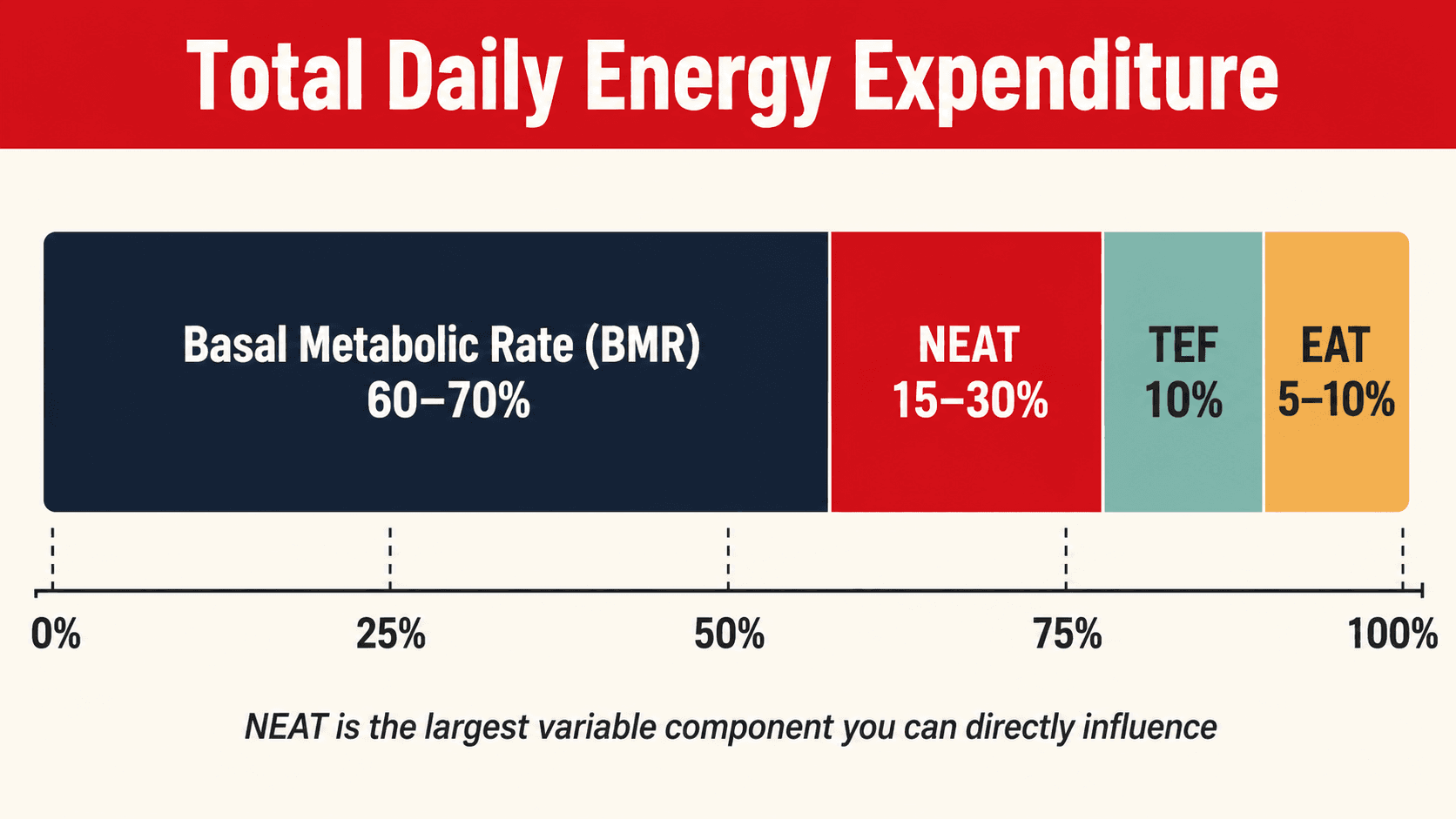
To understand why NEAT is so important, you need to understand how your body actually uses energy. Your total daily energy expenditure, the total number of calories you burn in a 24 hour period, is made up of four components. Basal metabolic rate is the energy required to keep you alive at complete rest. It accounts for approximately 60 to 70 percent of your total expenditure and is largely determined by your body size and lean mass. The thermic effect of food is the energy cost of digesting, absorbing, and processing what you eat. It accounts for roughly 10 percent and does not vary much between people. Exercise activity thermogenesis is the energy you burn during structured workouts. For most people, even regular exercisers, this accounts for only 5 to 10 percent of total daily expenditure because the average person exercises for less than an hour a day, if they exercise at all (2). NEAT accounts for everything else. For an active person, it can represent 15 to 30 percent or more of total daily expenditure. For a sedentary person, it can drop to almost nothing.
Here is the critical insight. Your basal metabolic rate and your thermic effect of food are relatively fixed. You cannot dramatically change them in the short term. Your structured exercise sessions, while valuable, occupy a small window of your day. NEAT is the single largest variable component of your daily energy expenditure that you can directly influence through behavioural choices. It is the lever that most people never pull, and it is the one that makes the biggest difference.
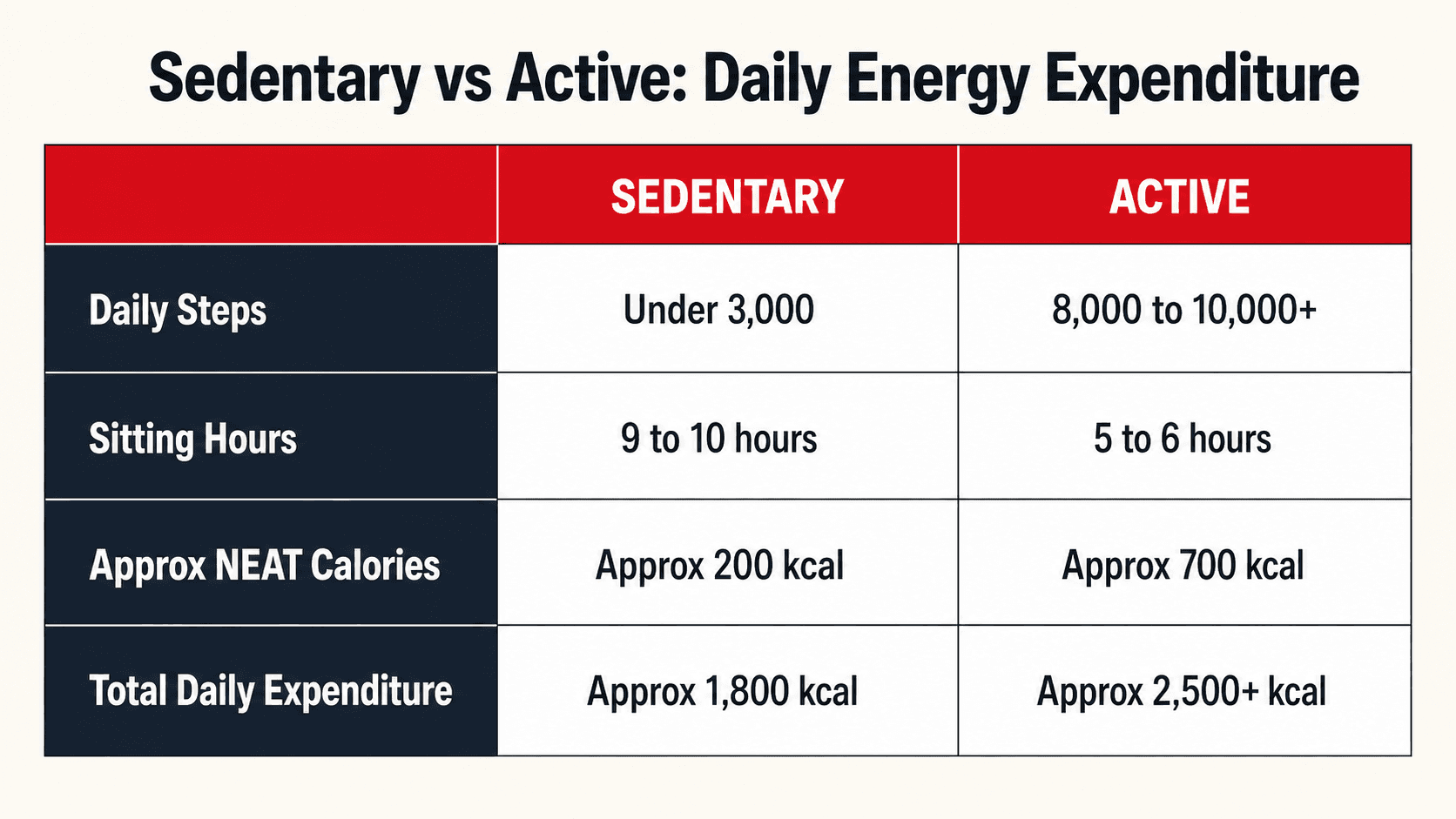
I see this pattern constantly in my coaching practice. A client trains three or four times per week, eats well, sleeps well, and still wonders why their fat loss has stalled. When I look at their daily activity data, the answer is almost always the same: outside of their training sessions, they are barely moving. They drive to work, sit at a desk for eight to ten hours, drive home, sit on the sofa, and go to bed. Their structured exercise burns perhaps 300 to 400 calories. Their NEAT is practically zero. The maths does not work. You cannot out-train a sedentary lifestyle.
The Study That Changed Everything
In 1999, Professor Levine published a landmark study in the journal Science that fundamentally changed our understanding of why some people gain fat more easily than others. He took 16 non-obese volunteers and overfed them by 1,000 calories per day above their maintenance needs for eight weeks. The question was simple: where did the extra energy go? The results were remarkable. Fat gain varied tenfold between participants, ranging from a gain of just 0.36 kilograms to 4.23 kilograms. The single strongest predictor of resistance to fat gain was not metabolic rate, not genetics in any obvious sense, and not the thermic effect of food. It was changes in NEAT (3).
The individuals who increased their NEAT the most in response to overfeeding, those who unconsciously moved more, fidgeted more, stood more, and walked more, gained the least fat. Those whose NEAT did not increase, or actually decreased, gained the most. Two thirds of the increase in total daily energy expenditure during overfeeding was accounted for by NEAT, not by changes in basal metabolic rate or exercise. This tells us something profound: your body has a mechanism for burning off excess energy through movement, and in some people that mechanism is highly active, while in others it is almost dormant.
The Hidden Trap: NEAT Drops When You Diet
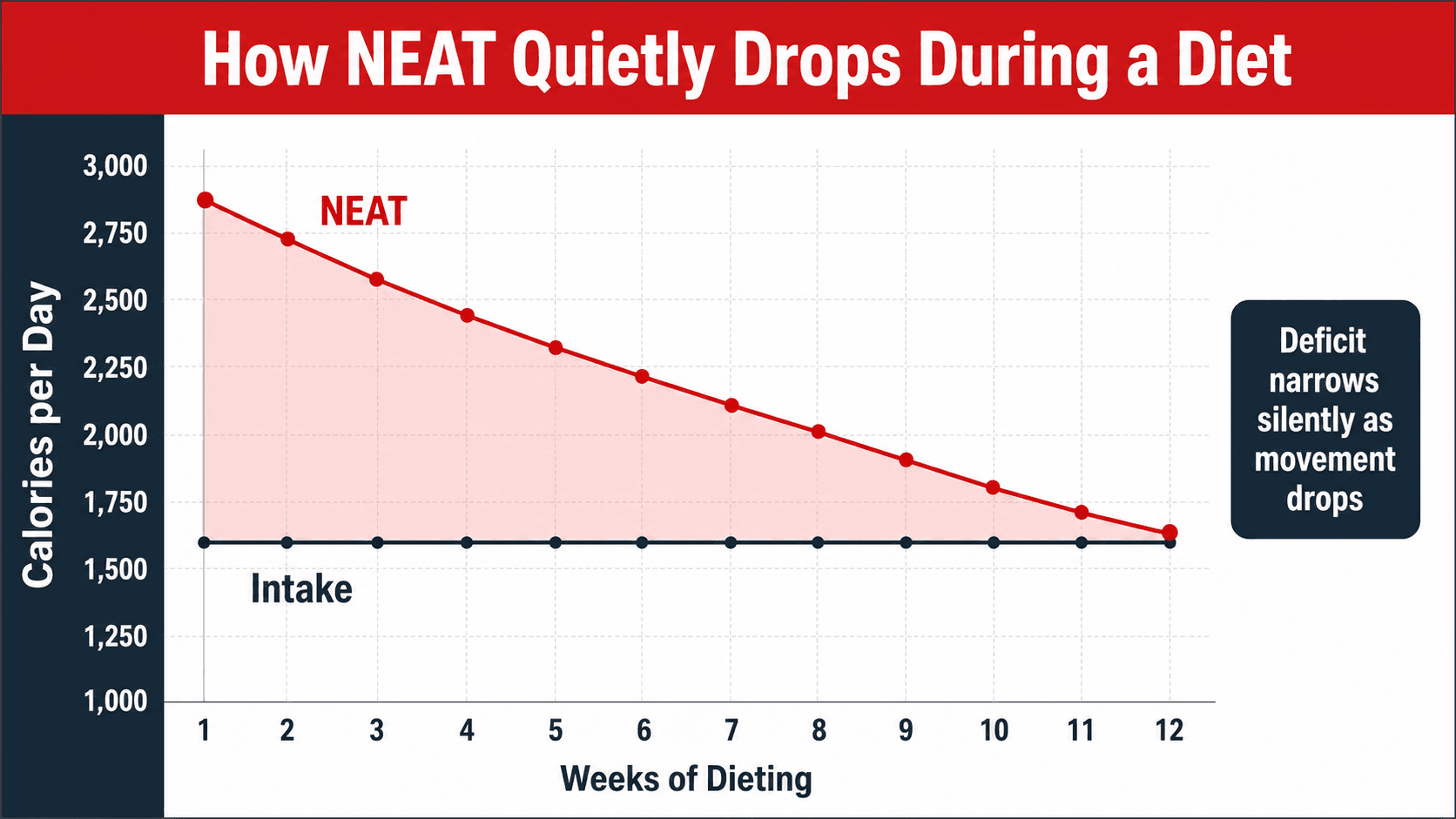
Here is where NEAT becomes particularly important for anyone actively trying to lose fat. When you create a calorie deficit through dieting, your body fights back. One of the ways it does this is by reducing your NEAT. You move less without realising it. You fidget less, stand less, take fewer steps, and generally become less active throughout the day. This is not laziness. It is a subconscious, biologically driven reduction in energy expenditure designed to conserve energy during a period of perceived scarcity (4).
This adaptive reduction in NEAT can be substantial. Studies have shown that during sustained calorie restriction, non-exercise physical activity can decrease by several hundred calories per day (4). This means that the calorie deficit you carefully calculated at the start of your diet is silently shrinking as your body downregulates your daily movement. If you are not actively monitoring and maintaining your NEAT during a fat loss phase, you may think you are in a 500 calorie deficit when in reality it has narrowed to 100 or 200 calories, and your fat loss stalls without any obvious explanation.
This is one of the primary reasons I track daily step counts with every client I coach. Steps are a practical, measurable proxy for NEAT. If a client's steps drop from 10,000 to 6,000 per day during a dieting phase, I know immediately that their NEAT has fallen and their effective deficit has shrunk. The fix is straightforward: bring the steps back up. But you cannot fix what you do not measure.
The Modern Epidemic of Sitting
The decline in NEAT over the past 50 years is one of the most significant and least discussed contributors to the obesity epidemic. We have engineered movement out of nearly every aspect of modern life. We drive instead of walk. We take lifts instead of stairs. We order food to our doors. We work at desks for eight hours or more. We entertain ourselves by sitting in front of screens. The average office worker in the UK sits for 9 to 10 hours per day (5). That is more time spent sitting than sleeping.
Professor Levine's research with lean and obese sedentary office workers found that obese individuals sat for an average of 2.5 hours more per day than their lean counterparts, even when both groups were in similar occupational and environmental settings (6). If those obese individuals had adopted the standing and movement patterns of the lean group, they could have expended an additional 350 calories per day without any structured exercise at all. Over a year, that amounts to approximately 16 kilograms of potential fat loss. This is not a theoretical number. This is the mathematical reality of what happens when you move more throughout your day.
Top Tips: How to Increase Your NEAT Starting Today
The beauty of NEAT is that it does not require a gym membership, special equipment, or dedicated training time. It requires a shift in daily habits. Here are the strategies I use with my clients to systematically increase NEAT and accelerate their fat loss.
Set a daily step target and treat it as non-negotiable. I set a minimum of 8,000 to 10,000 steps per day for all of my fat loss clients. For some, particularly those who are very sedentary at baseline, I start at 6,000 and build progressively. Use a phone, smartwatch, or pedometer to track your steps. If you get to the evening and you are 3,000 steps short, go for a walk. This is not optional. It is part of your programme, as important as your training sessions and your nutrition plan.
Walk for 15 to 20 minutes after your main meals. Post-meal walking is one of the simplest and most effective NEAT strategies. It increases energy expenditure, improves blood glucose clearance, aids digestion, and can be done anywhere. A short walk after lunch and dinner adds 3,000 to 4,000 steps and 100 to 150 calories of additional expenditure with almost zero effort or fatigue. Research has shown that post-meal walking significantly reduces post-prandial blood glucose spikes, which is particularly relevant for anyone managing insulin resistance, type 2 diabetes, or PCOS (7).

Stand more during your working day. If you work at a desk, invest in a standing desk or a desk converter that allows you to alternate between sitting and standing. Even standing for two to three hours of your working day increases your daily energy expenditure by 150 to 200 calories compared to sitting the entire time. If a standing desk is not available, set an alarm to stand and move for five minutes every hour. Walk to a colleague's desk instead of sending an email. Take phone calls standing or pacing.
Take the stairs every single time. This sounds trivial, but climbing stairs is one of the most energy-dense everyday activities you can do. It burns significantly more calories per minute than level walking and provides a cardiovascular stimulus that adds up over time. If your office is on the fifth floor, that is ten flights of stairs per day just from going up and down once. Over a year, those flights accumulate into thousands of additional calories burned.
Walk or cycle for short journeys instead of driving. Any journey under two miles can realistically be walked. Any journey under five miles can realistically be cycled. These are the easiest NEAT wins because they replace sedentary time (sitting in a car) with active time and require no additional time commitment if the travel time is similar.
Do active housework and errands yourself. Cook your own meals instead of ordering delivery. Hand wash dishes. Clean your home. Do your own gardening. Carry your shopping bags. These are not glamorous activities, but they all burn energy, and collectively they contribute meaningfully to your daily expenditure. The generation that struggled least with obesity was the generation that had no choice but to do these things manually. There is a lesson in that.
Reduce recreational screen time. Every hour spent watching television, scrolling social media, or gaming is an hour spent at minimal metabolic output. I am not suggesting you eliminate leisure time. I am suggesting you be intentional about it. Watch one episode instead of three. Go for a walk instead of a scroll. Play with your children instead of watching them play. The exchange of sedentary screen time for even light physical activity accumulates rapidly over the course of a week.
Use NEAT as a fat loss tool when progress stalls, before cutting more food. This is a coaching strategy I use constantly. When a client's fat loss plateaus, my first intervention is almost never to reduce their calories further. It is to increase their NEAT. Adding 2,000 extra steps per day, roughly 100 to 150 additional calories, is far more sustainable, far less psychologically taxing, and far better for long-term adherence than dropping another 200 calories from an already restricted diet. You can only cut food so far before it becomes unsustainable. You can almost always move more.

NEAT for Office Workers, Parents, and Busy Professionals
Most of the clients I work with are busy people. They are executives, professionals, parents, and people with demanding schedules. They do not have hours of free time to dedicate to additional exercise. This is precisely why NEAT is so valuable for them. It does not require extra time. It requires different choices within the time they already have.
For office workers, the biggest wins come from standing desks, walking meetings, stair use, and post-lunch walks. For parents, the wins come from active play with children, walking the school run, and doing household tasks manually. For frequent travellers, the wins come from walking through airports instead of using travelators, taking stairs in hotels, and walking to dinner instead of taking a taxi. None of these changes are dramatic individually. All of them compound into meaningful energy expenditure over time.
I have worked with executive clients in London who sit in meetings all day, eat at their desks, and are driven to and from work. Their structured exercise was excellent: three to four sessions per week with me. But their daily step count was under 3,000. When we focused on increasing their NEAT to 8,000 to 10,000 steps through the strategies above, their fat loss accelerated noticeably without any change to their diet or training programme. The calorie deficit widened, and the results followed.
Why NEAT Beats Traditional Cardio for Long-Term Fat Loss
Structured cardiovascular exercise has its place. It improves heart health, builds aerobic fitness, and burns calories. But as a primary fat loss strategy, it has significant limitations. Formal cardio sessions are time-consuming, they compete with resistance training for recovery resources, and they can increase appetite in ways that partially or fully offset the calories burned (8). Most people overestimate how many calories they burn during cardio and underestimate how much more they eat afterwards. The net calorie cost of a 45 minute jog may be as little as 200 to 300 calories, and if you reward yourself with a large coffee and a muffin afterwards, you have wiped out the entire expenditure.
NEAT avoids all of these problems. Walking and daily movement do not significantly increase appetite. They do not impair your recovery from resistance training. They do not require dedicated time blocks. They do not create the psychological burden of yet another exercise session to fit into an already full schedule. And because they can be accumulated throughout the day in small bouts, they are far more sustainable over months and years than a formal cardio programme that most people eventually abandon.
This is not to say you should never do cardio. If you enjoy running, cycling, swimming, or any other form of cardiovascular exercise, keep doing it. The health benefits are substantial. But if your primary goal is fat loss and you are time-limited, your first priority after resistance training and nutrition should be NEAT, not more time on a treadmill.
The Bottom Line
NEAT is the most underutilised, most sustainable, and most accessible fat loss tool available to you. It does not require a gym, a programme, or any special equipment. It requires you to move more throughout your day, every day, in whatever way your life allows. The research is unequivocal: NEAT can vary by up to 2,000 calories per day between individuals (1), it directly predicts resistance to fat gain (3), and it declines during dieting in ways that silently undermine your calorie deficit (4). If you are not actively monitoring and maintaining your NEAT, you are leaving your most powerful fat loss lever untouched.
Set your step target. Track it daily. Walk after meals. Stand more. Sit less. Use movement as your first response to a fat loss plateau, not starvation. These are the habits that separate people who transform their bodies and keep the results from those who diet endlessly and wonder why nothing sticks.
If you want a personalised fat loss programme that integrates NEAT alongside structured training, precise nutrition, and ongoing accountability, get in touch. I work one-to-one with clients online globally. Whether you eat meat, are vegetarian, vegan, or somewhere in between, whether you are a busy executive, a parent, or someone managing a medical condition like type 2 diabetes or PCOS, I will build a system that works with your lifestyle, not against it. You do not need to live in the gym to transform your body. You just need to stop sitting still.
Work with Me
Get a personalised coaching plan built around your goals, your schedule, and your life.
Enquire NowReferences
- Levine JA. Non-exercise activity thermogenesis (NEAT). Best Practice and Research Clinical Endocrinology and Metabolism. 2002; 16(4): 679-702.
- Levine JA. Nonexercise activity thermogenesis: liberating the life-force. Journal of Internal Medicine. 2007; 262(3): 273-287.
- Levine JA, Eberhardt NL, Jensen MD. Role of nonexercise activity thermogenesis in resistance to fat gain in humans. Science. 1999; 283(5399): 212-214.
- Rosenbaum M, Vandenborne K, Goldsmith R, et al. Effects of experimental weight perturbation on skeletal muscle work efficiency in human subjects. American Journal of Physiology: Regulatory, Integrative and Comparative Physiology. 2003; 285(1): R183-R192.
- Clemes SA, O'Connell SE, Edwardson CL. Office workers' objectively measured sedentary behavior and physical activity during and outside working hours. Journal of Occupational and Environmental Medicine. 2014; 56(3): 298-303.
- Levine JA, Lanningham-Foster LM, McCrady SK, et al. Interindividual variation in posture allocation: possible role in human obesity. Science. 2005; 307(5709): 584-586.
- Buffey AJ, Herring MP, Langley CK, Donnelly AE, Carson BP. The acute effects of interrupting prolonged sitting time in adults with standing and light-intensity walking on biomarkers of cardiometabolic health in adults: a systematic review and meta-analysis. Sports Medicine. 2022; 52(8): 1765-1787.
- Blundell JE, Gibbons C, Caudwell P, Finlayson G, Hopkins M. Appetite control and energy balance: impact of exercise. Obesity Reviews. 2015; 16(Suppl 1): 67-76.
- Villablanca PA, Alegria JR, Mookadam F, Holmes DR, Wright RS, Levine JA. Nonexercise activity thermogenesis in obesity management. Mayo Clinic Proceedings. 2015; 90(4): 509-519.