
You have been doing everything right for weeks or months. The scale was dropping, your clothes were getting looser, your energy was improving, and then everything stopped. The number on the scale has not moved in two weeks. Maybe three. Maybe four. You are still following your plan, still eating in what you believe is a calorie deficit, still training regularly, and yet the fat loss has ground to a halt. You are experiencing a fat loss plateau, and it is one of the most frustrating, demoralising, and misunderstood experiences in the entire process of body transformation.
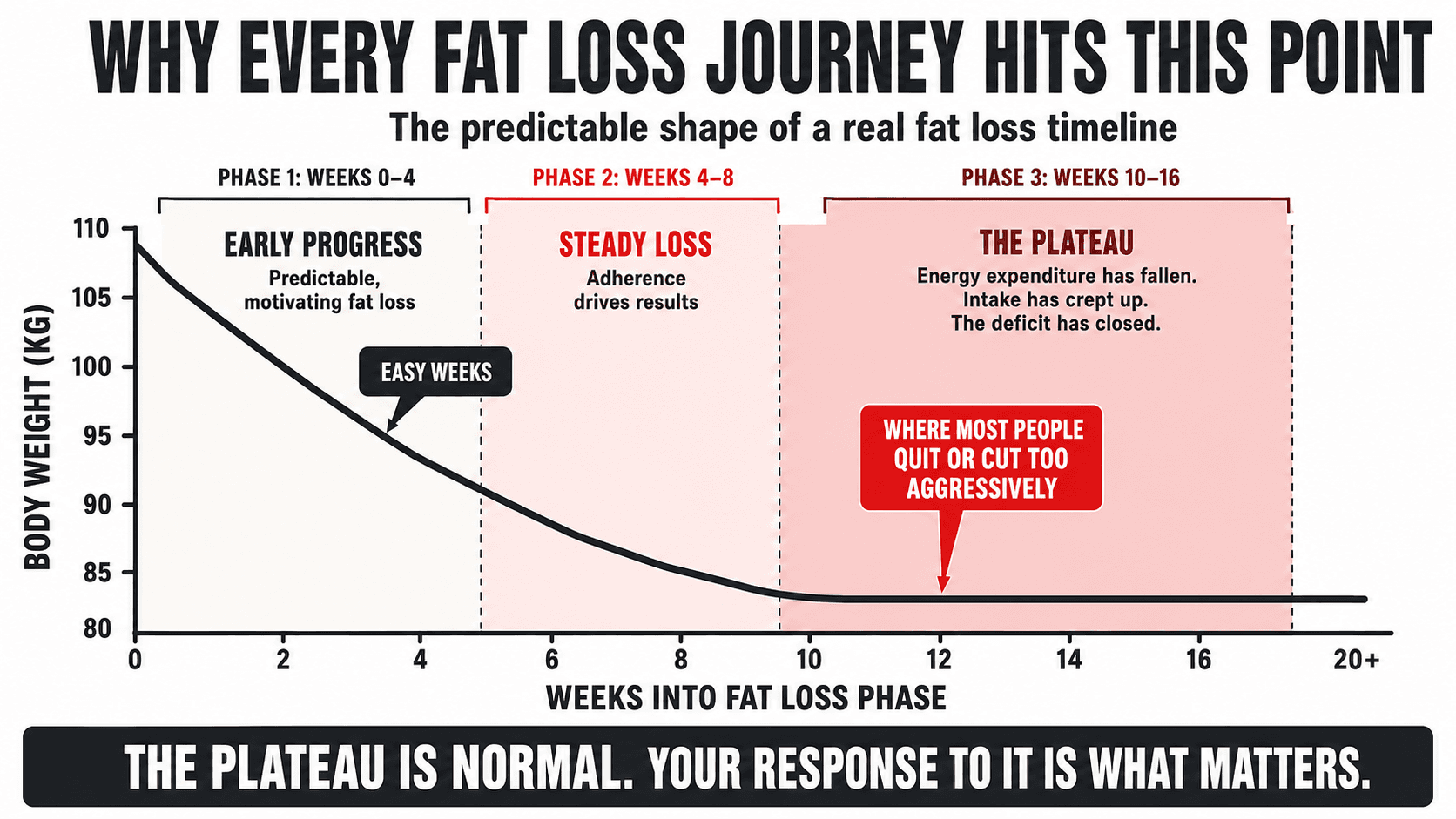
I want to start by telling you something important: fat loss plateaus are normal. They are not a sign that your body is broken. They are not evidence that your metabolism has shut down. They are not proof that you are doing something wrong. They are a predictable, physiological response to sustained weight loss that every person who has ever dieted will experience at some point. The question is not whether you will hit a plateau. It is whether you understand why it happens and what to do about it. Because most people respond to a plateau by either giving up or panicking into extreme restriction, and both of those responses make things worse.
What Happens If You Handle a Plateau Wrong
The standard response to a fat loss plateau is to cut calories further and add more cardio. It seems logical. If you are not losing weight, eat less and move more. But when you do this from an already depleted position, the consequences are significant. Your metabolic rate drops further. Your hunger hormones increase. Your cortisol rises, promoting visceral fat storage and muscle breakdown. Your energy crashes, your mood deteriorates, your training performance suffers, and your adherence to the plan collapses. Within days or weeks you are either white-knuckling your way through severe restriction or you have abandoned the whole effort and started regaining.
The other common response is to assume the plateau means the diet is not working and to switch to a completely different approach: a new programme, a new macronutrient split, a new meal timing strategy, a new supplement. This is the diet-hopping pattern I discussed in a previous article, and it is equally destructive. You abandon a plan that was working because it has temporarily stopped producing visible results, without understanding the physiological reasons behind the stall. The result is that you never stay on any plan long enough for it to work through a plateau, and you end up concluding that nothing works for you.
The Five Reasons Fat Loss Stalls
A fat loss plateau is not one thing. It is the combined effect of several overlapping physiological adaptations that converge to close the gap between the energy you are consuming and the energy you are expending. Understanding each of these mechanisms is essential because the appropriate response depends on which ones are primarily driving your stall.
Reason One: You Are Smaller, So You Burn Less. This is the most straightforward and mathematically inevitable reason for a plateau. Your total daily energy expenditure is determined in part by your body mass. A larger body requires more energy to maintain, move, and fuel than a smaller one. When you lose 5, 10, or 15 kilograms, you are carrying less weight through every activity, your organ mass has decreased slightly, and your body simply requires fewer calories to function than it did at your heavier weight. The deficit you started with gradually narrows as you lose weight, and eventually the calories you are eating may no longer represent a meaningful deficit at your new, lower body weight (1). This is not metabolic damage. It is basic physics.
Reason Two: Metabolic Adaptation (Adaptive Thermogenesis). Beyond the straightforward reduction in energy expenditure that comes from being smaller, research has demonstrated that the body also undergoes a disproportionate reduction in metabolic rate during weight loss that exceeds what would be predicted by the change in body size alone. This phenomenon is called metabolic adaptation or adaptive thermogenesis (2). The Biggest Loser study is the most dramatic example: six years after the competition, participants' resting metabolic rates were still approximately 500 calories per day lower than predicted for their body size, meaning their bodies were burning significantly less energy than would be expected for a person of their weight (3). While this is an extreme case involving rapid, severe weight loss, metabolic adaptation occurs to some degree in virtually every fat loss intervention.
The mechanisms behind metabolic adaptation include reductions in thyroid hormone output (particularly the conversion of T4 to the active form T3), decreased sympathetic nervous system activity, improved skeletal muscle efficiency (your muscles become better at doing work with less energy), and reductions in non-exercise activity thermogenesis or NEAT (4). More recent research has nuanced this picture: a study published in the American Journal of Clinical Nutrition found that metabolic adaptation was primarily detectable when participants were still in negative energy balance, and was less apparent once weight had stabilised (5). This suggests that the body's aggressive defence mechanisms are most active during active dieting and may partially resolve during maintenance phases.
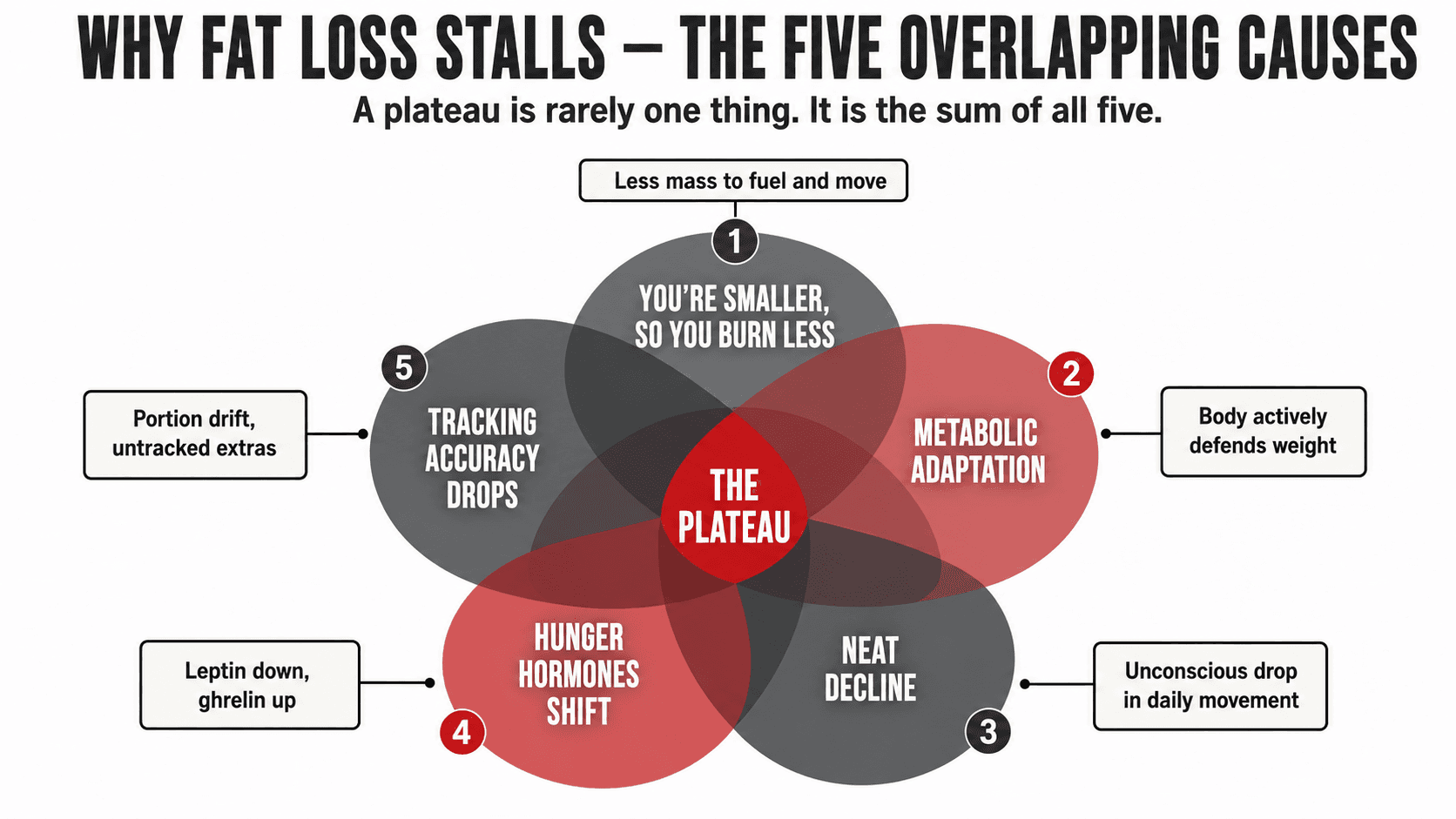
Reason Three: NEAT Drops Without You Noticing. Non-exercise activity thermogenesis, or NEAT, refers to the energy you burn through all movement that is not deliberate exercise: fidgeting, standing, walking to the kitchen, gesturing while talking, maintaining posture, taking the stairs. NEAT is the single most variable component of your daily energy expenditure and can account for several hundred calories per day. Research has consistently shown that NEAT decreases significantly during caloric restriction, often without the individual being aware of it (6). You move less. You fidget less. You stand less. You take fewer steps without consciously deciding to. Your body is quietly conserving energy by reducing all of the small, unconscious movements that add up to a significant calorie burn over the course of a day.
This is one of the reasons I track daily step counts with every one of my clients. Steps are a practical, measurable proxy for NEAT. If your step count was 10,000 per day at the start of your programme and has drifted down to 6,000 or 7,000 without you realising it, you have lost several hundred calories of daily expenditure. That alone can close a moderate deficit entirely and bring fat loss to a stop.
Reason Four: Hunger Hormones Fight Back. As you lose body fat, the hormonal signals that regulate appetite shift in favour of increased hunger. Leptin, produced by fat cells, signals satiety to the brain. As you lose fat, your fat cells shrink and produce less leptin, which the brain interprets as a signal to eat more (7). Simultaneously, ghrelin, the hunger hormone produced in the stomach, increases during sustained caloric restriction, making you feel more hungry between meals and more responsive to food cues (8). This hormonal shift does not mean your willpower has failed. It means your biology is actively working to restore the energy stores it perceives as depleted. Fighting this with willpower alone is a losing strategy. Managing it with smart nutritional and lifestyle approaches is the sustainable path.
Reason Five: You Are Eating More Than You Think. This is the reason nobody wants to hear, but research consistently confirms it: most people underreport their food intake, often substantially. A study published in the New England Journal of Medicine found that self-reported energy intake in individuals who described themselves as diet-resistant was, on average, 47 percent lower than their actual intake as measured by doubly labelled water (9). They were eating almost twice as much as they thought. This was not dishonesty. It was unconscious. Portion sizes creep up. Cooking oils and sauces are not counted. Bites, licks, and tastes accumulate. Weekend eating is forgotten by Monday. The accuracy of food tracking decays the longer you diet. A two-week plateau is sometimes nothing more than a two-week period of eating at maintenance without realising it.
Diagnosing Your Plateau: A Practical Assessment
| Question to Ask | If the Answer Is Yes | Action to Take |
|---|---|---|
| Has my daily step count dropped since starting? | NEAT has likely declined, closing your deficit | Restore step count to starting level (8,000-10,000/day minimum) |
| Have I been accurately tracking everything I eat and drink? | Calorie creep is probable. Portions and extras accumulate | Re-commit to 7-14 days of precise tracking. Weigh everything |
| Am I sleeping fewer than 7 hours per night? | Cortisol elevation, appetite dysregulation, and impaired fat loss | Prioritise 7-9 hours. This alone can restart progress |
| Has my scale weight been flat but my waist is shrinking? | You are likely still losing fat but gaining or retaining water or muscle | Trust waist measurements and photos. Continue the plan |
| Have I been in a deficit for more than 12-16 weeks without a break? | Metabolic adaptation and diet fatigue are likely contributing | Implement a 1-2 week diet break at maintenance calories |
| Am I training the same way I was 3 months ago? | Training stimulus may be insufficient for your new body | Reassess programme. Progressive overload. Consider periodisation |
| Am I under significant life stress or have I increased caffeine/stimulants? | Cortisol-driven water retention and appetite disruption | Address stress. Reduce caffeine. Add deliberate recovery |
| Has the scale been flat for fewer than 10-14 days? | This may not be a true plateau. Normal weight fluctuations can mask fat loss | Wait. Continue the plan. Reassess after 14 full days of consistency |
How to Break Through a Fat Loss Plateau: Evidence-Based Strategies
Strategy One: The Honest Audit. Before changing anything about your plan, spend seven to fourteen days tracking your food intake with complete accuracy. Weigh your portions. Log every cooking oil, every sauce, every drink, every bite. Track your step count daily. Log your sleep hours. Most apparent plateaus resolve themselves when tracking accuracy is restored. The research on self-reporting bias is unambiguous: we eat more than we think and move less than we believe (9). An honest audit costs nothing and fixes the most common cause of a plateau.
Strategy Two: Restore Your NEAT. Check your average daily step count over the past two weeks and compare it to your step count during the first two weeks of your programme. If it has dropped by 1,000 or more steps per day, you have found a significant source of lost expenditure. Restoring your step count to its original level can reopen a deficit of 200 to 400 calories per day without any changes to your food intake. This is the single easiest and most underutilised plateau-breaking strategy I use with clients. Walk more. Specifically, walk with the same intention and consistency you had at the start.
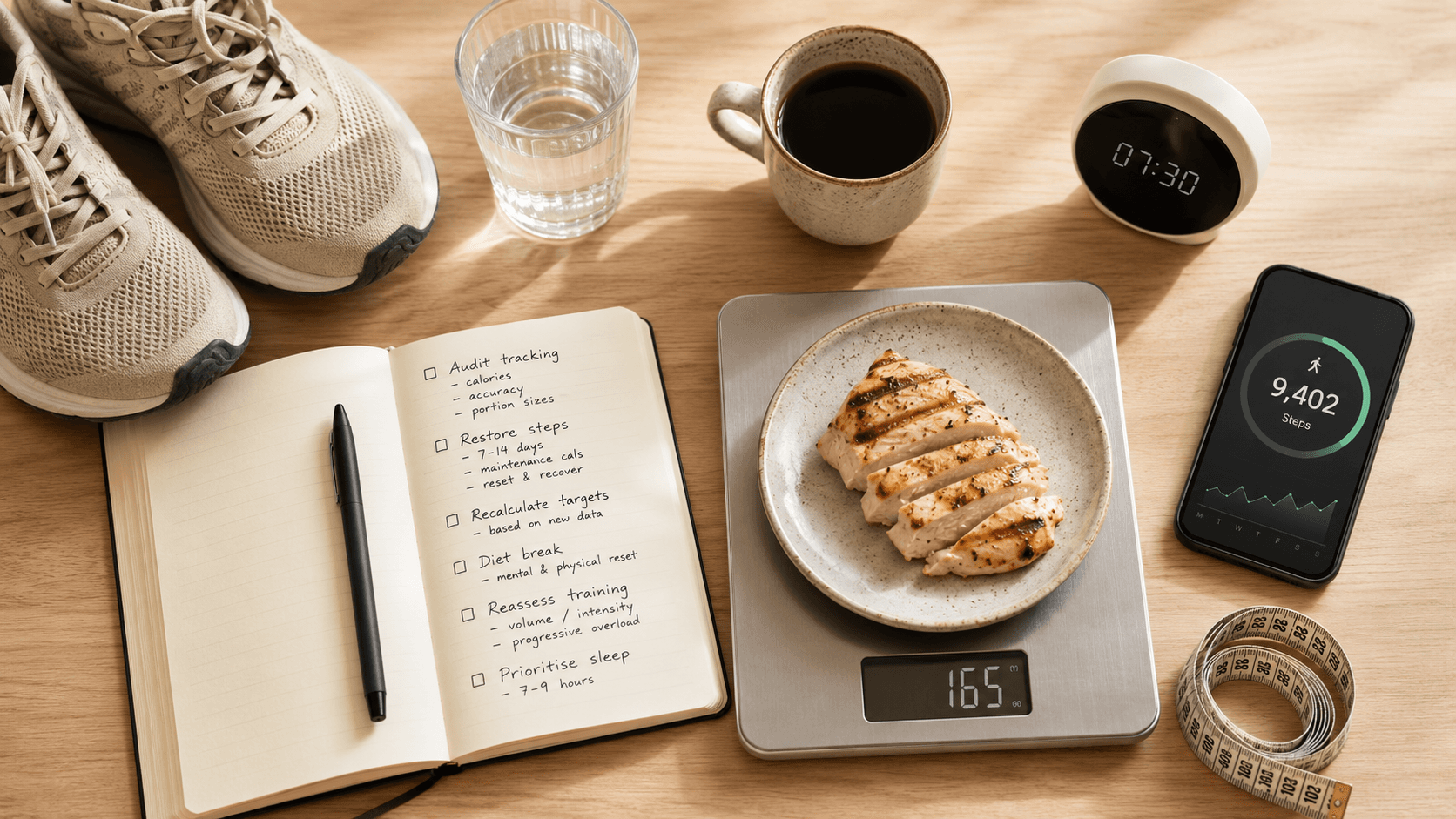
Strategy Three: Recalculate Your Targets. If you have lost 5 or more kilograms since your plan began, your calorie needs have changed. The deficit that worked at 90 kilograms may be maintenance at 82 kilograms. Recalculate your total daily energy expenditure based on your current weight, activity level, and body composition, then set a new deficit of 400 to 600 calories below that number. Adjust your macronutrient targets accordingly, keeping protein at 1.8 to 2.2 grams per kilogram of your current bodyweight to preserve lean mass. This is not a dramatic change. It is a necessary recalibration.
Strategy Four: The Diet Break. If you have been in a continuous calorie deficit for 12 to 16 weeks or longer, a planned diet break can be one of the most effective plateau interventions available. A diet break involves increasing your calorie intake to estimated maintenance for one to two weeks while maintaining your protein target and training programme. A randomised controlled trial (the MATADOR study) found that participants who alternated two weeks of caloric restriction with two weeks of maintenance eating lost significantly more fat and experienced less metabolic adaptation than those who dieted continuously for the same total duration (10). The diet break does not undo your progress. It gives your body a physiological and psychological reset, partially normalises leptin and thyroid hormone output, restores NEAT, and improves adherence when you return to the deficit.
Strategy Five: Reassess Your Training. Training serves two critical functions during fat loss: it preserves lean muscle mass and it contributes to energy expenditure. If you have been doing the same programme for three months without progressive overload, your body has adapted to the stimulus and both of these functions are compromised. Resistance training should be progressed in volume, intensity, or density over time. If you are not lifting heavier, doing more reps, or doing more work in less time than you were eight weeks ago, your programme needs to evolve. For cardiovascular training, consider replacing some steady-state cardio with higher-intensity intervals, which can produce a greater post-exercise metabolic effect and are more time-efficient.
Strategy Six: Prioritise Sleep and Stress Management. As I covered in detail in my article on cortisol and belly fat, chronic sleep deprivation and unmanaged stress elevate cortisol, increase appetite hormones, promote visceral fat storage, and cause water retention that masks fat loss on the scale. If your plateau coincides with a period of poor sleep, high stress, or both, addressing these factors is more important than any dietary adjustment. Research has shown that participants sleeping 5.5 hours per night lost 55 percent less fat than those sleeping 8.5 hours, despite identical calorie intakes (11). Sleep is not a nice extra. It is a fat loss intervention.
When the Plateau Is Not Actually a Plateau
I need to address something I see constantly with clients, particularly in the first few months of coaching: the scale stalls for seven to ten days and they believe they have hit a plateau. In most cases, they have not. Body weight fluctuates daily due to water retention from sodium intake, carbohydrate consumption, menstrual cycle phase (in women), training-induced muscle inflammation, stress, sleep quality, and bowel contents. A genuine plateau is defined as no change in scale weight AND no change in waist circumference AND no change in visual progress over a period of at least 14 to 21 consecutive days of confirmed adherence.
If the scale is flat but your waist is shrinking, you are losing fat. If the scale is flat around your menstrual cycle but drops afterwards, that is normal fluid retention, not a plateau. If the scale spiked after a higher-carbohydrate day and has not returned to its previous low, that is glycogen and water, not fat gain. I always tell clients to track their weight daily but to assess trends weekly and make decisions fortnightly. The scale on any single day tells you almost nothing. The trend over 14 days tells you everything.
Top Tips: Breaking Through a Fat Loss Plateau
Wait at least 14 days of confirmed adherence before calling it a plateau. Normal weight fluctuations can mask fat loss for one to two weeks. Track waist circumference and progress photos alongside scale weight. If you have not been tracking accurately for 14 full days, you do not have enough data to diagnose a real stall.
Audit your tracking before changing your plan. The single most common cause of an apparent plateau is calorie creep. Portions grow, extras accumulate, and tracking accuracy declines over time. Seven to fourteen days of precise tracking with a food scale resolves the majority of stalls without any other intervention.
Restore your step count. NEAT is the most variable and most commonly overlooked component of your energy expenditure. If your steps have dropped, your expenditure has dropped. Get them back up before you cut food further.
Recalculate your calorie targets for your current body weight. The deficit that worked at your starting weight may be maintenance at your current weight. Recalibrate every 5 to 8 kilograms of weight loss to ensure you are still in a meaningful deficit.
Use a diet break after 12 to 16 weeks of continuous dieting. One to two weeks at maintenance calories with maintained protein and training can partially reverse metabolic adaptation, restore NEAT, normalise hunger hormones, and dramatically improve adherence when you return to the deficit. The MATADOR study showed this approach produces superior long-term fat loss compared to continuous dieting.
Never panic-cut calories or add excessive cardio in response to a stall. Slashing your intake or doubling your cardio from a depleted position increases cortisol, accelerates muscle loss, drives metabolic adaptation harder, and makes the next plateau arrive faster. More is not better. Smarter is better.
Measure more than just weight. Track waist circumference, hip circumference, progress photos, training performance, energy levels, and sleep quality alongside scale weight. Body recomposition is real. You can be losing fat and gaining muscle simultaneously, particularly if you are newer to resistance training, and the scale may not reflect the transformation happening underneath.
The Bottom Line
Fat loss plateaus are a normal and predictable part of every transformation. They are driven by a combination of reduced energy expenditure from being lighter, metabolic adaptation, declining NEAT, shifting appetite hormones, and gradual losses in tracking accuracy. None of these things means your body is broken or your plan has failed. They mean you are human, and your body is doing exactly what it evolved to do: resist the loss of stored energy. The solution is almost never extreme restriction or dramatic change. It is systematic, evidence-based troubleshooting: audit your tracking, restore your movement, recalculate your targets, manage your stress and sleep, and when appropriate, use a strategic diet break to reset the system.
If you have hit a plateau and you are not sure what to do next, get in touch through trperformancecoaching.com. I work one-to-one with clients online globally. Whether you eat meat, are vegetarian, vegan, or anything in between, I will assess exactly where you are, identify what is driving your stall, and build a targeted plan to get you moving again. No guesswork. No panic. Just structured, evidence-based coaching that gets results.
Work with Me
Get a personalised coaching plan built around your goals, your schedule, and your life.
Enquire NowReferences
- Hall KD, Heymsfield SB, Kemnitz JW, Klein S, Schoeller DA, Speakman JR. Energy balance and its components: implications for body weight regulation. American Journal of Clinical Nutrition. 2012; 95(4): 989-994.
- Trexler ET, Smith-Ryan AE, Norton LE. Metabolic adaptation to weight loss: implications for the athlete. Journal of the International Society of Sports Nutrition. 2014; 11(1): 7.
- Fothergill E, Guo J, Howard L, et al. Persistent metabolic adaptation 6 years after “The Biggest Loser” competition. Obesity. 2016; 24(8): 1612-1619.
- Rosenbaum M, Hirsch J, Gallagher DA, Leibel RL. Long-term persistence of adaptive thermogenesis in subjects who have maintained a reduced body weight. American Journal of Clinical Nutrition. 2008; 88(4): 906-912.
- Martins C, Roekenes J, Salamati S, Gower BA, Hunter GR. Metabolic adaptation is an illusion, only present when participants are in negative energy balance. American Journal of Clinical Nutrition. 2020; 112(5): 1212-1218.
- Levine JA. Non-exercise activity thermogenesis (NEAT). Best Practice and Research Clinical Endocrinology and Metabolism. 2002; 16(4): 679-702.
- Friedman JM. Leptin and the endocrine control of energy balance. Nature Metabolism. 2019; 1(8): 754-764.
- Sumithran P, Prendergast LA, Delbridge E, et al. Long-term persistence of hormonal adaptations to weight loss. New England Journal of Medicine. 2011; 365(17): 1597-1604.
- Lichtman SW, Pisarska K, Berman ER, et al. Discrepancy between self-reported and actual caloric intake and exercise in obese subjects. New England Journal of Medicine. 1992; 327(27): 1893-1898.
- Byrne NM, Sainsbury A, King NA, Hills AP, Wood RE. Intermittent energy restriction improves weight loss efficiency in obese men: the MATADOR study. International Journal of Obesity. 2018; 42(2): 129-138.
- Nedeltcheva AV, Kilkus JM, Imperial J, Schoeller DA, Penev PD. Insufficient sleep undermines dietary efforts to reduce adiposity. Annals of Internal Medicine. 2010; 153(7): 435-441.