
Why Men's Mental Health Depends on Physical Health More Than You Think
By Tanvir Singh Rayet|TR PERFORMANCE COACHING
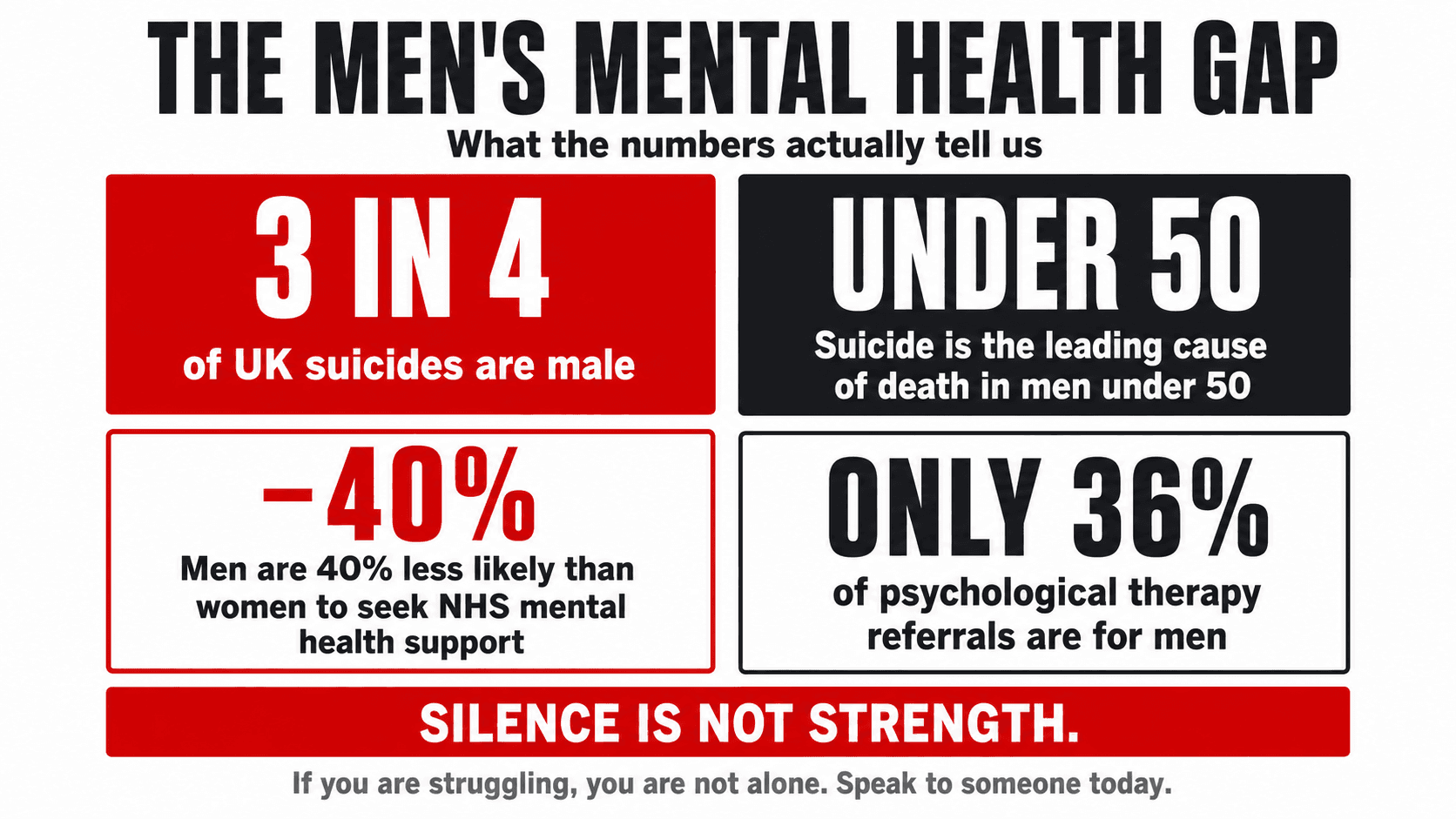
Three out of four suicides are male. Suicide is the biggest killer of men under the age of 50 in the UK. Men are significantly less likely to seek help for mental health problems, less likely to be diagnosed, and less likely to engage with talking therapies. And yet, when men do show up somewhere for support, it is rarely a therapist's office. It is often a gym.
This article is not a replacement for professional mental health support. If you are struggling, please seek qualified help. What this article is about is the undeniable, research-backed connection between what you do with your body and how you feel in your mind — and why for many men, getting physically healthy is one of the most powerful first steps they can take.
Key Statistics
- Three out of four suicides in the UK are male
- Suicide is the leading cause of death in men under 50
- Men are 40% less likely than women to seek NHS mental health support
- Only 36% of referrals to psychological therapies are for men
- Men are more likely to use alcohol and substance misuse as coping mechanisms
Why Men Do Not Talk About Mental Health
The reasons are layered and cultural. Men are often raised with explicit or implicit messages that vulnerability is weakness. Asking for help is seen as failure. Emotions are meant to be suppressed, not expressed. This is not a personal failing — it is the product of decades of social conditioning reinforced by media, sport, work culture, and family dynamics.
But there is a second barrier that gets less attention: many men genuinely do not have a language for what they are feeling. They know something is wrong. They are irritable, withdrawn, tired, not enjoying things they used to love. But they do not identify this as depression or anxiety. They just feel off. And without a name for it, they do not know what to do with it.
This is why physical health is such a powerful entry point. For many men, the gym is not a place of vulnerability — it is a place of action. It is somewhere they feel capable, in control, and task-focused. And it just so happens that those physical actions produce powerful neurological and psychological effects.
The Physical and Mental Health Feedback Loop
Mental and physical health are not separate. They are deeply interconnected systems that constantly influence one another. Poor mental health leads to physical inactivity, poor nutrition, disrupted sleep, and increased inflammation. Poor physical health — through the same mechanisms — increases the risk of depression and anxiety.
This feedback loop works in both directions. When you improve your physical health — through exercise, nutrition, and sleep — you also improve the biological conditions in which your brain operates. You change your neurochemistry. You reduce inflammation. You regulate your hormones. You give your brain the raw materials it needs to function well.
This is not motivational rhetoric. It is physiology.
THE DOWNWARD SPIRAL
How poor physical health feeds poor mental health
THE UPWARD SPIRAL
How improving physical health lifts mental health
How Exercise Physically Changes Your Brain
Exercise is one of the most powerful interventions known to improve mood, reduce anxiety, and protect against depression. The mechanisms are now well understood.
| Mechanism | What Happens | What You Feel |
|---|---|---|
| BDNF Release | Brain-Derived Neurotrophic Factor increases — a growth protein that supports neuron health and the creation of new neural connections | Improved learning, memory, mood, and cognitive sharpness |
| Serotonin Increase | Exercise raises serotonin availability in the brain, the neurotransmitter associated with mood stabilisation | Reduced depression, improved emotional regulation, sense of wellbeing |
| Dopamine Boost | Movement increases dopamine synthesis and receptor sensitivity | Improved motivation, drive, reward response, and focus |
| Cortisol Regulation | Regular exercise improves the body's cortisol response, making you more resilient to stress | Lower baseline anxiety, better stress tolerance, improved sleep |
| Endorphin Release | Moderate-to-high intensity exercise triggers endorphin release from the pituitary gland | Reduced pain perception, elevated mood, temporary euphoria |
| Reduced Inflammation | Chronic exercise lowers systemic inflammation, which is strongly linked to depression | Lower risk of depressive episodes, improved energy, reduced brain fog |
In Plain English: What Is BDNF and Why Should You Care?
Brain-Derived Neurotrophic Factor (BDNF) is essentially fertiliser for your brain. It keeps existing neurons healthy and helps grow new ones, especially in the hippocampus — the region tied to memory, learning, and mood regulation. People with depression consistently show lower BDNF levels, and the hippocampus actually shrinks in chronic depression. Exercise, particularly vigorous aerobic exercise and resistance training, is one of the most reliable ways to raise BDNF naturally. In other words, every time you train, you are physically rebuilding the part of your brain that depression erodes.

These are not minor effects. A meta-analysis published in the British Journal of Sports Medicine found that exercise was 1.5 times more effective at reducing mild to moderate depression and anxiety than standard counselling or leading medications in some studies. This is not to say exercise replaces treatment — it does not. But it illustrates just how powerful movement is as a biological tool for mental health.
Resistance Training and Depression
While all exercise has mental health benefits, resistance training deserves specific attention for men. A 2018 meta-analysis in JAMA Psychiatry analysed 33 randomised controlled trials and found that resistance training significantly reduced depressive symptoms regardless of health status, age, or training volume.
The mechanisms are similar to those above — hormonal changes, neurochemical shifts, inflammation reduction — but there is also something specific about the act of lifting weights that matters to men. It builds identity. It creates measurable progress. It gives you agency over your body. And for men who have lost their sense of purpose, direction, or control — often the underlying drivers of poor mental health — that structured, progressive challenge can be profoundly anchoring.
In Plain English: Why Resistance Training Specifically?
Lifting weights does more than build muscle. It raises testosterone, improves insulin sensitivity, lowers chronic inflammation, and floods the brain with the same mood-supporting neurochemicals as aerobic exercise — but it also gives you something psychological that running on a treadmill rarely does. You can see the numbers go up week by week. You can feel yourself getting physically stronger. For men who are struggling, that visible, measurable progress restores a sense of agency and capability when other parts of life feel out of control. It is structured, it is honest, and it works.
Evidence Summary
- A 2018 JAMA Psychiatry meta-analysis of 33 RCTs found resistance training significantly reduces depressive symptoms
- A 2019 British Journal of Sports Medicine analysis found exercise reduced depression and anxiety by 45%
- Regular aerobic exercise increases hippocampal volume — an area of the brain associated with memory and mood that shrinks with depression
- Just 150 minutes of moderate exercise per week is associated with a 26% lower risk of becoming depressed
How Nutrition Affects Your Mental Health
The gut-brain axis is one of the most significant emerging areas in neuroscience. Approximately 90% of the body's serotonin is produced in the gut — not in the brain. The bacteria in your gut communicate directly with your central nervous system, influence your neurotransmitter production, and regulate inflammation throughout the body.
What this means practically is that what you eat directly affects how you feel. Ultra-processed foods, high sugar diets, chronic caloric excess, and low protein intake all damage gut microbiome diversity, increase systemic inflammation, and impair neurotransmitter production. Diets rich in whole foods, fibre, protein, and key micronutrients do the opposite.
| Nutrient | Role in Brain Health | Omnivore Sources | Vegetarian / Vegan Sources |
|---|---|---|---|
| Omega-3 Fatty Acids | Anti-inflammatory, supports neuronal membrane health, reduces depression risk | Oily fish (salmon, mackerel, sardines) | Flaxseeds, walnuts, algae-based supplements |
| Tryptophan | Precursor to serotonin and melatonin — essential for mood and sleep | Turkey, eggs, dairy, lean meats | Pumpkin seeds, tofu, chickpeas, oats |
| Magnesium | Regulates the stress response, involved in over 300 enzymatic reactions including those affecting mood | Dark leafy greens, nuts, seeds, dark chocolate, whole grains | Same — plant sources are excellent |
| Zinc | Modulates the stress response and is a cofactor for neurotransmitter synthesis | Red meat, shellfish, eggs | Legumes, pumpkin seeds, cashews, fortified foods |
| Vitamin D | Deficiency is strongly linked to depression and seasonal mood changes | Oily fish, egg yolks, sunlight exposure | Fortified plant milks, sunlight, supplementation |
| B Vitamins (esp. B12, B6, Folate) | Essential for the methylation cycle — directly affects dopamine and serotonin synthesis | Meat, eggs, dairy, fortified cereals | Nutritional yeast, fortified foods, B12 supplementation essential for vegans |
| Fermented Foods | Support gut microbiome diversity, indirectly boosting serotonin and reducing inflammation | Yoghurt, kefir, fermented meats | Kimchi, sauerkraut, tempeh, kombucha, miso |

Sleep: The Foundation Everything Else Is Built On
Sleep deprivation is one of the fastest ways to destabilise mental health. After 24 hours without sleep, the brain begins to show patterns of activity resembling those seen in psychosis. After chronic partial sleep restriction — consistently getting five or six hours — emotional regulation deteriorates, cortisol increases, and the prefrontal cortex (responsible for rational thinking and impulse control) becomes less active.
For men specifically, poor sleep dramatically suppresses testosterone production. Most testosterone is produced during deep sleep stages. Less sleep means less testosterone, which means lower mood, lower drive, reduced motivation, and higher susceptibility to depressive symptoms. The relationship between sleep and mental health is bidirectional — poor sleep worsens mental health, and poor mental health disrupts sleep. But improving sleep is often the fastest way to break that cycle.
Sleep and Testosterone
Research from the University of Chicago found that restricting sleep to five hours per night for just one week reduced testosterone levels in young men by 10 to 15 percent — equivalent to ageing 10 to 15 years. Testosterone is not just about muscle — it is directly involved in mood, drive, confidence, and mental resilience.

Practical First Steps
You do not need to overhaul everything at once. The evidence suggests that small, consistent actions compound significantly over time. Here is a structured starting point.
| Step | What to Do and Why |
|---|---|
| 1. Move your body three times per week | You do not need a gym membership or a structured programme immediately. Walking, cycling, swimming, or any moderate activity for 30 to 45 minutes, three times per week, is enough to begin producing measurable neurochemical changes within two to four weeks. |
| 2. Add resistance training | Even two sessions per week of basic resistance training — bodyweight or weights — produces significant hormonal and neurological benefits. Focus on compound movements: squats, presses, rows, hinges. |
| 3. Eat more protein and whole foods | Aim for 1.6 to 2g of protein per kilogram of bodyweight. Reduce ultra-processed food intake and replace it with vegetables, legumes, whole grains, and quality fats. You do not need to be perfect — just better than yesterday. |
| 4. Protect your sleep | Set a consistent sleep and wake time, even at weekends. Avoid screens for 30 minutes before bed. Keep your bedroom cool and dark. Limit alcohol — it fragments sleep architecture and suppresses REM sleep, preventing emotional processing. |
| 5. Get outdoors daily | Sunlight in the morning regulates your circadian rhythm and boosts serotonin directly. Even a 15-minute walk outside in natural daylight has measurable effects on mood and energy. |
| 6. Talk to someone | This does not have to be a therapist. It can be a friend, a training partner, a coach. The act of verbalising how you are feeling, even in practical terms, is neurologically significant. It activates the prefrontal cortex and reduces amygdala reactivity — it literally calms the threat-response system in your brain. |

When to Seek Professional Support
Everything in this article is about building the physical foundation for mental wellbeing. But if you are experiencing persistent low mood, inability to function at work or at home, thoughts of self-harm or suicide, or a complete loss of interest in life, please reach out to a qualified professional. Physical health will support your recovery — but it is not a replacement for clinical care.
In the UK, you can contact your GP, refer yourself to IAPT (Improving Access to Psychological Therapies), or call the Samaritans on 116 123, available 24 hours a day, every day of the year.
Where to Get Help
- Samaritans: 116 123 (free, 24/7) — jo@samaritans.org
- CALM (Campaign Against Living Miserably): 0800 58 58 58 (5pm to midnight) — thecalmzone.net
- Mind: 0300 123 3393 — mind.org.uk
- NHS Urgent Mental Health Helpline: Search your local number on nhs.uk
- In a crisis: Call 999 or go to A&E
There is no weakness in asking for help. The strongest thing a man can do is recognise when he needs support and reach out for it.
How I Can Help
I work with men who are ready to take their physical health seriously — and who understand, often from direct experience, that physical and mental health cannot be separated. Whether you are looking to lose body fat, build strength, restore energy levels, or simply feel like yourself again, the programme I build for you will address the physical foundation that makes everything else possible.
Training, nutrition, sleep, and accountability — structured around your life, your schedule, and your goals. No generic plans. No guesswork. Just a clear, progressive approach built on what the evidence says works.
If you are ready to start, get in touch.
References
- Mental Health Foundation. Men and women: statistics. Available at: mentalhealth.org.uk.
- Office for National Statistics. Suicides in England and Wales: 2023 registrations. ONS Statistical Bulletin.
- Samaritans. Men, Suicide and Society: Research Report. Samaritans. 2012.
- Szuhany KL, Bugatti M, Otto MW. A meta-analytic review of the effects of exercise on brain-derived neurotrophic factor. Journal of Psychiatric Research. 2015; 60: 56–64.
- Schuch FB, Vancampfort D. Physical activity, exercise, and mental disorders: a review of mechanisms. Current Opinion in Psychiatry. 2021; 34(2): 162–167.
- Gleeson M, Bishop NC, Stensel DJ, Lindley MR, Mastana SS, Nimmo MA. The anti-inflammatory effects of exercise: mechanisms and implications for the prevention and treatment of disease. Nature Reviews Immunology. 2011; 11(9): 607–615.
- Gordon BR, McDowell CP, Hallgren M, Meyer JD, Lyons M, Herring MP. Association of efficacy of resistance exercise training with depressive symptoms: meta-analysis and meta-regression analysis of randomized clinical trials. JAMA Psychiatry. 2018; 75(6): 566–576.
- Zhang Y, et al. Resistance training for depression: a systematic review and meta-analysis of randomized controlled trials. Frontiers in Psychology. 2025; 16: 1655855.
- Cryan JF, Dinan TG. Mind-altering microorganisms: the impact of the gut microbiota on brain and behaviour. Nature Reviews Neuroscience. 2012; 13(10): 701–712.
- Grosso G, Galvano F, Marventano S, et al. Omega-3 fatty acids and depression: scientific evidence and biological mechanisms. Oxidative Medicine and Cellular Longevity. 2014; 2014: 313570.
- Yoo SS, Gujar N, Hu P, Jolesz FA, Walker MP. The human emotional brain without sleep: a prefrontal amygdala disconnect. Current Biology. 2007; 17(20): R877–R878.
Tanvir Singh Rayet | TR Performance Coaching | trperformancecoaching.com
High-performance expertise, at your fingertips.
Evidence-based coaching advice delivered straight to your inbox.