
The Daily Negotiation That Is Quietly Exhausting You
The non-negotiable health standard is the concept that separates people who are consistently healthy from people who are working very hard at being healthy and still finding it unsustainable. The distinction is not genetic. It is not motivational. It is not a difference in how much they want good health or how well they understand it. It is a difference in the cognitive architecture of the commitment. One group is making a decision about their health behaviour every day. The other stopped making that decision some time ago.
Most people in most health programmes are, without realising it, re-deciding every day. They are weighing the benefit of the session against the cost of getting there, the inconvenience of the schedule against the competing demands of the afternoon, the memory of yesterday's session against the weight of today's fatigue. The decision is usually made in favour of the session, which is why the programme appears to be working. But the cognitive and emotional cost of making that decision repeatedly, in every context, against every competing priority, across every week of a long programme, accumulates into a kind of chronic negotiation fatigue that motivation alone cannot sustain indefinitely.
Tony Robbins draws a distinction between goals and standards that I regard as one of the most practically important ideas in personal development. Goals, in his framework, are things you want to achieve. Standards are things you will not live without. A person can have a goal to be fit and still spend three months not going to the gym. The same person cannot have a standard of training four times a week and spend three months not going to the gym, because a standard that is not being met is not a standard. It is a former aspiration. The standard is defined by the behaviour it produces, not by the intention it expresses.(1)
“If you do not set a baseline standard for what you will accept in your life, you have already unconsciously set one.”
— Tony Robbins
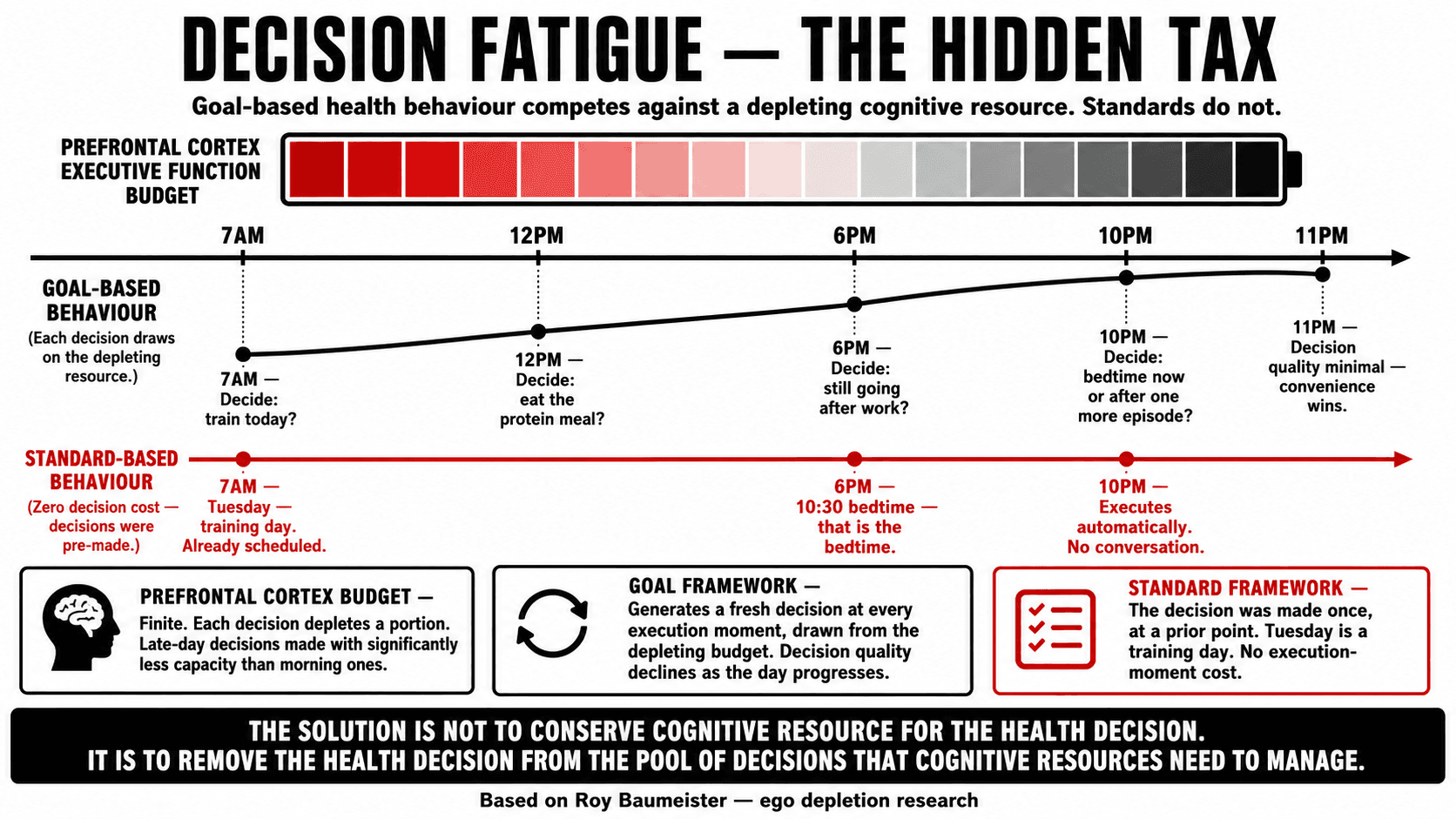
Decision Fatigue: The Hidden Tax on Goal-Based Health Behaviour
The research on decision fatigue establishes a clear neurological basis for why making the same health decision repeatedly across a day, a week, and a month produces deteriorating outcomes even in people who are genuinely motivated and well-informed. The prefrontal cortex, which governs executive function, self-regulation, and deliberate decision-making, operates on a finite cognitive budget. Each decision made depletes a portion of that budget. The quality of decisions made late in a depleted state is measurably worse than the quality of decisions made early in a fresh state, regardless of the importance of the decision or the motivation of the person making it.(2)
Roy Baumeister's ego depletion research demonstrated that acts of self-control, including resisting temptation, making choices, and overriding habitual responses, draw from the same finite resource, and that prior depletion in one domain impairs self-regulation in unrelated domains. The person who has spent the day making dozens of professional decisions, managing interpersonal demands, and navigating the full cognitive load of a demanding career arrives at the evening training session with a depleted executive function resource. The decision about whether to train is being made with a fraction of the cognitive capacity available in the morning. This is not weakness. It is neurophysiology.(2)
Roy Baumeister's research also established the glucose-depletion mechanism: self-regulation draws measurably on metabolic resources, and decisions made under depletion show demonstrably poorer outcomes. The implication for health behaviour design is significant and underappreciated. If training requires a deliberate decision to be made every day, and that decision must compete against a depleted cognitive budget, then the programme is structurally dependent on the person having enough remaining executive function on every training day to make the right call. Under any real-world schedule, this is not reliable. The solution is not to conserve cognitive resources for the health decision. It is to remove the health decision from the pool of decisions that cognitive resources need to manage.
This is exactly what a non-negotiable standard does. When training on Tuesday is a standard rather than a goal, the question of whether to train on Tuesday does not enter the decision queue. The cognitive resource is not allocated to it because the decision has already been made, permanently, at a prior point. What was a recurring drain on executive function becomes a fixed architectural feature of the week. The training happens because Tuesday is a training day, the same way that going to work happens because Tuesday is a work day. The motivational question has been replaced by a structural one.
Key Insight: Count the number of times this week you had an internal conversation about whether to do a planned health behaviour. Each of those conversations was a tax on your executive function, paid in a currency you cannot recover. A standard eliminates the conversation. There is nothing to discuss. The behaviour is what happens on that day, in the same category of inevitability as everything else that happens on that day.
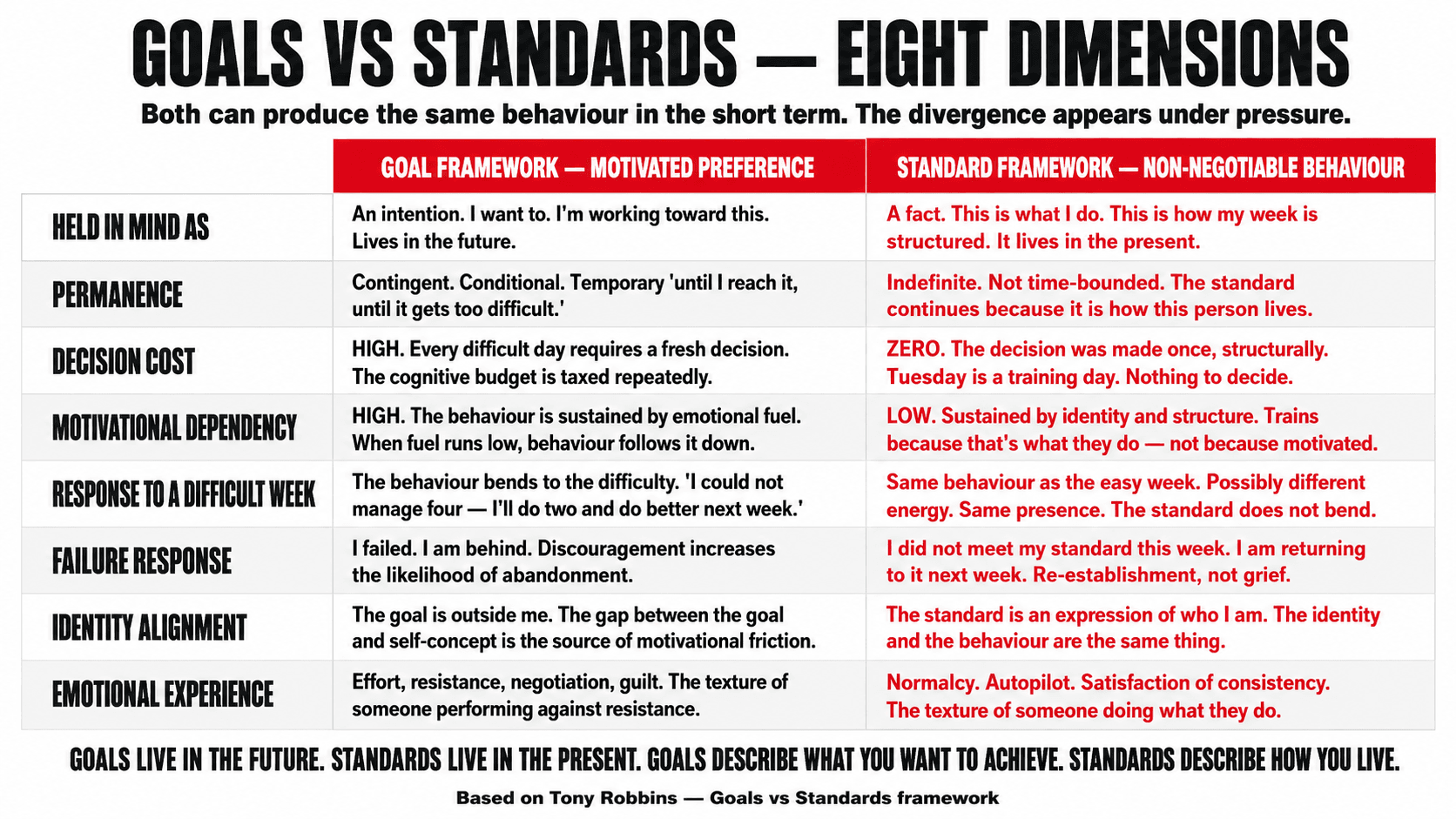
Goals vs Standards: The Eight Dimensions That Determine Which One You Are Operating From
The distinction between a goal and a standard is not always obvious from the outside, and it is often not obvious to the person themselves. Both can produce the same behaviour in the short term. The divergence appears under pressure: in a difficult week, when the competing priorities are real and the motivation is genuinely low, the goal is the thing you might not do. The standard is the thing you do anyway. The eight dimensions below map the full structural difference between the two operating frameworks.
Goals vs Standards Across Eight Dimensions — Which Framework Are You Actually Operating From?
| Dimension | Goal-Based Framework (Motivated preference) | Standard-Based Framework (Non-negotiable behaviour) |
|---|---|---|
| How it is held in the mind | As an intention: I am going to do this. I want to achieve this. I am working toward this. It lives in the future. | As a fact: This is what I do. This is how my week is structured. This is not something I am working toward. It is something I am. |
| Permanence | Contingent on continued motivation, absence of disruption, sustained favourable conditions. Duration is implicitly temporary: until I reach the goal, until something changes, until it becomes too difficult. | Indefinite. Not time-bounded. Not conditional. The standard does not end when the goal is reached because there is no goal to reach. The standard simply continues because it is how this person lives. |
| Decision cost | High. The goal requires a new decision on every difficult day. Am I doing this today? Is today the day I rest? Is this week an exception? The cognitive budget is taxed repeatedly. | Zero. The standard does not generate a decision because the decision was made once, structurally, at a prior point. Tuesday is a training day. There is nothing to decide. |
| Motivational dependency | High. When motivation is low, the goal is vulnerable. The behaviour is sustained by the emotional fuel of wanting the outcome, and when that fuel runs low, the behaviour follows it down. | Low. The standard is not sustained by motivation. It is sustained by identity and structure. The person who trains four days a week as a standard does not train because they are motivated. They train because that is what they do. |
| Response to a difficult week | The difficult week is a reason to reduce the behaviour: I could not manage four sessions this week, I will do two and do better next week. The standard bends to the difficulty. | The difficult week produces the same behaviour as the easy week, possibly with different energy levels, but the same presence. The standard does not bend. The difficult week is just a more effortful expression of what happens every week. |
| Failure response | I failed to meet my goal. I am behind. I have lost progress. The failure is measured against an external target that now feels further away, increasing the likelihood of discouragement and abandonment. | I did not meet my standard this week. I am returning to it next week. The standard is not gone because it was not met once. It is still the standard. The response is re-establishment, not grief. |
| Identity alignment | The goal is something I am trying to achieve. It is outside me. The person who has a goal to be fit is not yet a fit person in their own self-conception. The gap between the goal and the self-concept is the source of motivational friction. | The standard is an expression of who I am. The person who has a standard of training four days a week is someone who trains four days a week. The identity and the behaviour are the same thing. |
| Emotional experience | Effort, resistance, negotiation, occasional triumph, frequent guilt. The emotional texture of goal-based health behaviour is the texture of someone performing against resistance. | Normalcy, autopilot for the most part, satisfaction of consistency, occasional pride in the standard maintained under difficulty. The emotional texture is the texture of someone doing what they do. |
The shift from goal to standard is not a shift in ambition or discipline. It is a shift in the architectural level at which the commitment is held. Goals live in the future. Standards live in the present. Goals describe what you want to achieve. Standards describe how you live. The language difference reflects a fundamental difference in the operating framework.
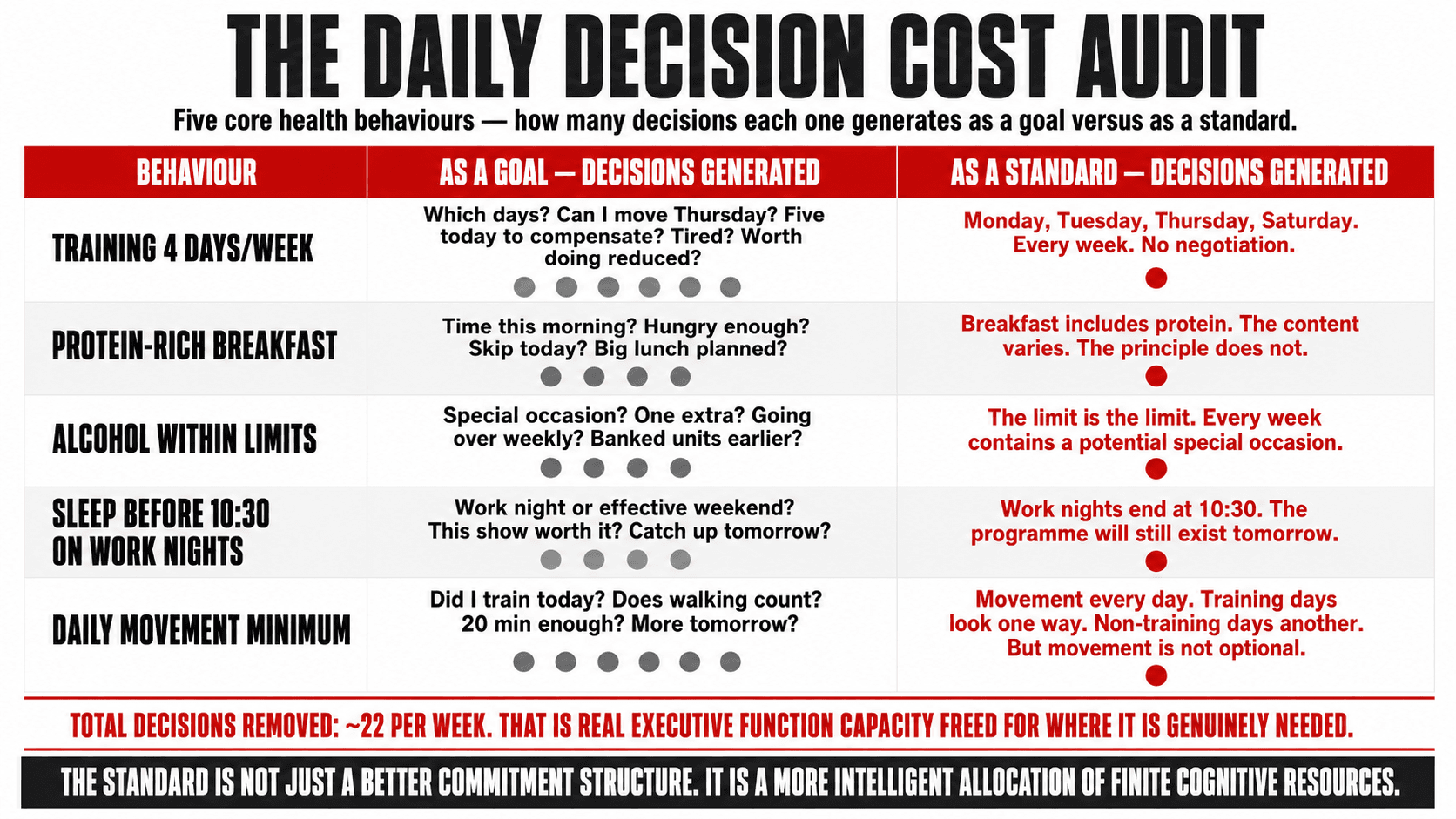
The Daily Decision Cost Audit: How Much Cognitive Resource Is Your Health Programme Consuming?
The most direct way to understand the structural cost of goal-based health behaviour is to map the specific decisions that a goal framework generates versus the decisions that a standard framework generates for the same behaviour. The difference in cognitive load between the two frameworks, across a full week, is not marginal. It is substantial enough to explain why motivated, disciplined, intelligent people find the goal framework exhausting in a way they often cannot fully account for.
Decision Cost Comparison — Five Core Health Behaviours as Goals vs Standards
| Health Behaviour | As a Goal (decisions generated) | As a Standard (decisions generated) | Cognitive resource freed by the standard |
|---|---|---|---|
| Training 4 days per week | Which days this week? Can I move Thursday? Should I do five this week to compensate? Is today too tired? Is this session worth doing at reduced energy? | Monday, Tuesday, Thursday, Saturday. Every week. No negotiation. | Eliminates the scheduling decision, the energy-assessment decision, the compensation calculation, and the negotiation with competing priorities. Frees significant executive function resource for the week. |
| Eating a protein-rich breakfast | Do I have time this morning? Will I be hungry enough? Is today a day I can skip it? What if I have a big lunch planned? | Breakfast includes protein. Every morning. The content varies. The principle does not. | Removes the morning negotiation entirely. The decision was made once: breakfast includes protein. What that looks like today is a minor logistical question, not a commitment question. |
| Alcohol within defined limits | Is tonight a special occasion? Can I have one extra? Am I going over my limit this week? Should I have banked more units earlier in the week? | The limit is the limit. It does not bend for special occasions because every week contains a potential special occasion. | Removes the recurring permission-assessment that goal-based alcohol limits generate. The standard does not require renegotiation at each social occasion. It simply is. |
| Sleep before 10:30pm on work nights | Is tonight a work night or effectively a weekend? Is this show worth it? Can I catch up tomorrow? Is eleven really that different from ten thirty? | Work nights end at 10:30. The television programme will still exist tomorrow. | Ends the late-evening negotiation between short-term entertainment and sleep standard. The standard makes the decision before the situation arises. |
| Daily movement minimum | Did I train today? Does that count? What if I walked a lot? Is twenty minutes enough if I am tired? Should I do more tomorrow to compensate? | Movement every day. Training days look one way. Non-training days look another. But movement is not optional on either. | Removes the daily adequacy assessment. Movement is not a question of whether. It is a question of what form today's movement takes. The whether has been answered permanently. |
The cognitive resource freed by moving health behaviours from goals to standards is not a trivial gain. Each decision removed from the daily queue represents real executive function capacity available for the domains where deliberate decision-making is genuinely required. The standard is not just a better commitment structure. It is a more intelligent allocation of finite cognitive resources.
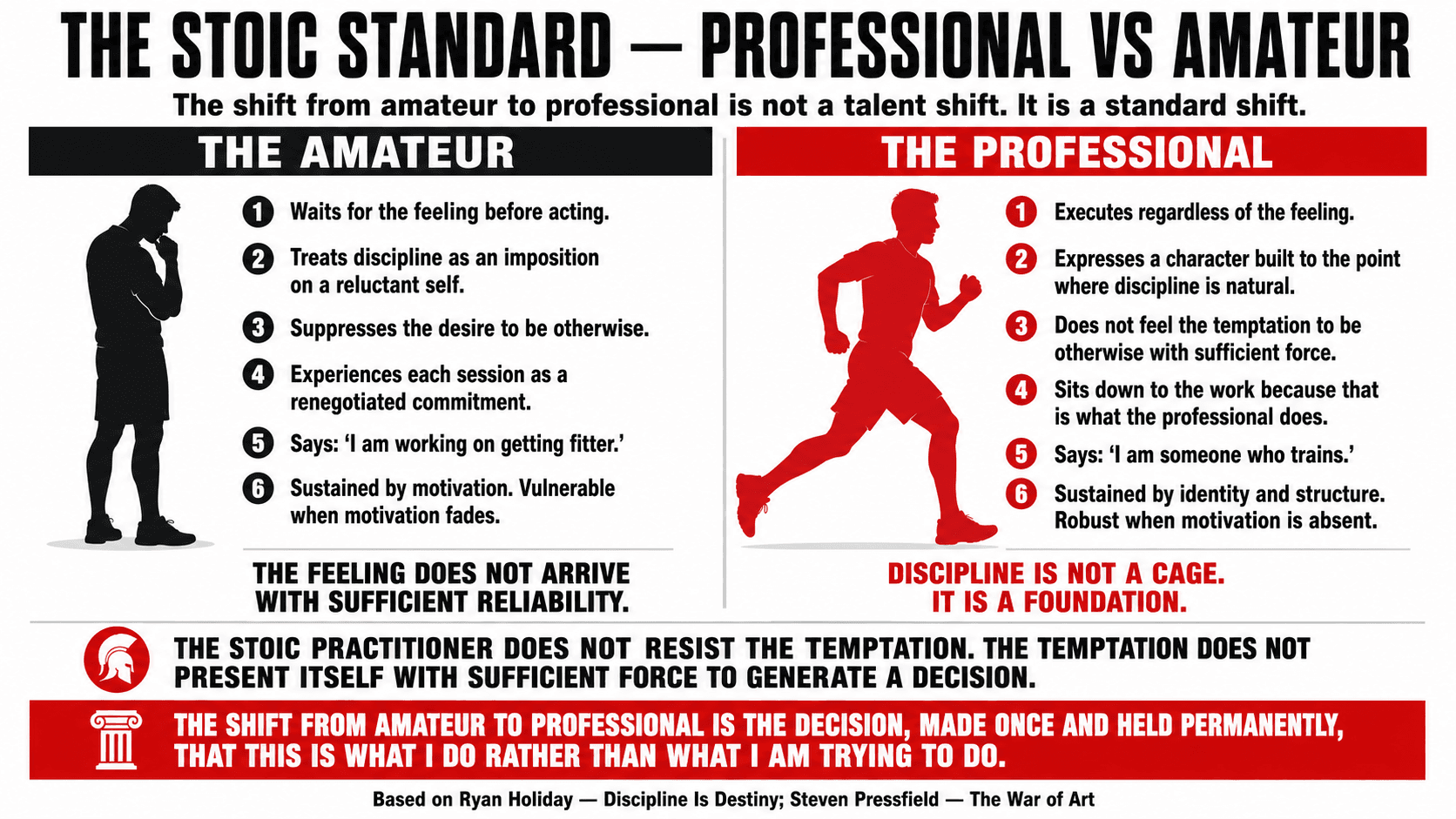
Ryan Holiday and the Stoic Standard: Discipline as Identity Rather Than Imposition
Ryan Holiday's work on Stoic philosophy applied to modern performance arrives at the standard concept from a different direction than the decision-fatigue research, but reaches the same practical conclusion with compelling force. In Discipline Is Destiny, Holiday draws on the Stoic framework to argue that self-discipline is not the imposition of rules on a reluctant self. It is the expression of character that has been developed to the point where the undisciplined option is simply not attractive. The Stoic practitioner does not resist the temptation to be undisciplined. The temptation does not present itself with sufficient force to generate a decision, because the character of the practitioner has been built to the level where discipline is the natural expression of who they are.(3)
This is the philosophical formulation of the standard. The person who is operating from genuine standards is not suppressing a desire to be otherwise. They are expressing a character that has been built over time to the point where the standard is simply who they are and how they live. Holiday draws on Marcus Aurelius, Epictetus, and Cato as examples of individuals whose discipline was not experienced as constraint but as freedom: freedom from the fluctuations of mood, the tyranny of momentary desire, and the inconsistency of motivation-dependent behaviour. The Stoic standard is not a cage. It is a foundation.
Steven Pressfield's formulation in The War of Art maps almost exactly onto Holiday's Stoic framework from a different starting point. Pressfield's professional, the term he uses for the person who has committed to their craft as a standard rather than a goal, does not feel like working. The professional sits down at the desk or enters the gym not because of motivation or inspiration but because this is what the professional does, in the same way that a doctor practices medicine whether or not they feel inspired on a particular Tuesday. The amateur, by contrast, waits for the feeling. The feeling, as any honest person who has maintained a long programme knows, does not arrive with sufficient reliability to sustain a programme of meaningful duration.(4)
The shift from amateur to professional in health behaviour is not a talent shift. It is a standard shift. It is the decision, made once and held permanently, that this is what I do rather than this is what I am trying to do. That single shift, properly made and properly held, changes the entire subsequent structure of the relationship with the programme. Not because the sessions become easier. But because the question of whether they happen has been removed from the daily decision queue permanently.
Key Insight: Write down five health behaviours that you currently hold as goals. For each one, ask: what would this look like if it were a standard rather than a goal? What would need to change about when it happens, how it is scheduled, and what the consequences of not doing it are? Then identify the one behaviour on that list that would have the largest impact on your health if it became a non-negotiable standard this week. Make that shift first. The others follow more easily once the first standard is established and the cognitive architecture of non-negotiability becomes familiar.
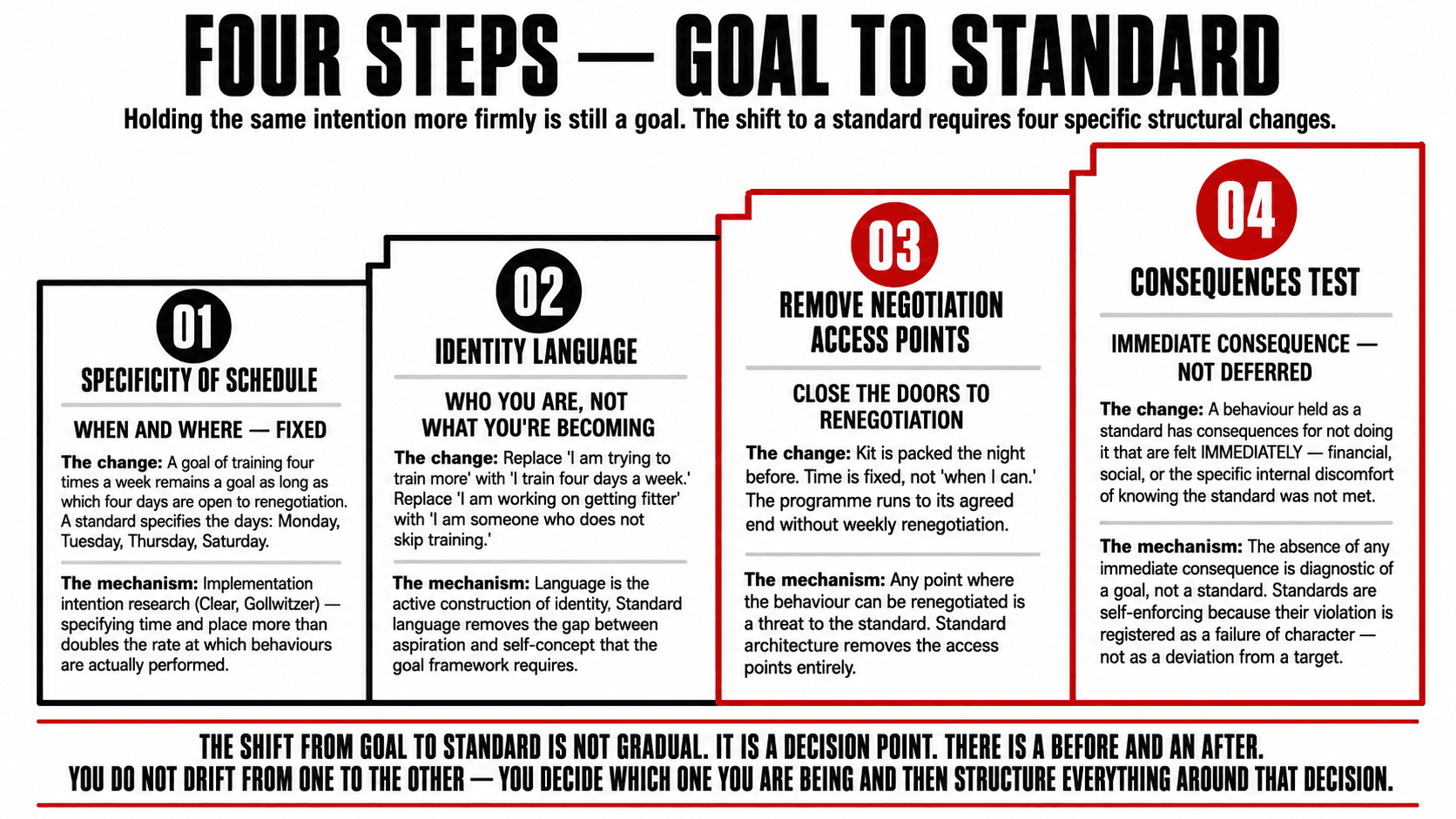
How to Make the Shift: The Four-Step Process for Converting Goals into Standards
The shift from goal to standard is not accomplished by simply deciding to hold the same intention more firmly. A goal held more firmly is still a goal. It still generates daily decisions. It still depends on motivation for its execution. The shift to standard requires four specific changes to how the behaviour is structured and held.
The first change is specificity of schedule. A goal of training four times a week remains a goal as long as which four days are open to weekly renegotiation. A standard specifies the days: Monday, Tuesday, Thursday, Saturday. These are training days. The schedule is not reviewed each week in the light of what else is happening. It is the fixed architecture into which everything else fits. James Clear's research on habit formation shows that the combination of specificity of time and place, what he calls an implementation intention, more than doubles the rate at which intended behaviours are actually performed.(5)
The second change is identity language. The goal framework generates language like I am trying to train more or I am working on getting fitter. The standard framework generates language like I train four days a week or I am someone who does not skip training. The language difference is not cosmetic. Language is the active construction of identity, and the identity language of the standard removes the gap between aspiration and self-concept that the goal framework requires. Tell yourself and others who you are, not what you are trying to become.
The third change is removing negotiation access points. Any point in the week where the behaviour can be renegotiated is a threat to the standard. Training kit left unpacked the night before requires a packing decision in the morning. Training at an unspecified time requires a scheduling decision under daily pressure. A programme that is reviewed and adjusted each week requires weekly motivation for the review to continue in the right direction. Standard architecture removes these access points: kit is packed, time is fixed, the programme runs until the end of the agreed period without weekly renegotiation of whether it continues.
The fourth change is the consequences test. A behaviour held as a standard has consequences for not doing it that are felt immediately, not deferred to a future date when results are assessed. These consequences can be structural, a financial cost, a social cost, a logged missed standard. They can be internal, the specific discomfort of knowing that the standard was not met, which a person who holds it as a standard feels distinctly. The absence of any immediate consequence is diagnostic of a goal, not a standard. Standards are self-enforcing because their violation is immediately registered as a failure of character rather than a deviation from a target.
Key Insight: The shift from goal to standard is not gradual. It is a decision point. There is a before and an after. The before is the person for whom training is something they do when conditions are right. The after is the person for whom training is part of how Tuesday and Thursday work, full stop. You do not drift from one to the other. You decide which one you are being and then structure everything around that decision. The decision is available to you right now.
What Changes When the Standard Is Set
The most immediate change I observe when clients make the shift from goal to standard is the change in the quality of their conversation about their programme. The goal framework generates a specific kind of conversation: How is it going? Is it working? Are you finding it hard? Is it sustainable? All of these questions contain within them the implicit assumption that the behaviour might stop, that the sustainability of the programme is under ongoing review, that the question of continuance is still open. The standard framework changes the conversation to: How was your session? How did you feel this week? The question of continuance does not arise because it is not in question.
The second change is the quality of attention available to the sessions themselves. The person who is spending cognitive resources on whether to train is arriving at the session with a depleted resource. The person for whom training is a standard arrives at the session with the full cognitive and motivational resource that was not spent on the decision. The sessions are better. The recovery from them is better. The adaptation they produce is better. Not because the programme changed but because the relationship to it changed.
I work with a significant number of executive clients, people whose professional lives are structured entirely around standards: the meeting happens, the delivery gets done, the obligation is met, regardless of how Tuesday feels. The work of our coaching relationship is frequently the transfer of that same standard framework from their professional lives, where it operates without question, into their health practice, where it has inexplicably never been applied. The health goal that has been pursued unsuccessfully for five years becomes the health standard that produces the result within the first six months of the programme. Not because anything in the physiology or the programme changed. Because the level at which the commitment is held changed.
I work one-to-one with clients online globally. If the goal framework has been producing inconsistent results, I would suggest that the problem is the framework rather than the person inside it.
Work with Me
Get a personalised coaching plan built around your goals, your schedule, and your life.
Enquire NowReferences
- Robbins T. Awaken the Giant Within: How to Take Immediate Control of Your Mental, Emotional, Physical and Financial Destiny. New York: Simon and Schuster; 1991.
- Baumeister RF, Bratslavsky E, Muraven M, Tice DM. Ego depletion: Is the active self a limited resource? Journal of Personality and Social Psychology. 1998; 74(5): 1252–1265.
- Holiday R. Discipline Is Destiny: The Power of Self-Control. London: Profile Books; 2022.
- Pressfield S. The War of Art: Break Through the Blocks and Win Your Inner Creative Battles. New York: Black Irish Entertainment; 2002.
- Gollwitzer PM, Sheeran P. Implementation intentions and goal achievement: a meta-analysis of effects and processes. Advances in Experimental Social Psychology. 2006; 38: 69–119.
- Muraven M, Baumeister RF. Self-regulation and depletion of limited resources: does self-control resemble a muscle? Psychological Bulletin. 2000; 126(2): 247–259.
- Clear J. Atomic Habits: An Easy and Proven Way to Build Good Habits and Break Bad Ones. London: Random House Business; 2018.