
The Decade Everyone Wastes
Your 30s are the most deceptive decade of your life. You still feel young enough to believe your body will keep running on autopilot. You can still get away with poor sleep, skipped meals, and weeks without exercise without seeing obvious consequences. Your metabolism has not yet visibly punished you. Your blood pressure is probably fine. Your blood work, if you have ever had it done, likely comes back normal.
And that is exactly the problem.
Because while everything looks fine on the surface, beneath it, the foundations of your long-term health are already shifting. Muscle mass begins to decline. Fat distribution starts to change, with more settling around your midsection. Bone density, which peaked in your late 20s, starts its slow but irreversible decline. Insulin sensitivity is gradually reducing. And if you spend your working days sitting at a desk, which the majority of professionals in their 30s do, the physiological damage of prolonged sedentary behaviour is accumulating silently every single day.
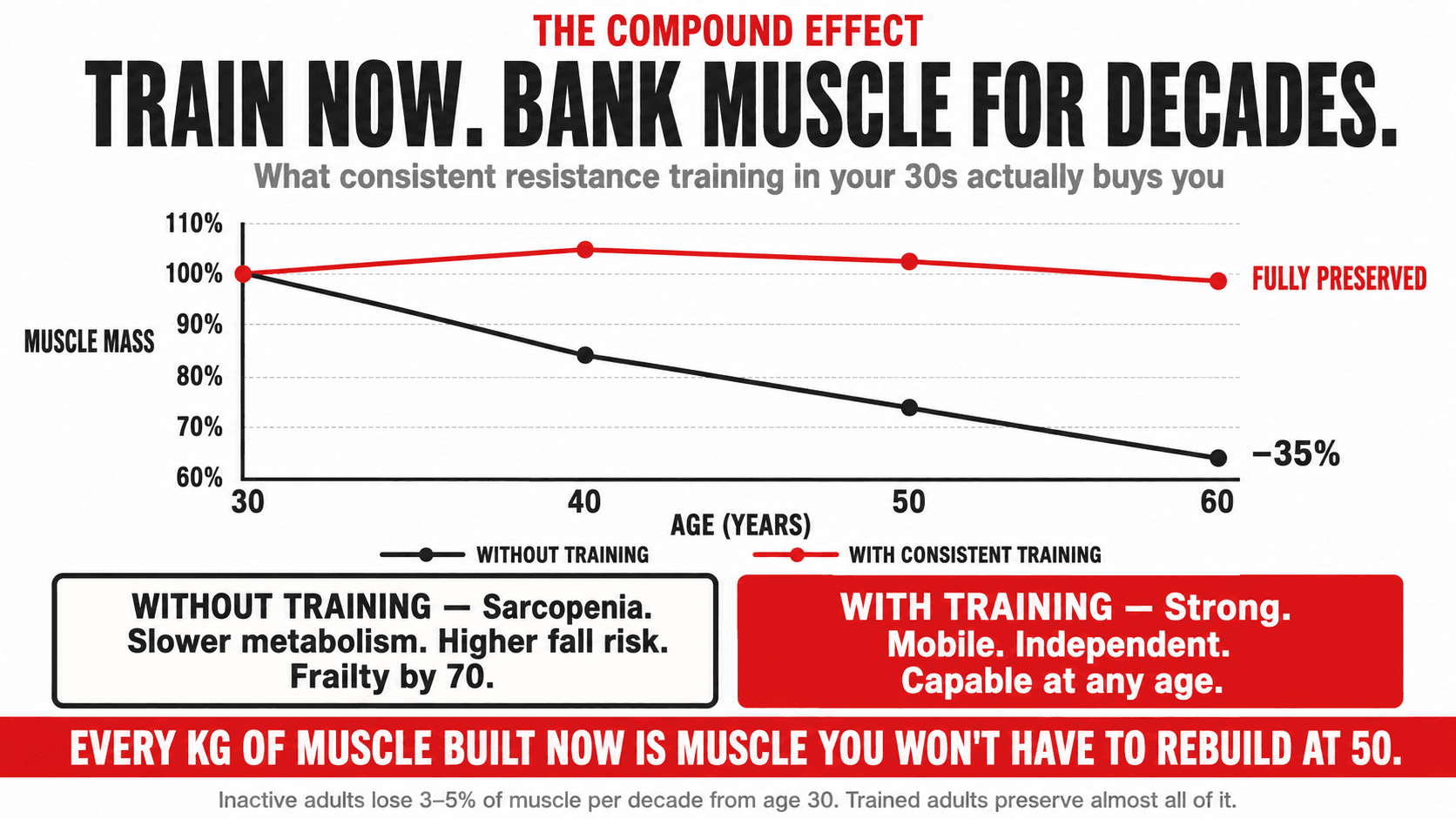
Research confirms that muscle mass begins to decline at around age 30, with inactive adults losing approximately 3 to 5 percent of their total muscle mass per decade from that point onward(1). That loss accelerates further after 60, but the process starts now. Longitudinal studies have shown clear declines in muscle mass, strength, and power beginning at approximately 35 years of age(2). This is not something that happens to other people. It is happening to you right now, unless you are actively doing something to prevent it.
What Happens If You Do Nothing in Your 30s
I work with clients across every age group, and I can tell you with certainty that the clients who arrive in their 40s and 50s in the worst shape are almost always the ones who coasted through their 30s. They assumed they would deal with their health ‘later.’ They told themselves they were too busy with their career, their young family, their mortgage. And by the time they finally pay attention, the hill they have to climb is steeper, the muscle they have lost is harder to rebuild, and the metabolic damage is more entrenched.
| Age | The Cost of Inaction in Your 30s |
|---|---|
| Age 30 | Muscle mass begins to decline. Fat storage patterns shift. Bone density starts to fall. |
| Age 35 | Metabolism slows noticeably. Desk-based lifestyle compounds fat gain. Stress and poor sleep become chronic. |
| Age 40 | Visceral fat has accumulated. Blood pressure rises. Blood sugar dysregulation begins. |
| Age 45–50 | Metabolic syndrome. Pre-diabetes or Type 2 diabetes. Hypertension. Significant muscle loss. |
| Age 55+ | Medication dependency. Chronic disease management. Reduced independence. This timeline is not inevitable. But it is the default trajectory for anyone who does not intervene during their 30s. |
A systematic review and meta-analysis found that higher levels of total daily sitting time are associated with increased risk of cardiovascular disease and diabetes, independent of physical activity(3). That last part is important. Even if you go to the gym three times a week, if you spend the remaining 10 to 12 hours of your day sitting at a desk, commuting, and sitting on the sofa, you are still at elevated risk. Your 30s are when this pattern typically becomes entrenched.
Wilmot and colleagues found in a systematic review that there was a 147 percent increased risk of cardiovascular disease events in people who were the most sedentary compared to those who were the least sedentary(4). One hundred and forty-seven percent. That is not a rounding error. That is a fundamentally different probability of heart disease, stroke, and early death.
Top Tip
Even if you train regularly, prolonged unbroken sitting is an independent health risk. Set a timer to stand and move for 2 to 3 minutes every 30 to 45 minutes during your working day. Walk during phone calls. Take the stairs. These micro-movements are not a substitute for training but they are a necessary complement to it.

Body Composition Is Changing Whether You Like It or Not
In your 20s, most people can maintain a reasonable body composition without much effort. In your 30s, that stops being true. Hormonal shifts begin, the basal metabolic rate starts to decline, and if you are not deliberately building and maintaining muscle through resistance training, the ratio of muscle to fat begins to tip in the wrong direction.
This is particularly relevant for women in their 30s. While the most dramatic hormonal shifts occur during perimenopause (typically late 30s to early 40s), the gradual decline in oestrogen and progesterone begins well before that. These hormonal changes affect where fat is stored, how easily it is lost, and how efficiently muscle is maintained. For men, testosterone begins a slow decline of approximately 1 to 2 percent per year after the age of 30(5), which directly impacts muscle protein synthesis, recovery, and body fat distribution.
The concept of ‘skinny fat’ is one I see frequently in this age group. People who appear lean or normal weight but carry very little muscle and a disproportionate amount of body fat. This is metabolically dangerous because low muscle mass is independently associated with insulin resistance, poor metabolic health, and increased mortality risk(6).
Top Tip
Do not judge your health by your weight on the scales alone. Body composition, the ratio of muscle to fat, matters far more. Two people weighing 75kg can have wildly different health outcomes depending on whether that weight is predominantly muscle or predominantly fat.
Why Resistance Training in Your 30s Is the Best Investment You Will Ever Make
If there is one habit that I could guarantee would change the trajectory of your health more than any other, it is consistent resistance training. Not running. Not yoga. Not cycling. Not Pilates. Resistance training. I say this not to dismiss other forms of exercise, which all have value, but because the evidence is overwhelmingly clear that lifting weights, or performing any form of progressive resistance exercise, is the single most effective intervention for preserving muscle mass, strengthening bones, improving metabolic health, and preventing chronic disease as you age(7).
In your 30s, you still have the full physiological capacity to build significant muscle and strength. Your recovery ability is still strong. Your hormonal environment, while beginning to shift, is still highly favourable for adaptation. Every kilogram of muscle you build now is muscle you will not have to fight to rebuild in your 40s, 50s, and beyond. Think of it as a deposit into a health savings account that will pay dividends for decades.
Sample Weekly Training Structure for Your 30s
| Day | Focus | Example Exercises | Sets x Reps |
|---|---|---|---|
| Monday | Lower Body Strength | Barbell back squat, Romanian deadlift, Bulgarian split squat, leg curl, calf raises | 4 x 6–10 |
| Tuesday | Upper Body Push | Barbell bench press, overhead press, incline dumbbell press, lateral raises, tricep dips | 4 x 8–12 |
| Thursday | Lower Body Hypertrophy | Front squat or leg press, walking lunges, hip thrust, leg extension, Nordic curl | 3–4 x 10–15 |
| Friday | Upper Body Pull | Weighted pull ups, barbell row, face pulls, dumbbell curls, farmer carries | 4 x 8–12 |
| Wed / Sat / Sun | Active Recovery | Brisk walking (30–45 min), stretching, mobility, light sport | n/a |
This four-day split is ideal for most people in their 30s who want to build a strong, well-balanced physique while managing recovery alongside work and family demands. If you can only commit to three days, combine the upper body sessions into two full-body sessions with a dedicated lower body day.
The key principles are compound movements first (squats, deadlifts, presses, rows, pull ups), progressive overload (gradually increasing the challenge), and consistency. You do not need to live in the gym. You need to show up regularly, train with purpose, and push yourself appropriately.
Top Tip
If you have never done structured resistance training before, your 30s are the perfect time to start. You are young enough to build a substantial base of muscle and strength, but old enough to understand the discipline required to stick with it. Invest in a coach to learn proper technique. The money you spend now on good form will save you years of injury management later.

Nutrition in Your 30s: Building the Foundation
Your nutritional habits in your 30s establish the metabolic patterns that will define your 40s, 50s, and beyond. If you spend this decade eating convenience food, skipping meals, relying on caffeine and sugar for energy, and consuming inadequate protein, you are programming your body for accelerated decline.
Here is what to focus on.
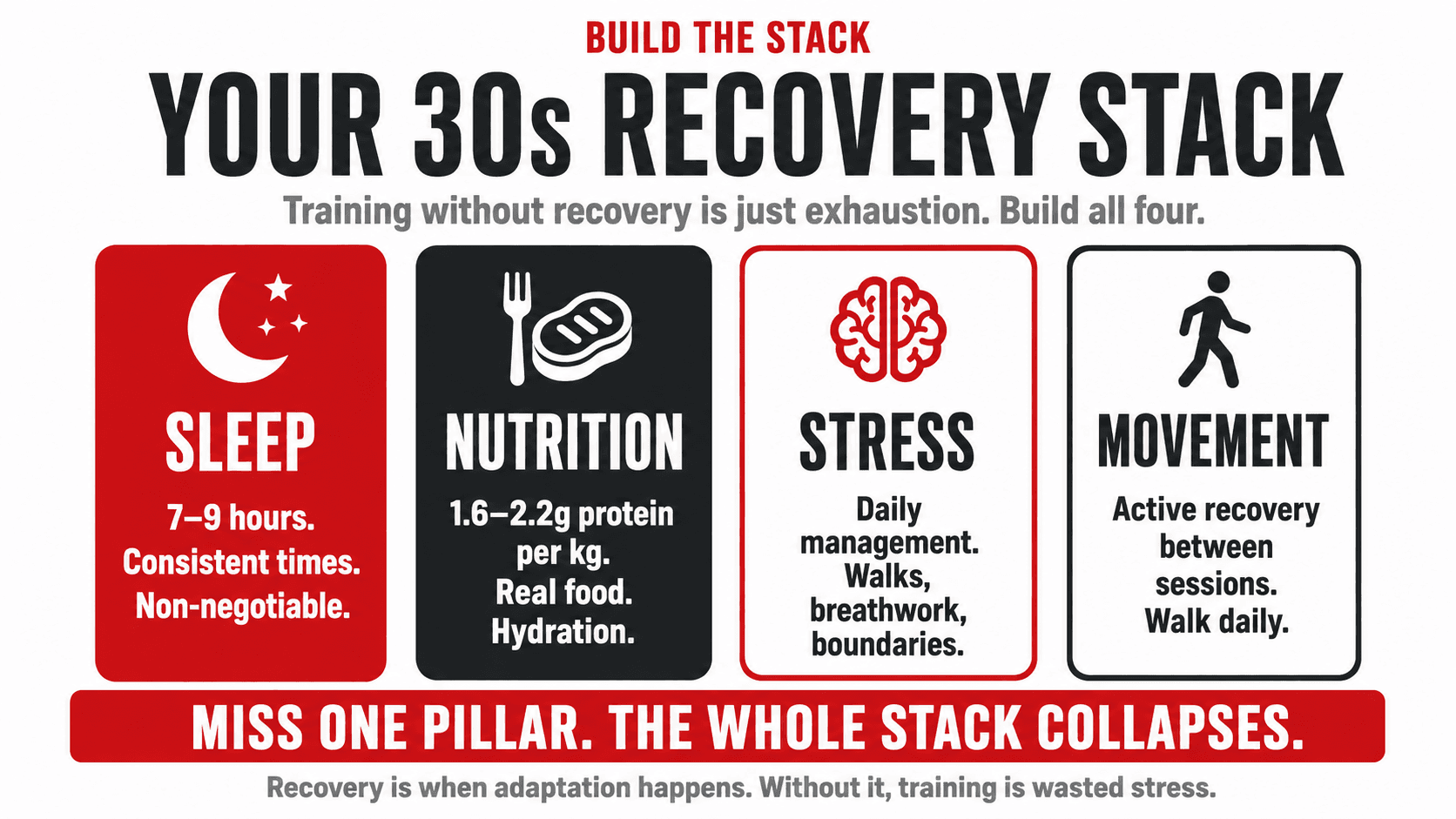
Protein. This is the single most important macronutrient for body composition. I recommend 1.6 to 2.2 grams of protein per kilogram of body weight for active individuals in their 30s who are resistance training(8). For a 75kg person, that means 120 to 165 grams per day, distributed across three to four meals. Good sources include chicken, fish, eggs, Greek yoghurt, tofu, tempeh, seitan, lentils, pea protein, and whey or plant-based protein supplements.
Vegetables and fibre. Aim for a minimum of 30 grams of fibre per day. This supports gut health, blood sugar regulation, and long-term cardiovascular protection. Most adults in the UK consume roughly 18 grams per day, which is significantly below the recommendation. Increase your intake through vegetables, beans, lentils, oats, wholegrains, nuts, and seeds.
Minimise ultra-processed food. Research increasingly links ultra-processed food consumption to weight gain, metabolic dysfunction, inflammation, and increased disease risk. These are the ready meals, the packaged snacks, the sugary cereals, the meal deal sandwiches. They are not occasional treats that sabotage your health. It is the daily reliance on them as dietary staples that causes damage.
Hydration. Aim for 2 to 3 litres of water per day. Many of the clients I work with in their 30s are chronically mildly dehydrated without realising it, which affects energy, concentration, performance, and recovery.
Protein Sources for All Dietary Backgrounds (Approx. 30g Protein per Serving)
| Food Source | Portion for ~30g Protein | Dietary Suitability | Additional Notes |
|---|---|---|---|
| Chicken breast | ~130g (cooked) | Omnivore | Lean, versatile, easy to prep in bulk |
| Salmon fillet | ~170g (cooked) | Omnivore / Pescatarian | Also provides omega-3 fatty acids |
| Eggs | ~5 large eggs | Vegetarian | Also provides choline, B12, and vitamin D |
| Greek yoghurt (0% fat) | ~300g | Vegetarian | Also provides calcium and probiotics |
| Tofu, firm | ~350g | Vegan / Vegetarian | Calcium-set versions provide additional calcium |
| Tempeh | ~160g | Vegan | Fermented; improved mineral bioavailability |
| Seitan | ~120g | Vegan | Very high protein density; made from wheat gluten |
| Red lentils (cooked) | ~330g | Vegan | Also provides iron and fibre |
| Pea protein isolate | ~35g scoop | Vegan | Convenient; mixes well in shakes |
| Whey protein | ~35g scoop | Vegetarian | Fast-absorbing; well researched for muscle protein synthesis |
Top Tip
If you struggle to hit your protein target, start by adding protein to breakfast. Most people’s breakfasts are protein-poor: toast, cereal, fruit. Swap it for eggs and vegetables, Greek yoghurt with nuts and seeds, a protein smoothie with oats and peanut butter, or tofu scramble on sourdough. That one change can add 25 to 35 grams of protein to your daily intake.

Stress and Sleep: The Habits You Build Now Matter
Your 30s are typically the decade where stress intensifies. Career demands increase. Financial pressures mount with mortgages, children, and the cost of living. Social commitments compete with family obligations. Sleep is sacrificed because it feels like the only discretionary time you have left.
But here is what I need you to understand: chronic stress and chronic sleep deprivation are not just inconveniences. They are metabolic disruptors. Sustained elevated cortisol promotes visceral fat storage, impairs insulin sensitivity, reduces testosterone in men, dysregulates reproductive hormones in women, weakens immune function, and impairs muscle recovery(9). Poor sleep, defined as fewer than 6 hours per night, has been associated with a 48 percent increase in coronary heart disease risk and a 15 percent increase in stroke risk(10).
The habits you build around sleep and stress management in your 30s become the default patterns that carry you through the rest of your life. If you normalise sleeping 5 hours a night now, that will not magically improve in your 40s when the demands are even greater.
Practical Stress and Sleep Management for Your 30s
| Strategy | What to Do | Why It Works |
|---|---|---|
| Protect your sleep window | Commit to 7–9 hours per night, consistent bedtime | Regulates circadian rhythm, optimises hormone production, improves recovery |
| Screen curfew | No phones, tablets, or laptops 60 minutes before bed | Reduces blue light exposure, allows melatonin production to begin naturally |
| Morning daylight | Get 10–15 minutes of natural light within 30 minutes of waking | Sets your circadian clock, improves alertness, supports evening sleepiness |
| Structured exercise | Train 3–4 times per week | Reduces cortisol, improves mood, enhances sleep quality |
| Walk daily | 20–40 minutes, ideally outdoors | Reduces stress hormones, aids digestion, clears the mind |
| Caffeine boundary | No caffeine after midday | Caffeine has a half-life of 5–6 hours; afternoon coffee disrupts sleep architecture |
| Alcohol awareness | Track intake honestly, aim for < 14 units per week | Alcohol fragments sleep, suppresses REM, impairs recovery and hormone regulation |
Top Tip
If you take one thing from this section, let it be this: protect your sleep. It is not a luxury. It is the foundation upon which every other health outcome rests. No training programme and no nutrition plan can compensate for chronic sleep deprivation.
Get Your Baseline Numbers: The Check-Up Nobody in Their 30s Gets
One of the most common mistakes I see in this age group is assuming that because you feel fine, you are fine. The reality is that many of the conditions that will define your health in your 40s and 50s are developing silently right now. Elevated blood pressure, rising blood sugar, creeping cholesterol levels, declining vitamin D, low B12. You will not feel any of these until they have progressed significantly.
I strongly encourage every client in their 30s to establish a baseline health profile. This means getting a comprehensive blood test and health screen that you can reference in future years. Here is what I recommend.
Recommended Baseline Health Screen for Your 30s
| Test | What It Measures | Why It Matters in Your 30s |
|---|---|---|
| Full blood count (FBC) | Red cells, white cells, haemoglobin, platelets | Detects anaemia, infection, and blood disorders early |
| Fasting glucose | Blood sugar after an overnight fast | Identifies early insulin resistance before it becomes pre-diabetes |
| HbA1c | Average blood sugar over 2–3 months | More reliable indicator of blood sugar control than a single glucose reading |
| Lipid panel | Total cholesterol, HDL, LDL, triglycerides | Identifies cardiovascular risk factors decades before symptoms appear |
| Blood pressure | Systolic and diastolic pressure | Hypertension often begins silently in the 30s |
| Liver function (LFTs) | ALT, AST, GGT, bilirubin | Screens for fatty liver disease, which is increasingly common in younger adults |
| Thyroid function (TSH) | Thyroid stimulating hormone | Thyroid disorders are common and often underdiagnosed, especially in women |
| Vitamin D (25-OH) | Circulating vitamin D status | Deficiency is extremely common in the UK and affects bones, immunity, and mood |
| Vitamin B12 and folate | B12 and folate levels | Essential for energy, nerve function, and red blood cell production |
| Iron studies (ferritin) | Iron storage levels | Low ferritin causes fatigue, poor recovery, and reduced training performance |
Top Tip
Ask your GP for a comprehensive blood panel. If your GP cannot accommodate all of these tests, consider a private health screen. The cost of a full panel is typically between 100 and 300 pounds. That is a small price for the peace of mind and actionable data it provides. Repeat annually.
Your Mindset in Your 30s: Stop Treating Health as a Future Project
The biggest barrier I see in clients in their 30s is not a lack of knowledge. It is a lack of urgency. They know they should train. They know they should eat better. They know they should sleep more. But they treat health as something they will ‘sort out’ when life calms down. Let me be frank: life does not calm down. It gets busier. The demands of your 40s will be greater than the demands of your 30s, not lesser.
The window of opportunity you have right now, where your body still responds quickly to positive stimulus, where muscle builds efficiently, where metabolic damage is still reversible, where habits are still forming rather than entrenched, this window is closing. Not dramatically. Not overnight. But steadily.
I am not trying to frighten you. I am trying to give you the clarity that most people do not receive until it is too late. Your 30s are not too early to start. They are the ideal time to start. And the version of yourself at 50 will be profoundly grateful that you did.
Your 30s Action Plan: Start This Week
| Action | Frequency | Impact |
|---|---|---|
| Start resistance training (compound lifts) | 3–4 times per week | Builds the muscle base that protects you for decades |
| Walk daily | 20–40 minutes | Cardiovascular health, stress reduction, recovery |
| Increase protein to 1.6–2.2g/kg | Every meal | Supports muscle building, satiety, and metabolism |
| Increase fibre to 30g/day | Daily | Gut health, blood sugar regulation, cardiovascular protection |
| Get a baseline health screen | Once, then annually | Know your numbers before problems develop |
| Prioritise 7–9 hours of sleep | Every night | Hormonal regulation, recovery, cognitive function, fat loss |
| Limit ultra-processed food | Ongoing | Reduces inflammation, improves body composition |
| Manage stress deliberately | Daily | Cortisol management, mental clarity, hormonal balance |
| Track food for one honest week | Once | Reveals exactly where your nutrition stands versus where you think it does |
| Invest in coaching | Ongoing | Accountability, technique, and a plan built specifically for you |
How I Can Help You
Your 30s are the single most powerful decade for building the health, the body, and the habits that will carry you through the rest of your life. The decisions you make now are not about looking good on holiday, though that will happen. They are about being strong, healthy, and independent at 50, 60, 70, and beyond.
I am a performance coach. I have helped hundreds of clients through body transformations. I work one-to-one with clients online globally. I work with men and women of all ages, all fitness levels, and all dietary backgrounds, including vegetarians, vegans, and omnivores. I am a lifelong vegetarian myself.
If you are in your 30s and ready to stop coasting and start building, I offer one-to-one coaching online globally. Let me show you what is possible when you train and eat with purpose.
Work with Me
Get a personalised coaching plan built around your goals, your schedule, and your life.
Enquire NowReferences
- Volpi E, Nazemi R, Fujita S. Muscle tissue changes with aging. Current Opinion in Clinical Nutrition and Metabolic Care. 2004; 7(4): 405–410.
- Cruz-Jentoft AJ, Landi F, Schneider SM, Zuniga C, Arai H, Boirie Y, et al. Prevalence of and interventions for sarcopenia in ageing adults: a systematic review. Report of the International Sarcopenia Initiative (EWGSOP and IWGS). Age and Ageing. 2014; 43(6): 748–759.
- Bailey DP, Hewson DJ, Champion RB, Sayegh SM. Sitting time and risk of cardiovascular disease and diabetes: a systematic review and meta-analysis. American Journal of Preventive Medicine. 2019; 57(3): 408–416.
- Wilmot EG, Edwardson CL, Achana FA, Davies MJ, Gorely T, Gray LJ, et al. Sedentary time in adults and the association with diabetes, cardiovascular disease and death: systematic review and meta-analysis. Diabetologia. 2012; 55(11): 2895–2905.
- Feldman HA, Longcope C, Derby CA, Johannes CB, Araujo AB, Coviello AD, et al. Age trends in the level of serum testosterone and other hormones in middle-aged men: longitudinal results from the Massachusetts Male Aging Study. Journal of Clinical Endocrinology and Metabolism. 2002; 87(2): 589–598.
- Srikanthan P, Karlamangla AS. Relative muscle mass is inversely associated with insulin resistance and prediabetes. Findings from the Third National Health and Nutrition Examination Survey. Journal of Clinical Endocrinology and Metabolism. 2011; 96(9): 2898–2903.
- Westcott WL. Resistance training is medicine: effects of strength training on health. Current Sports Medicine Reports. 2012; 11(4): 209–216.
- Morton RW, Murphy KT, McKellar SR, Schoenfeld BJ, Henselmans M, Helms E, et al. A systematic review, meta-analysis and meta-regression of the effect of protein supplementation on resistance training-induced gains in muscle mass and strength in healthy adults. British Journal of Sports Medicine. 2018; 52(6): 376–384.
- Chrousos GP. Stress and disorders of the stress system. Nature Reviews Endocrinology. 2009; 5(7): 374–381.
- Cappuccio FP, Cooper D, D’Elia L, Strazzullo P, Miller MA. Sleep duration predicts cardiovascular outcomes: a systematic review and meta-analysis of prospective studies. European Heart Journal. 2011; 32(12): 1484–1492.
Disclaimer: This article is for educational purposes only and does not constitute medical advice. If you have existing health conditions, consult your GP or relevant healthcare professional before starting any new exercise or nutrition programme.