
Why the Same Approach That Works for Men Does Not Work the Same Way for Women
Fat loss for women is one of the most searched, most discussed, and most consistently misunderstood areas of health and fitness. The advice is everywhere. Calorie deficits, macros, intermittent fasting, cutting carbs, eating less and moving more. Most of it is not wrong in principle. What it is, in the vast majority of cases, is advice designed on male physiology and applied to female physiology as though the two were equivalent. They are not.
Women who follow standard fat loss protocols often experience results that are slower, more inconsistent, more frustrating, and more easily reversed than they expect. They eat the same deficit as a male colleague, train with the same frequency, and lose half the weight in twice the time, or plateau while he continues progressing. They interpret this as personal failure. It is not. It is the predictable consequence of applying a framework that does not account for the fundamental hormonal and metabolic differences between male and female physiology.
Female fat loss is not inherently more difficult than male fat loss. It is different. It requires a different understanding, a different strategy, and a different relationship with the process. Once that framework is in place, the results are consistent and sustainable. This article gives you that framework.
The Physiological Differences That Make Female Fat Loss Distinct
Understanding why female fat loss operates differently requires a brief and practical explanation of the hormonal and metabolic factors that distinguish the female body from the male body in the context of energy balance and fat storage.
Oestrogen and fat distribution are inseparably linked. In premenopausal women, oestrogen drives fat storage toward the gluteal and femoral regions, the hips, thighs, and buttocks. This is not a cosmetic quirk. It is a physiologically meaningful pattern that protects cardiovascular health by keeping fat away from visceral depots. This peripheral fat is also more metabolically stable and more resistant to mobilisation than visceral fat, which is part of why women find certain areas of their body more resistant to fat loss than others. The body is protecting what it perceives as physiologically important reserves (1).
The menstrual cycle creates a cycling metabolic environment. Resting metabolic rate is not constant across the female cycle. Research has demonstrated that resting energy expenditure is measurably higher in the luteal phase, the second half of the cycle following ovulation, than in the follicular phase. This metabolic elevation, estimated at 100 to 300 calories per day above follicular phase baseline, is accompanied by increased appetite, food cravings, and reduced insulin sensitivity. Women who do not account for this natural variation interpret the luteal phase experience of hunger, water retention, and energy fluctuation as going off track, when in fact they are experiencing normal physiology (2).
Women are more sensitive to energy restriction than men. The female body has a lower threshold for interpreting calorie restriction as a survival threat, responding more rapidly with metabolic adaptation: reductions in thyroid hormone output, leptin levels, reproductive hormone production, and resting metabolic rate. This adaptive thermogenesis is a more pronounced and faster-activating response in women than in men, which is why aggressive calorie restriction in women produces faster plateaus, more significant hormonal disruption, and a harder rebound when the restriction ends (3).
Women use more fat as fuel during exercise at moderate intensities and more carbohydrate during high-intensity exercise compared to men. This means that the fat-burning zone is a more relevant metabolic zone for women than for men, and that very high-intensity training without adequate carbohydrate support impairs performance and recovery more in women than in men. A well-designed fat loss programme for women accounts for this by including both moderate-intensity work and resistance training, rather than defaulting to high-intensity cardio as the primary fat loss tool.
Top Tip
If your fat loss progress has plateaued after several weeks of consistent effort, the most likely culprits are insufficient protein, excessive calorie restriction causing metabolic adaptation, or a programme that does not include adequate resistance training. Before reducing calories further, assess whether you are eating enough protein at 1.6 to 2g per kilogram and whether your programme has a genuine resistance training foundation. More restriction is almost never the answer to a female fat loss plateau.

Why Female Fat Loss Is Different: A Clear Comparison
Female Fat Loss vs Male Fat Loss — The Key Physiological Differences
| Factor | Male Physiology | Female Physiology |
|---|---|---|
| Hormonal environment | Relatively stable testosterone and oestrogen day to day. Fewer hormonal fluctuations affecting metabolism. | Oestrogen and progesterone cycle across 28 to 35 days, creating consistent variation in metabolic rate, appetite, water retention, and energy. |
| Fat storage pattern | Tendency toward visceral fat storage around the abdomen. More readily mobilised in a deficit. | Oestrogen drives storage to peripheral sites (hips, thighs). Peripheral fat is more metabolically stable and more resistant to deficit mobilisation. |
| Metabolic adaptation to restriction | Occurs with sustained restriction but at a slower rate. Testosterone helps preserve lean mass during deficit. | More rapid and pronounced. Thyroid output, leptin, and reproductive hormones all fall faster in response to restriction. Muscle loss in a deficit is more likely without adequate protein and resistance training. |
| Appetite regulation | Leptin response generally more stable. Appetite fluctuates less across the month. | Ghrelin and leptin fluctuate across the menstrual cycle. Luteal phase produces genuine increases in hunger that are biological, not behavioural. |
| Fuel use during exercise | Higher carbohydrate oxidation across moderate to high intensities. More reliant on glycolytic energy systems. | Greater fat oxidation at moderate intensities. More sensitive to carbohydrate restriction impairing high-intensity performance. |
| Response to protein | Muscle protein synthesis response to protein is robust. Leucine threshold similar. | Muscle protein synthesis response is somewhat lower per gram, requiring either higher total protein or higher-leucine sources for equivalent anabolic stimulus. |
The differences above are not obstacles. They are information. A fat loss strategy built specifically around female physiology works consistently and sustainably. The same strategy applied without this understanding works inconsistently and produces frustration.
The Undereating Trap: Why Eating Less Is Not the Answer
This is the section I most want every woman reading this to understand, because the undereating trap is the single most common and most damaging pattern I encounter in female clients. Women who have been dieting for years, eating at low calorie levels, and seeing diminishing results are almost always caught in this cycle.
THE UNDEREATING TRAP FOR WOMEN
01
Severe Restriction
Woman reduces calories significantly, often below 1,200 to 1,400 kcal per day.
02
Survival Response
The body detects a sustained energy deficit and interprets it as a survival threat. Thyroid hormone output falls. Leptin levels drop. Metabolic rate decreases.
03
Appetite and Cortisol Rise
Appetite increases as ghrelin rises. Energy drops. Training performance suffers. Cortisol rises from the physiological stress of under-fuelling.
04
Muscle Breakdown
With insufficient protein and low training stimulus, the body breaks down muscle tissue for energy. Muscle mass falls.
05
Metabolic Rate Falls
Lower muscle mass means lower resting metabolic rate. Fat loss stalls despite maintaining a low calorie intake. The deficit that worked initially no longer works.
06
The Cycle Tightens
Woman reduces calories further. The cycle tightens. Each successive restriction produces less result and more metabolic damage.
07
The Trap Is Complete
The body is now burning fewer calories at rest, holding more fat, and has less muscle than when the restriction began. Restriction is not the solution. It has become the problem.
The exit from this trap is not a faster metabolism hack or a new diet protocol. It is a period of structured reverse dieting, gradually increasing calorie intake to rebuild metabolic rate, combined with the introduction of progressive resistance training to rebuild the muscle tissue that drives resting metabolism. This process takes time. It requires patience. And it requires a fundamental shift in the relationship between food and the goal.
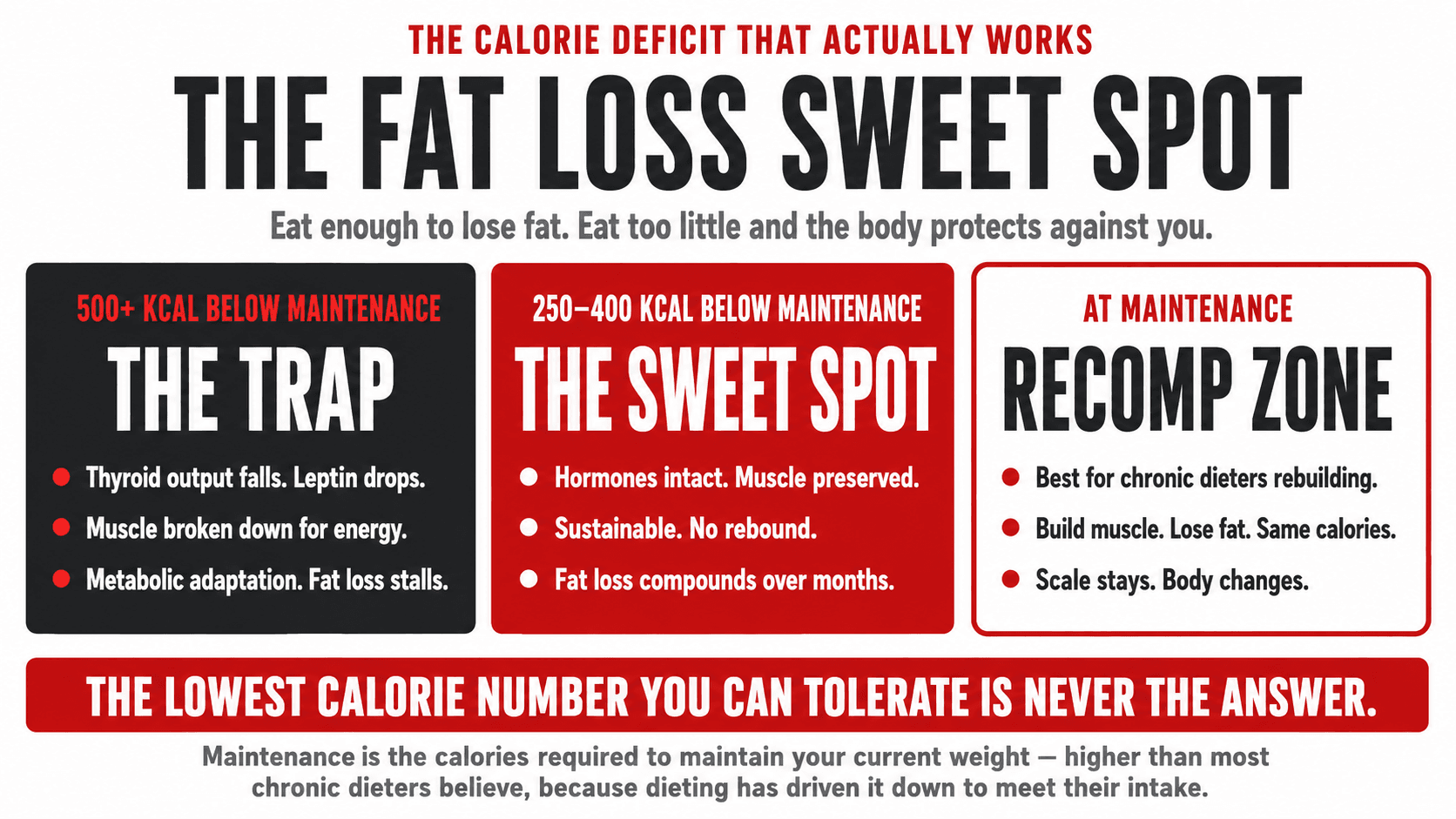
I want to be clear: fat loss does require a calorie deficit. It cannot happen without one. What I am describing is the difference between a modest, sustainable deficit of 250 to 500 calories below maintenance, combined with adequate protein and resistance training, and an aggressive restriction that produces short-term results and long-term metabolic damage. The former works. The latter creates the pattern described above.
Top Tip
The minimum effective calorie deficit for sustainable fat loss in women is approximately 250 to 400 calories below true maintenance, not the lowest number you can tolerate. The number of calories required to maintain your current weight is higher than most chronic dieters believe, because dieting has reduced their metabolic rate. If you have been eating 1,200 calories and your weight is not changing, you are not at maintenance. Your maintenance has been driven down to meet your intake. Reversing this requires eating more, not less.

Working With Your Cycle: How to Align Fat Loss With Your Hormonal Phases
One of the most practical and underused tools available to premenopausal women pursuing fat loss is the awareness of how their menstrual cycle affects metabolism, appetite, energy, and training performance across the month. Understanding these patterns does not require dramatic changes to nutrition or training. It requires recalibrating expectations and making modest, evidence-informed adjustments that work with the cycle rather than against it.
HOW THE MENSTRUAL CYCLE AFFECTS FAT LOSS
A Four-Phase Guide
01
Menstruation
Days 1–5
Oestrogen and progesterone both low. Energy may be reduced. Iron losses from blood.
Training
Moderate, listen to the body. Light to moderate resistance work.
Nutrition
Prioritise iron-rich foods. Maintain protein. Comfort foods are a hormonal signal, not weakness.
02
Follicular
Days 6–13
Oestrogen rising. Energy and motivation highest in the cycle. Insulin sensitivity at its best. Ideal window for heavier training and tighter nutrition.
Training
Push intensity here. Progressive overload sessions, heavier compound work.
Nutrition
Appetite is naturally lower. Calorie deficit is most sustainable here. Prioritise protein and whole foods.
03
Ovulation
Around Day 14
Oestrogen peaks. Energy peaks. Strength is typically at its highest in the cycle. Brief window but very productive for training.
Training
Heaviest sessions of the month. Record personal bests here if pursuing strength goals.
Nutrition
Maintain the deficit. Appetite is at its lowest relative to energy expenditure.
04
Luteal
Days 15–28
Progesterone rises. Metabolic rate elevates by 100 to 300 kcal per day. Appetite increases, cravings rise, water retention occurs. Mood and energy can drop.
Training
Moderate to high. Endurance slightly better here. Reduce peak intensity expectations.
Nutrition
Slightly higher calories tolerated without fat gain. Magnesium supports PMS symptoms. Do not interpret water retention as fat gain.
Cycle-aware training and nutrition does not mean stopping progress in half the month. It means calibrating effort and expectations to the hormonal reality of each phase, so that progress is consistent across the whole month rather than sabotaged by a week of biological inevitability.
What the Wrong Approach to Female Fat Loss Actually Produces
I work with women who have spent years doing everything they have been told, eating at strict calorie targets, completing daily cardio, avoiding carbohydrates, and tracking every gram of food, and whose bodies have not changed meaningfully despite this effort. The experience is demoralising in a way that goes beyond physical frustration. It creates a damaged relationship with food, a distorted perception of what is required to maintain a healthy weight, and in many cases a level of anxiety around eating that persists long after the dieting stops.
The physiological damage of chronic restriction in women is real and takes longer to reverse than it took to create. Metabolic adaptation, reduced thyroid output, impaired leptin signalling, disrupted reproductive hormones, and lost muscle mass are not fixed by returning to normal eating for a week. Rebuilding metabolic rate through reverse dieting and resistance training over three to six months is typically the minimum timeline, and this process requires eating more than most chronic dieters are comfortable with before any meaningful fat loss can resume sustainably (4).
The most significant consequence of the wrong fat loss approach for women is not a failure to lose weight. It is the creation of a metabolic and hormonal environment that makes future fat loss progressively more difficult. Every cycle of aggressive restriction and rebound leaves a woman slightly worse off than before: with less muscle, a lower metabolic rate, and a hormonal profile that prioritises fat storage over fat burning. The repeated application of a strategy that does not work does not eventually produce different results. It produces more of the same damage.
Top Tip
If you have dieted multiple times in the past and found that each diet becomes harder and produces less result than the last, this is metabolic adaptation at work, not a character flaw or a lack of willpower. Rebuilding your metabolism requires eating at or above maintenance for a period while introducing resistance training. This is not intuitive and it is not what most diet advice recommends. But it is what the physiology requires before fat loss can resume in a sustainable way.

The Fat Loss Approach That Works With Female Physiology
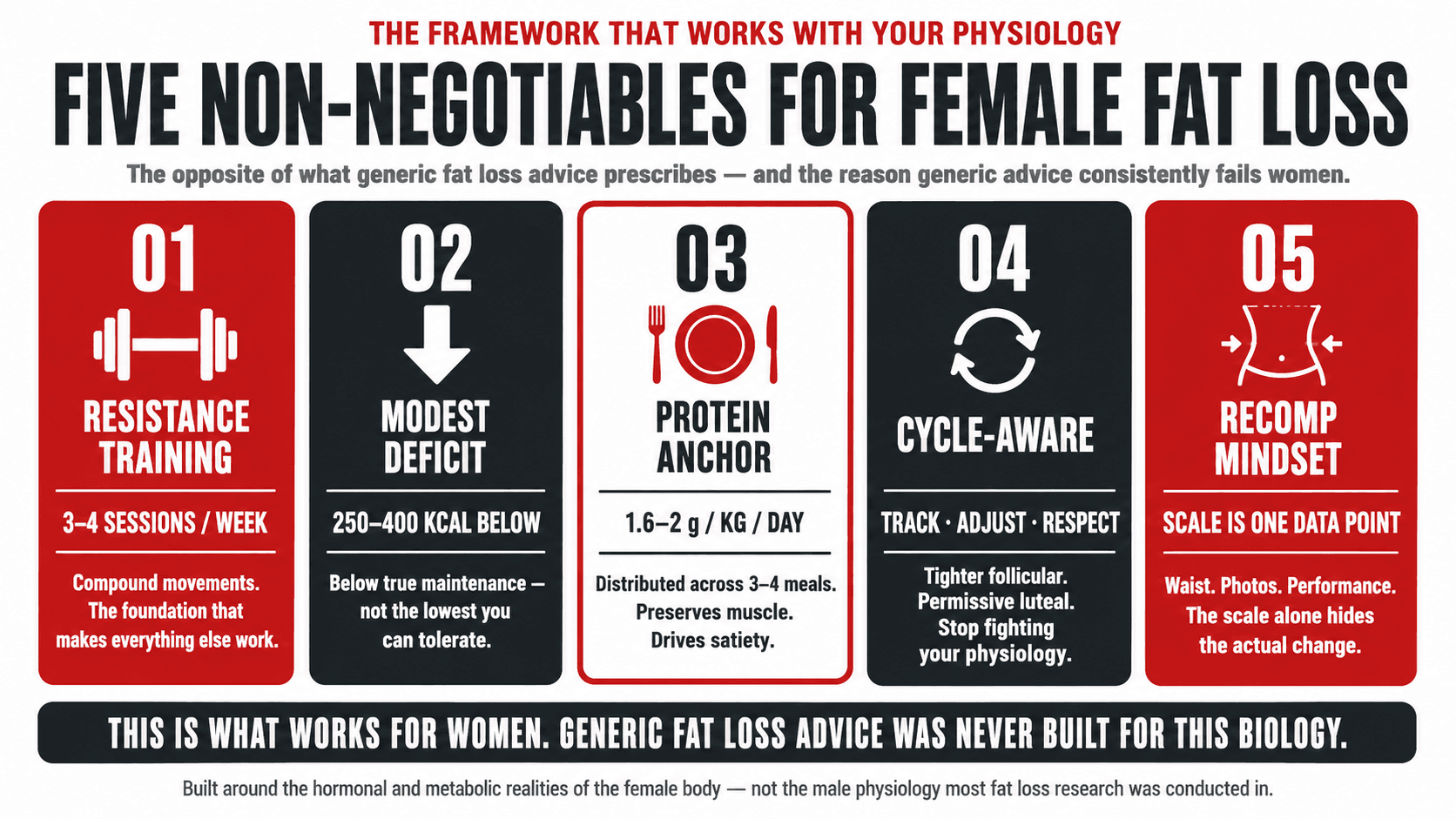
The strategy I build for female fat loss is not complicated, but it requires dismantling some deeply embedded beliefs about what fat loss should look and feel like. Here are the non-negotiable elements.
Resistance training as the foundation. Not optional. Not secondary to cardio. The primary driver of the metabolic environment that makes sustainable fat loss possible. Three to four sessions per week of compound-based resistance training builds the muscle tissue that raises resting metabolic rate, improves insulin sensitivity, and preserves lean mass during a deficit. This is the single most important structural change most women can make to their fat loss programme.
A modest, sustainable calorie deficit. Approximately 250 to 400 calories below true maintenance, not an arbitrary low number. This requires knowing what your actual maintenance calories are, which for many women who have been chronically restricting is higher than their current intake. A food diary or tracking app for two to three weeks, without changing intake, provides the data needed to establish a true maintenance baseline.
Protein as the non-negotiable macronutrient. 1.6 to 2 grams per kilogram of bodyweight per day, distributed across three to four meals. Protein preserves muscle mass during a deficit, produces the highest thermic effect of any macronutrient at 20 to 30% of its calories burned in digestion, and supports satiety more effectively than carbohydrate or fat. For plant-based women, tofu, tempeh, soy protein, pea protein, lentils, chickpeas, edamame, and high-leucine plant sources are the practical building blocks.
Cycle-aware nutrition where relevant. For premenopausal women, acknowledging the legitimate metabolic and appetite differences across the four phases of the cycle, and building them into the nutrition strategy rather than fighting them, produces significantly more consistent progress and a more sustainable relationship with the process. Slightly higher calories in the luteal phase, tighter targets in the follicular phase, and flexibility around the legitimate hormonal drivers of appetite and cravings.
Body recomposition as a realistic and often superior goal. For women who have not trained with weights before and who are starting with excess body fat, body recomposition, the simultaneous loss of fat and gain of muscle at similar calorie intake to maintenance, is frequently achievable and produces better outcomes than a traditional fat loss deficit. The scale may not move dramatically, but body fat percentage falls, waist circumference reduces, and physical shape improves significantly. This is the goal that should be driving the programme, not the scale number (5).
Top Tip
Track your waist circumference, how your clothes fit, and your performance in the gym alongside your body weight. A week where you have gained one kilogram on the scale at the same time as your trousers fit looser and your deadlift increased is a week of excellent progress. The scale is capturing water retention, food weight, and hormonal fluctuation alongside any genuine change in fat or muscle. It is one data point among several, not the verdict on your results.
Nutrition Specifics for Female Fat Loss
Female Fat Loss Nutrition Framework — What to Prioritise
| Element | Target | Best Plant-Based Sources | Best Omnivore Sources |
|---|---|---|---|
| Protein | 1.6 to 2g per kg per day | Tofu, tempeh, seitan, soy protein isolate, pea protein, lentils, chickpeas, edamame, black beans, quinoa | Chicken, turkey, white fish, salmon, eggs, Greek yoghurt, cottage cheese, lean beef, in addition to plant sources |
| Fibre | 25 to 35g per day minimum | Oats, lentils, chickpeas, black beans, broccoli, kale, flaxseed, chia seeds, sweet potato, berries | Same plant sources. Animal foods contain no fibre — plant diversity is key regardless of dietary background. |
| Calorie deficit | 250 to 400 kcal below true maintenance | Achieved through food volume and protein prioritisation rather than through eliminating food groups | Same principle. Calorie source matters less than total deficit size and protein adequacy. |
| Carbohydrate quality | Whole food, low GI sources | Oats, sweet potato, brown rice, lentils, legumes, quinoa, fruit. Remove refined options and processed foods first. | Same whole food sources. Refined carbohydrates are the primary reduction target regardless of dietary background. |
| Dietary fat | Do not restrict below 0.8g per kg per day. Hormonal function requires adequate fat. | Avocado, olive oil, walnuts, flaxseed, chia seeds, almonds, almond butter, algae oil for DHA and EPA | Same plant sources plus oily fish for DHA and EPA. Avoid processed seed oils as primary fat source. |
| Iron | 14.8mg per day for premenopausal women. Critical during fat loss. | Lentils, chickpeas, pumpkin seeds, spinach, quinoa, tofu, fortified cereals, dark chocolate. Pair with vitamin C. | Red meat and shellfish provide highly bioavailable haem iron. Plant sources still important for fibre and micronutrients. |
| Magnesium | 270mg per day. Critical for PMS, sleep, and cortisol management. | Dark chocolate, pumpkin seeds, almonds, cashews, spinach, black beans, avocado | Same plant sources are richest. Also found in whole grains and some fish. |
Body Recomposition: The Goal Most Women Do Not Know Is Achievable
Body recomposition refers to the simultaneous loss of fat and gain of muscle, occurring at or near maintenance calories rather than in a traditional deficit. It is most readily achievable in women who are new to resistance training, who are returning to training after a break, who carry meaningful excess body fat, or who have been chronically restricting and have significant muscle mass to recover as they resume adequate eating.
The scale is the least useful tool for tracking body recomposition because fat loss and muscle gain can cancel out on the scale while producing profound changes in body composition and physical appearance. A woman who has lost two kilograms of fat and gained two kilograms of muscle weighs exactly the same but looks entirely different, fits her clothes differently, and performs entirely differently. This is the transformation that matters.
Research has consistently demonstrated that body recomposition is achievable for beginners and deconditioned individuals through progressive resistance training and adequate protein intake, even without a calorie deficit (5). For women who have been told they need to be in a deficit to make progress and who have been restricting chronically, the discovery that they can improve their body composition while eating more is one of the most liberating and practically impactful realisations of the coaching process.
Top Tip
If the number on the scales has barely moved despite consistent training and nutrition over several weeks but your clothes fit differently and you look different in the mirror, you are experiencing body recomposition and it is real progress. Do not let a static scale number convince you that nothing is working. Photograph yourself, measure your waist, assess your performance in the gym. These are the metrics that capture what is actually happening.
How I Build Female Fat Loss Programmes
Every fat loss programme I write for a female client begins with an honest assessment of where she is in her relationship with food and training before any targets are set. A woman who has been chronically restricting for years needs a different starting point than a woman who has been eating adequately but not training. Getting this foundation right is what separates a programme that works from one that adds to the cycle of frustration.
The framework I use is always the same in its principles: resistance training as the foundation, a modest sustainable deficit, adequate protein, cycle-aware adjustments for premenopausal women, and a clear understanding of what success looks like that includes body composition measurements, performance metrics, and wellbeing markers alongside scale weight. The specific application of those principles is individual and always will be.
Female fat loss is not a mystery. It is not uniquely difficult. It is different from male fat loss in ways that are well understood and practically manageable with the right framework. If you are ready to approach it with that framework, I work one-to-one with women online globally. The programme will be built around your physiology, your history, your dietary background, and your goals.