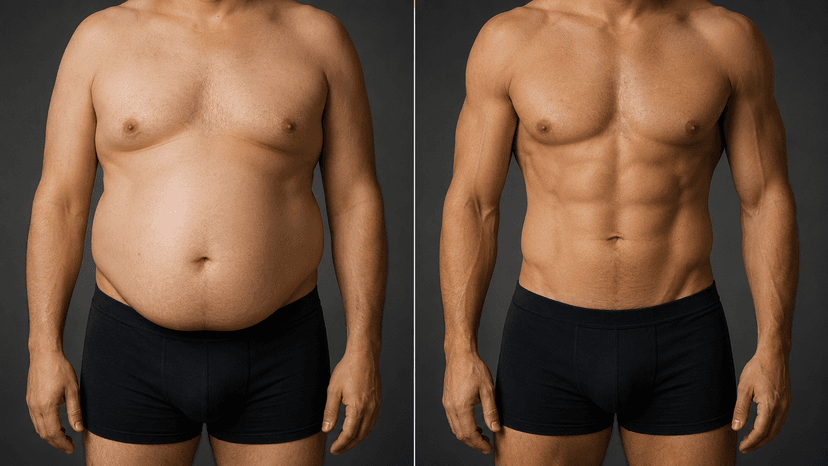
The fat loss industry is built on myths. Not all of them are malicious. Some started as well-intentioned oversimplifications that got repeated so many times they became accepted as fact. Others were manufactured to sell products, programmes, and supplements that would not exist if people understood how fat loss actually works. Either way, the result is the same: millions of people making decisions about their nutrition and training based on information that is either outdated, incomplete, or flat-out wrong, and then blaming themselves when the results do not come.
I have heard every fat loss myth there is, and I have watched every single one of them hold people back from the results they deserve. This article is going to dismantle the most persistent and most damaging of those myths using the actual scientific evidence, so you can stop wasting your time on strategies that do not work and focus on the ones that do.
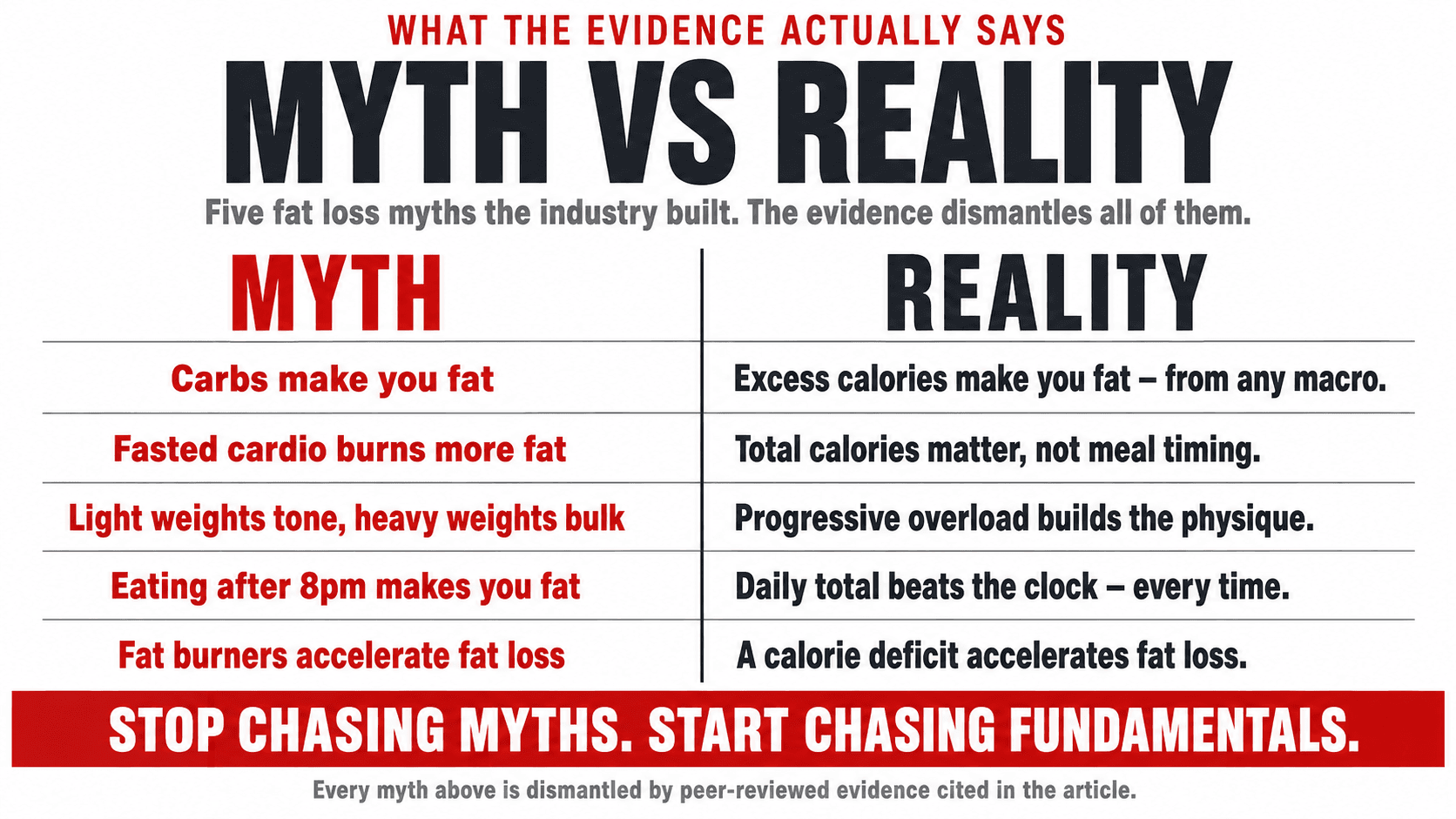
Myth One: You Need to Eat Less and Less to Keep Losing Fat
This is one of the most dangerous fat loss myths because it leads people into a destructive cycle of progressively more extreme restriction. The logic sounds intuitive: if eating fewer calories causes fat loss, then eating even fewer calories must cause even more fat loss. So when progress stalls, people cut more food. Then more. Then more again. Until they are eating 1,000 or 1,200 calories a day, feeling terrible, losing muscle mass, and still not seeing the results they want.
The reality is more nuanced. Yes, a calorie deficit is required for fat loss. That is non-negotiable. But the size of the deficit matters enormously. A systematic review and meta-analysis published in the British Journal of Nutrition found that rapid weight loss through aggressive calorie restriction produced greater loss of lean body mass, greater reductions in resting metabolic rate, and poorer long-term weight maintenance compared to gradual approaches using moderate deficits (1). When you slash calories too aggressively, your body responds by downregulating metabolic processes, reducing thyroid hormone output, increasing cortisol, ramping up hunger hormones, and decreasing non-exercise activity. This is metabolic adaptation, and while it does not “break” your metabolism permanently, it does make continued fat loss progressively harder and makes regaining the weight progressively easier once you stop dieting.
The intelligent approach is to use the smallest deficit that produces consistent progress. For most of my clients, that is 300 to 500 calories below maintenance. When progress stalls, the first levers I pull are increasing daily steps, making small adjustments to carbohydrate or fat intake, or introducing a strategic refeed rather than simply cutting more food. The goal is to keep calories as high as possible while still losing fat, not to see how little you can survive on. A study published in the Journal of the International Society of Sports Nutrition found that higher calorie diets with adequate protein produced comparable fat loss to very low calorie diets over 12 weeks, with significantly better retention of lean mass and metabolic rate (2).
Myth Two: Carbohydrates Make You Fat
This myth has been circulating in various forms for decades, and it refuses to die despite the weight of evidence against it. The claim is that carbohydrates raise insulin, insulin promotes fat storage, therefore carbohydrates are uniquely fattening compared to other macronutrients. It sounds logical on the surface, but it falls apart under scientific scrutiny.
A meta-analysis published in the American Journal of Clinical Nutrition compared low carbohydrate and isocaloric higher carbohydrate diets (meaning the total calories were matched) and found no significant difference in fat loss between the two approaches when protein intake and calories were controlled (3). Another tightly controlled metabolic ward study published in Cell Metabolism by researcher Kevin Hall found that when calories and protein were matched, a low fat diet actually produced slightly greater body fat loss than a low carbohydrate diet, directly contradicting the carbohydrate-insulin model of obesity (4). The conclusion from the totality of the evidence is clear: carbohydrates do not make you fat. Eating more calories than you expend makes you fat, regardless of where those calories come from.
This does not mean that carbohydrate quality and quantity are irrelevant. They are not. Choosing minimally processed, fibre-rich carbohydrate sources like oats, sweet potatoes, brown rice, quinoa, legumes, fruits, and vegetables is better for satiety, blood sugar management, and overall health than relying on refined sugars and white flour products. And for individuals with significant insulin resistance, moderating carbohydrate intake can improve metabolic markers and may support fat loss indirectly by improving adherence and reducing appetite. But the blanket claim that carbohydrates are inherently fattening is simply not supported by the evidence, and eliminating them unnecessarily removes a valuable fuel source for training performance, recovery, thyroid function, and long-term dietary adherence.

Myth Three: You Must Do Fasted Cardio to Burn Fat
The theory behind fasted cardio is that exercising in a fasted state forces your body to use stored fat for fuel because glycogen levels are depleted from the overnight fast. It sounds compelling, and it has been a staple recommendation in bodybuilding and fitness circles for years. The problem is that the evidence does not support any meaningful advantage for fat loss.
A randomised controlled trial published in the Journal of the International Society of Sports Nutrition assigned young women to either a fasted or fed aerobic exercise group, with both groups following an identical calorie-restricted diet. After four weeks, both groups lost a significant and equal amount of body fat and body weight, with no statistically significant difference between them (5). The researchers concluded that body composition changes from aerobic exercise in conjunction with a calorie deficit are similar regardless of whether the exercise is performed in a fasted or fed state. A subsequent systematic review and meta-analysis published in the British Journal of Nutrition confirmed these findings, concluding that fasted exercise does not enhance fat loss compared to fed exercise when total calorie intake is controlled (6).
If you prefer training fasted because it fits your schedule or because you feel better exercising on an empty stomach, that is perfectly fine. Do it. But if you are dragging yourself out of bed at 5am to do fasted cardio you hate because you believe it is physiologically superior for burning fat, you are suffering for no reason. Train at the time that works best for your life, your energy, and your consistency, whether that is fasted or fed. Consistency and total calorie balance determine your results, not the timing of your last meal relative to your workout.
Myth Four: Light Weights and High Reps for “Toning”
The concept of “toning” is one of the most persistent and misleading terms in the fitness industry. What people mean when they say they want to look “toned” is that they want visible muscle definition with low body fat. That requires two things: building or maintaining muscle mass through progressive resistance training, and reducing body fat through a calorie deficit. There is no special “toning” rep range, no “toning” workout, and no exercise that selectively firms a specific body part without building muscle and losing fat.
The myth that light weights and high repetitions (typically 15 to 25 reps) are better for “toning” while heavy weights and low repetitions are for “bulking” has no basis in exercise physiology. A study published in the Journal of Applied Physiology found that both high load (heavy weight, low reps) and low load (light weight, high reps) resistance training produced similar muscle hypertrophy when sets were performed to muscular failure, but that high load training produced significantly greater strength gains (7). However, when sets are not taken close to failure, which is the reality for most people doing high-rep “toning” workouts with very light weights, the stimulus for muscle growth is minimal.
For optimal body composition during a fat loss phase, the research consistently supports training with moderate to heavy loads in the 6 to 15 repetition range, with progressive overload (gradually increasing the weight or volume over time), and a focus on compound movements. This approach maximises the stimulus for muscle preservation, produces the greatest metabolic response, and creates the foundation for the lean, defined physique that people actually want when they say they want to look “toned.” Picking up 2 kilogram dumbbells and doing 30 bicep curls is not going to get you there. Squatting, pressing, rowing, and deadlifting with challenging weights will.

Myth Five: You Can Target Fat Loss in Specific Body Parts
Spot reduction, the idea that you can lose fat from a specific area of your body by exercising that area, is one of the oldest and most thoroughly debunked myths in exercise science. Doing 500 crunches a day will not give you visible abdominals if you have a layer of body fat covering them. Doing endless tricep exercises will not remove fat from the backs of your arms. Training your inner thighs will not slim your thighs.
A study published in the Journal of Strength and Conditioning Research had participants perform a 12 week abdominal exercise programme and measured changes in abdominal fat using DEXA and MRI scans. The result was that abdominal exercise alone had no significant effect on abdominal subcutaneous fat, waist circumference, or any other measure of abdominal fat (8). Where your body stores and loses fat is determined primarily by genetics, sex hormones, and your overall body fat percentage. You cannot override that with targeted exercise. The only way to reduce fat in a specific area is to reduce your overall body fat percentage through a sustained calorie deficit combined with resistance training, and your body will mobilise fat from wherever your genetics dictate, in the order your genetics dictate.
For many men, abdominal fat is the last area to go. For many women, fat around the hips, thighs, and upper arms can be particularly stubborn. This is not a training problem. It is a body fat percentage problem. Keep dieting, keep training, keep the deficit going, and those stubborn areas will eventually lean out. It just takes longer than you want it to, and no amount of targeted exercise will speed that up.
Myth Six: Eating After 8pm Will Make You Fat
The idea that your body somehow switches to a fat-storing mode after a certain time in the evening has been repeated so often that many people genuinely believe eating a meal at 9pm is fundamentally different from eating the same meal at 6pm. It is not. Your body does not have a clock-based threshold after which all calories are automatically stored as fat.
A controlled study published in the British Journal of Nutrition compared two groups eating identical diets: one group consuming the majority of their carbohydrates at dinner, the other distributing them throughout the day. The group eating most of their carbohydrates at dinner showed greater fat loss, better satiety, and improved hormonal profiles including lower daytime hunger and better evening relaxation (9). Another study published in Obesity found no difference in weight loss between participants eating their largest meal early in the day versus late in the day when total calorie intake was matched (10).
What matters for fat loss is your total calorie intake over the course of the day and the week, not the time of day you consume those calories. The real issue with evening eating is not the clock. It is the behaviour. People who eat late at night tend to eat mindlessly in front of the television. They tend to choose calorie-dense, highly palatable snack foods. They tend to eat on top of their daily calories rather than as part of a structured plan. If you plan your evening meal as part of your daily intake and it contains the same quality nutrition as any other meal, eating at 9pm is not going to make you fat. In fact, for many of my clients, having their largest meal in the evening improves adherence, family meal enjoyment, and sleep quality.

Myth Seven: Fat Loss Supplements Will Do the Work for You
Every January, the supplement industry sees a surge in sales of “fat burners,” thermogenics, detox teas, and other products marketed with the implicit or explicit promise that they will accelerate your fat loss. The evidence for the vast majority of these products ranges from negligible to non-existent. A systematic review published in Obesity Reviews examined the evidence for popular weight loss supplements including green tea extract, conjugated linoleic acid, and various thermogenic blends and concluded that the effects on body weight were modest at best, clinically insignificant in most cases, and often accompanied by adverse effects (11).
Caffeine is the one ingredient with a reasonable evidence base for modestly increasing metabolic rate and enhancing fat oxidation during exercise, and you can get it from a cup of coffee for a fraction of the price of a branded fat burner (12). Beyond caffeine, there is no supplement that will produce meaningful fat loss in the absence of a calorie deficit. None. The money people spend on fat burners, detox products, and metabolism boosters would be far better invested in higher quality food, a good protein powder, a creatine supplement for training performance, and if budget allows, a coach who can actually guide them through the process with evidence-based strategies.
Top Tips for Cutting Through the Myths and Getting Real Results
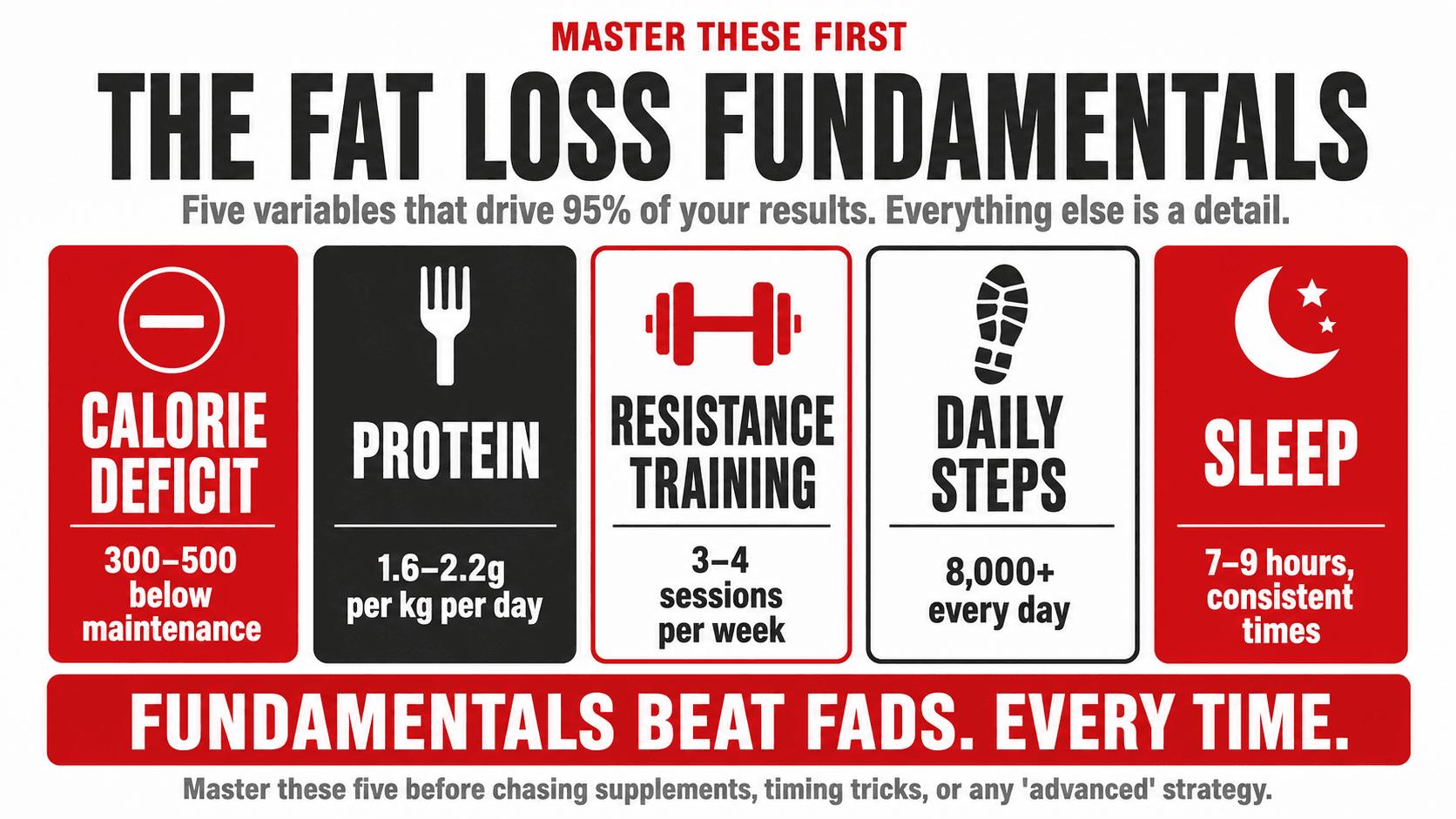
Focus on the Fundamentals First. Calorie deficit, adequate protein (1.6 to 2.2g/kg/day), resistance training 3 to 4 times per week, 8,000 plus daily steps, 7 to 9 hours of sleep. These five variables account for the vast majority of your results. Everything else is a detail. Master the fundamentals before worrying about anything advanced.
Do Not Eliminate Any Macronutrient Without a Medical Reason. Carbohydrates, fats, and protein all serve essential functions. Extreme elimination creates restriction, damages adherence, impairs training performance, and is not supported by the evidence as superior for fat loss when calories are controlled (3).
Train With Progressive Overload, Not Just Sweat. The goal of your training is not to feel destroyed. It is to progressively challenge your muscles with increasing load over time. Track your weights, your sets, and your reps. If you are not progressing in the gym, you are not providing the stimulus your body needs to preserve and build muscle during a deficit (7).
Stop Chasing the Perfect Meal Timing. Eat your meals at the times that fit your life and support your consistency. If that means two meals a day, fine. If that means five, fine. If that means eating your biggest meal at 9pm, fine. Total daily intake and macronutrient balance matter infinitely more than when you eat (10).
Be Sceptical of Anything That Promises Fast, Easy Results. If a product, programme, or influencer promises dramatic fat loss without effort, discipline, or time, they are lying. Fat loss requires a sustained calorie deficit over weeks and months. There are no shortcuts. There are only smart strategies and consistent execution.
Invest in Education, Not Supplements. Understanding the basic principles of energy balance, macronutrient composition, progressive resistance training, and recovery will serve you for the rest of your life. A bottle of fat burner pills will serve you for 30 days and produce nothing measurable (11).
The Bottom Line
Fat loss is not complicated when you strip away the myths, the marketing, and the misinformation. It requires a sustained calorie deficit. It requires adequate protein. It requires resistance training. It requires consistent daily activity. It requires adequate sleep and manageable stress. And it requires enough patience to allow the process to work over weeks and months rather than demanding overnight results from extreme measures that inevitably fail.
Every myth in this article exists because someone profits from you believing it, or because the truth is less exciting than the fiction. The truth is that fat loss is straightforward, it just is not easy. It requires effort, discipline, and time. But it works for everyone, every time, when the principles are applied correctly. I have seen it happen thousands of times with my clients, across every age group, every body type, and every dietary background.
If you are tired of chasing myths and ready for a coaching approach built entirely on evidence and real-world results, get in touch. I work one-to-one with clients online globally. No gimmicks. No fads. Just the fundamentals, applied with precision, and the accountability to see them through.
Work with Me
Get a personalised coaching plan built around your goals, your schedule, and your life.
Enquire NowReferences
- Ashtary-Larky D, Bagheri R, Abbasnezhad A, Tinsley GM, Alipour M, Wong A. Effects of gradual weight loss v. rapid weight loss on body composition and RMR: a systematic review and meta-analysis. British Journal of Nutrition. 2020; 124(11): 1121-1132.
- Garthe I, Raastad T, Refsnes PE, Koivisto A, Sundgot-Borgen J. Effect of two different weight-loss rates on body composition and strength and power-related performance in elite athletes. International Journal of Sport Nutrition and Exercise Metabolism. 2011; 21(2): 97-104.
- Hall KD, Guo J. Obesity energetics: body weight regulation and the effects of diet composition. Gastroenterology. 2017; 152(7): 1718-1727.
- Hall KD, Bemis T, Brychta R, et al. Calorie for calorie, dietary fat restriction results in more body fat loss than carbohydrate restriction in people with obesity. Cell Metabolism. 2015; 22(3): 427-436.
- Schoenfeld BJ, Aragon AA, Wilborn CD, Krieger JW, Sonmez GT. Body composition changes associated with fasted versus non-fasted aerobic exercise. Journal of the International Society of Sports Nutrition. 2014; 11(1): 54.
- Vieira AF, Costa RR, Macedo RCO, Coconcelli L, Kruel LFM. Effects of aerobic exercise performed in fasted v. fed state on fat and carbohydrate metabolism in adults: a systematic review and meta-analysis. British Journal of Nutrition. 2016; 116(7): 1153-1164.
- Mitchell CJ, Churchward-Venne TA, West DWD, et al. Resistance exercise load does not determine training-mediated hypertrophic gains in young men. Journal of Applied Physiology. 2012; 113(1): 71-77.
- Vispute SS, Smith JD, LeCheminant JD, Hurley KS. The effect of abdominal exercise on abdominal fat. Journal of Strength and Conditioning Research. 2011; 25(9): 2559-2564.
- Sofer S, Eliraz A, Kaplan S, et al. Greater weight loss and hormonal changes after 6 months diet with carbohydrates eaten mostly at dinner. Obesity. 2011; 19(10): 2006-2014.
- Raynor HA, Li F, Cardoso C. Daily pattern of energy distribution and weight loss. Physiology and Behavior. 2018; 192: 167-172.
- Pittler MH, Ernst E. Dietary supplements for body-weight reduction: a systematic review. American Journal of Clinical Nutrition. 2004; 79(4): 529-536.
- Astrup A, Toubro S, Cannon S, Hein P, Breum L, Madsen J. Caffeine: a double-blind, placebo-controlled study of its thermogenic, metabolic, and cardiovascular effects in healthy volunteers. American Journal of Clinical Nutrition. 1990; 51(5): 759-767.