
You Want to Start. But You Do Not Know Where to Begin.
If you are over 40 and thinking about starting resistance training for the first time, or coming back after years away, I know exactly how you feel. The information online is overwhelming. Every article contradicts the last one. Social media is full of people half your age doing exercises that look impossible. You are not sure what is safe, what is effective, and what is a waste of time.
The result? You either do not start at all, or you start badly, get injured, get disheartened, and stop. Both outcomes are completely avoidable if you begin with the right information.
The American College of Sports Medicine and the National Strength and Conditioning Association both recommend resistance training for all adults, including older adults, as a critical component of health and physical function(1)(2). The NSCA position statement on resistance training for older adults is unequivocal: properly designed programmes improve muscle strength, functional capacity, bone density, cardiovascular health, and quality of life(2). This is not optional health advice. It is essential.
But there is a difference between knowing you should lift weights and knowing how to do it properly. This article is your checklist. Twelve things I wish every beginner over 40 knew before their first session. If you understand and apply each of these, you will train safely, effectively, and sustainably for years to come.
#1 Get Medical Clearance If You Have Health Conditions
If you are generally healthy, you do not need your doctor’s permission to start lifting weights. But if you have a diagnosed health condition such as heart disease, uncontrolled hypertension, diabetes, or significant joint problems, get medical clearance first. This is not about fear. It is about making sure your programme is designed with the right parameters for your situation.
I specialise in coaching clients with hypertension, type 2 diabetes, and PCOS. These conditions do not prevent training. They require training to be more carefully structured. A quick conversation with your GP takes 10 minutes and removes any uncertainty.
Top Tip
Ask your GP specifically: ‘Are there any restrictions on the type or intensity of exercise I can do?’ A general ‘take it easy’ is not useful. You need specific guidance you can act on.
#2 Warm Up Properly Every Single Session
Over 40, a proper warm-up is not optional. It is the single most important injury prevention tool you have. Cold muscles, tendons, and joints are significantly more vulnerable to strain and injury. A good warm-up increases blood flow to the working muscles, raises tissue temperature, improves range of motion, and primes the nervous system for the work ahead(3).
I see too many people walk into the gym, load up a barbell, and start lifting. This is reckless at any age, but after 40, when connective tissue recovers more slowly and joints are less forgiving, it is asking for trouble.
A Complete Warm-Up Protocol for Over 40s (10 Minutes)
| Phase | Duration | What to Do | Why It Matters |
|---|---|---|---|
| 1. General raise | 3–4 minutes | Brisk walk, light cycling, or rowing machine at easy pace | Raises heart rate, increases blood flow to muscles, elevates tissue temperature |
| 2. Joint mobilisation | 2–3 minutes | Arm circles, hip circles, ankle circles, thoracic spine rotations, bodyweight squats | Lubricates joints with synovial fluid, improves range of motion before loading |
| 3. Muscle activation | 2–3 minutes | Glute bridges, band pull-aparts, dead bugs, light lateral walks with band | Switches on key stabilising muscles (glutes, rotator cuff, core) that protect joints under load |
| 4. Movement-specific preparation | 1–2 minutes | 1–2 light sets of the first exercise with 40–50% of working weight | Prepares the specific movement pattern and builds confidence before heavier sets |
Top Tip
Never skip the warm-up. If you only have 45 minutes, do a 10-minute warm-up and a 35-minute session. A shorter session done safely is infinitely better than a longer session that starts cold and ends with an injury.
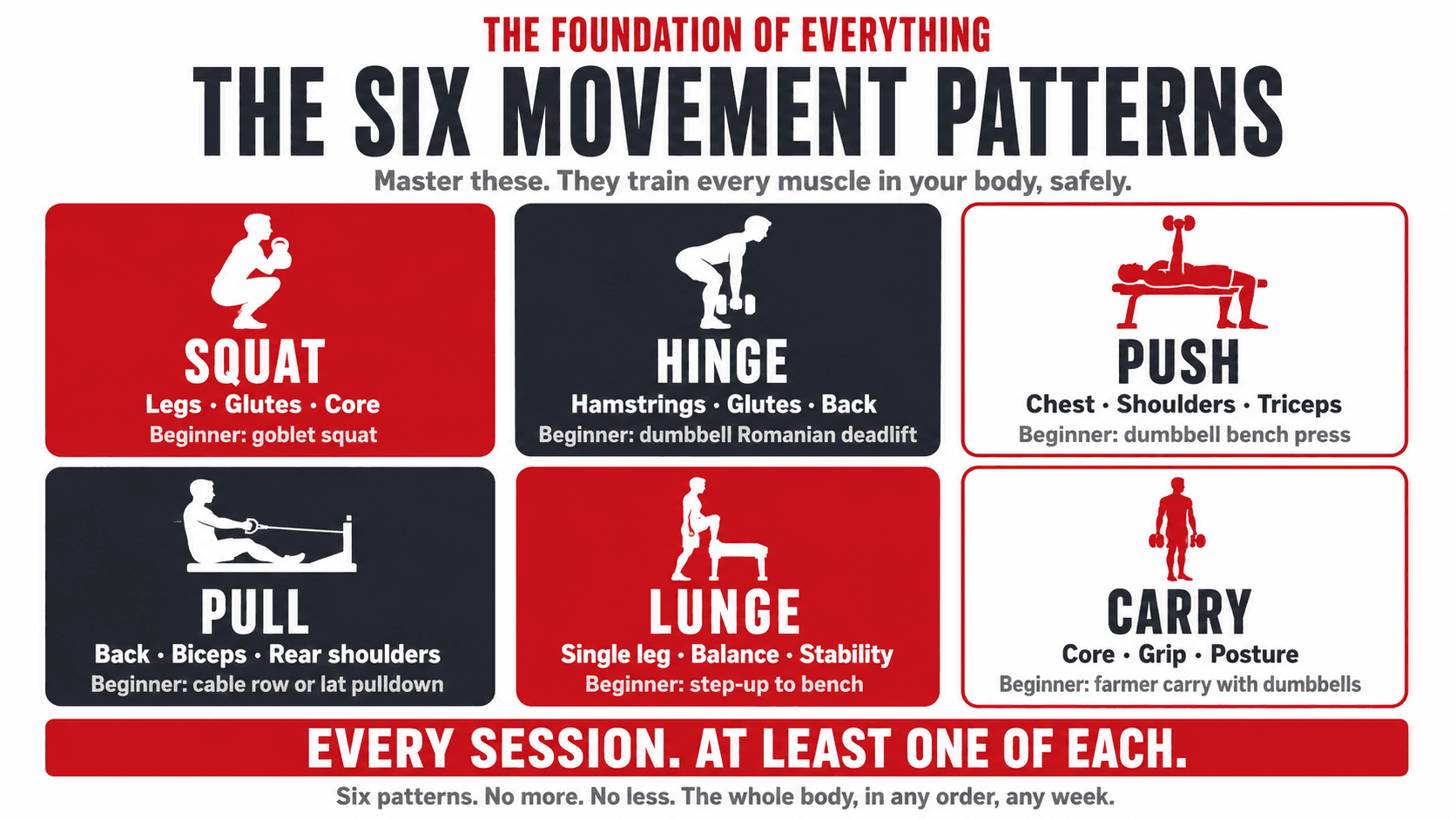
#3 Learn the Six Fundamental Movement Patterns
Every effective resistance training programme is built on six fundamental human movement patterns. If you learn these six movements well, you can train your entire body safely and effectively for the rest of your life. You do not need dozens of exercises. You need to master six patterns.
| Movement Pattern | What It Trains | Beginner Exercise | Progression |
|---|---|---|---|
| Squat | Quadriceps, glutes, core | Goblet squat | Barbell back squat |
| Hinge | Hamstrings, glutes, lower back | Dumbbell Romanian deadlift | Barbell deadlift |
| Push (horizontal) | Chest, shoulders, triceps | Dumbbell bench press | Barbell bench press |
| Pull (horizontal/vertical) | Back, biceps, rear shoulders | Cable row or lat pulldown | Barbell row, pull-up |
| Lunge / Single leg | Legs unilaterally, balance, stability | Step-up to bench | Walking lunge, Bulgarian split squat |
| Carry / Core | Core stability, grip, posture | Farmer carry with dumbbells | Heavier farmer carries, loaded carries |
Every training session should include at least one exercise from each pattern, or your weekly programme should cover all six patterns across your training days. This ensures balanced development and reduces injury risk from muscular imbalances.
Top Tip
If you learn nothing else from this article, learn this: squat, hinge, push, pull, lunge, carry. These six patterns are the foundation of everything. Master them with light weights first, then progress.
#4 Start Lighter Than You Think You Should
Every beginner overestimates the weight they should start with and underestimates how long it takes to learn proper form. This is ego, and ego causes injuries. I have seen more injuries from people lifting too heavy too soon than from any other cause.
For the first two to four weeks, use weights that feel almost too easy. This is deliberate. You are not trying to build muscle in week one. You are building movement quality, joint tolerance, and neuromuscular coordination. Your muscles might be ready for heavier weights, but your tendons, ligaments, and connective tissue, which adapt much more slowly, are not. After 40, connective tissue recovery takes longer(4). Respect that timeline.
Top Tip
Use the ‘two rep rule’ for progression. If you can complete your prescribed sets with two extra repetitions in reserve (you could have done two more), increase the weight by the smallest available increment at your next session. This is patient, sustainable progression that protects your joints.
#5 Prioritise Form Over Everything
The quality of each repetition matters more than the number of repetitions or the amount of weight on the bar. A perfectly executed squat with 20kg is infinitely more valuable than a sloppy squat with 60kg. Good form protects your joints, recruits the right muscles, and builds a foundation that supports heavier loading later.
What does good form look like? It means controlled movement through a full, pain-free range of motion. It means maintaining a stable spine throughout the lift. It means the weight moving at a deliberate pace, not bouncing, jerking, or swinging. It means you could stop at any point during the repetition and hold the position.
| The Form Checklist: Five Questions to Ask During Every Set |
|---|
| 1. Can I feel the target muscle working? (Mind-muscle connection) |
| 2. Am I controlling the weight on the way down, not just the way up? |
| 3. Is my spine in a neutral position throughout? |
| 4. Am I breathing properly? (Exhale on effort, inhale on return) |
| 5. Could I stop and hold at any point in the movement? |
| If the answer to any of these is NO, the weight is too heavy or the form needs correcting. Ask these five questions every session until they become automatic. |

#6 Train Three Times Per Week. Not More. Not Less.
For a beginner over 40, three resistance training sessions per week is the optimal frequency. The ACSM recommends a minimum of two sessions per week for all adults, with three sessions providing a greater training stimulus for those seeking meaningful improvements in strength and body composition(1). Three sessions gives you enough volume to stimulate adaptation while allowing adequate recovery between sessions.
Do not fall into the trap of training every day. More is not better. Better is better. Your muscles grow and adapt during recovery, not during the session itself. Over 40, recovery takes slightly longer, so respect rest days. On non-training days, stay active with walking, stretching, or light mobility work, but do not lift.
A Sample Beginner Weekly Schedule
| Day | Activity | Duration |
|---|---|---|
| Monday | Resistance training: Full Body A (squat, push, pull focus) | 45–60 minutes |
| Tuesday | Active recovery: brisk walk + stretching | 30–40 minutes |
| Wednesday | Resistance training: Full Body B (hinge, lunge, carry focus) | 45–60 minutes |
| Thursday | Active recovery: brisk walk + mobility | 30–40 minutes |
| Friday | Resistance training: Full Body C (combination of all patterns) | 45–60 minutes |
| Saturday | Active recovery: longer walk, light swimming, or yoga | 30–60 minutes |
| Sunday | Rest or gentle activity | As desired |
Top Tip
Never train the same muscle group on consecutive days. If you trained legs on Monday, do not train legs again until Wednesday at the earliest. This is not laziness. It is science. Muscle protein synthesis remains elevated for 24 to 72 hours after a resistance training session. Let the process complete.
#7 Recovery Is Where the Results Happen
Training is the stimulus. Recovery is the adaptation. You do not get stronger during the workout. You get stronger between workouts, while your body repairs and rebuilds the muscle tissue you have stressed. If you do not recover properly, you do not improve. You just accumulate fatigue and eventually break down.
After 40, recovery demands more attention than it did in your twenties. Sleep is the foundation: 7 to 9 hours per night, consistently. Growth hormone, the primary driver of tissue repair and muscle recovery, is released predominantly during deep sleep(5). Short-change your sleep and you short-change your recovery.
| Recovery Factor | What to Do | Why It Matters |
|---|---|---|
| Sleep | 7–9 hours per night, consistent bedtime | Growth hormone release, muscle repair, cognitive recovery, hormonal regulation |
| Nutrition (protein) | 25–40g protein within 2 hours post-training | Provides amino acids for muscle protein synthesis; triggers recovery process |
| Hydration | 2–3 litres water per day, more on training days | Dehydration impairs recovery, reduces strength, increases injury risk |
| Active recovery | Walking, stretching, mobility work on rest days | Increases blood flow to muscles, reduces stiffness, aids nutrient delivery |
| Stress management | Deliberate practices: walking, breathing, boundaries | Chronic stress elevates cortisol which impairs recovery and promotes fat storage |
Top Tip
If you are not sleeping 7 to 9 hours per night, fixing your sleep will do more for your training results than any supplement, programme change, or extra session ever will. Sleep is the single most undervalued recovery tool.

#8 Eat Enough Protein. Most Beginners Do Not.
Protein is the raw material your body uses to build and repair muscle tissue. Without adequate protein, your training stimulus is wasted. The International Society of Sports Nutrition recommends 1.4 to 2.0 grams of protein per kilogram of bodyweight per day for individuals engaged in resistance training(6). For a 75kg person, that is 105 to 150 grams per day.
Most beginners I assess are eating 40 to 60 grams of protein per day. That is enough to prevent deficiency but nowhere near enough to support muscle building. This is the single most common nutritional failure I see in new clients.
Distribution matters too. Research shows that spreading protein intake across three to four meals, with 25 to 40 grams per meal, is more effective for muscle protein synthesis than consuming the majority at one sitting(7). If your breakfast is toast and jam, you are starting the day in a protein deficit that is difficult to recover from.
| Meal | Protein Target | Omnivore Example | Vegetarian/Vegan Example |
|---|---|---|---|
| Breakfast | 25–35g | 3 eggs with smoked salmon on sourdough | Tofu scramble with vegetables on sourdough, or Greek yoghurt with nuts and seeds |
| Lunch | 30–40g | Grilled chicken salad with quinoa | Lentil and bean bowl with feta, or tempeh stir-fry with brown rice |
| Dinner | 30–40g | Salmon fillet with sweet potato and vegetables | Seitan stew with roasted vegetables, or chickpea and paneer curry |
| Snack/Post-training | 20–30g | Whey protein shake with banana | Pea protein shake with oat milk, or edamame and hummus |
Top Tip
If you struggle to hit your protein target, the single easiest change is fixing breakfast. Swap cereal or toast for eggs, Greek yoghurt, tofu scramble, or a protein smoothie. That one change can add 25 to 35 grams of protein to your day.
#9 Keep a Training Log
If you are not recording your workouts, you are guessing. And guessing does not produce results. A training log is the simplest, most effective tool for ensuring consistent progress. Every session, write down the exercises you performed, the weight you used, the sets and repetitions you completed, and how the session felt.
This does not need to be complicated. A notebook and a pen is all you need. Some people prefer an app on their phone. The format does not matter. What matters is that you have a record of what you did last session so you know what to do this session.
Progressive overload, the gradual increase in training demand over time, is the fundamental principle of all strength and muscle development(1). Without a log, you cannot track it. With a log, you can see exactly when to add weight, add a repetition, or adjust your programme.
Top Tip
At the end of every session, write down one thing: the weight and reps for your main lifts. If you lifted 40kg for 3 sets of 8 on the squat last week, your goal this week is 3 sets of 9, or 3 sets of 8 with 42.5kg. That is progressive overload. That is how results happen.

#10 Do Not Compare Yourself to Anyone Else
The person in the gym squatting twice their bodyweight has probably been training for ten years. The person on social media with the impressive physique has been doing this since they were 20. They are not your benchmark. You are your own benchmark.
The only comparison that matters is you today versus you last month. Are you stronger? Are you moving better? Do you feel more confident? Are your clothes fitting differently? Is your energy improving? Those are your measures of success. Everything else is noise.
I have seen this comparison trap derail more beginners than any physical barrier. Someone walks into the gym, sees everyone else looking more competent, feels defeated, and stops coming. The irony is that the people they are comparing themselves to were once exactly where they are now. Everyone starts somewhere.
#11 Listen to Your Body. Pain Is Not Gain.
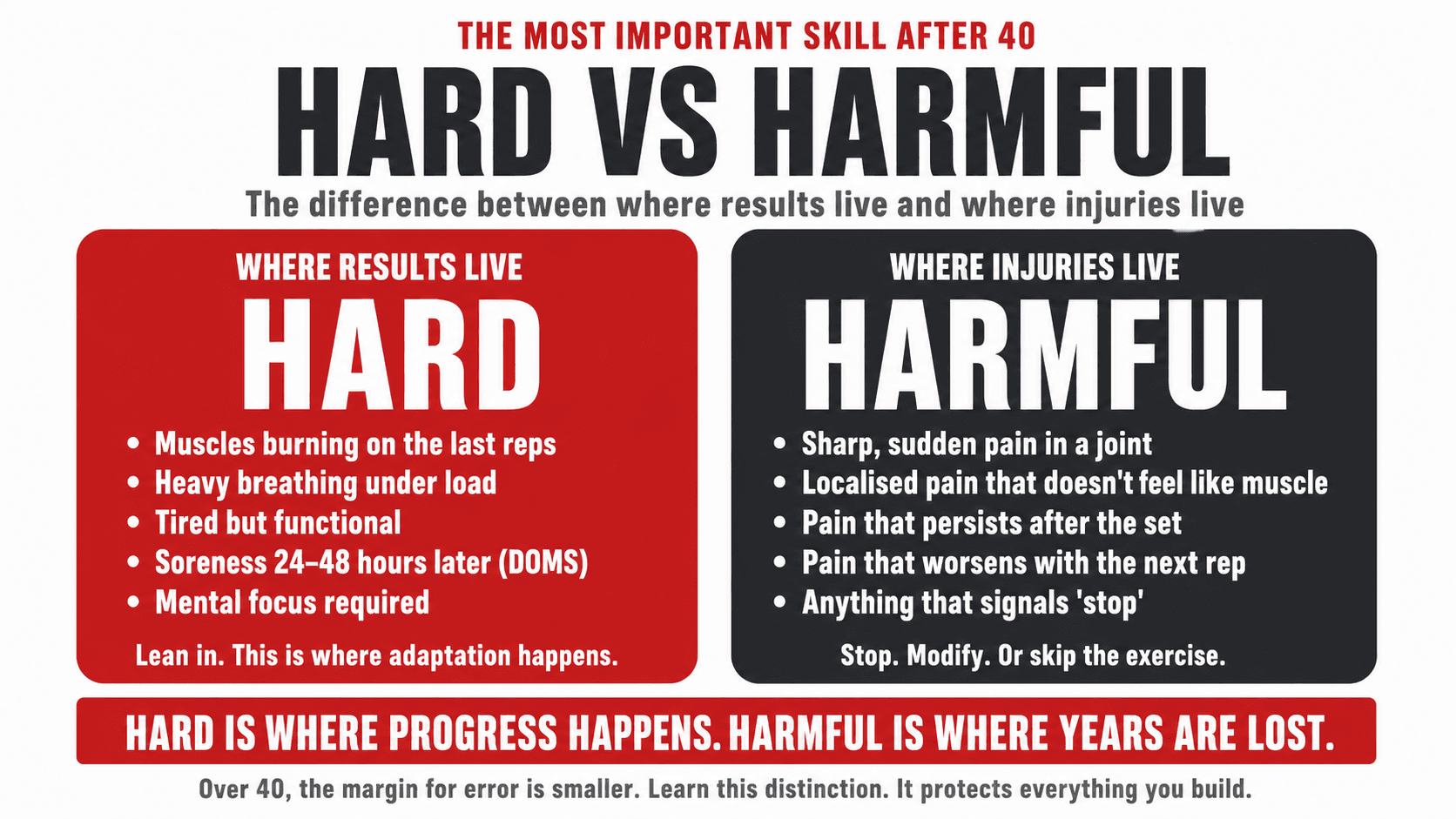
There is a critical distinction between discomfort and pain. Muscular discomfort during a hard set is normal. It is the feeling of muscles working near their limit. This is expected and safe. Pain, particularly sharp, sudden, or localised pain in a joint, is not normal. It is a warning signal that something is wrong.
After 40, the margin for error is smaller. Tendons and ligaments are less elastic. Joint surfaces have more wear. Discs in your spine are less hydrated. None of this prevents you from training, but it does mean that pain signals deserve respect. If a movement causes pain, stop. Modify the exercise, reduce the weight, or skip it entirely and try an alternative. There is no exercise so important that it is worth pushing through genuine pain.
Delayed onset muscle soreness (DOMS) after training, particularly in the first few weeks, is normal and expected. It typically peaks 24 to 48 hours after a session and resolves within a few days. This is not an injury. It is your body adapting to a new stimulus. Stay active, hydrate well, and it will diminish as your body acclimatises.
Top Tip
Learn the difference between ‘hard’ and ‘harmful.’ Your muscles burning during the last two reps of a set? Hard. A sharp twinge in your knee during a squat? Harmful. Hard is where results live. Harmful is where injuries live. Over 40, this distinction becomes the most important skill you develop.
#12 Get a Coach. Even If Only for the First Few Months.
I am biased because coaching is what I do. But I am also being honest with you. The investment in a qualified coach at the beginning of your training journey is the single best investment you can make in your long-term health and results.
A good coach will teach you correct form on every fundamental movement. They will design a programme tailored to your current ability, your goals, and any health conditions or limitations you have. They will ensure you progress at the right pace. They will hold you accountable. And they will save you years of trial and error, frustration, and potential injury.
You do not need a coach forever. Many of my clients start with intensive one to one coaching and gradually transition to more independent training as their confidence and competence grow. But those initial months of guided instruction create a foundation that serves you for decades.
Your Complete Beginner’s Checklist
| # | Checklist Item | When |
|---|---|---|
| 1 | Medical clearance obtained (if needed) | Before starting |
| 2 | 10-minute warm-up protocol memorised and practised | Every session |
| 3 | Six fundamental movement patterns learned (squat, hinge, push, pull, lunge, carry) | First 4 weeks |
| 4 | Starting weights selected conservatively (lighter than you think) | First 2–4 weeks |
| 5 | Form prioritised over weight in every exercise | Ongoing, always |
| 6 | Three training sessions per week scheduled in diary | Every week |
| 7 | Sleep, nutrition, hydration, and stress management addressed | Daily |
| 8 | Protein intake at 1.4–2.0g per kg bodyweight, spread across meals | Daily |
| 9 | Training log started (notebook or app) | From session one |
| 10 | Comparison to others eliminated; focus on personal progress only | Ongoing mindset |
| 11 | Difference between discomfort and pain understood | Every session |
| 12 | Qualified coach engaged (even if short-term) | Before or at start |
How I Can Help You
If you are over 40 and ready to start lifting weights, this checklist gives you the knowledge to begin with confidence. But knowledge without guidance only takes you so far. If you want a programme built specifically for your body, your goals, and your circumstances, that is what I do.
I am a performance coach. I have helped hundreds of people over 40 start lifting for the first time. I work one-to-one with clients online globally. I work with complete beginners through to experienced lifters. I coach clients managing health conditions including hypertension, type 2 diabetes, PCOS, and hormonal health. I work with all dietary backgrounds, including omnivores, vegetarians, and vegans.
I offer one-to-one coaching online globally. If you want to do this properly from day one, let me build you a programme that works.
Get in touch at trperformancecoaching.com. The checklist is done. Now it is time to start.
Work with Me
Get a personalised coaching plan built around your goals, your schedule, and your life.
Enquire NowReferences
- Garber CE, Blissmer B, Deschenes MR, Franklin BA, Lamonte MJ, Lee IM, et al. American College of Sports Medicine position stand. Quantity and quality of exercise for developing and maintaining cardiorespiratory, musculoskeletal, and neuromotor fitness in apparently healthy adults: guidance for prescribing exercise. Medicine and Science in Sports and Exercise. 2011; 43(7): 1334–1359.
- Fragala MS, Cadore EL, Dorgo S, Izquierdo M, Kraemer WJ, Peterson MD, et al. Resistance training for older adults: position statement from the National Strength and Conditioning Association. Journal of Strength and Conditioning Research. 2019; 33(8): 2019–2052.
- Fradkin AJ, Zazryn TR, Smoliga JM. Effects of warming-up on physical performance: a systematic review with meta-analysis. Journal of Strength and Conditioning Research. 2010; 24(1): 140–148.
- Kubo K, Kanehisa H, Fukunaga T. Effects of resistance and stretching training programmes on the viscoelastic properties of human tendon structures in vivo. Journal of Physiology. 2002; 538(Pt 1): 219–226.
- Van Cauter E, Plat L. Physiology of growth hormone secretion during sleep. Journal of Pediatrics. 1996; 128(5 Pt 2): S32–S37.
- Jager R, Kerksick CM, Campbell BI, Cribb PJ, Wells SD, Skwiat TM, et al. International Society of Sports Nutrition position stand: protein and exercise. Journal of the International Society of Sports Nutrition. 2017; 14: 20.
- Schoenfeld BJ, Aragon AA. How much protein can the body use in a single meal for muscle-building? Implications for daily protein distribution. Journal of the International Society of Sports Nutrition. 2018; 15: 10.
- Westcott WL. Resistance training is medicine: effects of strength training on health. Current Sports Medicine Reports. 2012; 11(4): 209–216.
Disclaimer: This article is for educational purposes only and does not constitute medical advice. If you have existing health conditions, consult your GP or relevant healthcare professional before starting any new exercise programme.